• Email
  • Facebook
  • Instagram
  • Pinterest
share our JOY

JOY{filled}family

striving to radiate Him always

  • Home
  • Blog
  • Brown Scapular
  • Liturgical Calendars & Planners
  • Wellness
    • Essential Oils
    • Fitness
    • Nutrition
  • Homeschool
  • Sacraments
    • Baptism
    • First Communion
    • Confirmation

A Lenten Birthday

April 8, 2021 by Lena {JOYfilledfamily} Filed Under: 03 March, Birthday, Happy Birthday Leave a Comment

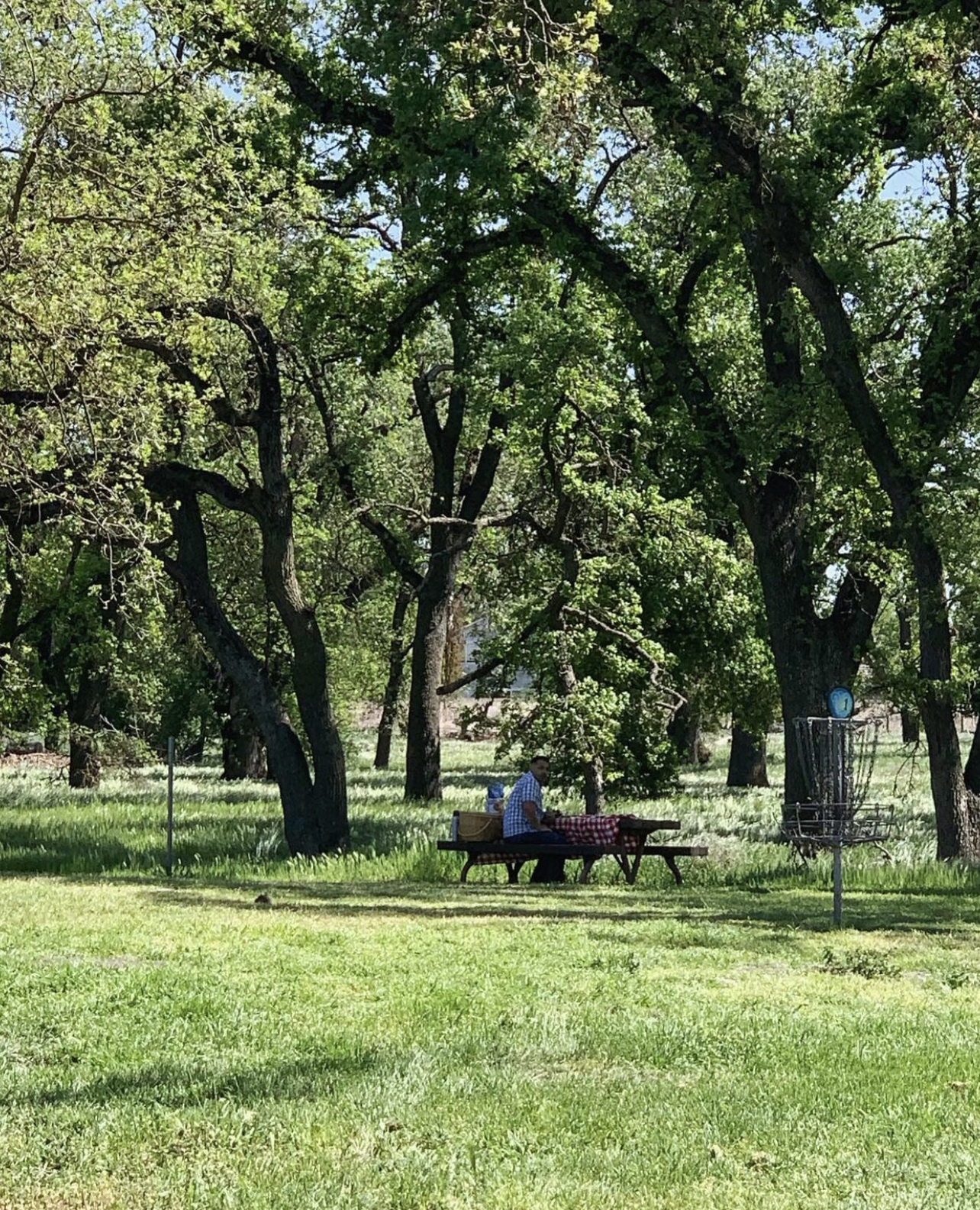
My birthday may be in Lent (Holy Week this year) but my beloved always finds a way to celebrate.

43 years old

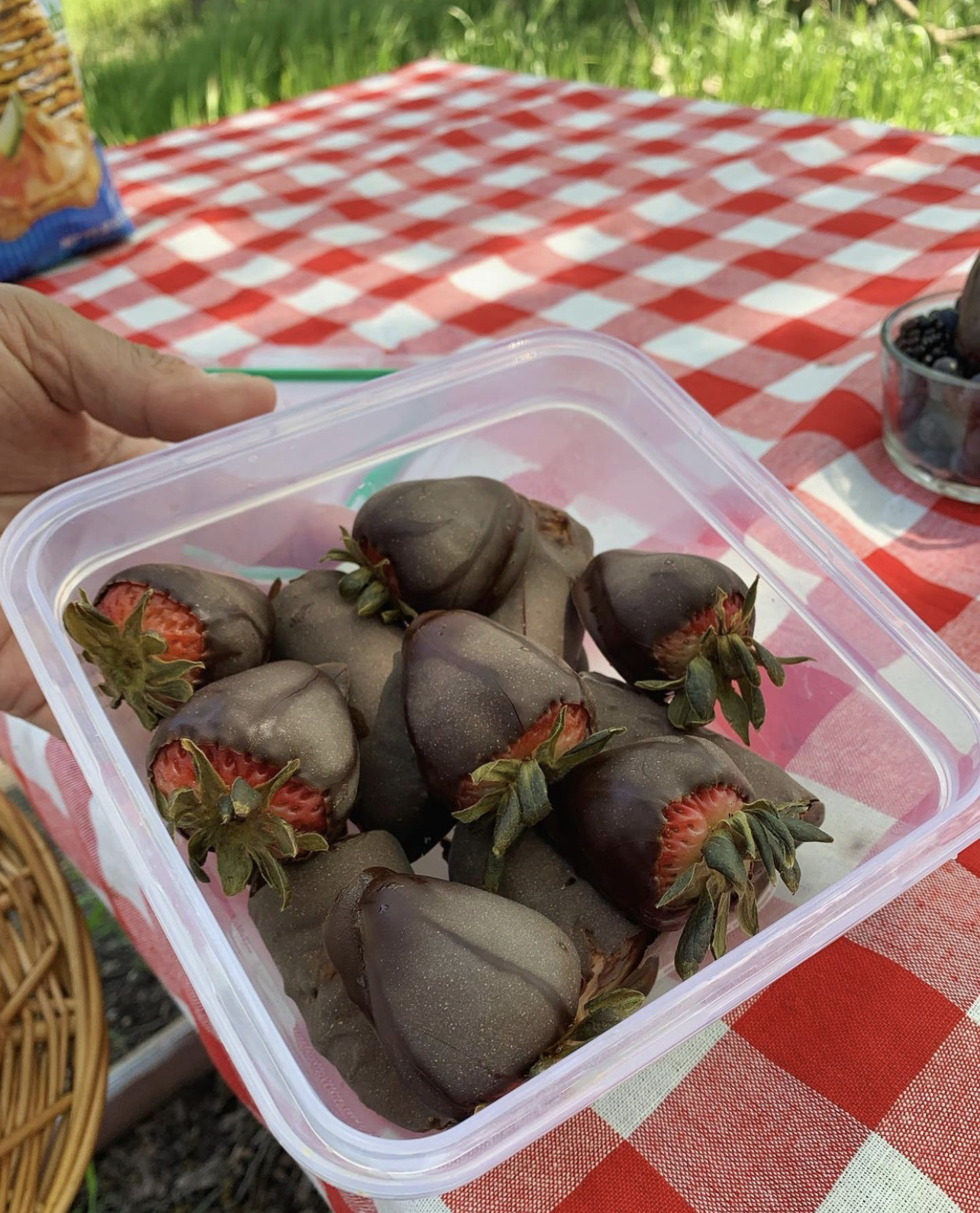
This year I was surprised with a day date — getaway for a picnic in the park. He even managed to be certain that we kept our Lenten fast/abstinence sans unsweetened chocolate dipped strawberries & bananas (my fave).

My girls asked to do my hair and make-up in the morning while the boys got their hair cut. I thought nothing of it aside from a generous pampering and sharing of self. Then he told me to get ready, Nana was here to watch the children. It was glorious!

Now that we’re in Eastertide and my birthday week (yes, we get birthday weeks here — like an octave of sorts) has come to end, I fully rejoice for the gift of life, my beloved husband, our children (all 14), and His abundant grace.

We continue to celebrate the most glorious season of all, Eastertide.

I leave you with with words from #domprospergueranger :

“Easter is the summit of the Mystery of the sacred Liturgy. The Christian who is happy enough to enter, with his whole mind and heart, into the knowledge and the love of the Paschal Mystery, has reached the very centre of the supernatural life. Hence it is, that the Church uses every effort in order to effect this: what she has hitherto done, was all intended as a preparation for Easter. The holy longings of Advent, the sweet joys of Christmas, the severe truths of Septuagesima, the contrition and penance of Lent, the heart-rending sight of the Passion — all were given us as preliminaries, as paths, to the sublime and glorious Paseh, which is now ours.” #domgueranger

May we all celebrate these 50 days of Easter with great joy! ALLELUIA!

The Liturgy & The Holy Mass

April 7, 2021 by Lena {JOYfilledfamily} Filed Under: Archbishop Vigano, Holy Mass, Libertas Leave a Comment

An interview of Archbishop Vigano was released in Holy Week (5.5.21). He was asked several questions regarding the apostasy that is spreading in the Church and the tyranny imposed by the ideology of the New World Order, to which the Hierarchy of the Church seems to be in total submission. Below is one on the Holy Mass, question and answer. You can read the entire interview, here.

Q: “Let us speak of the liturgy and the Holy Mass. Not all faithful Catholics, however well-intentioned, have the possibility of participating at Vetus Ordo Masses and must “content themselves” with the Masses that are celebrated in their parishes, often marked by liturgical rudeness if not true and proper abuses. In these Masses Communion is received on the hand, standing, the Our Father is recited according to the new formula [at Masses celebrated in Italian], those present are invited to exchange the “glance of peace,” [instead of the sign of peace], preaching is heard that is in line with Bergoglianism (to touch on only a few aspects). In the end, they leave Mass feeling sad, to put it mildly, rather than peaceful and reconciled with God and their brothers. So what should they do?“

A: “We should first ask ourselves how it can be possible that the supreme act of worship, instituted by Our Lord to perpetuate in an unbloody manner on our altars the infinite graces of the Sacrifice of Calvary, has become an obstacle to the sanctification of the faithful rather than an occasion of spiritual progress and interior peace. In other times, the Mass offered a glimpse of Heaven amidst the trials and chaos of the world; today it seems that the clamor of the world is an indispensable element to banish silence, prayerful adoration, and the sense of the sacred and the presence of God. But if in the natural order it is our duty to nourish the body with healthy food and avoid those that are poisoned or adulterated, all the more so is it our duty in the supernatural order to feed our souls with healthy nourishment, keeping ourselves away from what can spiritually poison us.

Obviously I understand the difficulty of the faithful in finding churches in which the traditional Holy Mass is celebrated, but I think that the Lord also knows how to appreciate the good will of those who are aware of the importance that the Holy Sacrifice has for our soul, especially in moments of great crisis like the ones we are going through, and for this reason they know how to make a small effort, at least on Sundays, to sanctify the Lord’s Day worthily. There have been times and places in which Catholics were persecuted and assisting at the Mass was difficult and dangerous, and yet the faithful succeeded in gathering clandestinely in the woods, in cellars, or in attics in order to honor God and nourish themselves with the Bread of Angels: we have the duty to be worthy of these our brothers in the Faith, without making excuses or pretexts. On the other hand, the Motu Proprio Summorum Pontificum recognizes the right of the faithful – a right, not a privilege – to have the traditional Mass, and if this does not happen everywhere it is in large part because the faithful do not know how to impose themselves. It is not a question of concern for aesthetics, of love for Latin or Gregorian chant, or a form of nostalgia for one’s own past; here what is in question is the heart of the life of the Church, the soul of the supernatural life of Catholics, the very good of the world.

I understand that many of the faithful find themselves in a situation of difficulty, at least from the human point of view, at the moment when they must decide whether to abandon the life of their parish in order to seek out a traditional Mass which is sometimes miles away. The faithful have a grave moral duty at least to seek out a Mass celebrated with decorum and respect by a pious priest who administers Holy Communion on the tongue.

The pandemic has given the pretext for abusively imposing restrictions on liturgical functions: let us not make ourselves sharers in responsibility for these abuses by our silence and our resignation in allowing indecorous or sacrilegious Masses to be imposed on us. God is also offended by the indolence and indifference with which we repay His love for us: an indolence that is increasingly perceptible in the faithful who even allow themselves to be vaccinated in church on Holy Saturday, replacing meditation on the Last Things with the groundless fear of physical death. In the face of these manifestations of the enslavement of the Clergy and the Hierarchy to the diktats of a corrupt and corrupting authority, raising one’s voice aloud is not only a moral duty but also a brake on the excesses of so many ecclesiastics who have forgotten the sense of their Priesthood and the soul of their vocation. They should seriously consider how grave their cooperation with the Covid narrative is, above all when pseudo-scientific superstition becomes the only possible form of faith, appropriating the symbology, lexicon, and rituality of a religion. Let whoever has ears to hear, understand.

Let us therefore ask our priests to celebrate the Holy Mass as if it was the first and last Mass of their lives, to do away with these worldly rites, and to give back to us the treasure that they stubbornly keep hidden. Let us not forget to give material and spiritual help to priests who courageously and consistently celebrate the traditional liturgy, remembering that one day soon they will be the ones to rebuild the fabric that will restore Christian society. And if we ourselves cannot assist with regularity at the Holy Sacrifice in the rite handed down to us by the Apostles, let us keep our distance from those who profane the Blessed Sacrament and use the pulpit to corrupt Faith and Morals. I would like to reiterate, however, out of a duty of conscience, that wherever it is possible to assist at the Tridentine Mass without serious inconvenience, this must certainly be preferred to the reformed Mass.”

Easter Greetings

April 4, 2021 by Lena {JOYfilledfamily} Filed Under: Easter, Family Easter Leave a Comment


Surrexit Dominus vere, alleluia!

We have made things pretty, are rejoicing, and enjoying some goodies. But we ultimately seek to keep the spirit of Easter.

We pray to make this brief time, here in the vale of tears, fruitful. We pray that His joy and hope of Easter remind us always of Our Lord’s desire that we remain united to Him here on earth & in heaven. May we take this responsibility seriously, celebrate this season properly, and look forward to the day when all sorrows shall end!

Easter 2021

St. John Chrysostom, in his famous Easter sermon, teaches us something of the true spirit of Easter:

“…Let all partake of the feast of faith. Let all receive the riches of goodness;
Let no one lament their poverty, for the universal kingdom has been revealed;
Let no one mourn their transgressions, for pardon has dawned from the grave;
Let no one fear death, for the Savior’s death has set us free.

O death, where is thy sting
O Hades, where is thy victory?

Christ is risen, and you are overthrown!
Christ is risen, and the demons are fallen!
Christ is risen, and the angels rejoice!
Christ is risen, and life reigns!
Christ is risen, and not one dead remains in a tomb!”

➕

Easter Vigil. 8 Hours (not including the yard work that Dad and the boys did at church in the morning) — left at 2pm for Church, the sacred ceremonies started at 6.

🔥 THE NEW FIRE & THE GRAINS OF INCENSE

🕯 THE PASCHAL CANDLE

📖 THE (TWELVE) PROPHECIES

🎶 THE LITANY

➕THE MASS

With no real pictures to share of the Easter Vigil and the glorious sacred ceremonies, I leave you with a blessed jubilation out of the mouth of a babe (post-Communion).

Our little one could not contain his joy! We cherish the “A” word in our home and it is a sweet consolation to see that he has a growing devotion to it as well.

The Alleluia, which means “Praise God”, is a song of jubilation and is repeated six times (in the Easter Vigil), to give praise to each of the Three Divine Persons, first by the Celebrant and then by the people. The reason for such joy is shown in the verse Confitémini which follows the Alleuia.

Ps. 117,1 Confitémini Dómino, quó- niam bonus: quóniam in sæculum mi- sericórdia eius.

V. Ps. 117,1 Give praise to the Lord, for He is good: for His mercy endureth for ever.

Here is a brief commentary on the Easter Vigil:

The Easter Vigil is the symbol of the expectation of the Divine Judge. He has warned us that he will come as a thief in the night, and since the most important affair of our life is at stake – our eternal salvation – no precaution is to be considered excessive when it comes to disposing us to that tremendous instant on which our eternity depends. The ancients, during the Easter Vigil, awaited the fulfillment of the longed for parousia of the Redeemer.

We know nothing about the time when it will come; we only know that it will come when we least expect it. Though it is not only the parousia that is sudden; during a Christian’s day, Jesus comes to us so many times, suddenly, with His graces: what misery to let them go unnoticed! They pass and do not return. A grace that God offers us today, and which we allow to go to waste, will be like a precious treasure that – because of our lack of response – is lost forever.➕

Alleluia!!

May the Resurrection of Our Lord give us special graces to see, to judge, and to act as He expects in this present-day Passion of Holy Mother Church. ➕

Holy Saturday

April 3, 2021 by Lena {JOYfilledfamily} Filed Under: Fr. Leonard Goffine, Holy Saturday, Holy Week, Sacred Triduum, The Church’s Year Leave a Comment


Below is Instruction on Holy Saturday from Fr. Leonard Goffine, The Church’s Year.

INSTRUCTION ON HOLY SATURDAY

Why is this day called Holy Saturday?

Because on this day Jesus, the Holy of holies, rested in the sepulchre, and because the Church today blesses the new fire, the Easter candle, and the baptismal water.

Why is fire struck anew, blessed, and the lamps and candles in the Church lighted from it?

In ancient times it was customary to strike a new fire every day, bless it, and light the candles from it, and later this was done every Saturday; in the eleventh century this ceremony was restricted to Holy Saturday. The fire is struck from a stone to indicate, that Christ is the light of the world, and the Stone which the Jews rejected has now become the Corner stone of His Church; (Ps. CXVII. 22.) that the divine Son, the light of the world, was apparently extinguished at His death, but at His resurrection shone anew; that all those who witness this ceremony today be spiritually enlightened hereafter. This fire is blessed, because the Church blesses every thing that is used for divine service, and because the light and fire represent Christ, who brought the fire of love upon earth with which to enkindle our hearts. Luke XII. 49.)


What is represented by the triple candle?

The triple candle represents the most Holy Trinity of which the second Divine Person came down upon the earth as the true light. For this reason the priest (or deacon) sings at the lighting of each candle: Lumen Christi, Light of Christ, and kneeling, three times humbly adores the Triune Deity, and especially Christ the true, divine Light. The chanter responds Deo gratias, Thanks be to God.


What does the Easter candle signify?

It is an emblem of Christ who has risen from death. Christ the true Light leads us from the bondage of Satan into the freedom of the children of God as the pillar of fire led the children of Israel out of the bondage of Egypt. The five holes in the candle represent the five wounds of Jesus by which mankind was healed, (I Pet. II. 24,) and the five grains of frankincense signify the spices with which the body of our Lord was embalmed.


Why are all the candles and lamps lighted from the triple candle?

To show that Christ was begotten by the Father of Light from all eternity, and is therefore true God from true God, true Light from true Light, from whom enlightenment is diffused over all men. (II Cor. IV, 6.)


To what do the twelve prophecies refer which are read before the blessing of the baptismal font?

They have reference to Christ in whom the predictions contained therein were verified. The number corresponds to the twelve apostles, who announced their fulfillment to the world.


Why is the baptismal water blessed with so many ceremonies, and what is its signification?

The baptismal water is blessed with so many ceremonies that a different effects of baptism may be shown, and that the holy Sacrament may be administered and received with more reverence and devotion; it signifies the blood of Christ by which our souls are purified.


What is the meaning of these ceremonies?

The priest with his hand parts the water in the form of the cross, to illustrate that God gives to it the virtue of regenerating all those born in original sin, making them children of God through Christ who died on the cross. He touches the surface of the water with the palm of his hand, to show that the Holy Ghost is over this water as at the creation, and bestows many graces on those who are baptized. He blesses it, signing it three times with the sign of the cross, because the water receives its sin-cleansing power only through the sufferings and the merits of Christ, from the Father, by the cooperation of the Holy Ghost. The baptismal water is thrown by the priest towards the four parts of the earth, because the grace of baptism should reach all nations. The priest breathes on the water three times in the form of a cross, as the Creator breathed into man the breath of life; Christ breathed upon the apostles the divine Spirit who by His grace and power revives and sanctifies those who are baptized. The Easter candle, (emblem of Christ, risen from the dead) is dipped three times into the water each time deeper, to show that the baptized should become more and more enlightened through the light of Christ’s doctrine, more and more penetrated by, its divinity, more and more purified from sin. The people are sprinkled with this water to remind all those present who have received sanctification in baptism, and have lost it by sin, that they should strive to regain it by true repentance. Finally, oi1 and chrism are mixed with the water as a sign that the grace of the Holy Ghost of which these are figures, is given through the water to those who receive this Sacrament; and also, that the baptized should, after baptism, devote themselves to the service of Christ, the Anointed One, and unite themselves in love to Him.


Why is the baptismal water blessed only on this day and on the Saturday before Pentecost?

Because in early times converts were baptized only on these days; and because the risen Saviour is the example of a soul sanctified by the Holy Ghost in baptism.


How should we assist at the blessing of the baptismal water?

With sentiments of sincere gratitude for the grace of baptism; with the firm resolution of preserving our baptismal innocence, or if we have lost it, of gaining it by penance. We should renew our baptismal vows especially on this day by saying the apostle’s creed, making acts of faith, hope, love, and contrition; and renounce anew the devil, all his pride, and all his suggestions.


Why does the priest prostrate himself after blessing the baptismal water, and rise again after the litany of the saints has been chanted?

To most humbly ask God, by the intercession of the saints, that He would give to all men the grace of baptism, that as all men have been dead and buried in sin, so they may rise with Christ as new creatures to grace and eternal life.


Why are the altars decorated on this day?                                                    

Because the Church, the beloved bride of Christ, desires to announce in advance to her children the glad tidings, that the Lord has risen from the dead; she decorates herself therefore, and causes the bells to peal and joyous hymns, to resound. It also has reference to the glorious, incorruptible body with which Christ adorned Himself at His Resurrection.


Why is there no Introit in this day’s Mass?

The Introit of the Mass was formerly an entire psalm which was sung while the people were assembling in church; but as in early times the people on Easter were already assembled to assist at the ceremonies, no Introit was sung at the Mass. The Church observes the same practice, although she abolished the night vigils on account of the abuses to which they gave rise.

COLLECT O God, who makest this most sacred night illustrious by the glory of the Resurrection of our Lord, preserve in the new offspring of Thy family the spirit of adoption, which Thou hast given them; that being renewed in body and soul, they may serve Thee with purity of heart. Thro’ the same &c.

EPISTLE (Coloss. III. 1-4.) Brethren: If you be risen with Christ, seek the things that are above, where Christ is sitting at the right hand of God: mind the things that are above, not the things that are on the earth. For you are dead, and your life is hidden with Christ in God. When Christ shall appear, who is your life, then shall you appear with him in glory.

After the epistle the priest sings three times: Alleluia as a joyful exclamation over the Redeemer’s triumphant victory. 

EXLANATION St. Paul places Christ’s, resurrection before us as the example and, motive of the spiritual resurrection from sin, which should be effected m us by the holy Sacraments at Easter. With Christ we should die to the world, and live hidden in Him, if we desire to rise at the Last Day with Him in glory, and be acknowledged before all men by Him as His own.

GOSPEL (Matt. XXVIII, 1-7,) , In the end of the Sabbath, when it began to dawn towards the first day of the week,came Mary Magdalen, and the other Mary, to view the sepulchre. And behold there was a great earthquake. For an angel of the Lord descended from heaven: and coming, rolled back the stone, and sat upon it. And his countenance was as lightning, and his raiment as snow. And for fear of him, the guards were struck with terror, and became as dead men. And the angel answering, said to the women: Fear not you: for I know that you seek Jesus, who was crucified. He is not here, for he is risen, as he said. Come, and see the place where the Lord was laid. And going quickly, tell ye his disciples that he is risen: and behold, he will go before you into Galilee; there you shall see him. Lo, I have foretold it to you.


What are we to learn from this gospel?

That we, too, will receive the plenitude of divine grace and heavenly blessings, if like these pious women we seek Christ early, that is, by making a , good intention before we begin our work.


Why is there no Credo or Agnus Dei said, nor the kiss of peace given, and why are short vespers said after communion?

Formerly, the Credo or confession of faith was said by the newly baptized, the Agnus Dei was sung in the litany of .the saints, and these are therefore omitted in the Mass. The kiss of peace is, not given, because Christ had not yet said to His disciples, Peace be with you. Short vespers are said after the priest’s communion, because this day, is a type of the eternal Sabbath in heaven which has no vespers, that is, evening. 

Do not omit on this day to thank our Lord for the many graces He has given us through His passion and death. If in the evening the solemn ceremonies of the resurrection are held, assist at them and there make the repeated resolution to rise from the sleep of sin and begin a new life with Christ.

Good Friday

April 2, 2021 by Lena {JOYfilledfamily} Filed Under: Fr. Leonard Goffine, Good Friday, Holy Week, The Church’s Year Leave a Comment


Below is instruction on Good Friday by Fr. Leonard Goffine, The Church’s Year
.

INSTRUCTION ON GOOD FRIDAY

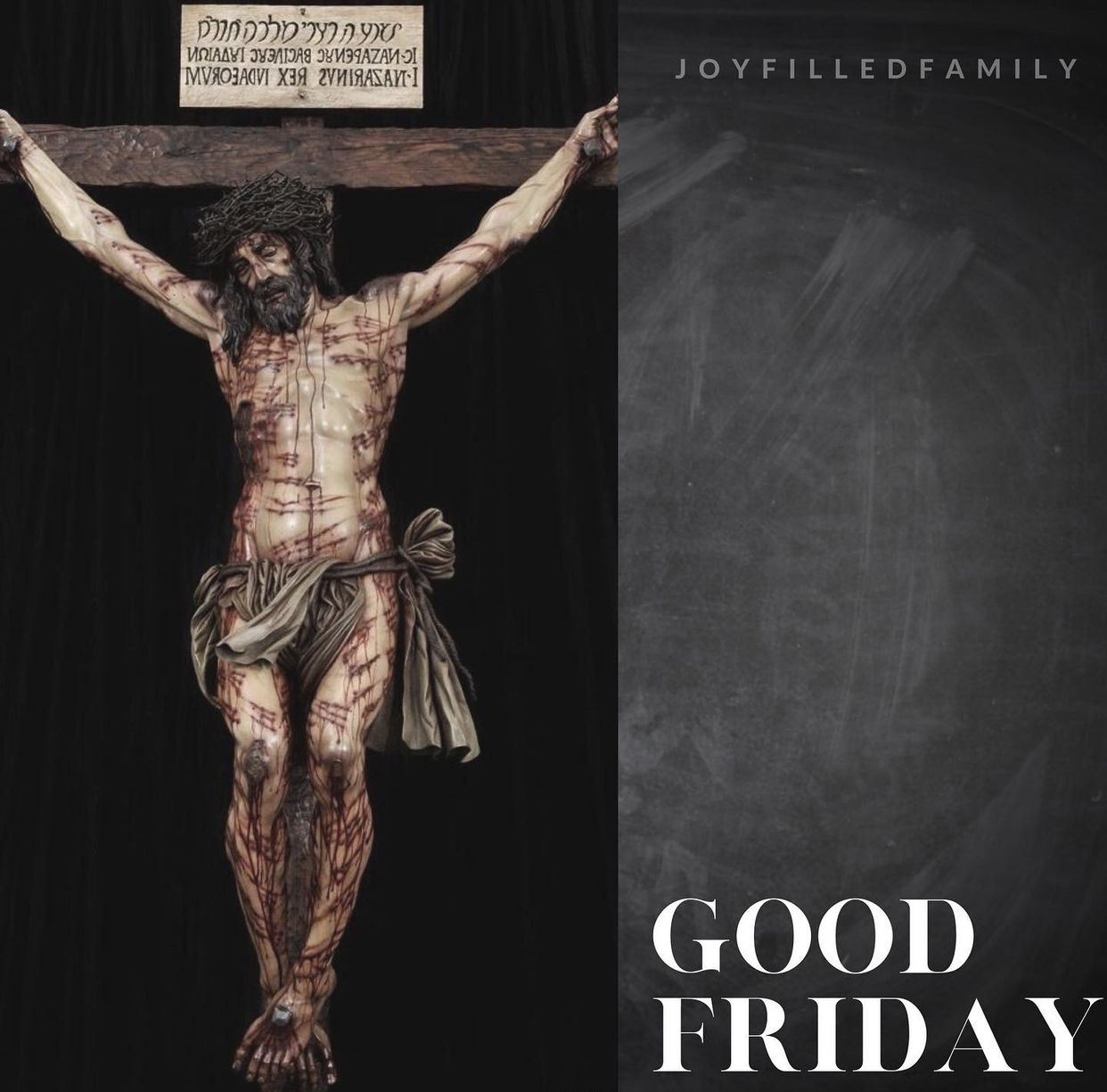
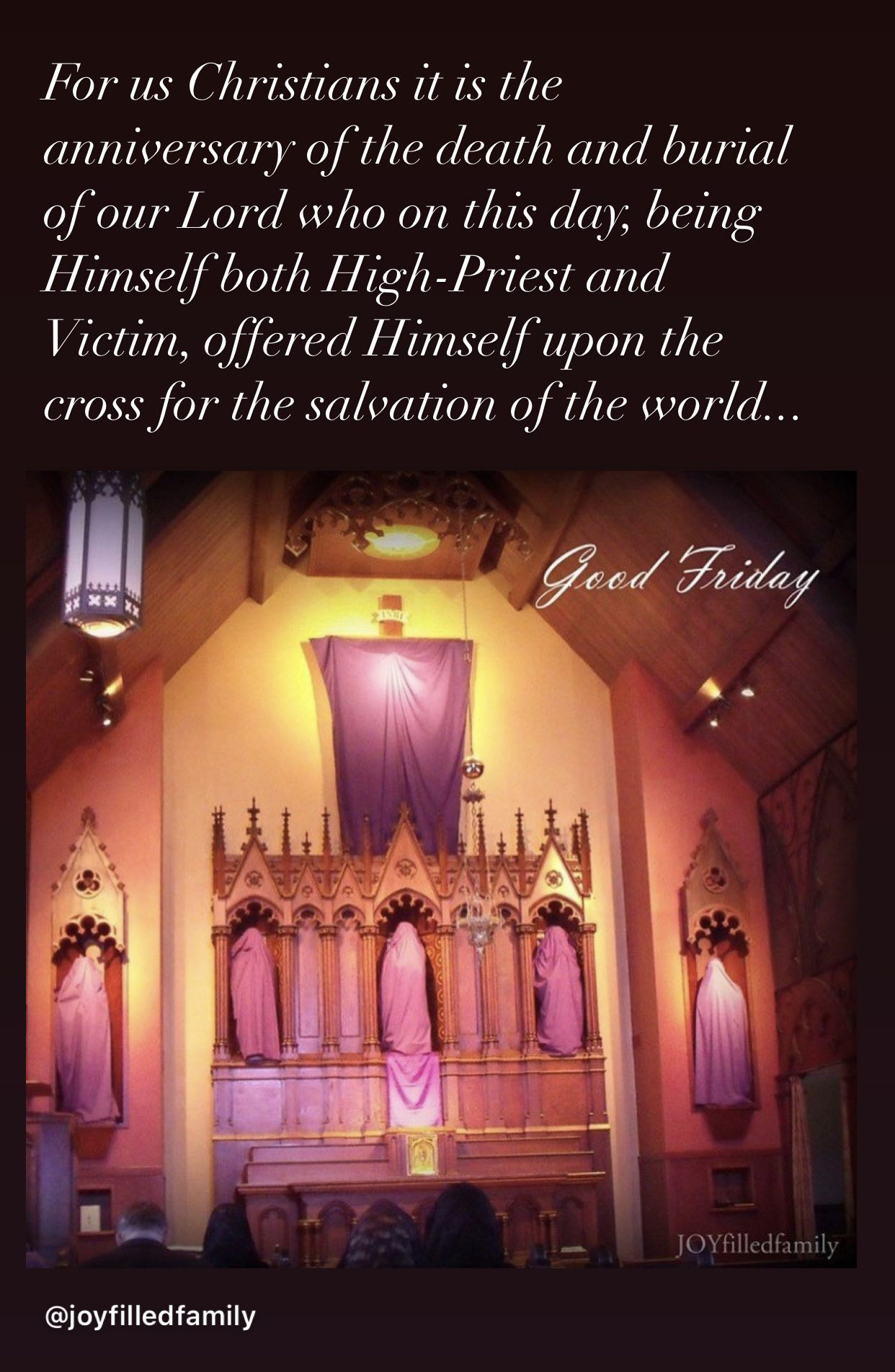
This day was formerly for the Jewish people a day of preparation for Easter, and was called by them the Parasceve; for us Christians it is the anniversary of the death and burial of our Lord who on this day, being Himself both High-Priest and Victim, offered Himself upon the cross for the salvation of the world.

Why do Catholics hold this day in such veneration?

Because it is one of the greatest days from the beginning of the world to its end. On this day the designs which God had from all eternity were perfected, as Jesus Himself expressed when He said, All is consummated; for on this day He was given up to the Gentiles by the Jews, was scourged, crowned with thorns, loaded with the cross, dragged to Calvary amid taunts and sneers, there nailed to the cross between two thieves, and by His painful death finished the great work of redemption.

Why did Christ suffer so much to redeem, us?

To show us what an immense evil sin is, on account of which He underwent such cruel sufferings that He might satisfy divine justice. His love for us was so great that He gave the last drop of His blood to save us. He rendered satisfaction for all men without exception, that none might be lost, that every one might possess eternal life. Look up today, and every day of thy life, to Christ on the cross, and see how God punishes sin, since He did not even spare His only-begotten Son, who took upon Himself our sins, and for them died this cruel death. What death is due to thee, if thou dost not despise and flee from sin?


Why does the Church celebrate the commemoration of the passion of Christ in such solemn quietness?

That we may be induced to thank the Saviour for our redemption, and to move us to sincere love for Him by serious meditation on His passion. For this reason St. Paul ordered the observance of this day, and the Christians even in his time sanctified it by deep mourning, and rigorous fasting. 


Why do we not observe Good Friday with such festivities as do the Protestants? [in Europe.]

Because our grief for our Saviour’s death is too great to permit us to celebrate it joyously, even nature mourned His death; the sun was darkened, the earth trembled and the rocks were rent. Although the Christian rejoices on this day in the grace of redemption through Christ, he is aware that his joy cannot be pleasing to God unless he endeavors to participate in the merits of the passion and death of Christ by sorrow for his sins, by amendment and penance; and this is the very reason why the Church solemnizes this day in a sad and touching manner.


Why are there no candles lighted at the beginning of the service?

To signify that on this day Christ, the Light of the world, became, as it were, extinguished.


Why does the priest prostrate himself before the altar at the beginning of the service?

That with him we should consider in deepest sorrow and humility how the Saviour died on the cross for our sins, and how unworthy we are on account of them to lift up our faces.


Why does the service commence with the reading of two lessons?

Because Christ died for Jews and Gentiles. The first lesson is from the Prophet Osee, (Osee VI, 1-6.) and the other from Exodus, (Exod. XII. 1-11.) from them we infer that by the bloody death of the immaculate Lamb Jesus we are healed of our sins, and redeemed from death.

After the first lesson the Priest says the following:

COLLECT O God! from whom Judas received the punishment of his sin, and the thief the reward of his confession: grant us the effects of Thy mercy; that as our Lord Jesus Christ at the time of His passion bestowed on each a different recompense of his merits, so having destroyed the old man in us, He may give us the grace of His Resurrection. Who liveth, & c.

REMARK After the Passion the priest prays in behalf of the one, only true Church, that she may increase, and that peace and unity may always remain with her; for the pope, that his government may be blessed; for the bishops, priests, the clergy, and the people, that they may serve God in justice; for those converted to the faith, that they may continue to grow an knowledge and a zeal for the holy religion; for rulers as defenders of the Church, that they may govern with wisdom and justice, and that those under them may be loyal to them with fidelity and obedience; for the unfortunate, that God may have mercy on them; for heretics and apostates, that they may be brought back from error to the truth of the Catholic faith; for the Jews, that they may be enlightened; for the heathens, that they may be converted. Before each prayer the priest says Oremus, Let us pray Flectamus genua, (Let us kneel) when kneeling, we say Amen, and at the call Levate (Rise up) we rise: except at the prayer for the Jews, when the genuflection is omitted, because the Jews bent the knee in mockery before our Lord. As Christ on this day prayed for all men, the Church desires, that we do the same; say, therefore, the following: 

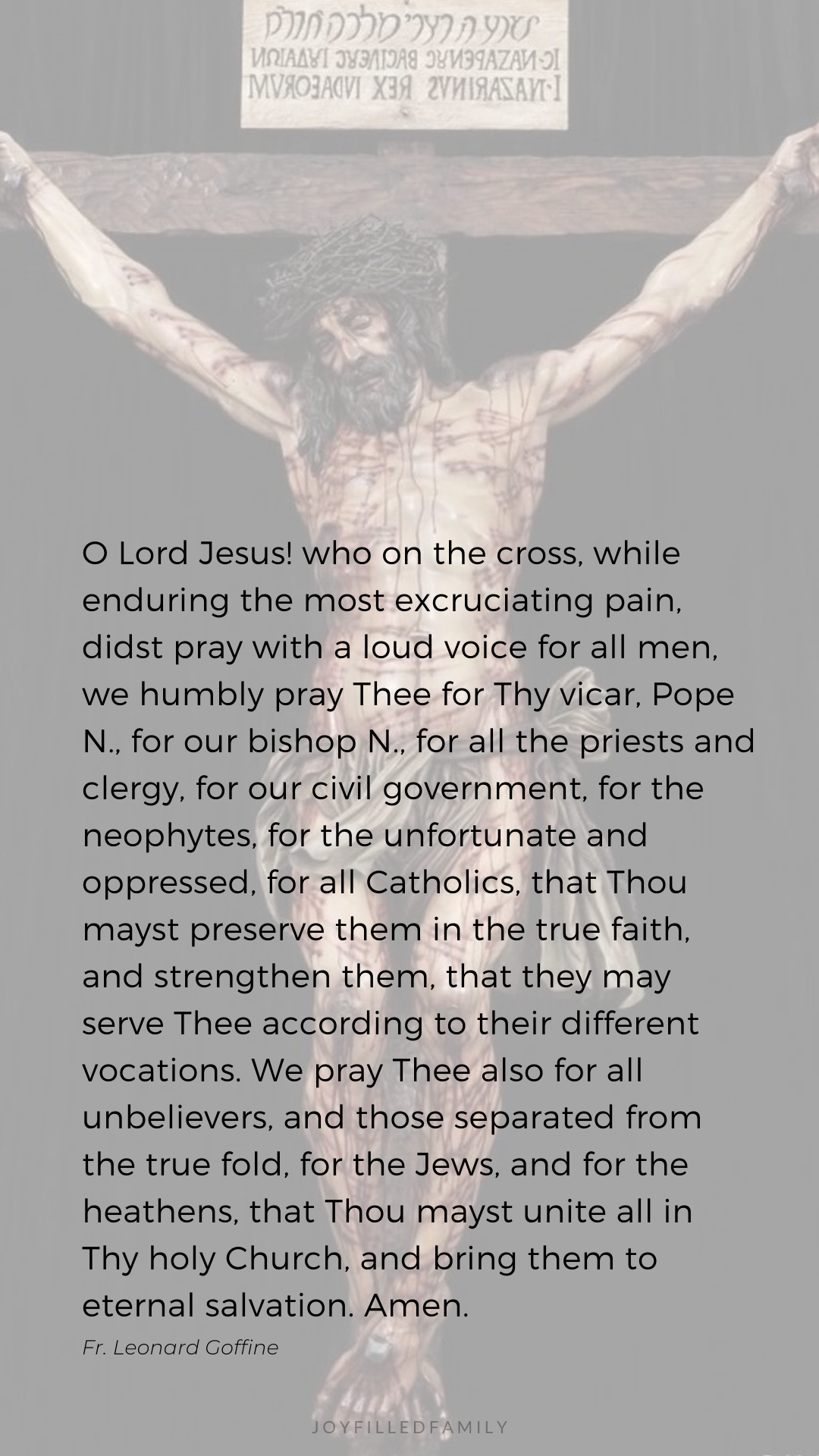
PRAYER O Lord Jesus! who on the cross, while enduring the most excruciating pain, didst pray with a loud voice for all men, we humbly pray Thee for Thy vicar, Pope N., for our bishop N., for all the priests and clergy, for our civil government, for the neophytes, for the unfortunate and oppressed, for all Catholics, that Thou mayst preserve them in the true faith, and strengthen them, that they may serve Thee according to their different vocations. We pray Thee also for all unbelievers, and those separated from the true fold, for the Jews, and for the heathens, that Thou mayst unite all in Thy holy Church, and bring them to eternal salvation. Amen.

What is done by the priest after these prayers?

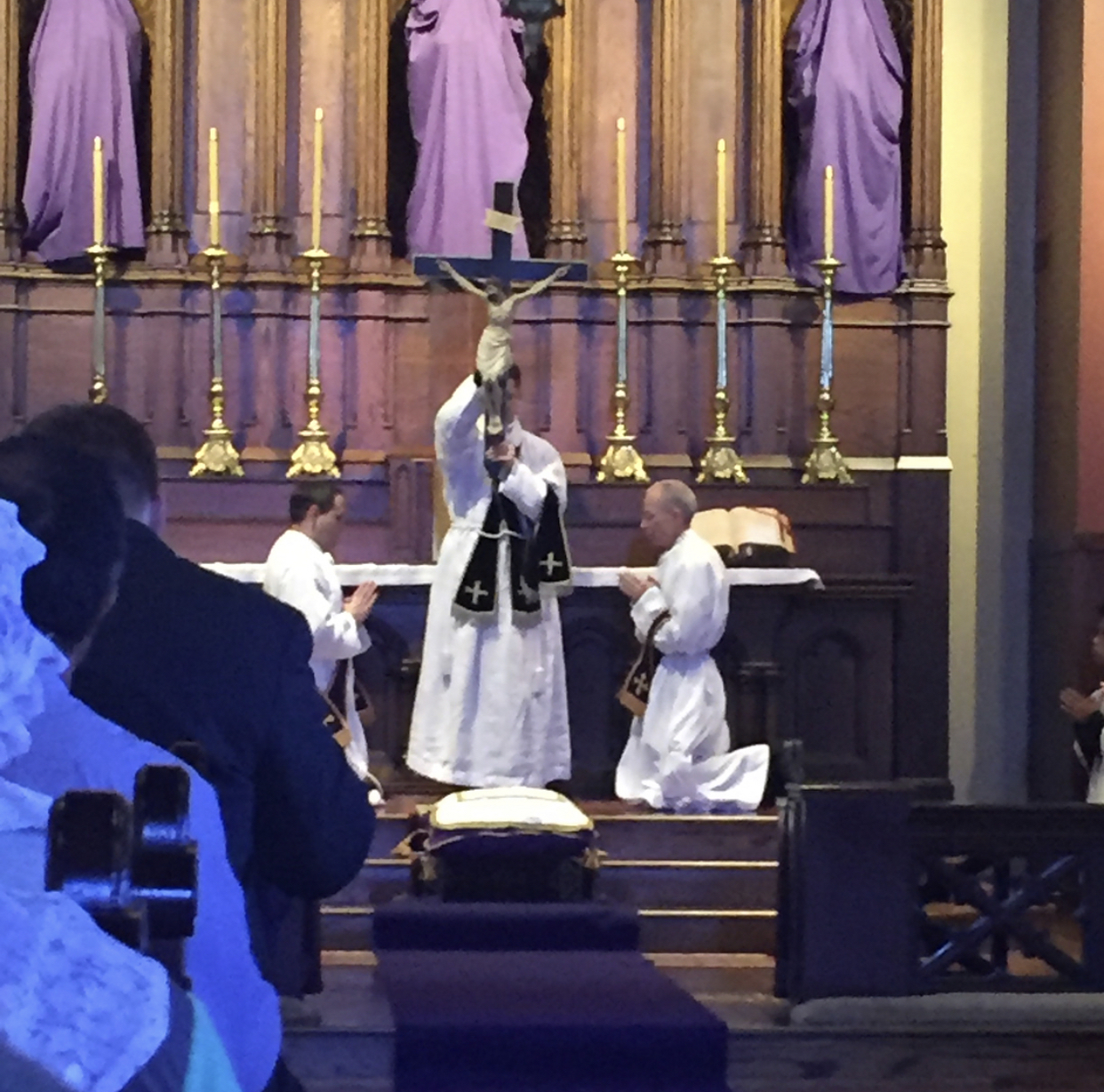
The priest then goes down from the epistle side of the altar, takes the veiled crucifix, and extending it towards the people, uncovers it so much that the head is seen, and sings in a low voice: Ecce lignum crucis, &c.: Behold the wood of the cross on which the Salvation of the world was hanged! The choir answers: Venite, adoremus: Come, let us adore! at which all kneel, adoring Christ who died on the cross for us. The priest then advances to the corner of the altar, uncovers the right arm of the Crucifix, and sings in a higher tone: Ecce lignum crucis, &c.; to which the choir responds as before. Then at the middle of the altar he uncovers the entire Crucifix, and elevating it, sings in a still higher tone than before: Ecce lignum, &c. The choir responds again: Venite adoremus. The image of the crucified Redeemer, which has been hidden from our view since Passion Sunday should make a deep impression upon us; it teaches us at the same time how the Saviour became gradually known to the world. Jesus is adored three times, because He was mocked three times: in the court-yard of the high-priest, in Pilate’s house, and on mount Calvary. When the crucifix is unveiled the priest carries it to the place prepared for it, and kneeling he places it on the cushion covered with a white veil to represent the laying of Christ in the sepulchre; he then retires to the gospel side of the Altar where he puts off his shoes, like Moses, when he was about to approach Almighty God; he then kneels and meditates on the passion of Christ; goes a few steps forward, again kneels, and still a third time, this time directly in front of the crucifix. He adores Jesus with humility, considers His infinite love, which brought Him to the cross and laid Him in the sepulchre for our Redemption; and then kisses with reverence the image of the crucified Saviour. During this veneration of the cross the choir chants alternately the versicles called the Reproaches, and between each part of the canticle the following words in Greek and Latin: “Holy God! Holy and strong God! Holy and immortal God! have mercy on us!” In these versicles Christ tenderly and lovingly reproaches the people who crucified Him, which we may also take to ourselves, who have so often crucified Jesus anew by sin. They are therefore called reproaches, words of complaint, and continue during the veneration of the cross by the priest. Afterwards a hymn of praise composed by St. Fortunatus is sung in honor of the victory gained on the cross by our Saviour, which calls upon us also to render praise and thanks to Jesus crucified.

Adore also in deepest humility the Saviour who died on the cross, and is now victoriously enthroned; ask with sincere contrition the forgiveness of your sins, and by a threefold advance, kiss with sincere love His sacred wounds, promising to love all men, even your enemies, and to have pity on all in distress, according to His example.


What follows the veneration of the cross?

The sacred Host consecrated on Holy Thursday, and kept in the chalice, is brought by the priest in procession, from the repository to the high altar, incensed in sign of adoration, and after a few short prayers the priest elevates It with the right hand, breaks It, puts one part in the chalice and communicates, and soon after leaves the altar.


Is there, then, no Mass said on this day?

No; for on this day there is no bread and wine consecrated, which is the essential part of the Sacrifice of the Mass.


Why is no Mass said on this day?

Because Jesus Christ having this day sacrificed Himself on the altar of the cross in a bloody offering, it is not meet that His death sacrifice should be today repeated even in an unbloody manner. Besides this, Mass is a joyous and comforting sacrifice, and is therefore omitted because of our mourning.


What devotions may be practiced today?

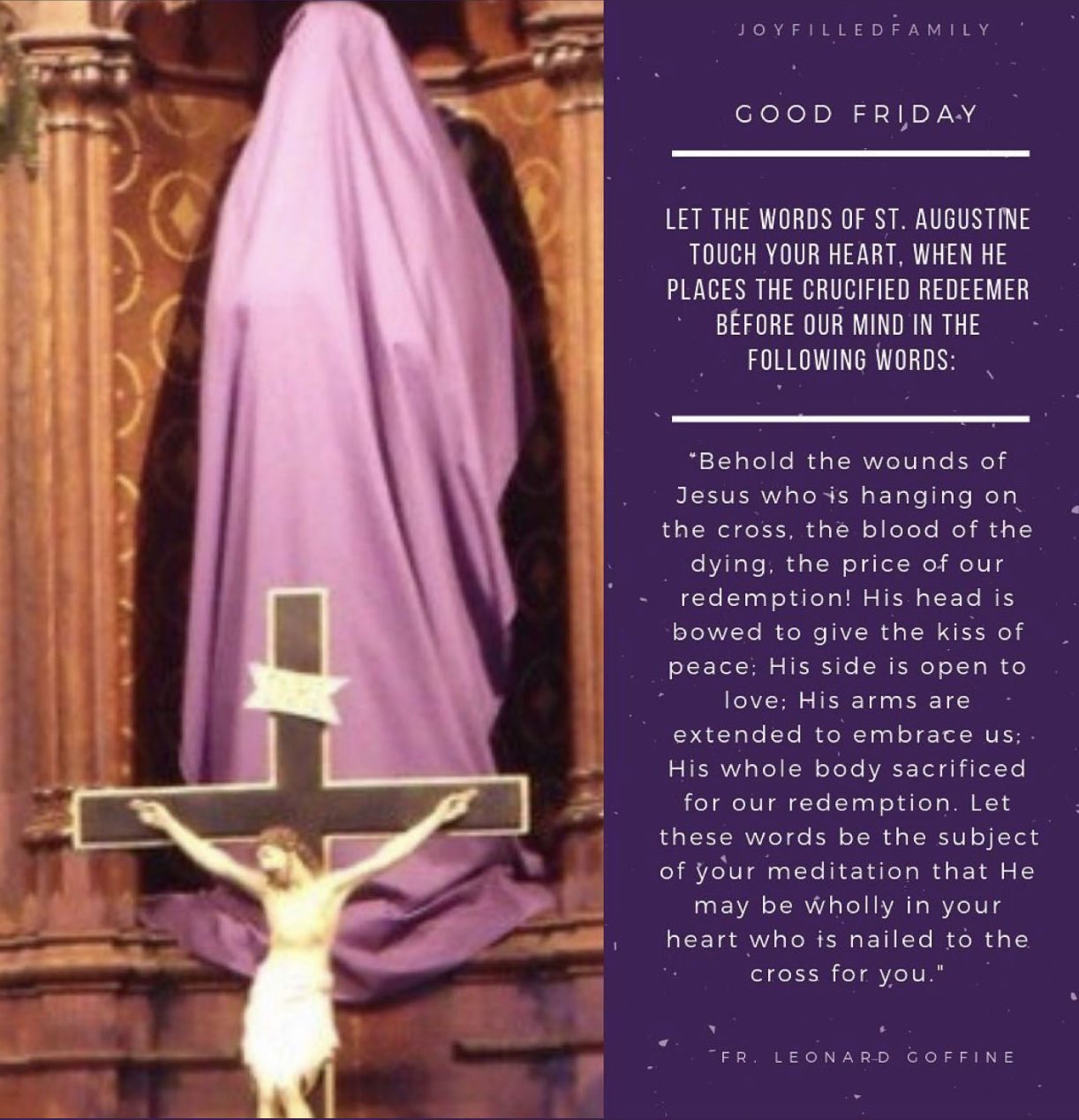
Besides adoring Jesus in the holy sepulchre, the stations may be said, meditations made on the sufferings of our Lord. Let the words of St. Augustine touch your heart, when he places the crucified Redeemer before our mind in the following words: “Behold the wounds of Jesus who is hanging on the cross, the blood of the dying, the price of our redemption! His head is bowed to give the kiss of peace; His side is open to love; His arms are extended to embrace us; His whole body sacrificed for our redemption. Let these words be the subject of your meditation that He may be wholly in your heart who is nailed to the cross for you.”


MANNER OF CONTEMPLATING CHRIST’S BITTER PASSION
Christ also suffered for us: leaving you an example that you should follow his steps. (I Peter II. 21.)

Whence does it come,” writes St. Alphonsus Ligouri, “that so many of the faithful look with so much indifference at Christ on the cross? They generally assist during Holy Week at the commemoration of His death without any feeling of gratitude or compassion, as if it were a fable or an event in which they had no interest. Know they not, or believe they not what the gospel relates of Christ’s passion? Indeed they know it, and believe it, but do not think of it. It is impossible that he who believes and meditates, should fail to become burning with love for God who suffers and dies for love of him.” But why, we may ask here, are there so many who draw so little benefit even from the contemplation of the passion and death of Jesus? Because they fail to consider and imitate the example which Christ gives in His sufferings.

“The cross of Christ,” says St. Augustine, “is not only a bed of death, but a pulpit of instruction.” It is not only a bed upon which Christ dies, but the pulpit from which He teaches us what we must do. It should now be our special aim to meditate upon the passion of Christ, and to imitate those virtues which shone forth so preeminently in His passion and death. But many neglect to do this: They usually content themselves with compassion when they see Christ enduring such great pains, but they see not with what love, humility, and meekness He bears them; and so do not endeavor to imitate His example. That you, O Christian soul, may avoid this mistake, and that you may draw the greatest possible benefit for your soul, from the contemplation of the passion, and death of Christ, attend to that which is said of it by that pious servant of God, Alphonse Rodriguez:

We must endeavor to derive from the meditation on the mysteries of the passion and death of Christ this effect, that we may imitate His virtues, and this by slowly and attentively considering each virtue by itself, exercising ourselves in forming a very great desire for it in our hearts, making a firm resolution to practice it in words and works, and also to conceive a holy aversion and horror of the opposite vice; for instance, when contemplating Christ’s condemnation to the death of the cross by Pilate, consider the humility of Jesus Christ, who being God, as humble as He was innocent, voluntarily submitted and silently accepted the unjust sentence and the ignominious death. Here you see from the example given by Jesus, how you should despise yourself, patiently bear all evil, unjust judgment; and detraction, and even seek them with joy as giving you occasion to resemble Him. To produce these necessary effects and resolutions, you should at each mystery contemplate the following particulars:

First, Who is it that suffers? The most innocent, the holiest, the most loving; the only-begotten Son of the Almighty Father, the Lord of heaven and earth. Secondly; What pains and torments, exterior and interior, does He suffer? Thirdly, In what manner does He suffer, with what patience, humility, meekness and love, does He bear all ignominy and outrage? Fourthly, For whom does He suffer? For all men, for His enemies and His executioners. Fifthly, By whom does He suffer? By Jews and heathens, by soldiers and tyrants, by the devil and all impious children of the world to the end of time, and all who were then united in spirit with His enemies. Sixthly, Why does He suffer? To make reparation for all the sins of the whole world, to satisfy the justice of God, to reconcile the Heavenly Father, to open heaven, to give us His infinite merits that we may from them have strength to follow the way to heaven. At the consideration of each of these points, and indeed at each mystery of the passion of Christ, the imitation of the example of His virtues is the main object, because the true life of the Christian consists in the imitation of Jesus. In considering each stage of the passion of Christ place vividly before your mind the virtue which He practiced therein; contemplate it and ask yourself whether you possess this virtue, or whether you still cherish the opposite vice. If you find the latter to be the case make an act of contrition, with the firm resolution to extirpate this vice, and excite in yourself a sincere desire for the opposite virtue. In this way you will draw the greatest advantage from the contemplation of Christ’s passion, and will resemble Christ, and, as the pious Louis of Granada says, there can be no greater honor and adornment for a Christian than to resemble his divine Master, not in the way that Lucifer desired, but in that which He pointed out, when He said: “I have given you an example, that as I have done to you, so do you also.”


THE PASSION OF OUR LORD JESUS CHRIST
ACCORDING TO ST. JOHN. (CHAPS. XVIII., XIX.)

At that time, Jesus went forth with his disciples, over the brook of Cedron, where there was a garden into which he and his disciples entered. Now Judas also, who betrayed him, knew the place: because Jesus had often resorted thither together with his disciples. Judas therefore having received a band of men and servants from the chief priests and the Pharisees, cometh thither with lanterns and torches and weapons. Jesus, therefore, knowing all things that should come upon him, went forth and said to them: Whom seek ye? They answered him: Jesus of Nazareth. Jesus saith to them: I am he. And Judas also, who betrayed him, stood with them. As soon then as he had said to them: I am he; they went backward, and fell to the ground.

Again therefore he asked them: Whom seek ye? And they said: Jesus of Nazareth. Jesus answered: I have told you, that I am he. If therefore you seek me, let these go away. That the word might be fulfilled which he had said: Of them whom thou hast given me, I have not lost any one. Then Simon Peter having a sword, drew it, and struck the servant of the high-priest, and cut off his right ear. And the name of the servant was Malchus. Then Jesus said to Peter: Put up thy sword into the scabbard. The cup which my Father hath given me, shall not I drink it?

Then the band, and the tribune, and the servants of the Jews took Jesus, and bound him: and they led him away to Annas first: for he was father-in-law to Caiphas, who was the high-priest of that year. Now Caiaphas was he who had given the counsel to the Jews, that it was expedient that one man should die for the people.

And Simon Peter followed Jesus, and so did another disciple. And that disciple was known to the high-priest, and went in with Jesus into the palace of the high-priest. But Peter stood at the door without. Then the other disciple who was known to the high-priest, went out, and spoke to her that kept the door: and brought in Peter. And the maid that waited at the door, saith to Peter: Art not thou also one of this man’s disciples? He saith : I am not.

Now the servants and officers stood at a fire of coals, because it was cold, and warmed themselves: and with them was Peter also standing, and warming himself.


The high-priest then asked Jesus of his disciples, and of his doctrine. Jesus answered him: I have spoken openly to the world: I have always taught in the synagogue, and in the temple, whither all the Jews resort: and in secret I have spoken nothing. Why askest thou me? ask them who have heard what I have spoken to them: behold they know what things I have said. And when he had said these things, one of the officers standing by, gave Jesus a blow, saying: Answerest thou the high-priest so? Jesus answered him: If I have spoken, evil, give testimony of the evil: but if well, why strikest thou me?

And Annas sent him bound to Caiphas the high-priest.

And Simon Peter was standing and warming himself. They said therefore to him: Art not thou also one of his disciples? He denied it and said: I am not. One of the servants of the high-priest, a kinsman to him whose ear Peter, cut off, saith to him: Did not I see thee in the garden with him? Then Peter: again denied, and immediately the cock crowed. Then they led Jesus from Caiphas to the governor hall. And it was morning: and they went not into the hall, that they might not be defiled, but that they might eat the passover.

Pilate therefore went out to there, and said: What accusation bring you against this man? They answered and said to him: If he were not a malefactor, we would not have delivered him up to thee. Pilate then said to them: Take him you, and judge him according to your law. The Jews therefore said to him: It is not lawful for us to put any man to death. That the word of Jesus might be fulfilled which he said, signifying what death he should die. Pilate therefore went into the hall again, and called Jesus, and said to him: Art thou the king of the Jews? Jesus answered: Sayest thou this thing of thyself, or have others told it thee of me. Pilate answered: Am I a Jew? Thy own nation, and the chief priests have delivered thee up to me. What hast thou done? Jesus answered: My kingdom is not of this world. If my kingdom were of this world, my servants would certainly strive that I should not be delivered to the Jews: but now my kingdom is not from hence. Pilate therefore said to him: Art thou a king then? Jesus answered: Thou sayest that I am a king. For this was I born, and for this came I into the world, that I should give testimony to the truth: every one that is of the truth, heareth my voice.


Pilate saith to him: What is truth?


And when he had said this, he went out again to the Jews, and saith to them: I find no cause in him. But you have a custom that I should release one unto you at the passover: will you therefore that I release unto you the king of the Jews? Then cried they all again, saying: Not this man, but Barabbas. Now Barabbas was a robber.

Then, therefore, Pilate took Jesus, and scourged him. And the soldiers platting a crown of thorns, put it upon his head: and they put on him a purple garment, and they came to him, and said: Hail, King of the Jews! And they gave him blows. Pilate, therefore, went forth again, and saith to them: Behold I bring him forth to you that you may know that I find no cause in him. So Jesus came forth wearing the crown of thorns, and the purple garment. And he saith to them: Behold the man. When the chief priests, therefore, and the officers had seen him, they cried out, saying: Crucify him, crucify him. Pilate saith to them: Take him you, and crucify him; for I find no cause in him. The Jews answered him: We have a law; and according to the law he ought to die, because he made himself the Son of God. When Pilate therefore had heard this saying, he feared the more. And he entered into the hall again, and he said to Jesus: Whence art thou? But Jesus gave him no answer. Pilate therefore said to him: Speakest thou not to me? knowest thou not that I have power to crucify thee, and I have power to release thee? Jesus answered: Thou shouldst not have any power against me, unless it were given thee from above. Therefore he that hath delivered me to thee, hath the greater sin. And from thenceforth Pilate sought to release him. But the Jews cried out, saying: If thou release this man, thou art not Caesar’s friend. For whosoever maketh himself a king, speaketh against Caesar.

Now when Pilate had heard these words, he brought Jesus forth: and sat down in the judgment-seat, in the place that is called the Pavement, and in Hebrew, Gabbatha. And it was the parasceve of the passover, about the sixth hour, and he saith to the Jews: Behold your king. But they cried out: Away with him, away with him, crucify him. Pilate saith to them: Shall I crucify your king? The chief priests answered: We have no king but Ceasar. Then therefore, he delivered him to them to be crucified. And they took Jesus, and led him forth. And bearing his own cross he went forth to that place which is called Calvary, but in Hebrew, Golgotha, where they crucified him, and with him two others, one on each side, and Jesus in the midst. And Pilate wrote a title also, and he put it upon the cross. And the writing was: Jesus of Nazareth, the king of the Jews.

The title, therefore, many of the Jews did read, because the place where Jesus was crucified was nigh to the city: and it was written in Hebrew, in Greek, and in Latin. Then the chief-priest of the Jews said to Pilate: Write not, the king of the Jews: but that he said: I am the king of the Jews. Pilate answered: What I have written, I have written. Then the soldiers, when they had crucified him, took his garments (and they made four parts, to every soldier a part) and also his coat. Now the coat was without seam, woven from the top throughout.

They said then one to another: Let us not cut it, but let us cast lots for it, whose it shall be: that the Scripture might be fulfilled which saith: They have parted my garments among them, and upon my vesture they have cast lots. And the soldiers did indeed these things. Now there stood by the cross of Jesus, his mother, and his mother’s sister, Mary of Cleophas, and Mary Magdalene.

When Jesus therefore saw his mother, and the disciple standing, whom he loved, he saith to his mother: Woman! behold thy son. After that, he saith to the disciple: Behold thy mother. And from that hour the disciple took her to his own. Afterwards, Jesus knowing that all things were now accomplished, that the Scripture might be fulfilled, said: I thirst. Now there was a vessel set there full of vinegar. And they put a sponge full of vinegar, about hyssop, and put it to his mouth. When Jesus, therefore, had taken the vinegar, he said: It is consummated. And bowing his head, he gave up the ghost.


Then the Jews (because it was the parasceve) that the bodies might not remain upon the cross on the Sabbath-day(for that was a great Sabbath-day), besought Pilate that their legs might be broken, and that they might be taken away. The soldiers, therefore, came: and they broke the legs of the first, and of the other that was crucified with him.

But after they were come to Jesus, when they saw that he was already dead, they did not break his legs. But one of the soldiers opened his side with a spear, and immediately there came out blood and water. And he that saw it gave testimony, and his testimony is true. And he knoweth that he saith true, that you also may believe.

For these things were done that the Scripture might be fulfilled: You shall not break a bone of him. And again another Scripture saith: They shall look on him whom they pierced.

And after these things, Joseph of Arimathea (because he was a disciple of Jesus, but secretly for fear of the Jews), besought Pilate that he might take away the body of Jesus. And Pilate gave him leave. He came therefore and took away the body of Jesus. And Nicodemus also came, he who at the first came to Jesus by night, bringing a mixture of myrrh and aloes; about a hundred pound weight.

They took therefore the body of Jesus, and wrapped it in linen cloths with the spices, as the manner of the Jews is, to bury. Now there was a garden in the place where he was crucified; and in the garden a new sepulchre, wherein no man yet had been laid. Therefore, because of the parasceve of the Jews, they laid Jesus there; for the sepulchre was nigh at hand.


THE PEOPLE AT THE CROSS, AND THE PEOPLE OF TODAY

At Golgotha, in sight of the temple and city of Jerusalem, in the presence of two or three millions of Jews, who had come to the city from all lands, Jesus, the Son of God, hung upon the cross, an expiatory sacrifice for mankind burdened with all manner of sin. Near cross of her dying Son stood Mary, His mother, filled with grief; by her side John, the beloved disciple, and kneeling at the foot of the cross almost insensible from sorrow and anguish, convulsively winding her arms around the wood of the cross, was Mary Magdalen, the penitent. On a cross at the right hand hung a penitent thief turned towards the Saviour; at the left hand on another cross groaned another criminal of impenitent heart, blaspheming the Holy One of Israel. Around the agonizing Saviour stood the Scribes and Pharisees, that hypocritical class of practiced miscreants, who hated and persecuted the innocent Lamb Jesus, even in death, who blink to all the predictions of the prophets whose books they had read, blind to the actual miracles which Jesus had wrought before their eyes to prove His divinity and His mission, filled with envy and hatred, reviled the dying Redeemer. At a distance stood a crowd of curious, indifferent people, who had come to Jerusalem to attend the feast of the Passover, and having heard of Jesus were present at His crucifixion. Not far from them the rough soldiers and executioners lay around, dividing among themselves the Saviour’s clothes and casting lots for His seamless garment.

This was the society that surrounded the Son of God and Redeemer of the world bleeding on the cross, and in their different phases they are types of the men of today.

Only few were there who clung to the Saviour in unwavering faith and true love, ready to die with Him, and for Him. There were few who suffered all taunts and sneers all revilings and blasphemies and departed not from the cross. Of these three were especially faithful, viz. Mary, John, and Magdalen. Those who like Mary and John are pure and innocent, or like Magdalen are weeping for their sins, who confess Jesus with their heart and lips, cling faithfully to Him, and permit neither persecution nor death to separate them from Him, are like the faithful three at the cross. As then by the cross, so today, the number of the faithful is small, and great is the number of those who, like the careless spectators of the crucifixion, are not decided enemies of Jesus crucified, nor yet His firm friends. They have indeed been baptized in the name of Jesus, they remain externally with the Catholic Church, which Christ founded, but they are sunk in lukewarmness, have no living faith, and are wavering to and fro like a reed between the world and Jesus. They fear the sneers of the so-called learned and enlightened, many of whom are well represented by the Scribes and Pharisees, who, having no faith in Christ themselves, bear in their hearts only hatred and contempt for His Church; they shun the cross, because it is too heavy for their sensuality; they do not, it is true, commit public crimes, they prize highly a good name, occasionally observe the law of the Church, but are accessible to every error; their ears incline to every blasphemy against the religion of Jesus and His ministers, the priests. Instead of standing fearlessly and boldly for Christ, for the holy faith He has taught, and which the Church teaches, they turn away, are silent, even go with the Church’s enemies that they may not be sneered at. The are neither hot, nor cold, so that the words of the Scriptures are verified in them: Because thou art lukewarm, and neither cold, nor hot, I will begin to vomit thee out of my mouth. (Apoc. III. 16.) The Lord casts away from Him these lukewarm, indifferent Christians, as nauseous saliva, and leaves them to their destruction. The true Pharisees of our day are those who purposely close their eyes to the light of truth, who have put aside faith in Jesus, and are no longer disposed to receive instruction. Their pride, their egotism has blinded them, with their poor reason they wish to understand the mysteries of ,the Almighty, with their weak intellect to fathom His ways, even seek to be equal to God; they deny every revealed truth, they deny the existence of heaven and hell, they propose to live like the animals, without God, — but their end is, ruin! Few of them, having seen their error, as the thief on the cross at the right hand of Jesus, turn repentingly to the Redeemer; obdurate as the robber and murderer at His left, the Pharisees of our day cease not to blaspheme the Crucified, and to revile His holy Church. These are assisted by the apostates and unbelievers, who, like the soldiers and executioners, divide among themselves His clothes, and cast lots for His seamless garment. Those clothes which the soldiers divided among themselves, are the truths which the apostates and heretics yet retain after their apostacy from the Church. They have divided these truths, for they have separated themselves into thousands of sects, and possess only portions of the one truth, which Jesus has laid down in. His Church, whole and complete. “Upon my vesture they have cast lots.”

This seamless vesture of Christ is His holy Church that cannot be separated or divided, she is one, and must remain one to the end of time. Concerning this one true Church, the sects all quarrel, all want to be the true Church without considering that, as but one soldier, by the lots, received Christ’s seamless garment, so only one association of men can be the true Church, and that is the association which Christ has chosen. 

Thus we find at the cross on Golgotha the different classes of people of our day represented, namely, the pure and innocent; the repenting sinners, firm adherents of Jesus and His teachings; as also the lukewarm, wavering, nominal Christians; obdurate heretics, professed infidels and apostates. So today mankind is divided into like parties.

To which party do you belong, O Christian soul? To which do you wish to belong? Choose! The time of the division is near. The Lord already holds in His hand the winnowing shovel to clear His floor. If you are not a firm adherent of Jesus and His Church, in the storm that is gathering you will be blown like chaff. If you remain with the small group at the cross, in persevering courage, you will stand firm, and on the day when the cross shall appear in the clouds of heaven, you, with Mary, the mother of the faithful, with John and with Magdalen, will triumph forever, as a victorious knight of the cross. Decide!

Tenebrae

March 29, 2021 by Lena {JOYfilledfamily} Filed Under: Fr. Leonard Goffine, Holy Week, Lent, Sacred Triduum, The Church’s Year 1 Comment


Here is instruction from Fr. Leonard Goffine, The Church’s Year.

What is Tenebrae, and what its meaning?

It is the office which the clergy say on Wednesday, Thursday, and Friday of this week, accompanied by the lamentations of the Prophet Jeremias, and other ceremonies. The word means darkness, and represents the prayers formerly said in the dark hours of the morning. In the Tenebrae the Church mourns the passion and death of, Jesus, and urges her children to return to God; she therefore makes use of those mournful words of Jeremias: “Jerusalem! Jerusalem, be converted to the Lord, thy God!”

Why is the Tenebrae said in the evening?

In memory of that time when the early Christians spent the whole night preceding great festivals in prayer, but later, when zeal diminished, it was observed only by the clergy on the eves of such festivals; also in order that we may consider the darkness, lasting for three hours, at the crucifixion of Christ, whence the name Tenebrae; and lastly, to represent by it that mourning, of which darkness is the type. 

Why, during the Prayers of the clergy, are the lights in the triangular candlestick extinguished one after another?


Because the Tenebrae, as has been already remarked, in the earliest times of the Church, were held in the night, the candles were extinguished one after another, as the daylight gradually approached they were no longer, necessary; again, at the time of the passion and death of Jesus, His apostles whom He calls the light of the world, one, after another gradually left Him; at the death of Christ the earth was covered with darkness. The Jews, blinded by pride, would not recognize Christ as the Saviour of the world, and therefore fell by His death into the deepest darkness of hardened infidelity.

What is meant by the last candle which is carried lighted behind the altar, and after prayers are finished, is brought back again?

This candle signifies Christ; who on the third day came forth from the grave, by His own power, as the true light of the world, though according to His human nature He died and lay in the grave until the third day.

Why is a noise made with clappers at the end of the Tenebrae?

This was formerly a sign that service was over; it, also signifies the earthquake which took place at Christ’s death.

How should we attend the Church service on this day?

The Church commemorates on this day the institution of the Most Blessed Sacrament of the Altar; we should therefore consider with a lively faith that Jesus, our divine Teacher and Saviour, is really and truly here present; we should adore Him as the Son of God, who became man to redeem us; should admire the love which determined Him to institute the Blessed Sacrament, that He might always be with us; and should thank Him for all the inestimable graces which we derive from this Sacrament.

Tenebrae of Maundy Thursday
Tenebrae of Good Friday – FSSP
Tenebrae of Holy Saturday – FSSP
Tenebrae of Holy Saturday
Tenebrae prayed in the home in 2020

On this and the two following days, the Church anticipates the Night-Office; she celebrates it on the previous evening of each day, and this in order that the Faithful may be present at it. The Matins and Lauds of Maundy Thursday are, therefore, said this afternoon. The Faithful should make every effort to assist at this solemn Office, seeing it is on their account that the Church has changed her usual hours. As to the merit there is in joining in it, there can be no doubt, but that it is to be preferred to any private devotions. The surest means for obtaining favours from God, and winning him to our requests, is to approach him through the Church. And as regards the feelings of devotion wherewith we ought to celebrate the mysteries of these three great Days, the Offices of the Church are, ordinarily speaking, a surer and richer source than the Exercises of Piety composed by men. The soul that feeds on the words and ceremonies of the holy Liturgy, will be all the more disposed to profit by the private devotions she practises at home. The prayer of the Church will thus become the basis, whereon is built the edifice of christian piety during these glorious Anniversaries of our Redemption; and we shall be imitating our forefathers who lived in the Ages of Faith, and who were such admirable Christians, because they lived the life of the Church, by means of the sacred Liturgy.

Dom proSper gueranger
Holy Week 2018


RESOURCES:

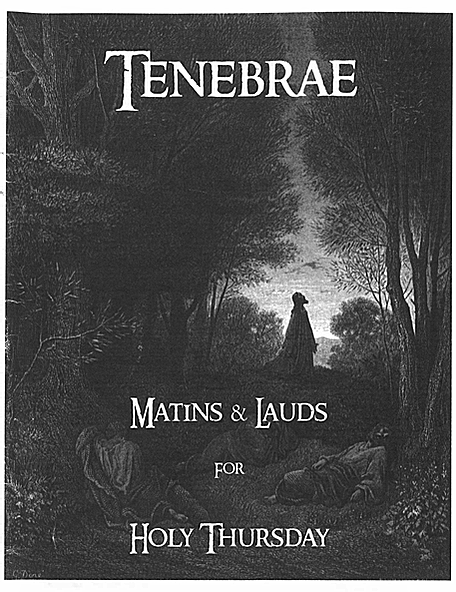
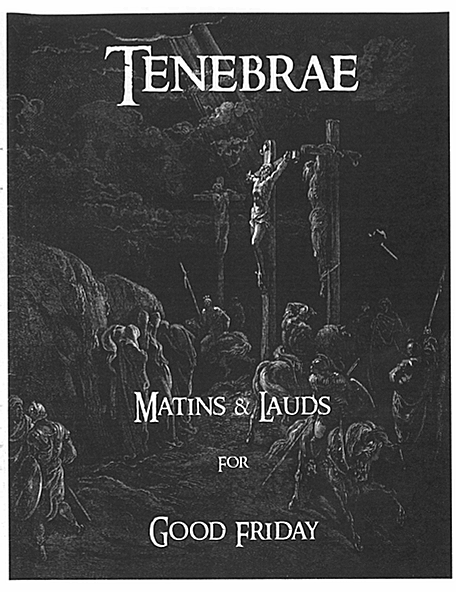
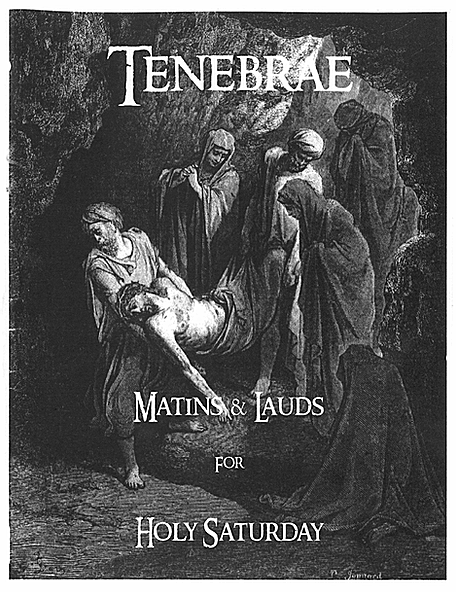
The Office of Tenebrae booklets by Our Lady of Mt. Carmel, Littleton, CO. Click the image for the PDF download.

  • Live Holy Thursday Tenebrae 2021 St. Mary’s on Broadway FSSP YouTube
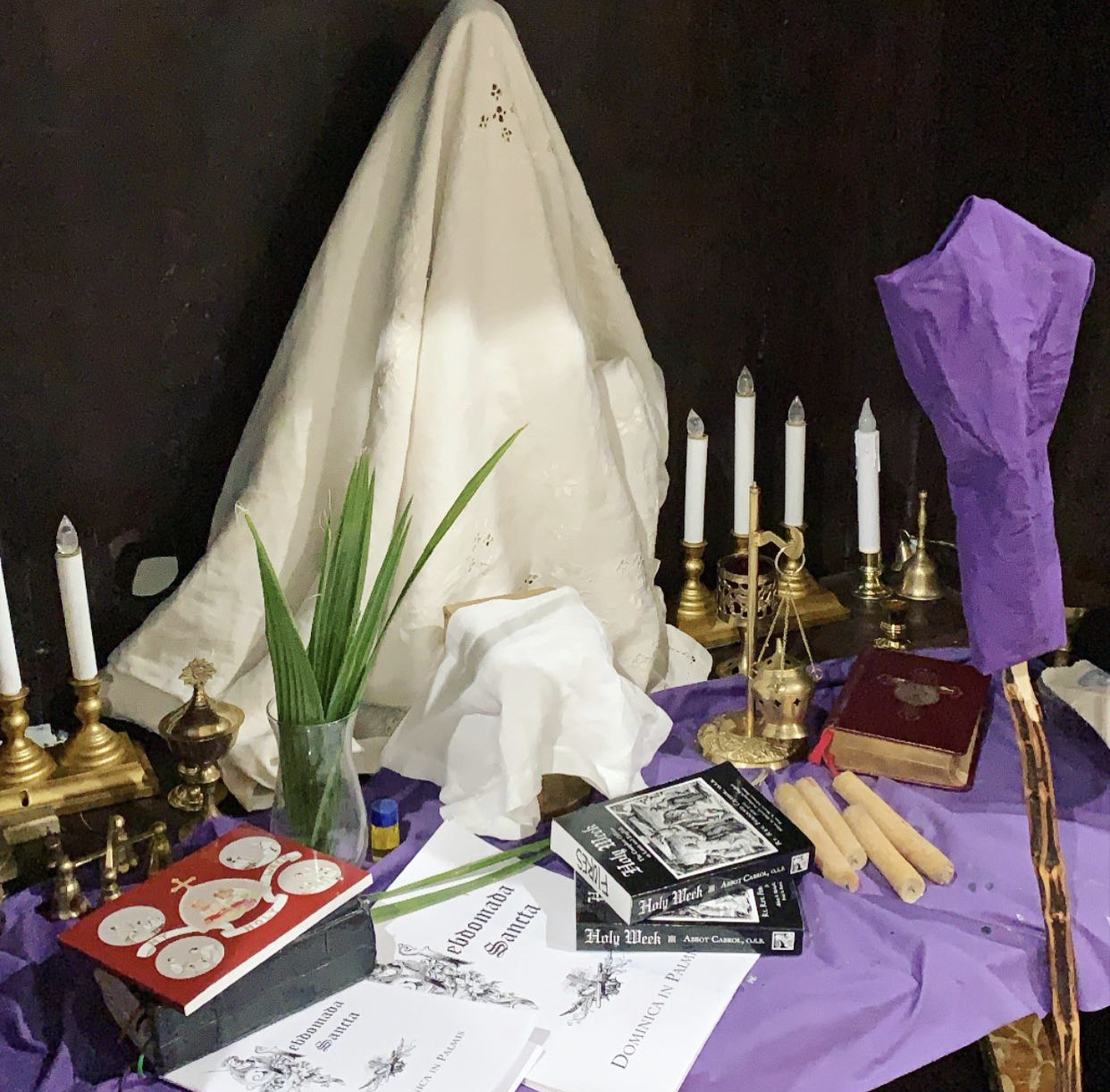
  • Holy Week in the Home — PDF with live links — Pre 1955 Holy Week Missal printables or DF to follow online, simple instructions, supplies needed for each day, and more!

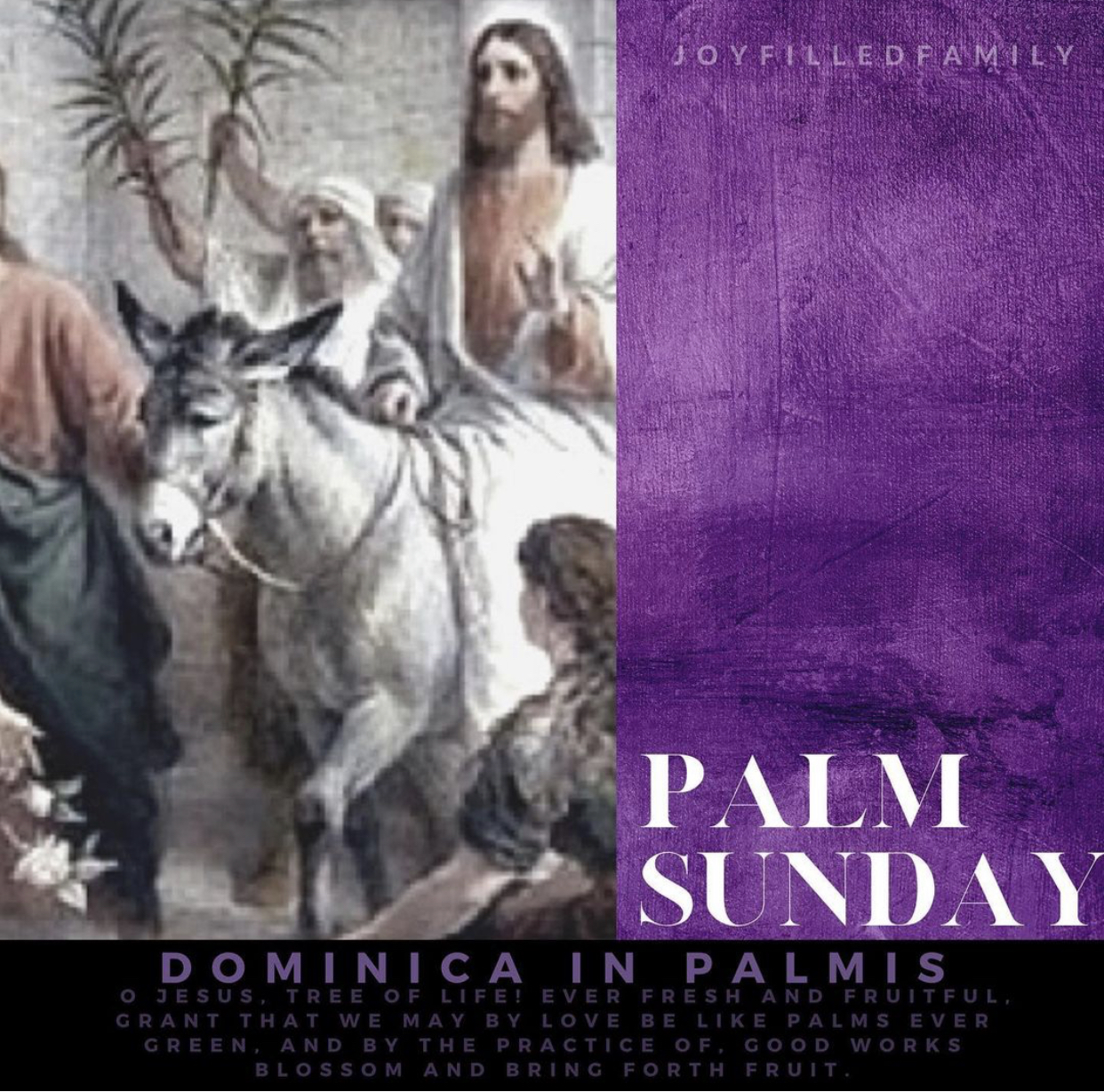
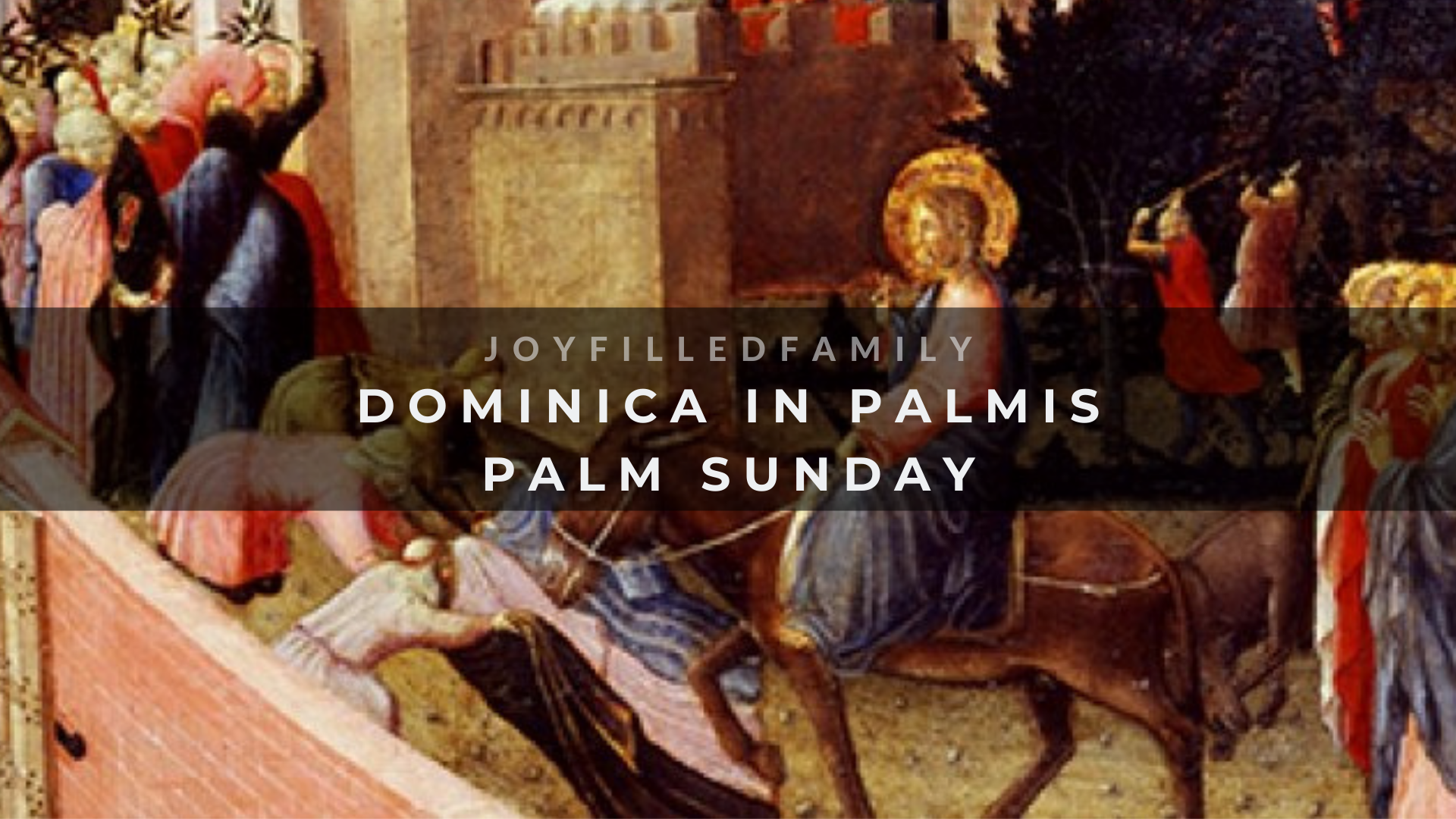
Dominica in Palmis {Palm Sunday}

March 27, 2021 by Lena {JOYfilledfamily} Filed Under: Fr. Leonard Goffine, Lent, Palm Sunday, The Church’s Year Leave a Comment

PALM SUNDAY

The following is instruction from Fr. Leonard Goffine, The Church’s Year.

Why is this day called Palm Sunday?

In memory of our Saviour’s triumphant entry into Jerusalem, when the multitude strewed palm branches before Him, for which reason the Church, on this day, blesses palms, and carries them in procession.

Why are palms blessed?

That those who carry them with devotion, or keep them in their houses, may receive protection of soul and body, as prayed for in the blessing; that those who carry the palms may, by means of the prayers of the Church, adorn their souls with good works and thus, in spirit, meet the Saviour; that, through Christ whose members we are, we may conquer the kingdom of death and darkness, and be made worthy to share in His glorious resurrection and triumphant entrance into heaven.

St. Augustine writes of the palms: “They are the emblem of praise, and sign of victory, because the Lord by death conquered death, and with the sign of victory, the cross, overcame the devil, the prince of death.”

Holy Week 2020 — observed at home due to the closing of Churches.

Therefore, preceded by the cross, we go in procession around the church singing hymns of praise; when we come to the church door, we find it locked; the priest knocks at it with the cross. Heaven was closed to us by the sin of Adam, and it is opened to us by reconciliation through Jesus on the cross.

To move us to compassion for the suffering Redeemer, the Church, in the person of Christ, cries in lamenting tones at the Introit:

INTROIT O Lord, remove not Thy help to a distance from me, look towards my defence: save me from the lion’s mouth, and my lowness from the horns of the unicorns. O God, my God! look on me, why hast Thou forsaken me? Far from my salvation are the words of my sins. O Lord! Remove not, &c. (Ps. XXI.)

COLLECT Almighty and everlasting God! who didst vouchsafe to send Thy Son, our Saviour, to take upon Him our flesh, and to suffer death upon the cross, to give mankind an example of humility; mercifully grant, that we may both follow the example of His patience, and be made partakers of His Resurrection. Through the same &c.

EPISTLE (Philip. II. 5-11.) Brethren, let this mind be in you, which was also in Christ Jesus: who being in the form of God, thought it not robbery himself to be equal to God; but debased himself, taking the form of a servant, being made to the likeness of men, and in shape found as a man. He humbled himself, becoming obedient unto death, even the death of the cross. Wherefore, God also hath exalted him, and hath given him a name, which is above every name: that in the name of Jesus every knee should bow, of those that are in heaven, on earth, and under the earth; and that every tongue should confess, that the Lord, Jesus Christ, is in the glory of God, the Father.

INSTRUCTION In this epistle, the apostle urges us in a special manner to humility by which we are made like to Christ, our Lord, who putting off the majesty of His divinity, became man, and humbled Himself in obedience to the ignominious death of the cross. “Would that all might hear,” exclaims St. Gregory, “that God resists the proud, and gives His grace to the humble! Would that all might hear: Thou dust and ashes, why dost thou exalt thyself? Would that all might hear the words of the Lord: Learn of me, because I am humble of heart. The only-begotten Son of God assumed the form of our weakness, suffered mockery, insult and torments for the purpose that the humble God might teach man not to be proud.”

ASPIRATION  Ah, that my sentiments were as Thine, O my Lord, Jesus! who so humbled Thyself and were obedient to the most ignominious death of the cross. Grant me, I beseech Thee, O my Redeemer, the grace diligently to follow Thee in humility.

Instead of the gospel of the Passion, that is, the history of the sufferings of our Lord according to St. Matthew, (Chaps. XXVI. XXVII.) is read in this day’s Mass, and neither incense, nor lights are used, nor is the Dominus vobiscum said, thus signifying that Jesus, the Light of the world, was taken away by death, and that the faith and devotion of the apostles was shaken, and became almost extinct. When reading the History of the Passion at the words: and bowing his head, he gave up the ghost, the priest with all the congregation kneel and meditate for a short time on the great mystery of the death of Jesus, by which our redemption was effected.

At the blessing of the palms, the priest reads the following

GOSPEL (Matt. XXI. 1-9.) At that time, when Jesus drew nigh to Jerusalem, and was come to Bethphage, unto Mount Olivet; then he sent two disciples, saying to them: Go ye into the village that is over against you, and immediately ye will find an ass tied, and a colt with her; loose them, and bring them to me; and if any man shall say any thing to you, say ye that the Lord hath need of them, and forthwith he will let them go. Now all this was done, that the word might be fulfilled, which was spoken by the prophet, saying: Tell ye the daughter of Sion, behold thy king cometh to thee, meek, and sitting upon an ass, and a colt, the foal of her that is used to the yoke. And the disciples going, did as Jesus commanded them. And they brought the ass and the colt, and laid their garments upon them, and made him sit thereon. And a very great multitude spread their garments in the way; and others cut down boughs from the trees, and strewed them in the way; and the multitudes that went before and that followed, cried, saying: Hosanna to the Son of David! Blessed is he that cometh in the name of the Lord.

Why did Jesus enter Jerusalem so solemnly and yet so humbly?

To show that He was the promised Messiah and King of the Jews, as foretold by the Prophet Zacharias, (IX 9.) and that He had come to conquer the world, the flesh and the devil, for which He used the weapons of meekness, humility, and poverty and therefore came seated not on a proud steed but like a poor person on the weak colt of an ass, entering Jerusalem in all humility, thus teaching us that meekness and indifference to earthly goods are our best weapons to gain victory over our enemies. Jesus entered Jerusalem so humbly to perfect the type of the Paschal lamb, for on this day the lambs which were to be sacrificed in the temple on the following Friday, were solemnly led into the city. Thus Jesus like a meek lamb, entered the city of Jerusalem to be sacrificed for us.

Why did the people meet Christ with palm branches?

This happened by the inspiration of God, to indicate that Christ, the conqueror of death, hell and the devil, would reconcile man with God, and open the heavenly Jerusalem to him, for the palm is the emblem of victory and peace. By this we learn also the inconsistency and mutability of the world; for the very people who on this day met Christ with palm branches exclaiming: “Hosanna to the Son of David,” a few days later shouted: “Crucify him! Crucify him!” – Learn from this to despise the praise of the world, and be careful not to imitate the inconsistency of this people by crucifying Him again by sin (Heb. VI. 6.) after having received Him with joy in holy Communion.

How should we take part in the procession on this day?

With the pious intention of meeting Christ in spirit, with the devout people of Jerusalem, adoring Him, saying: “Hosanna to the Son of David, Hosanna to Him who comes in the name of the Lord; Hosanna to the Highest!” and with the heart-felt prayer to Jesus for His grace, that with Him we may conquer the world, the flesh and the devil, and thus merit to be received into the heavenly Jerusalem.

PETITION  O Jesus, Tree of Life! ever fresh and fruitful, grant that we may by love be like palms ever green, and by the practice of, good works blossom and bring forth fruit.

THE PASSION OF OUR LORD JESUS CHRIST

ACCORDING TO ST. MATTHEW, CHAP. XXVI., XXVH.

At that time, Jesus said to his disciples: You know that after two days shall be the Pasch, and the Son of Man shall be delivered up to be crucified. Then were gathered together the chief priests and the ancients of the people into the palace of the high-priest, who was called Caiphas. And they consulted together, that, by subtilty, they might apprehend Jesus and put him to death. But they said: Not on the festival day, lest there should be a tumult among the people. And when Jesus was in Bethania, in the house of Simon the leper, there came to him a woman having an alabaster-box of precious ointment, and poured it on his head, as he was at table. And the disciples seeing it, had indignation, saying: To what purpose is this waste? For this might have been sold for much, and given to the poor. And Jesus knowing it, said to them: Why do you trouble this woman? for she hath wrought a good work upon me. For the poor you have always with you: but me you have not always. For she, in pouring this ointment upon my body, hath done it for my burial. Amen, I say to you, wheresoever this gospel shall be preached in the whole world, that also which she hath done, shall be told for a memory of her.

Then went one of the twelve, who was called Judas Iscariot, to the chief priests, and said to them: What will you give me, and I will deliver him unto you? But they appointed for him thirty pieces of silver. And from thenceforth he sought opportunity to betray him.

And on the first day of the Azymes, the disciples came to Jesus, saying: Where wilt thou that we prepare for thee to eat the Pasch? But Jesus said: Go ye into the city to a certain man, and say to him: The master saith: my time is near at hand, I will keep the Pasch at thy house with my disciples. And the disciples did as Jesus had appointed them, and they prepared the Pasch. Now when it was evening, he sat down with his twelve disciples. And whilst they were eating, he said: Amen, I say to you, that one of you is about to betray me. And they being very much troubled, began everyone to say: Is it I, Lord? But he answering, said: He that dippeth his hand with me in the dish, the same shall betray me. The Son of Man indeed goeth as it is written of him; but woe to that man, by whom the Son of Man shall be betrayed: it were better for that man, if he had not been born. And Judas that betrayed him, answering, said: Is it I, Rabbi? He said to him: Thou hast said it. And whilst they were at supper, Jesus took bread, and blessed and broke, and gave to his disciples, and said: Take ye and eat: This is my body. And taking the chalice he gave thanks: and gave to them, saying: Drink ye all of this. For this is my blood of the new testament, which shall be shed for many for the remission of sins. And I say to you, I will not drink from henceforth of the fruit of the vine, until that day, when I shall drink it new with you in the kingdom of my Father. And when they had sung a hymn, they went out to Mount Olivet.

Then Jesus saith to them: All you shall be scandalized in me this night. For it is written: I will strike the shepherd, and the sheep of the flock shall be dispersed. But after I shall be risen again, I will go before you into Galilee. And Peter answering, said to him: Though all shall be scandalized in thee, I will never be scandalized. Jesus said to him: Amen, I say to thee, that in this night, before the cock crow, thou wilt deny me thrice. Peter saith to him: Though I should die with thee, I will not deny thee. And in like manner said all the disciples. Then Jesus came with them to a country place which is called Gethsemani, and he said to his disciples: Sit you here, till I go yonder, and pray. And taking with him Peter and the two sons of Zebedee, he began to grow sorrowful and to be sad.

Then he saith to them: My soul is sorrowful even unto death; stay you here, and watch with me. And going a little further he fell upon his face, praying, and saying: O my Father! if it is possible, let this chalice pass from me. Nevertheless not as I will, but as thou wilt. And he cometh to his disciples, and findeth them asleep; and he saith to Peter: What! could you not watch one hour with me? Watch ye, and pray that ye enter not into temptation. The spirit indeed is willing, but the flesh is weak. Again he went the second time, and prayed, saying: O my Father! if this chalice cannot pass away except I drink it, thy will be done. And he cometh again, and findeth them asleep; for their eyes were heavy. And leaving them, he went away again, and he prayed the third time, saying the same words. Then he cometh to his disciples, and with to them: Sleep on now, and take your rest: behold the hour is at hand, and the Son of Man shall be betrayed into the hands of sinners. Rise, let us go; behold, he is at hand that will betray me.

As he yet spoke, behold, Judas, one of the twelve, came, and with him a great multitude with swords and clubs, sent from the chief priests and the ancients of the people. And he that betrayed him, gave them a sign, saying: Whomsoever I shall kiss, that is he: hold him fast. And forthwith coming to Jesus, he said: Hail, rabbi! And he kissed him. And Jesus said to him: Friend! whereto art thou come? Then they came up and laid hands on Jesus, and held him. And behold one of them that were with Jesus, stretching forth his hand, drew out his sword; and striking the servant of the high-priest, cut off his ear. Then Jesus saith to him: Put up again thy sword into its place for all that take the sword shall perish by the sword. Thinkest thou that I cannot ask my Father, and he will give me presently more than twelve legions of Angels? How then shall the scriptures be fulfilled, that so it must be done? In that same hour Jesus said to the multitude: You are come out as against a robber, with swords and clubs to apprehend me. I sat daily with you teaching in the temple, and you laid not hands on me. Now all this was done, that the scriptures of the prophets might be fulfilled. Then the disciples all leaving him, fled away.

But they holding Jesus, led him to Caiphas, the high-priest, where the scribes and the ancients were assembled. But Peter followed him afar off to the high-priest’s palace. And going in, he sat with the servants, to see the end. Now the chief priests and whole council sought false witness against Jesus, that they might put him to death: and they found not, though many false witnesses had come in. And last of all, there came two false witnesses. And they said: This man said: I am able to destroy the temple of God, and in three days to rebuild it. And the high-priest rising up, said to him: Answerest thou nothing to the things which these witness against thee? But Jesus held his peace. And the high-priest said to him: I adjure thee by the living God, that thou tell us if thou be the Christ, the Son of God. Jesus saith to him: Thou hast said it. Nevertheless I say to you, hereafter you shall see the Son of Man, sitting on the right hand of the power of God, and coming in the clouds of heaven. Then the high-priest rent his garments, saying: He hath blasphemed, what further need have we of witnesses? Behold, now you have heard the blasphemy. What think you? But they answering, said: He is guilty of death.
Then they spit in his face, and buffetted him, and others struck his face with the palms of their hands, saying: Prophesy unto us, O Christ! who is he that struck thee? But Peter sat without in the palace, and there came to him a servant maid, saying: Thou also wast with Jesus the Galilean. But he denied before them all, saying: I know not what thou sayest. And as he went out of the gate, another maid saw him, and she saith to them that were there: This man also was with Jesus of Nazareth. And again he denied with an oath: I do not know the man. And after a little while, they that stood by came and said to Peter: Surely thou also art one of them: for even thy speech doth discover thee. Then he began to curse and to swear that he knew not the man.

And immediately the cock crew. And Peter remembered the word of Jesus which he had said: Before the cock crow, thou wilt deny me thrice. And going forth, he wept bitterly.

And when the morning was come, all the chief priests and ancients of the people held a council against Jesus, to put him to death. And they brought him bound, and delivered him to Pontius Pilate, the governor.

Then Judas, who betrayed him, seeing that he was condemned, repenting himself, brought back the thirty pieces of silver to the chief priests and the ancients, saying: I have sinned, in betraying innocent blood. But they said: What is that to us? look thou to it.

And casting down the pieces of silver in the temple, he departed: and went and hanged himself with a halter. But the chief priests having taken the pieces of silver, said: It is not lawful to put them into the corbona, because it is the price of blood. And having consulted together, they bought with them the potter’s field, to be a burying-place for strangers. Wherefore that field was called Haceldama, that is the field of blood, even to this day.

Then was fulfilled that which was spoken by Jeremias the prophet, saying: And they took the thirty pieces of silver, the price of him that was valued, whom they prized of the children of Israel. And they gave them unto the potter’s field, as the Lord appointed to me.

And Jesus stood before the governor, and the governor asked him, saying: Art thou the king of the Jews? Jesus saith to him: Thou sayest it. And when he was accused by the chief priests and ancients, he answered nothing. Then Pilate saith to him: Dost thou not hear how great testimonies they allege against thee?

And he answered him not to any word: so that the governor wondered exceedingly.

Now upon the solemn day the governor was accustomed to release to the people one prisoner, whom they would. And he had then a notorious prisoner, that was called Barabbas. They, therefore, being gathered together, Pilate said: Whom will you that I release to you, Barabbas, or Jesus, who is called Christ? For he knew that through envy they had delivered him up. And as he was sitting on the judgment-seat, his wife sent to him, saying. Have thou nothing to do with that just man. For I have suffered many things this day in a dream on account of him. But the chief priests and ancients persuaded the people, that they should ask Barabbas, and make Jesus away. And the governor answering, said to them: Which will you have of the two to be released unto you? But they said: Barabbas. Pilate saith to them: What shall I do then with Jesus that is called Christ? They all say: Let him be crucified. The governor said to them: Why, what evil hath he done? But they cried out the more, saying: Let him be crucified. And Pilate seeing that he prevailed nothing, but that rather a tumult was made; having taken water, washed his hands before the people, saying: I am innocent of the blood of this just man: look you to it. And all the people answering, said: His blood be upon us, and upon our children. Then he released to them Barabbas, and having scourged Jesus, delivered him to them to be crucified.

Then the soldiers of the governor, taking Jesus into the hall, gathered together unto him the whole band. And stripping him, they put a scarlet cloak about him. And platting a crown of thorns, they put it upon his head, and a reed in his right hand. And bowing the knee before him, they mocked him, saying: Hail, king of the Jews!


And spitting upon him, they took the reed, and struck his head. And after they had mocked him, they took off the cloak from him, and put on him his own garments, and led him away to crucify him.

And going out, they found a man of Cyrene, named Simon; him they forced to take up his cross. And they came to the place that is called Golgotha, which is, the place of Calvary. And they gave him wine to drink mingled with gall. And when he had tasted, he would not drink. And after they had crucified him, they parted his garments, casting lots; that the word might be fulfilled which was spoken by the prophet, saying: They divided my garments among them; and upon my vesture they cast lots. And they sat down, and watched him. And they put over his head his cause written: This is Jesus, the King of the Jews. Then were there crucified with him two thieves; the one on the right hand, and the other on the left. And they that passed by blasphemed him, wagging their heads, and saying: Vah, thou who destroyest the temple of God, and in three days buildest it up again, save thy own self: if thou be the Son of God, come down from the cross. In like manner also, the chief priests with the scribes and ancients, mocking, said: He saved others; himself he cannot save: if he be the king of Israel, let him now come down from the cross, and we will believe him. He trusted in God, let him deliver him now if he will save him: for he said: I am the Son of God.

And the self-same thing the thieves also, that were crucified with him, reproached him with. Now from the sixth hour there was darkness over all the earth, until the ninth hour. And about the ninth hour, Jesus cried with a loud voice, saying: Eli, Eli, lamma sabacthani? that is: My God! my God! why hast thou forsaken me? And some of them that stood there and heard, said: This man calleth for Elias. And immediately one of them, running; took a sponge, and filled it with vinegar; and put it on a reed and gave him to drink. And the others said: Stay, let us see whether Elias will come to deliver him. And Jesus again crying with a loud voice, yielded up the ghost.

And behold the veil of the temple was rent in two, from the top even to the bottom, and the earth quaked, and the rocks were rent; and the graves were opened: and many bodies of the saints that had slept arose: and coming out of the tombs after his resurrection, came into the holy city, and appeared to many. Now the centurion, and they that were with him, watching Jesus, having seen the earthquake and the things that were done, were greatly afraid, saying: Indeed this was the Son of God. And there were there many women afar off, who had followed Jesus from Galilee, ministering unto him; among whom was Mary Magdalen, and Mary, the mother of James and Joseph, and the mother of the sons of Zebedee. And when it was evening, there came a certain rich man of Arimathea, named Joseph, who also himself was a disciple of Jesus. He went to Pilate and begged the body of Jesus. Then Pilate commanded that the body should be delivered. And Joseph taking the body, wrapped it up in a clean linen cloth. And laid it in his own new monument, which he had hewed out in a rock; and he rolled a great stone to the door of the monument, and went his way. And there was Mary Magdalen, and the other Mary sitting over against the sepulchre.

And the next day, which followed the day of the preparation, the chief priests and the Pharisees came together to Pilate, saying: Sir, we have remembered that seducer said, while he was yet alive: After three days I will rise again. “Command, therefore, the sepulchre to be guarded until the third day; lest his disciples come and steal him away, and say to the people: He is risen from the dead. So the last error shall be worse than the first. Pilate said to them: You have a guard, go guard it as you know. And they departing, made the sepulchre sure, with guards, sealing the stone.


INSTRUCTION ON HOLY WEEK

Why is this week called Holy Week?

This week is called Holy Week because during it we celebrate the most holy mysteries of our religion, and in all her offices and ceremonies the Church refers in quiet mournfulness to the passion and death of our Redeemer.

What remarkable things did Christ do during the first four days of this week?

After He had entered the temple at Jerusalem on Palm Sunday amidst the greatest rejoicings of the people, and was saluted by the children with that cry of joy: “Hosanna to the Son of David,” He drove the buyers and sellers out of the temple, and when He had spent the entire day in preaching and healing the sick, He went in the evening to Bethania, where He remained over night in Lazarus’ house, because in Jerusalem no one wished to receive Him for fear of His enemies. The three following days He spent in Jerusalem, teaching in the temple, and passing the night in prayer on Mount Olivet. In His sermons during these days He strove especially to convince the Jewish priests, the Doctors of the Law and the Pharisees, that He was really the Messiah, and that they would commit a terrible sin by putting Him to death; that they would bring themselves and the whole Jewish nation to destruction. This ruin of the people He illustrated most plainly causing the fig-tree to wither under His curse, and by foretelling the destruction of the city and the temple of Jerusalem. He disputed with them, and confounded them, and brought them publicly to shame by parables, so that out of anger and hatred they with one mind determined to kill Him. The impious Judas aided the most in the execution of their design; through avarice he sold Him for thirty pieces of silver (about eighteen dollars in our money) to the chief priests, and the next day, Thursday, became His betrayer and delivered Him over into their hands.

Judica {Passion Sunday – Fifth Sunday in Lent}

March 20, 2021 by Lena {JOYfilledfamily} Filed Under: Fifth Sunday In Lent, Fr. Leonard Goffine, Lent, The Church’s Year Leave a Comment


Everything around us urges us to mourn. The images of the saints, the very crucifix on our altar, are veiled from our sight. The Church is oppressed with grief.

During the first four weeks of Lent, she compassionated her Jesus fasting in the desert; His coming sufferings and crucifixion and death are what now fill her with anguish. We read in to-day’s Gospel, that the Jews threaten to stone the Son of God as a blasphemer: but His hour is not yet come. He is obliged to flee and hide Himself. It is to express this deep humiliation, that the Church veils the cross. A God hiding Himself, that He may evade the anger of men – what a mystery! Is it weakness? Is it, that He fears death? No; we shall soon see Him going out to meet His enemies: but at present He hides Himself from them, because all that had been prophesied regarding Him has not been fulfilled. Besides, His death is not to be by stoning: He is to die upon a cross, the tree of malediction, which, from that time forward, is to be the tree of life. Let us humble ourselves, as we see the Creator of heaven and earth thus obliged to hide Himself from men, who are bent on His destruction! Let us go back, in thought, to the sad day of the first sin, when Adam and Eve bid themselves because a guilty conscience told them they were naked. Jesus has come to assure us of our being pardoned, and lo! He hides Himself, not because He is naked – He that is to the saints the garb of holiness and immortality – but because He made Himself weak, that He might make us strong. Our first parents sought to hide themselves from the sight of God; Jesus hides Himself from the eye of men. But it will not be thus for ever. The day will come when sinners, from whose anger He now flees, will pray to the mountains to fall on them and shield them from His gaze; but their prayer will not be granted, and they shall see the Son of Man coming in the clouds of heaven, with much power and majesty [St. Matt. xxiv. 30].

This Sunday is called Passion Sunday, because the Church begins, on this day, to make the sufferings of our Redeemer her chief thought. It is called also, Judica, from the first word of the Introit of the Mass; and again Neomania, that is, the Sunday of the new (or the Easter) moon, because it always falls after the new moon which regulates the feast of Easter.
-Dom Propser Gueranger


The following is instruction from Fr. Leonard Goffine, The Church’s Year.

This Sunday, called Judica from the first word of the Introit, is also called Passion Sunday, because from this day the Church occupies herself exclusively with the contemplation of the passion and death of Christ. The pictures of Christ crucified are covered today in memory of his having hidden Himself from the Jews until His entrance into Jerusalem, no longer showing Himself in public. (John XI. 54.) In the Mass the Glory be to the Father, etc. is omitted, because in the person of Christ the Holy Trinity was dishonored. The psalm Judica is not said today, because on this day the high priests held council about our Lord, for which reason the Church in the name of the suffering Saviour uses these words at the Introit: 

INTROIT Judge me, O God, and distinguish my cause from the nation that is not holy: deliver me from the unjust and deceitful man, for Thou art my God and my strength. Send forth thy light and thy truth: they have conducted me, and brought me unto thy holy hill, and into thy tabernacles. (Ps. XLII. 1. 3.)

COLLECT We beseech Thee, Almighty God, graciously to look upon Thy family; that by Thy bounty it may be governed in body, and by Thy protection be guarded in mind. Through, &c.

EPISTLE (Heb. IX. 11-15.) Brethren, Christ being come, a high-priest of the good things to come, by a greater and more perfect tabernacle, not made with hands, that is, not of this creation, neither by the blood of goats or of calves, but by his own blood, entered once into the Holies, having obtained eternal redemption. For if the blood of goats and of oxen, and the ashes of an heifer being sprinkled, sanctify such as are defiled, to the cleansing of the flesh, how much more shall the blood of Christ, who, by the Holy Ghost, offered himself without spot to God, cleanse our conscience from dead works, to serve the living God? And therefore he is the Mediator of the new testament; that by means of his death, for the redemption of those trangressions which were under the former testament; they that are called may receive the promise of eternal inheritance.

EXPLANATION St. Paul here teaches, that Christ as the true high-priest of the New Testament, through His precious blood on the altar of the cross, has indeed rendered perfect satisfaction for sins, but that the sinner must also do his own part, by cooperating with Christ to make himself less unworthy of participating in His passion and merits, and to appropriate to himself its fruits. This is done when he diligently and devoutly assists at the unbloody Sacrifice of the Mass, by which the fruits of the death on the cross are attributed to us; when, according to the will of the Church, he purifies his conscience by true contrition and confession; and when he seeks by trust in Christ’s merits to render some satisfaction for his sins through voluntary penance and faithful following of Christ.

ASPIRATION  Grant us, O meek Jesus, Thy grace, that through perfect sorrow for our sins and the exercise of good works we may become participators in the merits of Thy bitter passion.

GOSPEL (John VIII. 46-59.) At that time, Jesus said to the multitudes of the Jews: Which of you shall convince me of sin? If I say the truth to you, why do you not believe me? He that is of God, heareth the words of God. Therefore you hear them not, because you are not of God. The Jews therefore answered, and said to him: Do not we say well, that thou art a Samaritan, and hast a devil? Jesus answered: I have not a devil; but I honor my Father, and you have dishonored me. But I seek not my own glory; there is one that seeketh and judgeth. Amen, amen, I say to you, if any man keep my word, he shall not see death for ever. The Jews therefore said: Now we know that thou hast a devil. Abraham is dead, and the prophets; and thou sayest: If any man keep my word, he shall not taste death for ever. Art thou greater than our Father Abraham, who is dead? and the prophets are dead. Whom dost thou make thyself? Jesus answered: If I glorify myself, my glory is nothing. It is my Father that glorifieth me, of whom you say that he is your God. And you have not known him; but I know him. And if I shall say that I know him not, I shall be like to you, a liar. But I do know him, and do keep his word. Abraham your father rejoiced that he might see my day: he saw it, and was glad. The Jews therefore said to him: Thou art not yet fifty years old, and hast thou seen Abraham? Jesus said to them: Amen, amen, I say to you, before Abraham was made, I am. They took up stones therefore to cast at him: but Jesus hid himself, and went out of the temple.

Why did Christ ask the Jews, which of them should convince Him of sin?

To show us that he who would teach and punish others, should strive to be irreproachable himself; and to prove that He, being free from sin, was more than mere man, and therefore, the Messiah, the Son of God, as He repeatedly told the Jews, especially in this day’s gospel, and substantiated by His great and numerous miracles.

Why did He say: He that is of God, heareth the words of God?

To prove that the Jews on account of their stubbornness and unbelief were not the children of God, but of the devil. “Therefore,” St. Gregory says, “let every one when he hears the word of God, ask himself, of whom he is. Eternal truth demands that we be desirous of the heavenly fatherland, that we tame the desires of the flesh, be indifferent to the praises of the world, covet not our neighbor’s goods, and give alms according to our means. Therefore examine yourself, and if you find in your heart this voice of God, then you will know that you are of God.”

CONSOLATION UNDER CALUMNY

When Christ told the Jews the truth, He received insults and calumny; they called Him a Samaritan, that is, an unbeliever, a heretic, one possessed of a devil. This was a terrible slander, and it must have pained Him exceedingly, but at the same time it is a great consolation to those who are innocently calumniated, when they consider that Christ Himself received nothing better. St. Augustine consoles such by saying: “O friend, what is there that can happen to you that your Saviour did not suffer before you? Is it slander? He heard it, when He was called a glutton, a drunkard, a heretic, and a rebel, a companion of sinners, one possessed of a devil; He even heard, when casting out devils, that He did so by Beelzebub, prince of devils.” (Matt. IX. 34.) He therefore comforts His apostles, saying, If they have called the good man of the house Beelzebub, how much more them of his household? (Matt, X. 25.) Are the pains bitter? There is no pain so bitter that He has not endured it; for what is more painful, and at the same time more ignominious, than the death of the cross? For think, says St. Paul, diligently upon him who endured such opposition from sinners against himself: that you be not wearied (by all contempt and calumny), fainting in your minds. (Heb. XII. 3.)

How and why did Christ defend Himself against those who slandered Him?

Only by denying with the greatest modesty the things with which they reproached Him, saying that He had not a devil, that He was not a Samaritan, because He honored His Father not in their manner, but in His own. In repelling this calumny while He left the rest unanswered, Christ removed all doubt in regard to His divine mission, thus vindicating the honor of God, and securing the salvation of man. Christ thus teaches us by His own conduct to defend ourselves only against those detractions and insults which endanger the honor of God and the salvation of man, and then to defend ourselves with all modesty; by no means however to do it, if they injure only our own good name, for we should leave the restoration of that to God, as exemplified by Christ, who knows better than we how to preserve and restore it.

[See the Instruction on the Epistle of the third Sunday after Epiphany.]

How had Abraham seen Christ’s day?

In spirit, that is, by divine revelation he foresaw the coming of Christ and rejoiced; also, he heard, by revelation from God, with the other just in Limbo, that Christ’s coming had taken place, and derived the greatest comfort from it.

Why did Christ conceal Himself from the Jews, instead of taking vengeance?

Because the time of His death had not come; because He would show His meekness and patience and teach us that we should avoid our enemies rather than resist them or take vengeance on them; Christ wished to instruct us to avoid passionate and quarrelsome people, for it is an honor for a man, to separate from quarrels: but all fools are meddling with reproaches. (Prov. XX. 3.)

PETITION  When Thine enemies calumniated Thee, most meek Jesus, Thou didst answer them with tender words, and when they were about to stone Thee, Thou didst depart from them, whilst we can scarcely bear a hard word, and far from yielding to our neighbor, defend and avenge ourselves most passionately. Ah! pardon us our impatience, and grant us the grace to bear patiently the wrongs done us, and when necessary, answer with gentleness for Thy glory and the salvation of our neighbor.

St. Patrick’s Good News Popcorn

March 16, 2021 by Lena {JOYfilledfamily} Filed Under: Uncategorized Leave a Comment

This is a blast from the past. Note, this is not a healthy treat but something that we allowed for a bit of nostalgia on a first-class feast day for us during Lent, St. Patrick is the patron saint of our diocese.

Patrick suffered much in Ireland and there was always the danger that he would be killed, yet the saint kept on preaching about Jesus.….How happy he was to bring the Good News of the true God to the people who once held him a slave. ~Holy Spirit Interactive

My parents used to treat my sis and me to flavored popcorn. There was a small snack shop in the mall that had a variety of flavored popcorn. My favorite was bubblegum. It has been a long time since I’ve enjoyed that yummy treat.

I decided that this was the perfect opportunity to treat my GFG to a childhood novelty of mine.
I made green lemon-lime flavored popcorn, AKA Good News Popcorn, in honor of St. Patrick. The children loved the Good News.

St. Patrick’s – Good News PopcornPrep Time: 15 Minutes | Cook Time: 30 | Difficulty: EASY | Servings: 10
INGREDIENTS:

  • 2 cups Sugar
  • 1 cup Light Corn Syrup
  • 1 teaspoon Baking Soda
  • ⅔ cups Butter
  • 6 quarts Plain Popped Popcorn
  • 1.5-2 packages Kool-Aid (without the sugar)

PREPARATION INSTRUCTIONS:

  • Pre-heat the oven to 225 degrees.
  • Boil sugar, syrup, and butter together for 3 min.
  • On a large, ungreased, baking pan, spread out popped popcorn.
  • In a separate bowl, combine the Kool-Aid with baking soda.
  • Remove the syrup from the stove. Slowly and carefully stir in the Kool-Aid mixture — the mixture may ooze.
  • Pour sugar mixture over the popped popcorn. Carefully mix all until combined.
  • Place the coated popcorn into the oven for 30 min. Stir every 10 minutes.
  • Take popcorn out of the oven. Break it apart once it starts to cool.

Enjoy the GOOD NEWS!

Hence, then, I give unwearied thanks to God, who kept me faithful in the day of my temptation, so that today I can confidently offer Him my soul as a living sacrifice–to Christ my Lord, who saved me out of all my troubles. Thus I can say: `Who am I, O Lord, and to what have Thou called me, Thou who did assist me with such divine power that to-day I constantly exalt and magnify Thy name among the heathens wherever I may be, and not only in good days but also in tribulations?’ So indeed I must accept with equanimity whatever befalls me, be it good or evil, and always give thanks to God, who taught me to trust in Him always without hesitation, and who must have heard my prayer so that I, however ignorant I was, in the last days dared to undertake such a holy and wonderful work–thus imitating somehow those who, as the Lord once foretold, would preach His Gospel for a testimony to all nations before the end of the world. So we have seen it, and so it has been fulfilled: indeed, we are witnesses that the Gospel has been preached unto those parts beyond which there lives nobody. ~ The Confession of St. Patrick, St. Patrick

Catholic Cuisine Posts written by Lena

Laetare {Fourth Sunday in Lent}

March 14, 2021 by Lena {JOYfilledfamily} Filed Under: Fourth Sunday in Lent, Laetare Sunday, Lent Leave a Comment

LAETARE

The following is instruction from Fr. Leonard Goffine, The Church’s Year.

The Introit of this day’s Mass, which begins with the word Laetare, is as follows: 

INTROIT Rejoice, O Jerusalem, and come together all you that love her; rejoice with joy you that have been in sorrow: that you may exult, and be filled from the breasts of your consolation. (Isai: LXVI. 10. 11.) I rejoiced at the things that were said to me: We shall go into the house of the Lord. (Ps. CXXI. 1.) Glory be to the Father, etc.

COLLECT Grant, we beseech Thee, almighty God, that we who justly suffer for our deeds may be relieved by the consolation of Thy grace. Through etc.

EPISTLE (Gat. IV. 22-31.) Brethren, it is written that Abraham had two sons; the one by a bond-woman and the other by a free-woman. But he who was of the bond-woman was born according to the flesh; but he of the free-woman was by promise: which things are said by an allegory. For these are the two testaments. The one from Mount Sina, engendering unto bondage, which is Agar: for Sina is a mountain in Arabia, which hath affinity to that Jerusalem which now is, and is in bondage with her children. But that Jerusalem which is above is free, which is our mother. For it is written: Rejoice, thou barren that bearest not: break forth and cry, thou that travailest not; for many are the children of the desolate, more than of her that hath a husband. Now we, brethren, as Isaac was, are the children of promise. But as then he that was born according to the flesh persecuted him that was after the spirit, so also it is now. But what saith the scripture? Cast out the bond-woman and her son: for the son of the bond-woman shall not be heir with the son of the free-woman. So, then, brethren, we are not the children of the bond-woman, but of the free: by the freedom wherewith Christ hath made us free.

EXPLANATION  It was the common custom, in the days of the patriarchs, for a man to have more than one wife. This was permitted by God, partly because they and their descendants would hardly have been satisfied with one marriage, (Matt. XIX. 8.) partly because bigamy was a means of promoting the increase of the people of Israel, typical of the future increase of the children of God. Thus Abraham had two wives, who had each a son; of these Ismael was born to Abraham from his bond-woman Agar, in the natural way; the other, Isaac, the son of the free wife Sara, was born in a supernatural manner according to the promise, (Gen. XVIII. 11. 14. ) that she by the grace of God, although aged, would give birth to a son. These two women with their sons were types, as St. Paul says, of the two Testaments: Agar the bond-woman typified the Old, Sara, the free-woman, the New Testament; the son of Agar, the Jews, the son of Sara, the Christians; for the Jews, like Ismael, are descendants of Abraham by natural descent, but the Christians, like Isaac, by grace. The Old Testament gave birth only to servants; for the Jews obeyed the commandments of God through fear of punishment, and in hope of temporal reward; the New Testament, the Jerusalem from above, that is, the Christian Church, gives birth to children who willingly and through love obey the commandments of God. Although the Christian Church, the New Jerusalem, chosen from heathenism, was in the beginning barren, as was Sara, she gives birth, by the grace of God and through His apostles, to more children than the Jewish Church, which was so long the Church of God, that is, more were converted to Christianity from the Gentiles than from the  Jews. The latter even hated and persecuted the Christians, as did Ismael his brother Isaac. For their hardness of heart they were cast out by God, like Agar and her son; that is, after the destruction of Jerusalem the Jews were dispersed to all parts of the world. Let us, therefore, give thanks to God, that through Jesus we have become the free children of our heavenly Father, who through love fulfil His holy will by which we shall be saved.

ASPIRATION Give me the grace, O Jesus, that by prayer and fasting, and patience in all adversities and persecutions, I may be made less unworthy of Thy passion; that I may not, one day, be cast out by Thee, but become worthy of Thy divine promise and Thy eternal consolation in the heavenly Jerusalem.

GOSPEL (John VI. 1-15.) At that time, Jesus went over the sea of Galilee, which is that of Tiberias; and a great multitude followed him, because they saw the miracles which he did on them that were diseased. Jesus therefore went up into a mountain, and there he sat with his disciples. Now the pasch, the festival day of the Jews, was near at hand. When Jesus therefore had lifted up his eyes, and seen that a very great multitude cometh to him, he said to Philip: Whence shall we buy bread that these may eat? And this he said to try him; for he himself knew what he would do. Philip answered: Two hundred pennyworth of bread is not sufficient for them, that every one may take a little. One of his disciples, Andrew, the brother of Simon Peter, saith to him: There is a boy here that hath five barley loaves and two fishes: but what are these among so many? Then Jesus said: Make the men sit down. Now there was much grass in the place. The men therefore sat down, in number about five thousand. And Jesus took the loaves; and when he had given thanks, he distributed to them that were set down: in like manner also of the fishes, as much as they would. And when they were filled, he said to his disciples: Gather up the fragments that remain, lest they be lost. They gathered up, therefore, and filled twelve baskets with the fragments of the five barley loaves, which remained over and above to them that had eaten. Now those men, when they had seen what a miracle Jesus had done, said: This is of a truth the prophet that is to come into the world. Jesus therefore when he knew that they would come to take him by force, and make him king, fled again into the mountain himself alone.

Why did Christ try St. Philip?

To test his faith and confidence; to instruct us that before seeking supernatural means, we should first look for natural ways of providing; that the miracle of the multiplying of the loaves should be more marvellous to the people from having seen there was no provision; and that we may learn to trust in God, who is a helper in due time in tribulation. (Ps. IX. 10.)

What signs did Christ make use of in this miracle, and why?

According to St. Matthew (XIV. 19.) He lifted up His eyes to heaven, by which He showed that all good gifts come from above; He gave thanks, thus teaching us to give thanks to God for all His blessings. “The table,” says St. Chrysostom, “that is approached and is left with prayer will never know want, but the more richly yield its gifts.” He blessed the bread showing us that the divine blessing increases all things.

Why did Christ require them to gather up the fragments that were left?

That they should not be wasted or destroyed; that the greatness of the miracle should be made evident by the quantity of the fragments; and that we might learn to honor the gifts of God, even the most insignificant, and if we do not ourselves need them, give them to the poor.

Why did Christ, after this miracle, flee from the people?

Because after this miracle the people recognized in him the Messiah, and would have made Him king. He wished to teach us to flee from praise and honor, and in all our actions seek not our own, but God’s glory.

CONSOLATION IN POVERTY

This gospel gives the account of Christ providing for those who followed and listened to Him, which is indeed consoling for the poor. God from the beginning of the world has always cared for His own. For the aid and comfort of His chosen people in time of famine God sent Joseph, the son of the Patriarch Jacob, in advance into Egypt: (Gen. XLV. 5.) for forty years He fed the children of Israel in the desert with bread from heaven; (Deut. VIII. 2. 3.) He fed the Prophet Elias by a raven; (III Kings VII. 6.) and thought of Daniel in the lions’ den. (Dan. XIV. 37.) In the New Testament God shows His merciful care for His own, because in great need He fed them marvelously through angels, men, and even animals, as we frequently see in the lives of the saints. Truly has David said: God forsakes not the just, I have been young, and am now old: and I have not seen the just forsaken, nor his seed seeking bread, (PS. XXXVI. 25.) that is, one who sincerely serves Him, and seeks before all the kingdom of God and His Justice, as Christ commands. (Luke XII. 31.) Strive to be a faithful child, and you will have God for your father, and with King David you can cast your care upon the Lord, and He will sustain you. You must not think it is enough to pray and trust in God, He demands that you should use your strength to receive help, for if any man will not work, neither let him eat. (II Thess. III. 10.)

ASPIRATION  In Thy omnipotence and goodness, O my God, I put my trust, firmly believing that if I fear Thee, serve Thee faithfully, and avoid evil, I shall not be abandoned in poverty, but receive many good things. Amen.

INSTRUCTION ON PREPARATION FOR EASTER

Now the Pasch the festival day of the Jews, was near at hand. (John VI. 4.)

If we would sing a joyful Alleluia with the Church on the festival of Easter, we must fulfill her desire, and prepare ourselves to celebrate it worthily. Therefore, we should shun improper, clamorous meetings, and retire often to pray in solitude, especially to meditate on the bitter sufferings of our Saviour, for when man is alone, God speaks to his heart. (Osee. II. 14.) We should carefully examine our conscience, and consider how we stand before God, for upon this day shall be the expiation for you, and the cleansing from all your sins: you shall be cleansed before the Lord; for it is a Sabbath of rest, and you shall afflict your souls, that is, by fasting, watching, and praying. (Lev. XVI. 30-31.) From this Sunday until Easter we should fast more strictly, give more alms to the poor if we are able, or if poor ourselves, bear our poverty more patiently, offering it to Christ in union with His poverty, His hunger, thirst, etc. ; we should make a sincere and contrite confession, and purify our heart from the old leaven of iniquity, that we may keep the Easter meal with Christ in the unleavened bread of purity and truth. (I Cor. V. 7. 8.) For this end we should incite ourselves to holy desires, rise from sin, which is the death of the soul.

  • « Previous Page
  • 1
  • …
  • 23
  • 24
  • 25
  • 26
  • 27
  • …
  • 124
  • Next Page »

Stay Connected

Search

Categories

Archives

Hi! I'm Lena, mama of JOYfilledfamily.
We are a traditional Catholic family striving to live for Jesus Christ in everything we do. We pray to completely surrender our will to His and to become His servants. Our mission of this blog is to share our JOY.

This blog serves as a journal of us making good memories, living the liturgical year, and our spiritual journey.

Subscribe to our Newsletter

  • Home
  • About
  • Blog

Copyright © 2026 swank WordPress Theme <a PDCD