• Email
  • Facebook
  • Instagram
  • Pinterest
share our JOY

JOY{filled}family

striving to radiate Him always

  • Home
  • Blog
  • Brown Scapular
  • Liturgical Calendars & Planners
  • Wellness
    • Essential Oils
    • Fitness
    • Nutrition
  • Homeschool
  • Sacraments
    • Baptism
    • First Communion
    • Confirmation

Summer Checklists

May 26, 2020 by Lena {JOYfilledfamily} Filed Under: Prints, Rule of Life, Summer Leave a Comment

It’s officially Summer in my home — it has been for the past few weeks.

We shift gears a bit and continue to school. We almost always get on the same schedule for Summer.  We all prefer to have checklists.  It makes my job much easier — no constant reminding or fuss.  Everyone knows what is required before any special privileges will be granted.


Here’s one of my favorite reflections for keeping order in my home:


“Let me call your attention to the advantages of a rule of life.  First, it saves you from yourselves, so to speak; from the spirit of caprice which finds its way so easily into your actions, and robs you of the greater part of your merit.  We all are tempted to do only what pleases us, and to avoid sacrifices as much as possible.  An act needs but to take on the appearance of duty to become an object of aversion to us.  The result is that unless you are bound by a rule, your lives will drift unceasingly; they will float along guided only by caprice, and the sense of duty will be almost entirely lost.  In that case it is your own will that you have followed from morning until evening, and not the will of God…..”

Counsels of Perfection for Christian Mothers

You’re welcome to share & download any of the printables for your personal use.

DOWNLOAD SUMMER CHECKLISTS

**USAGE TIP**
Print on card stock
Laminate or use clear binder sleeve
Use wet or dry erase pen
Start new each day!

I’d love to see how you use the lists, share in the comments or tag me on IG – #joyffsummerlist

Regina Coeli

April 16, 2020 by Lena {JOYfilledfamily} Filed Under: Easter, Marian 1 Comment

The Regina Coeli is an Easter hymn dedicated to Our Lady’s Queenship.

During this Eastertide, the Marian hymn used to conclude the Office of Compline is changed from the common Salve Regina (Hail, Holy Queen) to the joyful, Regina Coeli (Queen of Heaven, rejoice!). The Regina Coeli also replaces the Angelus said three times a day (6am, 12pm, and 6pm).


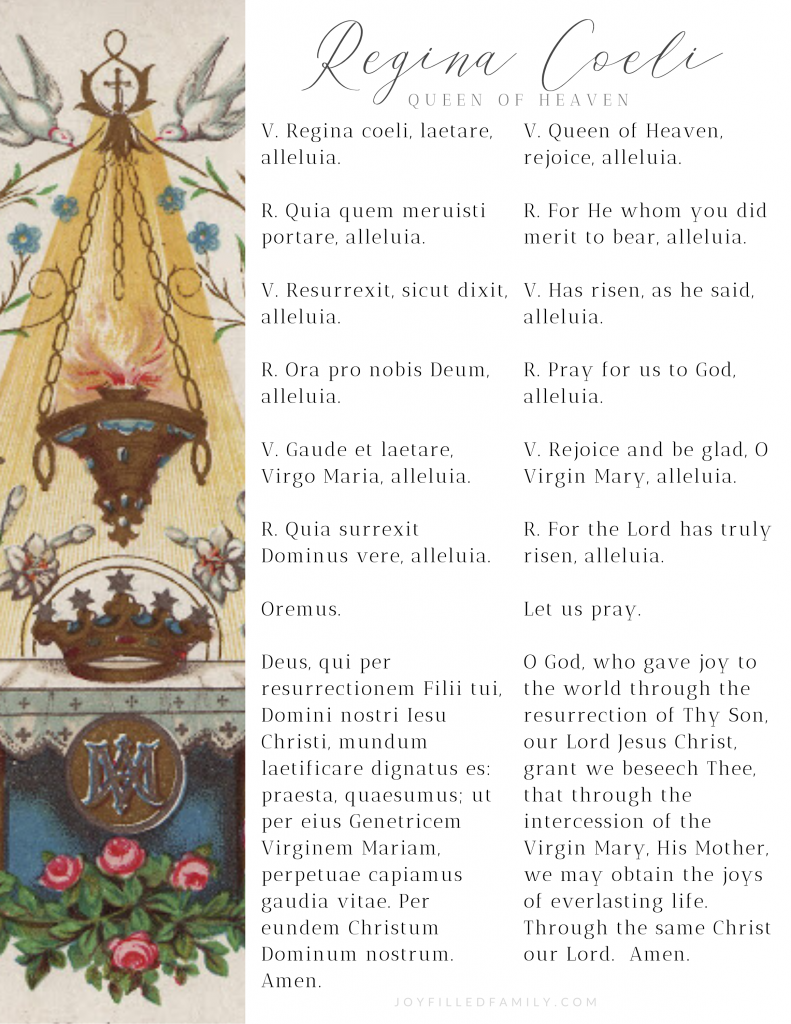
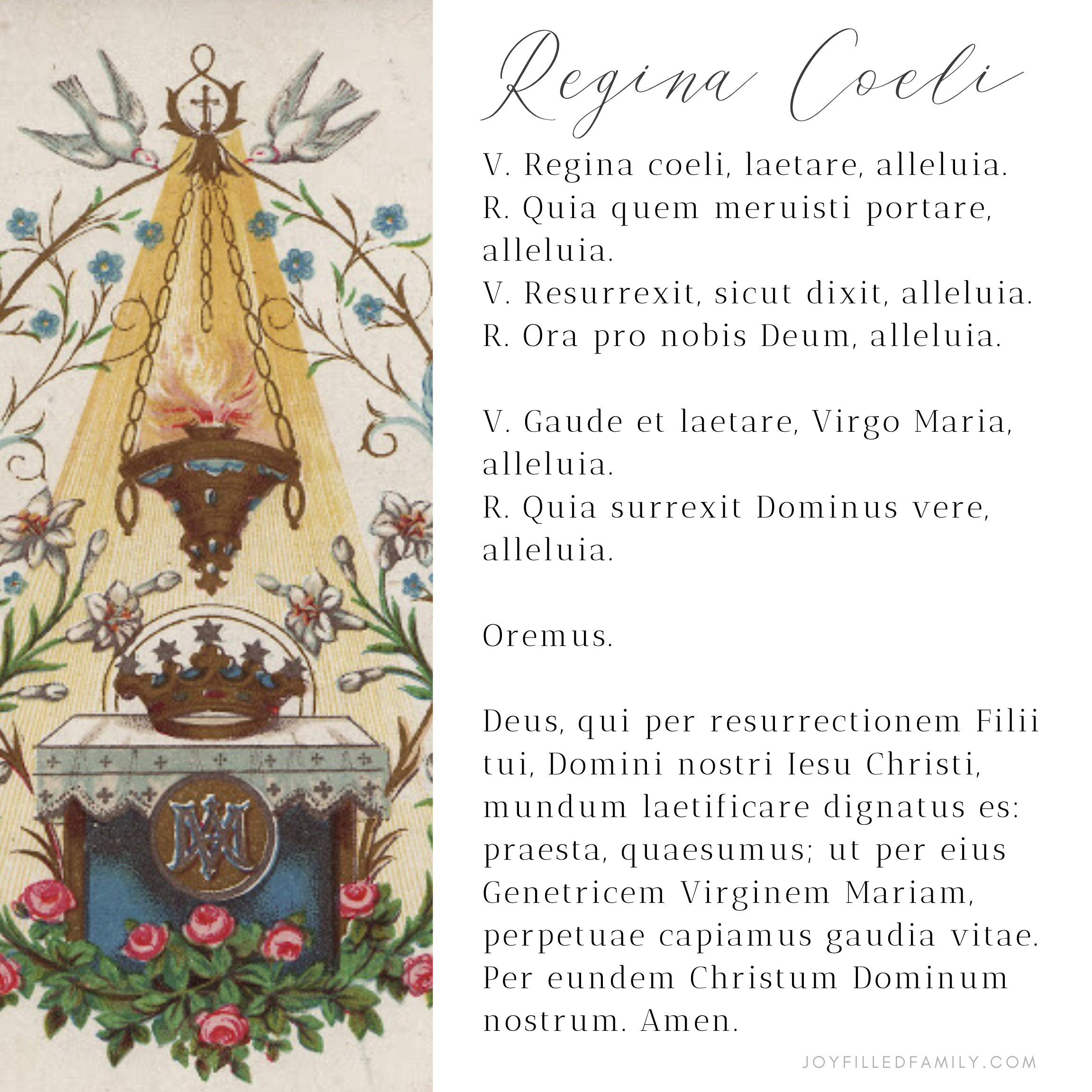
Regina Coeli

V. Regina coeli, laetare, alleluia.

R. Quia quem meruisti portare, alleluia.

V. Resurrexit, sicut dixit, alleluia.

R. Ora pro nobis Deum, alleluia.

V. Gaude et laetare, Virgo Maria, alleluia.

R. Quia surrexit Dominus vere, alleluia.

Oremus.

Deus, qui per resurrectionem Filii tui, Domini nostri Iesu Christi, mundum laetificare dignatus es: praesta, quaesumus; ut per eius Genetricem Virginem Mariam, perpetuae capiamus gaudia vitae. Per eundem Christum Dominum nostrum. Amen.


Queen of Heaven

V. Queen of Heaven, rejoice, alleluia.

R. For He whom you did merit to bear, alleluia.

V. Has risen, as he said, alleluia.

R. Pray for us to God, alleluia.

V. Rejoice and be glad, O Virgin Mary, alleluia.

R. For the Lord has truly risen, alleluia.

Let us pray.

O God, who gave joy to the world through the resurrection of Thy Son, our Lord Jesus Christ, grant we beseech Thee, that through the intercession of the Virgin Mary, His Mother, we may obtain the joys of everlasting life. Through the same Christ our Lord. Amen.


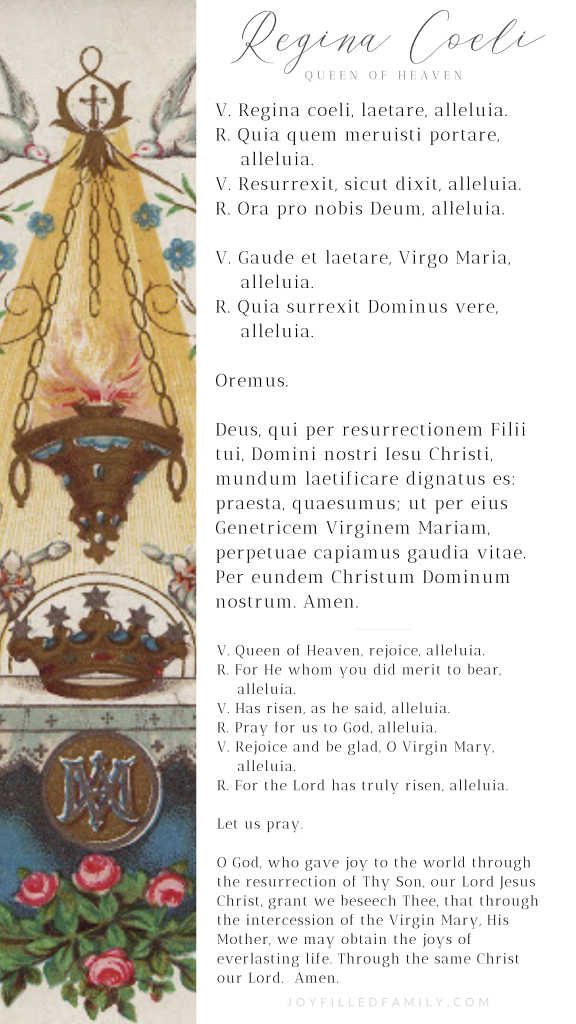
Below are images and a PDF that can be download for your personal use.

Click image to download PDF for print.

For use as wallpaper on your phone.

Below is an abbreviated explanation about this Marian hymn from The Catholic Encyclopedia.
 
The opening words of the Eastertide anthem of the Blessed Virgin, the recitation of which is prescribed in the Roman Breviary from Compline of Holy Saturday until None of the Saturday after Pentecost inclusively. In choro, the anthem is to be sung standing. 
 
The authorship of the Regina Coeli being unknown, legend says the St. Gregory the Great (d. 604) heard the first three lines chanted by angels on a certain Easter morning in Rome while he walked barefoot in a great religious procession and that the saint thereupon added the fourth line: “Ora pro nobis Deum. Alleluia.” The authorship has also been ascribed to Gregory V, but without good reason. The beautiful plainsong melodies (a simple and an ornate form) are variously given in the Ratisbon antiphonary and in the Solesmes Liber Usualis of 1908, the ornate form in the latter work, with rhythmical signs added, being very attractive. The official or “typical” melody will be found (p. 126) in the Vatican Antiphonary (1911). Only one form of melody is given. The different syllabic lengths of the lines make the anthem difficult to translate with fidelity into English verse. The anthem has often been treated musically by both polyphonic and modern composers.
 
Here are some suggested links of musical variations available on YouTube:
  • Gregorian chant: simple tone
  • Giovanni Antonio Rigatti (1613-1648); Motetti a voce sola
  • Wolfgang Amadeus Mozart (1756-1791); K. 276
  • Gregorian chant: solemn tone
  • Marc-Antoine Charpentier (1643-1704); H.32
  • Michel Richard de Lalande (1647-1726); S53
  • Wolfgang Amadeus Mozart; KV 108

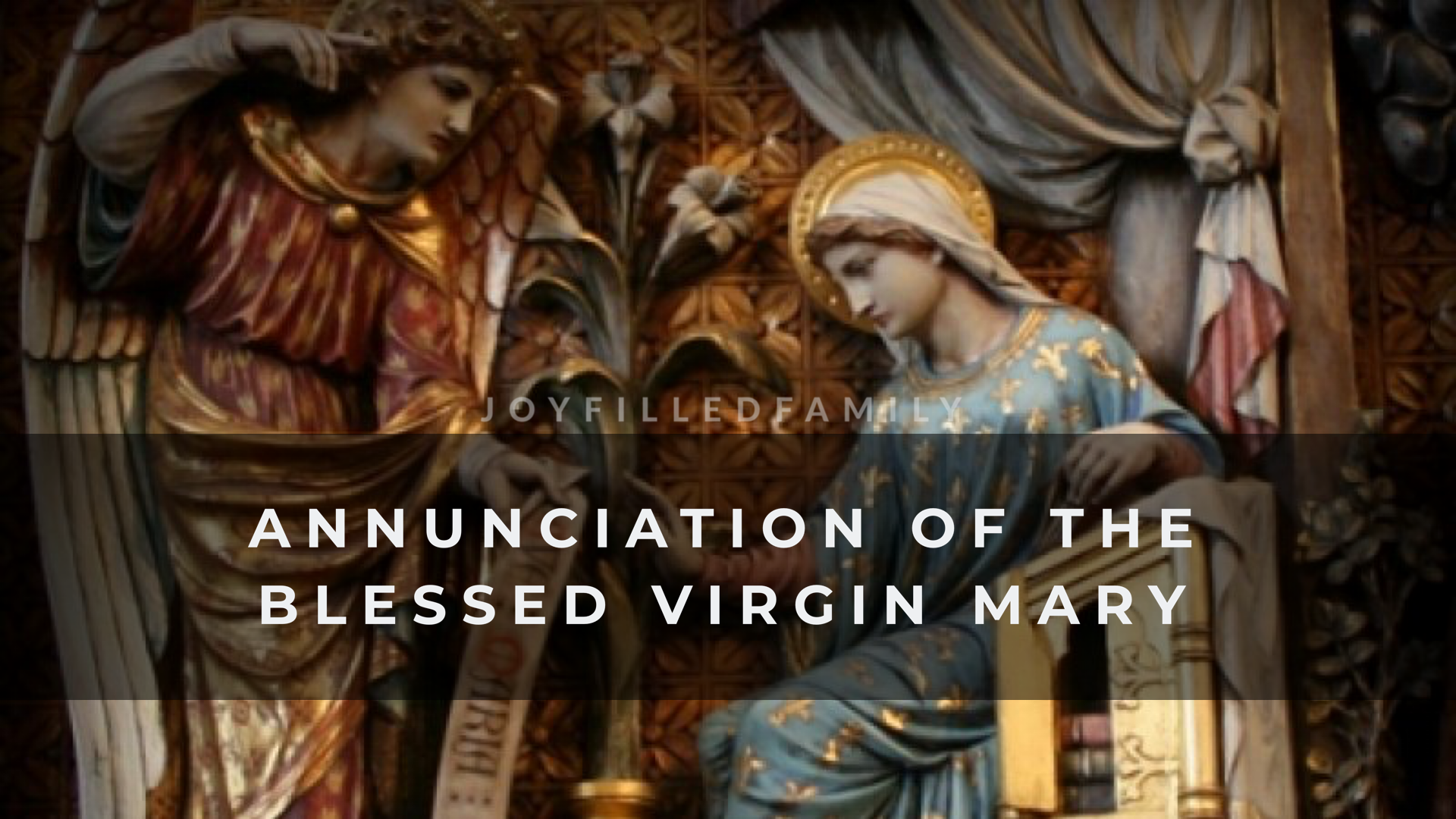
Annunciation of the Blessed Virgin Mary – Lessons

March 25, 2020 by Lena {JOYfilledfamily} Filed Under: 03 March Saints, Annunciation Leave a Comment

Lessons from The Church’s Year of Fr. Leonard Goffine.

Instruction on the festival of the Annunciation of the Blessed Virgin Mary

The Church on this day celebrates the commemoration of the day, ever memorable in the Book of Life, upon which the holy, angelically pure Virgin Mary received the glorious announcement that she was chosen to be the Mother of the Redeemer.

The Church in the INTROIT exclaims: All the rich among the people shall entreat thy countenance: after her shall virgins be brought to the King: her neighbors shall be brought to thee in gladness and rejoicing. (Ps. 44) My heart hath uttered a good word: I speak my works to the King. Glory be to the Father, etc.

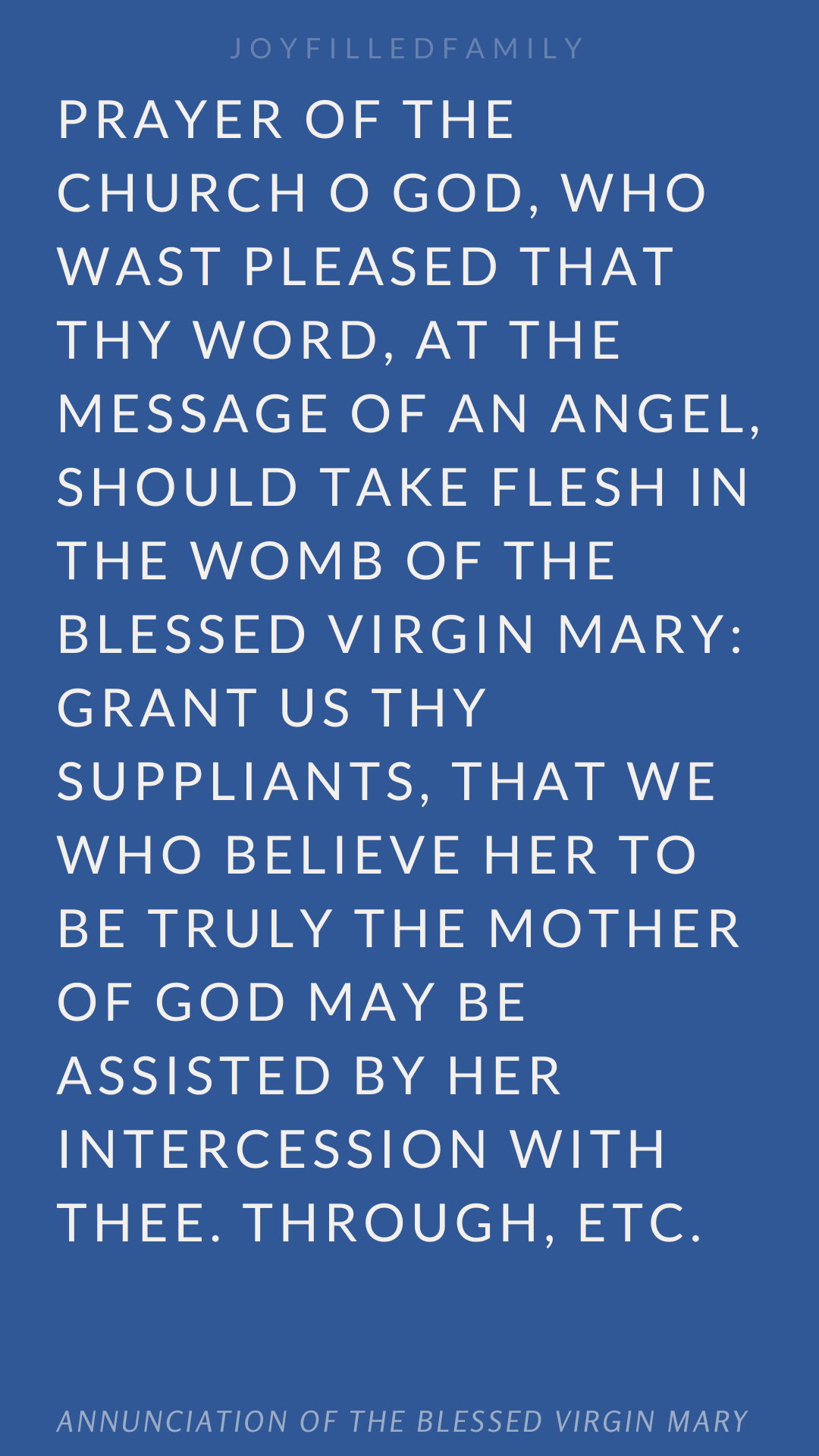
PRAYER OF THE CHURCH O God, who wast pleased that Thy Word, at the message of an angel, should take flesh in the womb of the blessed Virgin Mary: grant us Thy suppliants, that we who believe her to be truly the Mother of God may be assisted by her intercession with Thee. Through, etc.

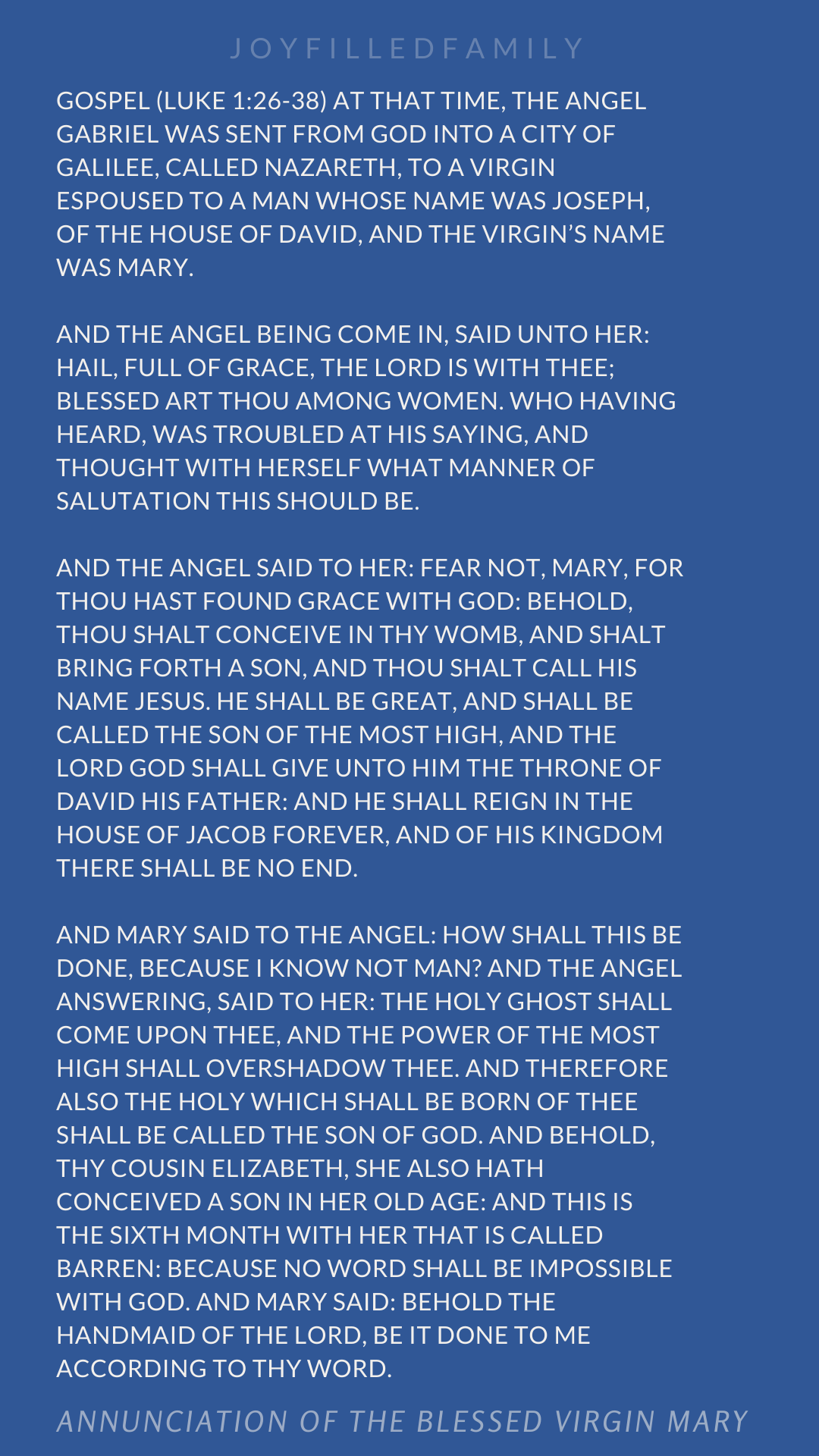
GOSPEL (Luke 1:26-38) At that time, the Angel Gabriel was sent from God into a city of Galilee, called Nazareth, to a virgin espoused to a man whose name was Joseph, of the house of David, and the virgin’s name was Mary.

And the Angel being come in, said unto her: Hail, full of grace, the Lord is with thee; blessed art thou among women. Who having heard, was troubled at his saying, and thought with herself what manner of salutation this should be.

And the Angel said to her: Fear not, Mary, for thou hast found grace with God: Behold, thou shalt conceive in thy womb, and shalt bring forth a son, and thou shalt call his name Jesus. He shall be great, and shall be called the Son of the Most High, and the Lord God shall give unto him the throne of David his father: and he shall reign in the house of Jacob forever, and of his kingdom there shall be no end.

And Mary said to the Angel: How shall this be done, because I know not man? And the Angel answering, said to her: The Holy Ghost shall come upon thee, and the power of the Most High shall overshadow thee. And therefore also the Holy which shall be born of thee shall be called the Son of God. And behold, thy cousin Elizabeth, she also hath conceived a son in her old age: and this is the sixth month with her that is called barren: because no word shall be impossible with God. And Mary said: Behold the handmaid of the Lord, be it done to me according to thy word.

Why does the Evangelist so minutely detail the announcement of the Incarnation?

That we may clearly impress upon our mind, believe in, and meditate upon the mystery of the Incarnation, upon which depends our eternal salvation.

Why was an angel sent to Mary?

To announce to her that it was God’s will that His divine Son, in order to redeem the human race by His sufferings and death, should take human nature from her, and because the human race, redeemed by Christ, was to occupy the place made vacant by the fallen angels.

Was the Incarnation necessary for our redemption?

Yes; for as God, Christ could not suffer; without an infinitely meritorious suffering a sufficient satisfaction could not have been rendered to God, had not the Son of God humiliated Himself before His heavenly Father, and suffered: this could only be effected by the Incarnation. This shows the enormity of sin, for which no man however pure, no, not even an angel, but only a God-Man could atone.

Why did God require Mary’s consent for the Incarnation of His Son?

To show us that God forces no one to good, much less to evil; that we might learn that our good intention and free assent are necessary even to good works, if we wish them to be meritorious. Venerable Bede says: that because of her consent God imparted to Mary all, even the greatest graces, greater than all creatures, angels as well as men, ever merited.

Why was Mary troubled at the angel’s message?

On account of her humility and modesty. She was so humble that she regarded herself as the least of all creatures, and could not comprehend how such an honor could be hers. She was so modest, and loved virginal purity so much that the presence of the angel and his message troubled her. From this all maidens should see that their loveliest adornments and most necessary virtues are modesty, humility and love of purity, which Mary so valued that she would not lose them even to become the Mother of God.

What is meant by the throne of David?

The kingdom of Christ, of which David’s government was a representation. (Ps. 131)

Why is David called the father of Christ?

Because Mary descended from the house of David, and, therefore, David according to nature was the forefather of Christ.

Who was the real father of Christ?

To answer this properly, we must observe that in Christ there are two natures, the divine and the human. According to His human nature He had indeed a mother, but no father, for Joseph was only His foster-father; according to His divine nature He had no mother, but only a father, the Heavenly Father.

How, then, was Christ conceived?

By the overshadowing and power of the Holy Ghost, who by His divine omnipotence effected the conception of Him whom Mary was to bring forth.

How should we be encouraged by the words: No word shall be impossible with God?

We should be encouraged to a great confidence in God, who can readily assist us in the most difficult circumstances, even when help seems impossible, and He will aid us, if it is beneficial, and if we ask Him. These words, moreover, admonish us to a firm faith which cannot be shaken by the most incomprehensible mystery in matters of faith.

Why does Mary call herself the handmaid of the Lord?

From humility, which next to her maidenly modesty was her most remarkable virtue, which causes St. Bernard to say: “By her purity she pleased God, and by her humility she conceived Him.”

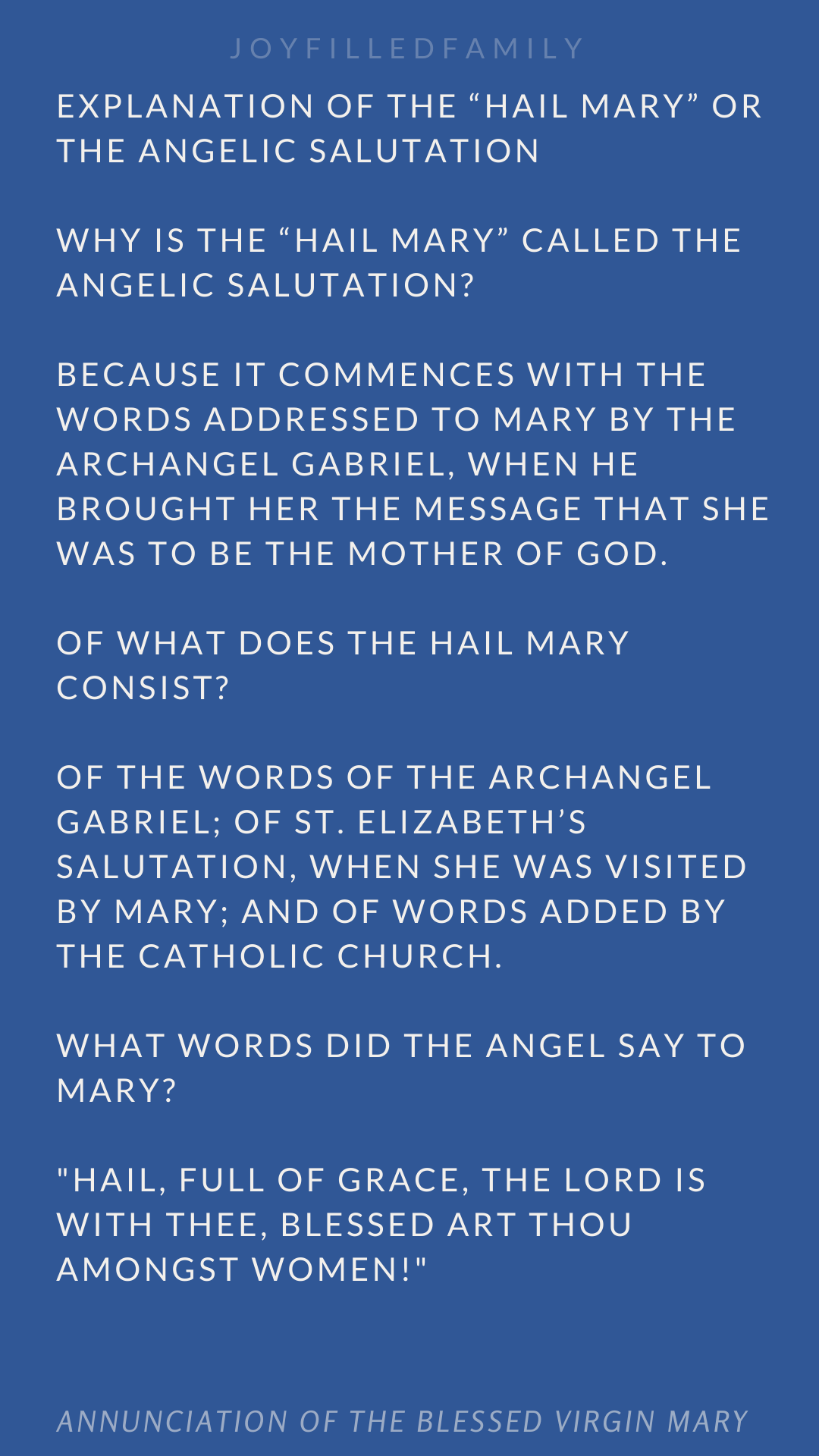
Explanation of the “Hail Mary” or the Angelic Salutation

Why is the “Hail Mary” called the Angelic Salutation?

Because it commences with the words addressed to Mary by the Archangel Gabriel, when he brought her the message that she was to be the Mother of God.

Of what does the Hail Mary consist?

Of the words of the Archangel Gabriel; of St. Elizabeth’s salutation, when she was visited by Mary; and of words added by the Catholic Church.

What words did the angel say to Mary?

“Hail, full of grace, the Lord is with thee, blessed art thou amongst women!”

What is meant by these words?

The word “Hail”, that is, “Salutation to thee!” “Peace with thee!” or, “Joy to thee!” expresses the reverence which the angel had for the Blessed Virgin, and which we should also cherish. The words: full of grace remind us that God bestowed more graces upon the Blessed “Virgin than upon all men and angels together.” We should for this reason always pray with confidence to her to obtain for us, by her powerful intercession, those graces which are most necessary for our salvation. By the words: the Lord is with thee, the angel intended to express, that the Lord was with this maiden not only in His reality, presence, and omnipotence as with all men, not only in His grace as with the just, but with the greatest and most extraordinary grace, love and familiarity.

St. Augustine observes: “The angel wished to say: The Lord is with thee more than with me; the Lord is with thee, so that He may be in thy heart, in thy body, may fill thy spirit, may fill thy flesh.” “Could God raise her higher!” St. Bernard here exclaims:

Ah, that the Lord might be with us also, and Mary by her intercession obtain graces for us! Finally, the words: Blessed art thou amongst women, mean: thou art the happiest of women, for thou of all thy sex art chosen to be the Mother of God, at the same time Mother and Maid.” 

How much is contained in the salutation which one of the highest spirits surrounding the throne of God, addressed to Mary, and how much it behooves us to love and daily salute Mary, our most tender Mother!

What were the words used by St. Elizabeth, and what is their signification?

Elizabeth repeated the words of the angel: Blessed art thou amongst women, adding “and blessed is the fruit of thy womb” which signified that Jesus should be glorified, because through Him God would bestow all spiritual and heavenly blessings upon us.

Which are the words added by the Church?

They are: “Jesus”, who is the fruit of her womb, by which she wishes us to offer this prayer to God in the name of Christ; and then she adds the invocation to Mary: “Holy Mary, Mother of God, pray for us sinners, now and at the hour of our death. Amen.”

What do these words mean?

When we say Holy Mary, we mean to express that Mary is God’s holy and wonderful work, Daughter of the Heavenly Father, Mother of the Son, and Bride of the Holy Ghost, and has all her sanctity, beauty, and that great veneration from the fruit of her womb, Jesus Christ. The glorious title of Mother of God is given her, because Mary bore not an ordinary man, but Jesus Christ who is both God and Man. Therefore from her was born the Son of God, the incarnate God, not a man who appeared like God, but God in flesh. She is, then, really and truly the Mother of God, our Lord’s Mother.

The Fathers who had assembled in the holy Council of Chalcedon, to refute Nestorius, who sought to deprive Mary of the title of Mother of God, called her “Holy Mary, Mother of God.” Of herself Mary is not holy, and cannot of herself help us, therefore we say: pray for us, by which we ask for her powerful intercession; and conscious of our poverty and sinfulness, call ourselves poor sinners, who turn to Mary, the Mother of mercy, because we feel ourselves too unworthy to pray to Christ Himself, and, therefore, entreat this loving mother to obtain for us amendment of life, remission of sin, consolation in affliction, remedy in sickness, assistance in need, increase of grace, preservation, perseverance, and the crown; and may Mary pray for us now and at the hour of our death.

Now, that is, while the divine mercy is given us, and especially in the hour of death, when the weapons for battle against the enemy fall from our hands, and the evil one tempts us the more violently, because he knows that his time is short, (Apoc. 12:12) in that hour on which depends our eternal welfare or grief. By the word Amen we affirm that we remain true venerators of the Virgin Mother of God, and at all times expect grace from God through her intercession. “Yes,” says St. Bernard, “let us venerate Mary as sincerely, heartily, and confidently as we can, for such is His will who desired that we should have all (salvation and redemption in Christ) through Mary.” The Son will assuredly hear the Mother, and the Father the Son. Let us, then, strive to rise by her to Him who by her came down to us!

Through thee, who hast found grace with God, Mother of life! Mother of salvation! we have access to the Son, who accepts us from thee, who was given us by thee—to Jesus Christ, eternally blessed.

On the “Angelus Domini,” the Angel of the Lord

Who introduced the angelic salutation into the Catholic Church?

Pope Urban II, who at the Council of Clermont, France, in 1095, ordered that the bells be rung every day in the morning, at noon, and in the evening, and that at each time the angelic salutation be repeated. His special intention was to obtain Mary’s protection for the Crusades of the 11th century, which had for their object the rescuing of the Holy Sepulcher from the hands of the infidels.

These wars are now ended, but the life of the whole Church, of every Christian, is a crusade against sin and temptation. We always need Mary’s protection; and, therefore, the custom of repeating the salutation is still retained in the Church. Formerly at the ringing of the Angelus, all the faithful fell on their knees, and even now pious Catholics do the same. St. Charles Borromeo, an archbishop, did not hesitate to kneel in the open street and repeat the angelic salutation.

Of what does the “Angelus Domini” consist?

It consists of three Hail Marys:

before the first is said: “The angel of the Lord declared unto Mary, and she conceived of the Holy Ghost”;

before the second: “Behold the handmaid of the Lord; be it done unto me according to thy word”;

before the third: “and the word was made flesh and dwelt amongst us.”

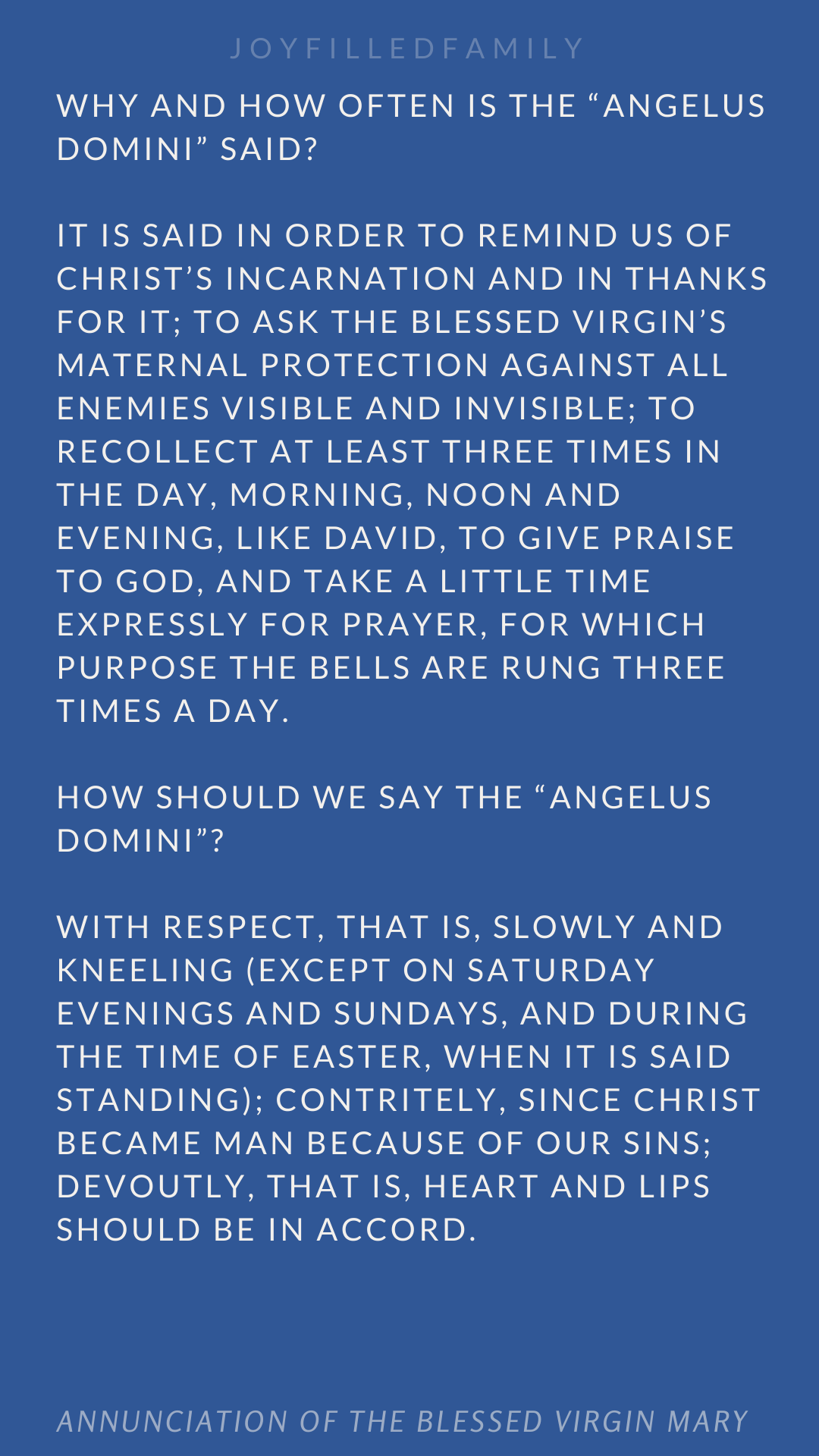
Why and how often is the “Angelus Domini” said?

It is said in order to remind us of Christ’s Incarnation and in thanks for it; to ask the Blessed Virgin’s maternal protection against all enemies visible and invisible; to recollect at least three times in the day, morning, noon and evening, like David, to give praise to God, and take a little time expressly for prayer, for which purpose the bells are rung three times a day.

How should we say the “Angelus Domini”?

With respect, that is, slowly and kneeling (except on Saturday evenings and Sundays, and during the time of Easter, when it is said standing); contritely, since Christ became man because of our sins; devoutly, that is, heart and lips should be in accord.

Salutation to Mary

Hail Mary, full of grace! I rejoice and congratulate thee, because thou wert chosen to be the Mother of the Most High and Queen of heaven and earth. With thee is the Father who from all eternity begot Him whom thou didst bear; with thee is the Son whom thou didst carry in thy virginal womb; with thee is the Holy Ghost, overshadowed by whose power thou didst become the Mother of God. Thou art blessed amongst women, thou art the joy of heaven and the ornament of the Church of God, pray for us now and at the hour of our death. Amen.

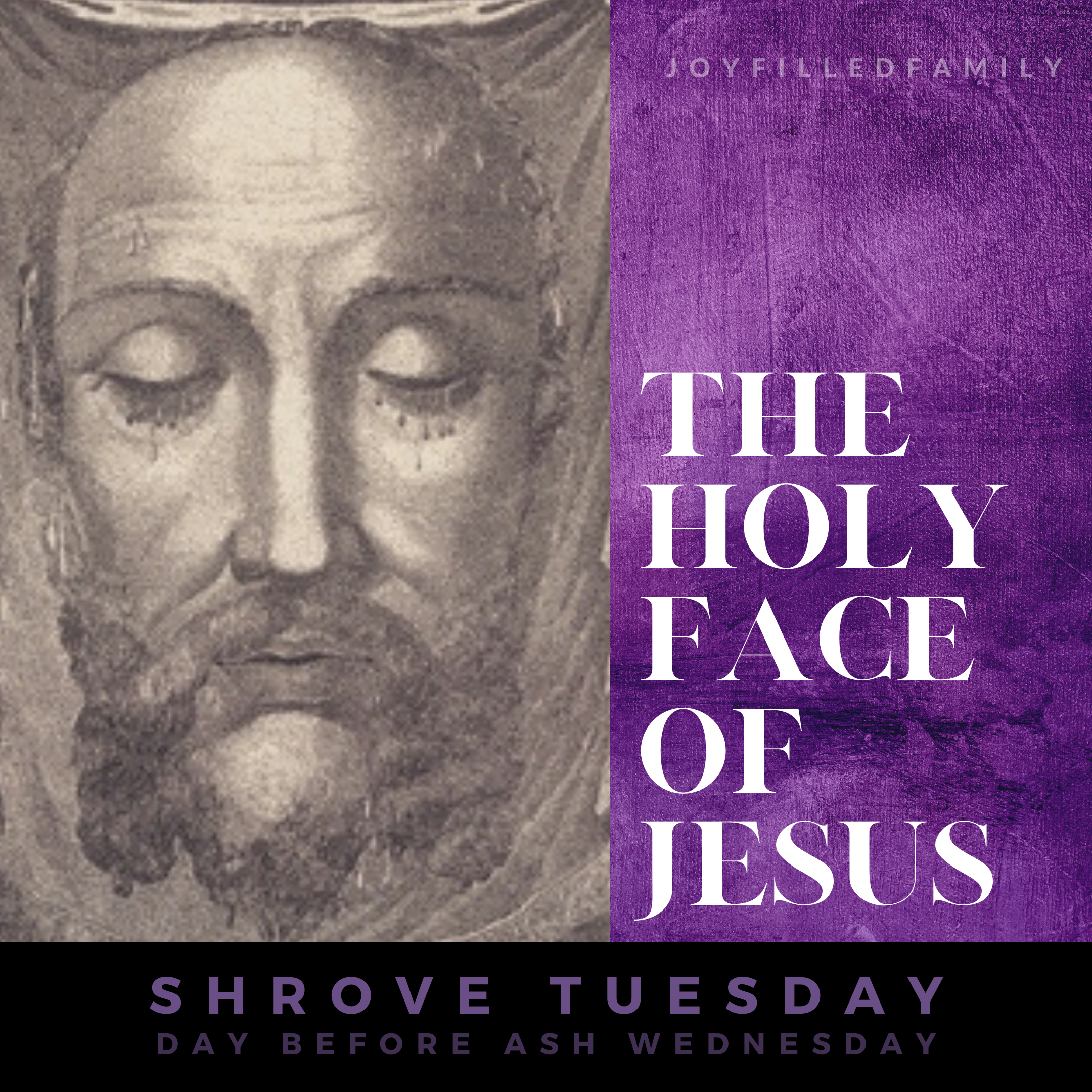
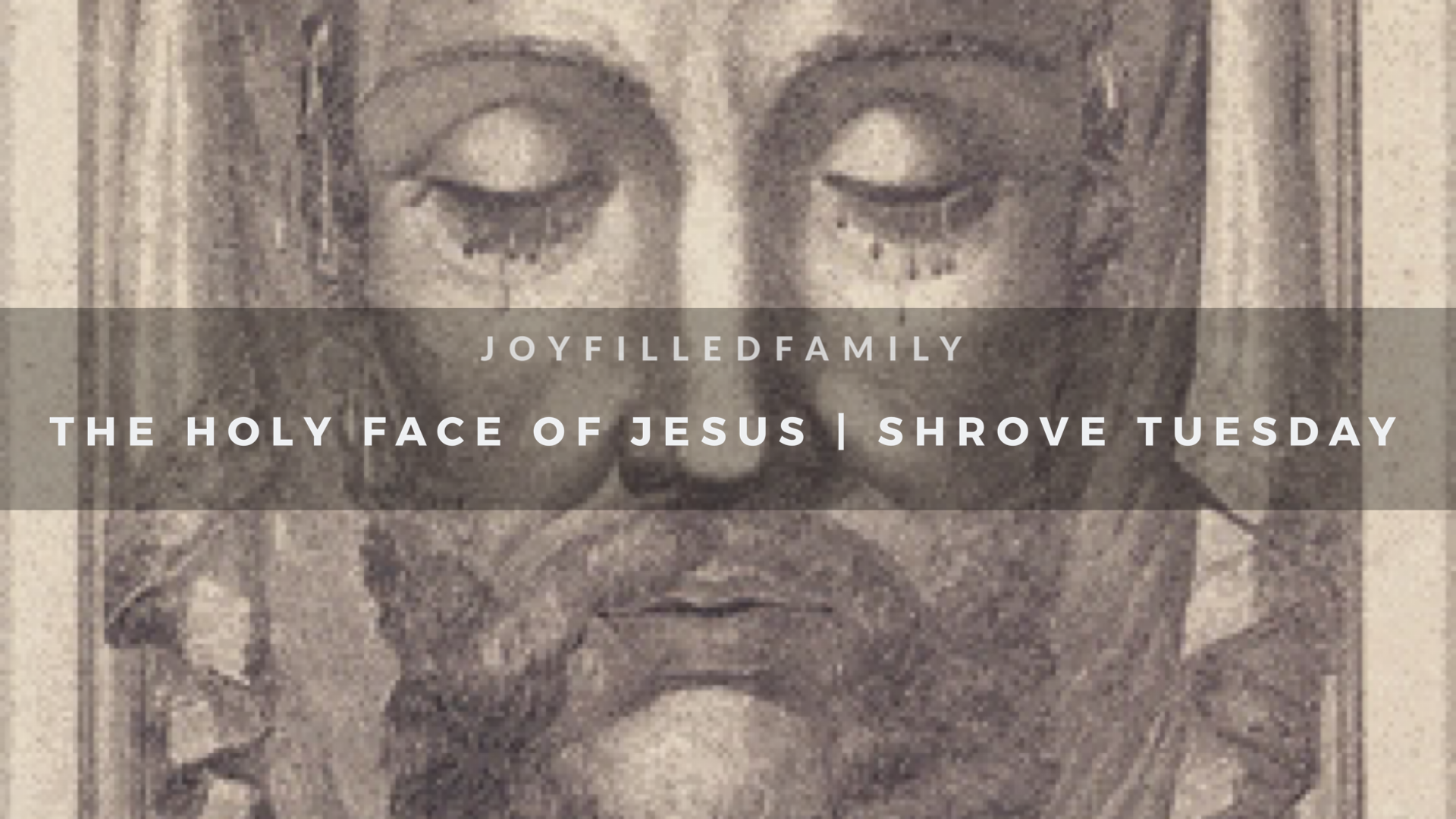
The Holy Face of Jesus

February 25, 2020 by Lena {JOYfilledfamily} Filed Under: Holy Face of Jesus, Shrove Tuesday Leave a Comment

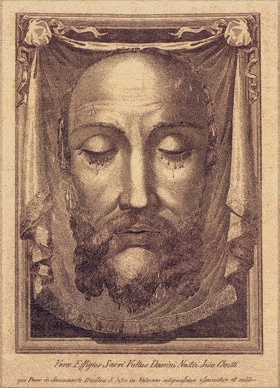
The Holy Face feast was established throughout the universal Church in 1958 by Pope Pius XII to be observed on the Tuesday (historically known as Shrove Tuesday) before Ash Wednesday. It is a beautiful and precious opportunity to make reparation for the outrages that the Holy Face of Jesus received during His Passion, and which He continues to receive daily in the Sacrament of the Holy Eucharist.

I firmly wish that My Face reflecting the intimate pains of My Soul, the suffering and love of My Heart, be more honored! Whoever gazes upon Me already consoles Me…

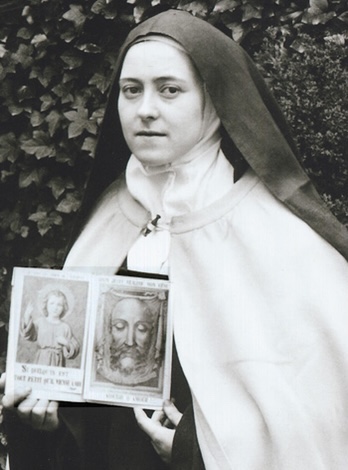
Devotion to the Holy Face of Christ is of ancient origin, reaching back to the fourth century and before. From the 12th century on, the devotion began to revolve around the Veil of Veronica, held to be the cloth Veronica gave to Our Lord to wipe His face during the carrying of the Cross.  Popularity of the devotion grew enormously with St. Therese of the Child Jesus making known her devotion to the Holy Face, with an Archconfraternity of the Holy Face formed in Tours, France, in 1884.  A pious nun, Sr. Pierina, was deeply devoted to the Holy Face as a way to console Our Lord, to make reparation for the conversion of sinners, and make reparation for the negligence and contempt shown for the Blessed Sacrament.  She was miraculously able to obtain permission to cast a medal of the Holy Face, and its use was widespread amongst Italian soldiers in WWII.

Prayer of St. Therese of Lisieux to the Holy Face of Jesus

O Jesus, Who in Thy bitter Passion didst become “the most abject of men, a man of sorrows,” I venerate Thy Sacred Face whereon there once did shine the beauty and sweetness of the Godhead; but now it has become for me as if it were the face of a leper! Nevertheless, under those disfigured features, I recognize Thy infinite Love and I am consumed with with the desire to love Thee and make Thee loved by all men. The tears which well abundantly in Thy sacred eyes appear to me as so many precious pearls that I love to gather up, in order to purchase the souls of poor sinners by means of their infinite value. O Jesus, Whose adorable Face ravishes my heart, I implore Thee to fix deep within me Thy Divine Image and to set me on fire with Thy Love, that I may be found worthy to come to the contemplation of Thy glorious Face in Heaven. Amen.

St. Therese had a special devotion to the Holy Face of Jesus, and always had its picture near her.

ACT OF CONSECRATION

Lord Jesus, we believe most firmly in Thee, we love Thee. Thou art the Eternal Son of God and the Son Incarnate of the Blessed Virgin Mary. Thou art the Lord and Absolute ruler of all creation. We acknowledge Thee, therefor-e, as Uni- versal Sovereign of all creatures. Thou art the Lord and Supreme Ruler of all mankind, and we, in acknowledging this Thy domin- ion, consecrate ourselves to Thee now and forever. Loving Jesus, we place our family under the protection of Thy Holy Face, and of Thy Virgin Mother, Mary Most Sorrowful. We promise to be faithful to Thee for the rest of our lives and to observe with fi- delity Thy holy Commandments. We will never deny before men Thee and Thy Divine rights over us and all mankind. Grant us the grace to never sin again; nevertheless, should we fail, O Divine Savior, have mercy on us and restore us to Thy grace. Radiate Thy Divine Countenance upon us and bless us now and forever. Embrace us at the hour of death in Thy kingdom for all eternity, through the intercession of Thy Blessed Mother, of all Thy Saints who behold Thee in Heaven, and the just who glorify Thee on earth. O Jesus, be mindful of us forever and never forsake us; protect our family. O Mother of Sorrows, by the eternal glory which Thou enjoyest in Heav- en, through the merits of Thy bitter anguish in the Sacred Passion of Thy Beloved Son, our Lord Jesus Christ, obtain for us the grace that the Precious Blood shed by Jesus for the re- demption of our souls, be not shed for us in vain. We love thee, O Mary. Embrace us and bless us, O Mother. Protect us in life and in death. Amen.

Glory be to the Father and to the Son and to the Holy Ghost. As it was in the beginning, is now and ever shall be world without end. Amen.

According to the care you take in making Reparation to My Face, disfigured by blasphemies, so will I care for yours, which has been disfigured by sin. I will reprint on it My Image and render it as beautiful as it was on leaving the baptismal font.” (November 3, 1845) –Promises of Our Lord to Sister Marie de Saint-Pierre 

Instruction on Quinquagesima Sunday

February 23, 2020 by Lena {JOYfilledfamily} Filed Under: Lent, Pre-Lent, Quinquagesima Sunday, Septuagesima Sunday Leave a Comment

This is the  last preparatory Sunday before the start of Lent (on Ash Wednesday).  

Fr. Goffine provides as with an important spiritual lesson on the Quinquagesima Sunday propers. Her also gives an instruction about the Lenten Season in preparation for the great feast of our redemption, Easter.

The Introit of this day’s Mass is the sigh of an afflicted soul confiding in God:

INTROIT Be thou unto me a God, a protector, and a place of refuge, to save me: for thou art my strength and my refuge: and for thy name’s sake thou wilt be my leader, and wilt nourish me. (Ps. 30:3, 4) In thee, O Lord, I have hoped, let me never be confounded: deliver me in thy justice, and set me free. (Ps. 30:2)

COLLECT O Lord, we beseech Thee, graciously hear our prayers, and unloosing the bonds of our sins, guard us from all adversity. Through our Lord, etc.

EPISTLE (I Cor. 13:1-13) Brethren, if I speak with the tongues of men and of angels, and have not charity, I am become as sounding brass or a tinkling cymbal. And if I should have prophecy, and know all mysteries and all knowledge, and if I should have all faith, so that I could remove mountains, and have not charity, I am nothing. And if I should distribute all my goods to feed the poor, and if I should deliver my body to be burned, and have not charity, it profiteth me nothing.

Charity is patient, is kind: charity envieth not; dealeth not perversely; is not puffed up; is not ambitious; seeketh not her own; is not provoked to anger; thinketh no evil; rejoiceth not in iniquity, but rejoiceth in the truth; beareth all things, believeth all things, hopeth all things, endureth all things. Charity never falleth away: whether prophecies shall be made void, or tongues shall cease, or knowledge shall be destroyed. For we know in part, and we prophesy in part: but when that which is perfect is come, that which is in part shall be done away.

When I was a child, I spoke as a child, I understood as a child, I thought as a child: but when I became a man, I put away the things of a child. We see now through a glass in a dark manner; but then face to face. Now I know in part; but then I shall know even as I am known. And now there remain faith, hope, charity, these three: but the greatest of these is charity.

EXPLANATION In this epistle St. Paul speaks of the necessity, the excellence and the nature of true charity. He says that all natural and supernatural gifts, all good works, even martyrdom, cannot save us if we have not charity; because love alone can render our works pleasing to God. Without charity, therefore, though ever so many prayers be recited, fasts observed, and good deeds performed, nothing will be acceptable to God, or merit eternal life. Strive then, O Christian soul, to lead a pious life in love, and to remain always in the state of grace.

Can faith alone, as the so-called Reformers assert, render man just and save him?

Faith alone, however strong, though it could move mountains, without love, that is, without good works performed for love of God and our neighbor, can never justify or save us. For, when St. Paul says, that man is justified by faith without works, (Rom. 3:28; 11:6; Eph. 2:8, 9) he means to refer to those works which were performed by command of the law of Moses, and which, as they were external and without true charity, were of no avail; he did not refer to those works which are performed in a state of grace with a lively, love-inspired faith.

Therefore the same Apostle writes to the Galatians: (Gal. 5:6) Faith only availeth which worketh by charity; to Titus: (Tit. 3:8) It is a faithful saying: and these things I will have thee affirm constantly: that they who believe in God, may be careful to excel in good works. These things are good and profitable unto men; and he exhorts the Colossians (Colos. 1:10) to be fruitful in every good work.

St. James confirms the same by saying: (James 2:17-24) So faith if it have not works, is dead in itself; by works man is justified and not by faith only. That this is the true doctrine of Christ is evident from His own words, when He says: “Every tree that bringeth not forth good fruit, shall be cut down and shall be cast into the fire.” (Matt. 7:19) At the day of judgment Christ will demand good works from all men, (Matt. 25:35) and will not judge them only according to their faith, but by their good works, which true faith must always produce. (Apoc. 20:12)

Would Christ and His apostles demand good works, if faith alone be sufficient? “The devil’s also believe and tremble,” (James 2:19) they believe, but they are not saved, and their faith but increases their torments. Therefore, the assertion that faith without good works is sufficient for justification and salvation, is plainly against the doctrine of Christ and His Church, and must of necessity lead man to vice and misery, as shown by the history of the unhappy separation of the sixteenth century.

Are good works available when performed in the state of mortal sin?

Good works performed while in a state of mortal sin avail nothing in regard to eternal life, writes St. Lawrence Justinian, but aid in moderating the punishment imposed for disobedience and the transgression of God’s commandments. They bring temporal goods, such as honor, long life, health, earthly happiness, etc.; they prevent us from falling deeper into sin, and prepare the heart for the reception of grace; so the pious person writes: “Do as much good as you can, even though in the state of mortal sin, that God may give light to your heart.”

ASPIRATION O God of love, pour the spirit of true charity into my heart that, according to the spirit of St. Paul, I may endeavor to be always in a state of grace; that all my works may be pleasing to Thee, and meritorious for me.

GOSPEL (Luke 18:31-43) At that time, Jesus took unto him the twelve, and said to them Behold, we go up to Jerusalem, and all things shall be accomplished which were written by the prophets concerning the Son of Man. For he shall be delivered to the Gentiles, and shall be mocked, and scourged, and spit upon; and after they have scourged him, they will put him to death; and the third day he shall rise again. And they understood none of these things, and this word was hid from them, and they understood not the things that were said.

Now it came to pass, when he drew nigh to Jericho, that a certain blind man sat by the wayside, begging. And when he heard the multitude passing by, he asked what this meant. And they told him that Jesus of Nazareth was passing by. And he cried out, saying: Jesus, Son of David, have mercy on me. And they that went before rebuked him, that he should hold his peace. But he cried out much more: Son of David, have mercy on me. And Jesus standing, commanded him to be brought unto him. And when he was come near, he asked him, saying: What wilt thou that I do to thee? But he said: Lord, that I may see. And Jesus said to him: Receive thy sight; thy faith hath made thee whole. And immediately he saw, and followed him, glorifying God: and all the people, when they saw it, gave praise to God.

Why did Christ so often foretell His passion to His disciples?

Because He wanted to show how great was His desire to suffer for us, for we speak often of that which we crave; and because He wished His disciples when they should see Him treated as a criminal and martyred, not to think evil of Him, or imagine themselves deceived, but remember that He had foretold all minutely that all happened of His own will.

Did not the disciples understand anything of what He predicted in regard to His future sufferings?

They may, certainly, have well understood He was to suffer, for which reason Peter tried to dissuade Him from it; (Matt. 16:22) but they did not comprehend why or for what He would suffer, or how He would rise again. All this the Holy Ghost gave them to understand, after it had come to pass. (John 14:26) The light of the Holy Ghost is of so much value, that without it even the clearest doctrines of faith are not understood.

Why does Christ so often call Himself the Son of Man?

He wished to show, in the Jewish way of speaking, He was also man, a descendant of Adam, and that we should be humble, and not seek or desire high titles.

Why did the blind man call Christ the Son of David?

Because, like all the Jews, he believed that the Messiah, according to humanity, would be of the house of David, as was promised. (Ps. 131:11)

Why did Christ ask the blind man: What wilt thou that I do to thee?

This He asked, not because He was unaware of the blind man’s wish, but to enable him the better to prove his faith and hope that through Christ he would receive his sight; and to teach us how willing He is to help us, and how it pleases Him if we confidingly place our wants before Him. We should learn from this blind man, who would not be restrained by the passing crowd in his ardent and reiterated request, not to pay attention, in the work we have commenced, to human respect, or human judgment, but to persevere, and not allow ourselves to be led astray by the world’s mockery or contempt. We should also learn to be grateful to God, and faithfully cling to Him, if He has once opened the eyes of our mind, and healed our spiritual blindness, which is far more deplorable than physical blindness, for nothing can be more miserable than not to see and understand God, not to know what is necessary for our salvation, and what is pernicious.

Why is this gospel read on this Sunday?

The Church wishes to remind us of the painful passion and death of Jesus, and to move us by the contemplation of those mysteries to avoid and despise the wicked, heathenish amusements of carnival, sinful pleasures which she has always condemned, because they come from dark paganism, and, to avert the people from them, commands that during the three days of carnival the Blessed Sacrament shall be exposed for public adoration, sermons given, and the faithful exhorted to have recourse at this time to the Sacraments of Penance and the Blessed Sacrament of the Altar, with the reception of which Pope Clement XIII. (Breve, June 23, 1765) connected a plenary indulgence. A true Catholic will conform to the desire of his holy Church, considering the words which St. Augustine spoke, at this time, to the faithful:

The heathens (as also the worldly people of our days) shout songs of love and merriment, but you should delight in the preaching of the word of God; they rush to the dramatic plays, but you should hasten to Church; they are intoxicated, but you should fast and be sober.”

PRAYER O most benign Jesus! who didst so desire to suffer for us, grant, that we may willingly suffer for love of Thee; that we may hate and flee from the detestable pleasures of the world and the flesh, and practice penance and mortification, that by so doing we may merit to be released from our spiritual blindness to love Thee more and more ardently, and finally possess Thee forever.

Instruction on Lent

Who instituted Lent?

According to the fathers of the Church, Justin and Irenaeus, the fast before Easter was instituted and sanctified by Christ Himself; according to the saints Leo and Jerome, the holy apostles ordained it given by Jesus.

Why has the Church instituted this fast forty days before Easter?

To imitate Christ who fasted forty days; to participate in His merits and sufferings; to subject our flesh by voluntary mortification to the spirit, and to mortify our evil desires as did St. Paul; (Col. 1:24) to enable us to lead a pure life, and thus prepare for the holy festival of Easter, and the reception of the divine Lamb, Jesus: and, finally, to render God satisfaction for our sins, and do penance, as Pope Gregory says, for the sins of one whole year by one short fast, lasting only the tenth part of a year.

Was the fast of Lent observed in early times as in the present?

Yes, but more strictly; for the people of the early ages not only abstained from meat, but also from all that which is connected with it, such as eggs, butter, cheese, etc., even from wine and fish, although this was not the general command of the Church; they fasted all day, and only ate in the evening after vespers, in remembrance of which, vespers are now said before dinner time, because the Church, as a kind mother, now permits the supper to be changed into a dinner, and also allows something to be taken in the evening, that the body may not be too much weakened, and become unfit for labor.

How much does this ancient custom put to shame the Christians of today who think the fast in our times too severe! “But,” asks St. Ambrose, “what sort of Christians are they? Christ, who never sinned fasted for our sins, and we will not fast for our own great and numerous offences?”

How should the holy season of Lent be spent?

As according to the teaching of St. Leo, the main thing in fasting is not that the body be deprived of food, but that the mind at the same time be withdrawn from wickedness, we should endeavor during Lent, not only to be temperate in eating and drinking, but especially to lead a modest life, sanctifying the days by persevering prayer and devoutly attending church.

Prayer at the beginning of Lent

Almighty God! I unite myself at the beginning of this holy season of penance with the Church militant, endeavoring to make these days of real sorrow for my sins and crucifixion of the sensual man. O Lord Jesus! in union with Thy fasting and passion, I offer Thee my fasting in obedience to the Church, for Thy honor, and in thanksgiving for the many favors I have received, in satisfaction for my sins and the sins of others, and that I may receive the grace to avoid such and such a sin, N. N. and to practice such and such a virtue, N. N.

  • « Previous Page
  • 1
  • …
  • 65
  • 66
  • 67
  • 68
  • 69
  • …
  • 233
  • Next Page »

Hi! I'm Lena, mama of JOYfilledfamily.
We are a traditional Catholic family striving to live for Jesus Christ in everything we do. We pray to completely surrender our will to His and to become His servants. Our mission of this blog is to share our JOY.

This blog serves as a journal of us making good memories, living the liturgical year, and our spiritual journey.

Subscribe to our Newsletter

  • Home
  • About
  • Blog

Copyright © 2026 swank WordPress Theme <a PDCD