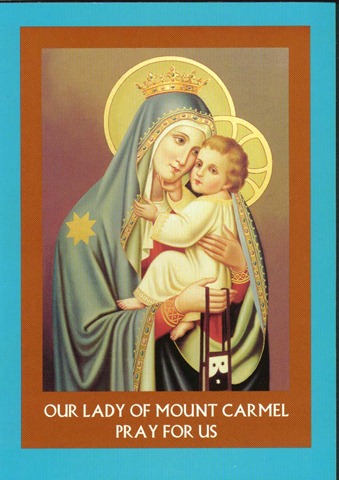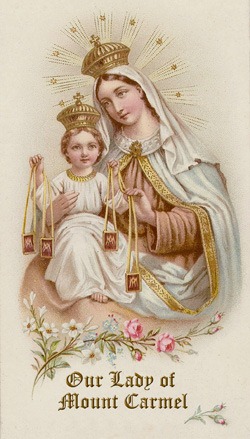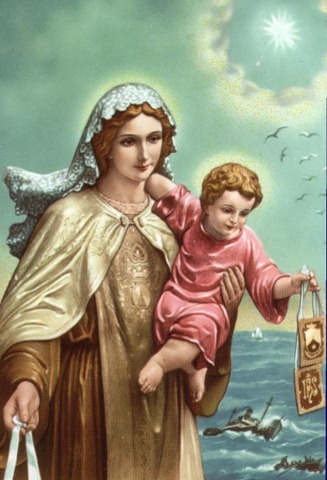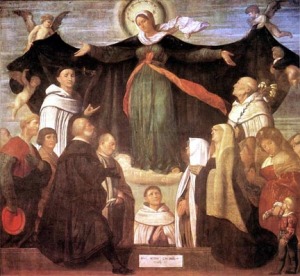
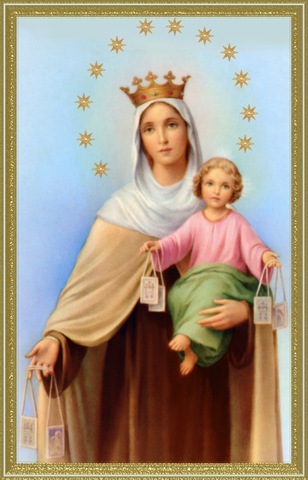
The Virgin of Carmel
Moretto da Brescia c. 1522
Gallerie dell’Accademia, Venice
 Dinner: Mini Meatball Sandwiches
Meatball ~ Mount Carmel
Although there is no historical evidence for the pre-Christian Carmelite community, references in the 12th century record a community of monks on the holy mountain. Despite continual difficulties, the community built a monastery and church dedicated to the Virgin Mary on Mount Carmel in 1263. Saint Louis, King of France, had visited Mount Carmel in 1254, and brought back six French hermits for whom he built a convent near Paris. Mount Carmel was taken by the Saracens in 1291, and the brothers were killed and the convent burned. The spread of the Carmelites in Europe is largely attributable to the work of Saint Simon Stock (1247-65). The Carmelite Order was formally approved in 1274 at the Council of Lyon.’
Provolone Cheese ~ White for the purity of Our Lady
Bread ~ The Bread of Life, Jesus – who Mary ALWAYS leads us to
Sauce ~ The Blood of Christ that was shed for all
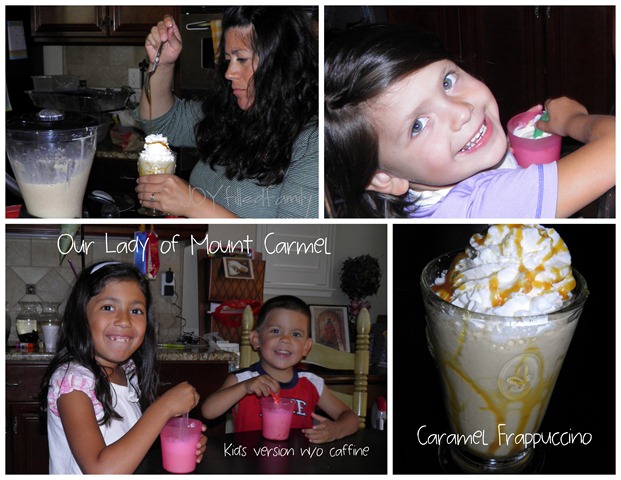
Dessert: Caramel Iced Frappuccino
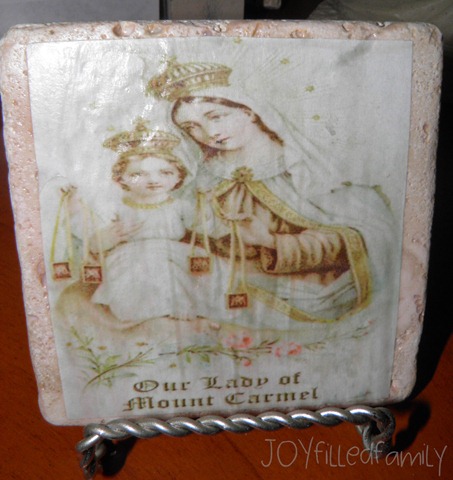 Craft: Our Lady of Mt. Carmel Tile
Additional Resources:
Mt. Carmel Talk given by Fr. Mitch Pacwa – Audio In these five video clips, I hope you come to a better historical understanding of the significance of this great feast we celebrate every year on July 16th ~ The Feast of Our Lady of Mt. Carmel. ~ Fr. Mitch Pacwa
Our Lady of Mount Carmel - Resources from EWTN
Brown Scapular – Free Offer
Celebrating Our Lady of Mt. Carmel – Catholic Cuisine
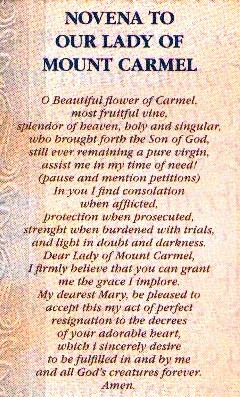
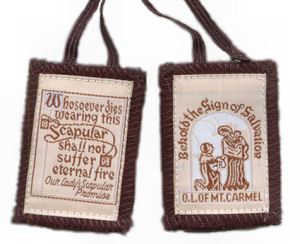 July 16 – Today is the principal feast day of the Carmelite Order. Through the efforts of the crusader Berthold, a group of hermits living on Mount Carmel were organized into an Order after the traditional Western type about the year 1150. Oppressed by the Saracens, the monks slowly emigrated to Europe. During the night preceding the sixteenth of July, 1225, the Blessed Virgin is said to have commanded Pope Honorius III to approve the foundation. Since the Carmelites were still under constant harassment, the sixth General of the Order, St. Simon Stock, pleaded with the Blessed Virgin for some special sign of her protection. On July 16, 1251, she designated the scapular as the special mark of her maternal love. That is why the present feast is also known as the feast of the Scapular. The scapular, as part of the habit, is common to many religious Orders, but it is a special feature of the Carmelites. A smaller form of the scapular is given to lay persons in order that they may share in the great graces associated with it. Such a grace is the “Sabbatine privilege.” In the so-called Bulla Sabbatina John XXII affirmed that wearers of the scapular are soon freed from the flames of purgatory, at least by the Saturday after death. The confirmation of the Bulla Sabbatina was promulgated by the Sacred Congregation of Indulgences, July 4, 1908