• Email
  • Facebook
  • Instagram
  • Pinterest
share our JOY

JOY{filled}family

striving to radiate Him always

  • Home
  • Blog
  • Brown Scapular
  • Liturgical Calendars & Planners
  • Wellness
    • Essential Oils
    • Fitness
    • Nutrition
  • Homeschool
  • Sacraments
    • Baptism
    • First Communion
    • Confirmation

Halloween for Catholics?

October 4, 2022 by Lena {JOYfilledfamily} Filed Under: 10 October Saints, 11 November Saints, All Hallow's Eve, All Saints Day Leave a Comment
If you’ve been following us for a while, you know where we stand. But it wasn’t always this way. In the past, we allowed our eldest child to dress up in cute, secular costumes and collect treats from friends and family for the first few years of her life. However, as we grew in the Faith, our priorities began to shift. We Enthroned our home to the Sacred Heart of Jesus and felt called to live more radically for Christ.

A turning point came when we were invited to an All Saints’ Party at a traditional Latin Mass parish, nearly 20 years ago. That experience opened our eyes and helped us respond to God’s promptings, leading us to set aside secular Halloween celebrations.

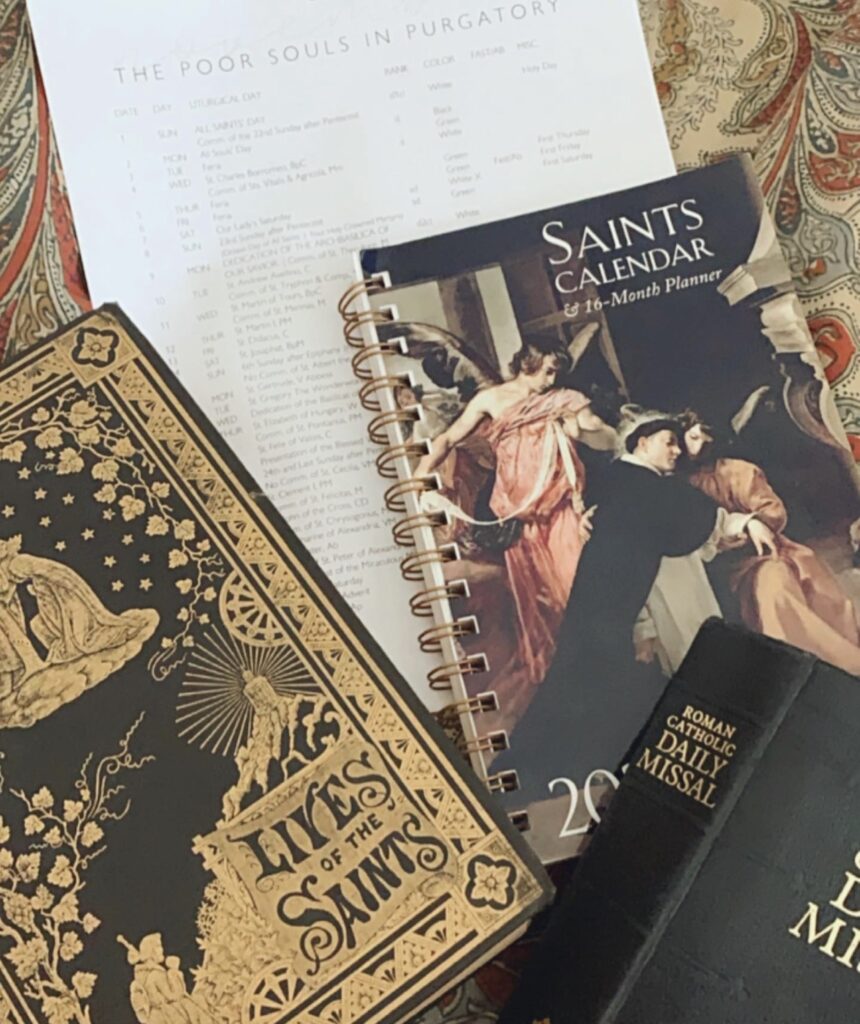
Below are a few resources I’ve previously shared on Instagram, now gathered here to make them easier to find. Every year, I get questions about this topic, and I hope these tools will inspire others to embrace the richness of Catholic traditions.

Let’s Restore Catholic Customs

May we work together to reinstitute the beautiful customs & traditions of thr Church and joyfully celebrate holy feasts of All Saints and All Souls.

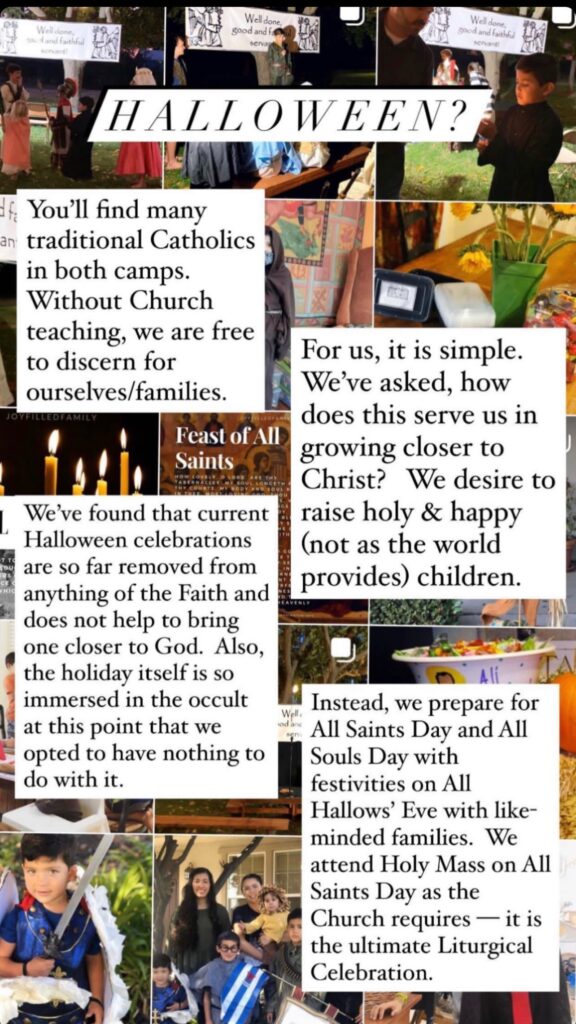
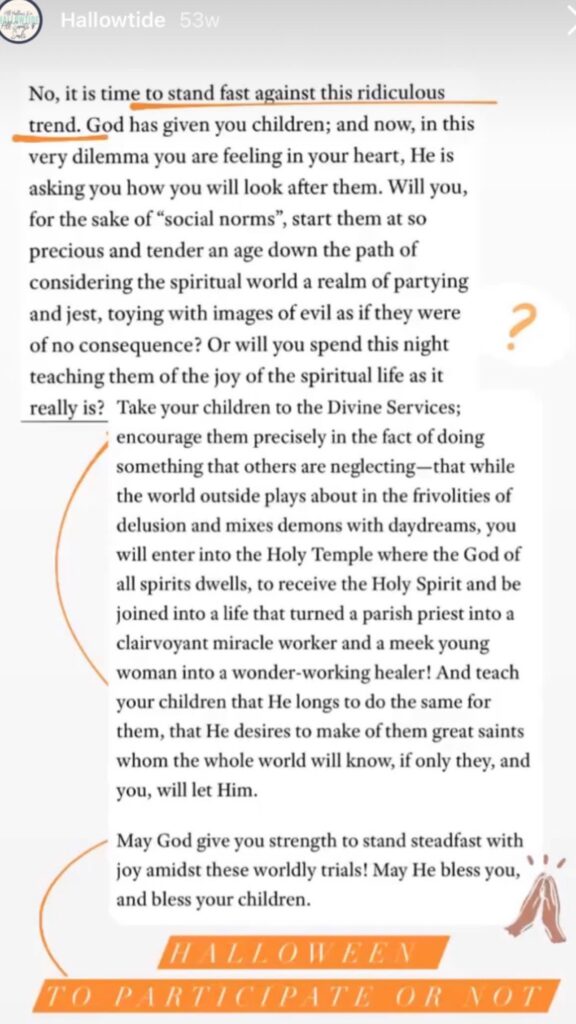
When it comes to Halloween, you’ll find traditional Catholics on both sides of the debate. Since there’s no definitive Church teaching on the matter, families are free to discern what’s best for them.

For our family, we’ve come to see that modern Halloween celebrations are far removed from anything of the Faith. They don’t help us grow closer to God, and the holiday itself is now steeped in occult practices. For us, the decision was simple: Does this celebration aid our journey toward Christ? The answer was no.

We’ve asked, how does this serve us in growing closer to Christ?

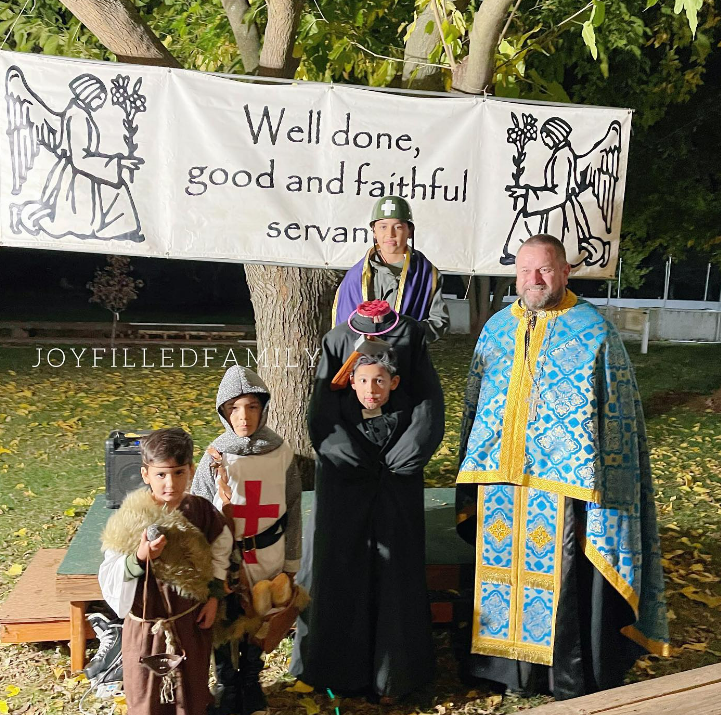
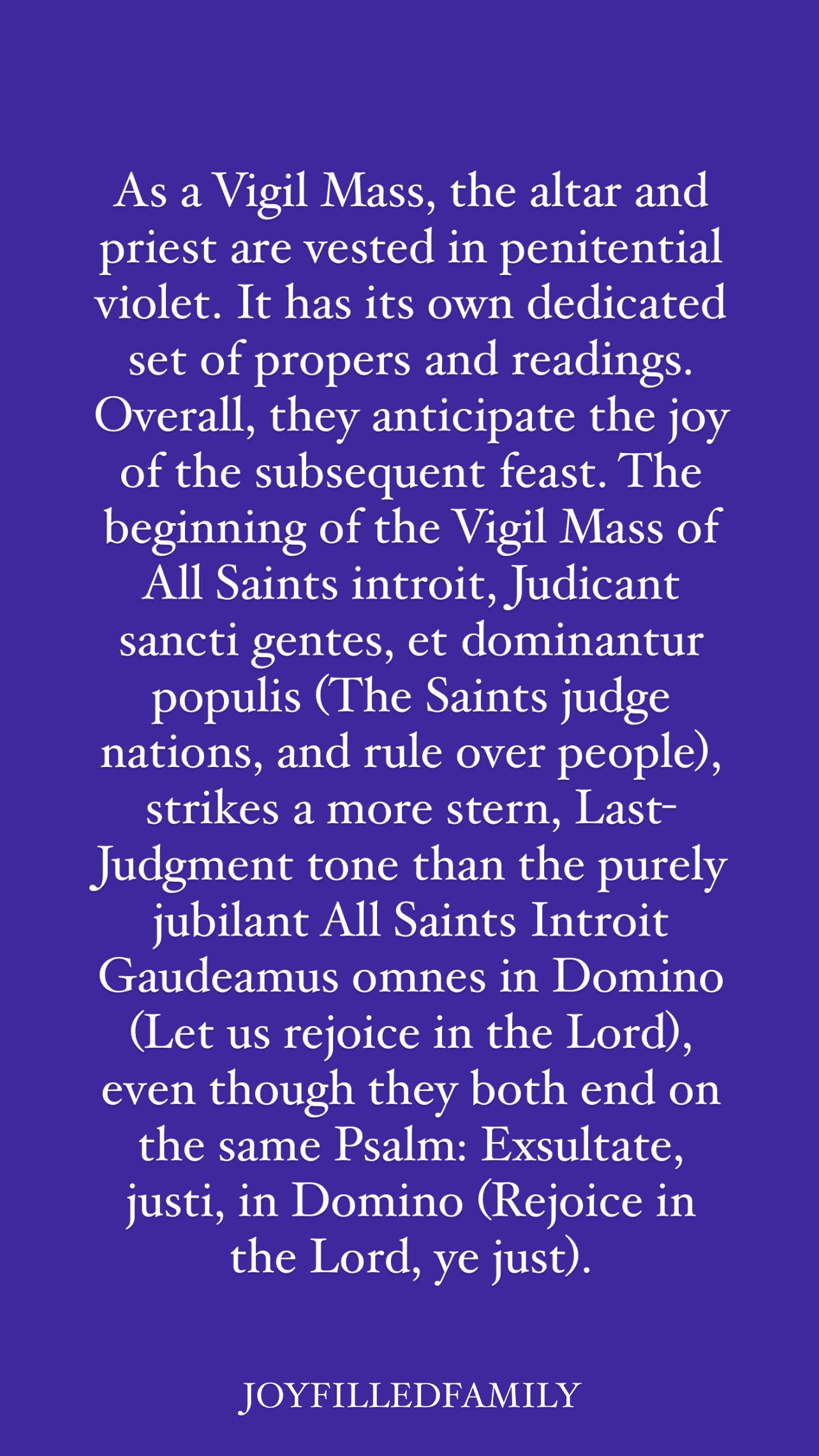
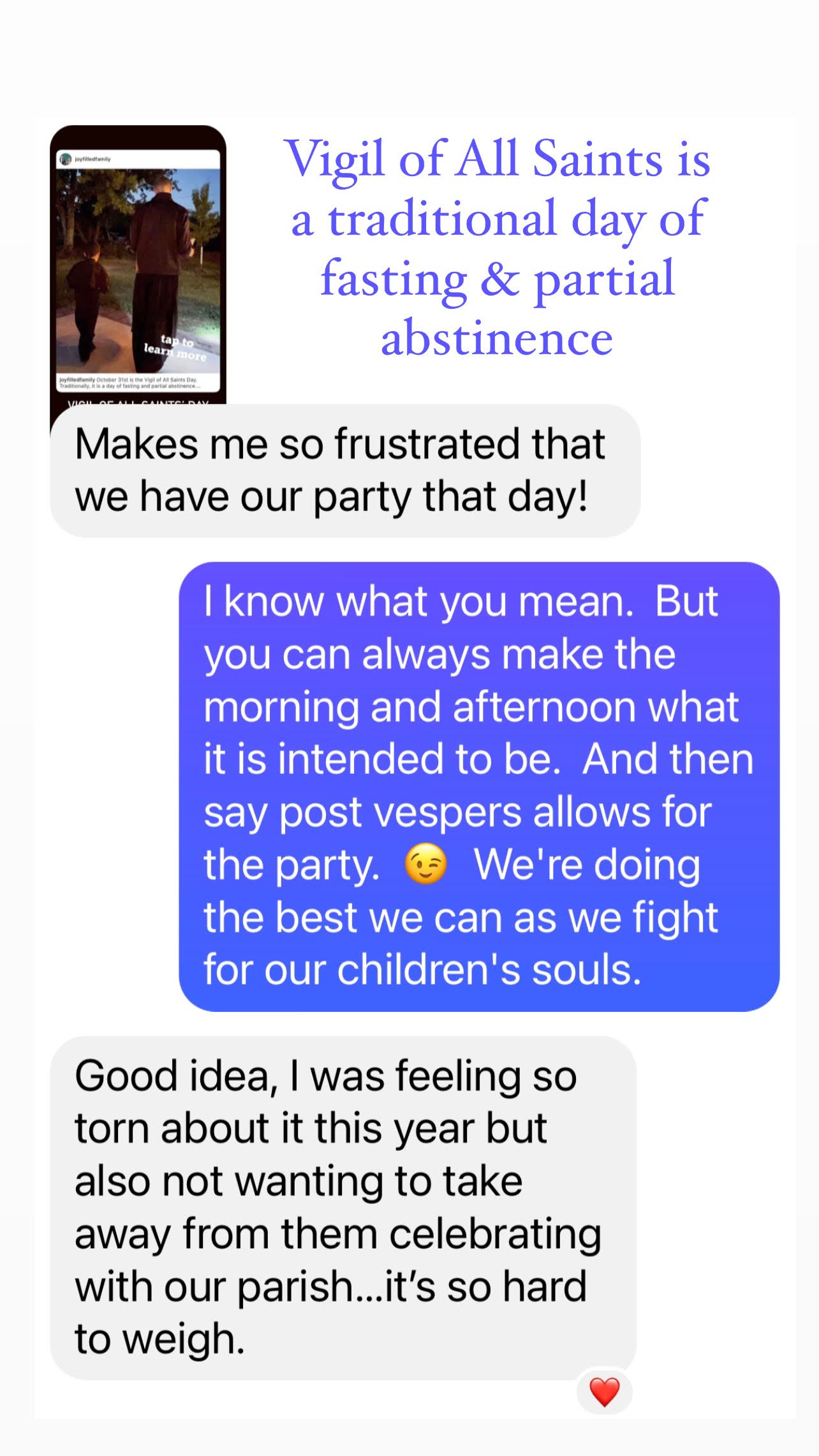
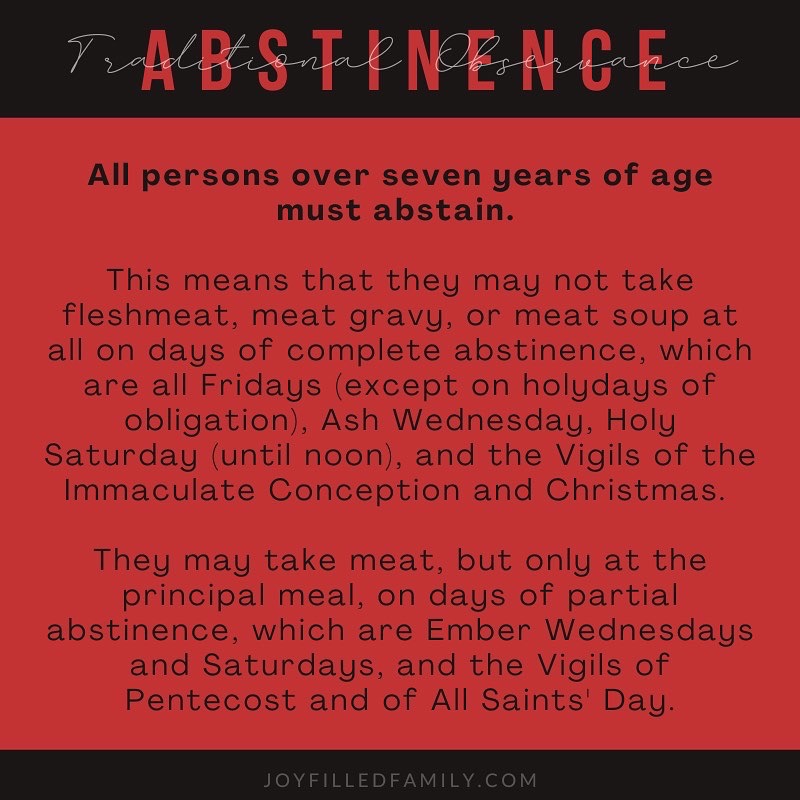
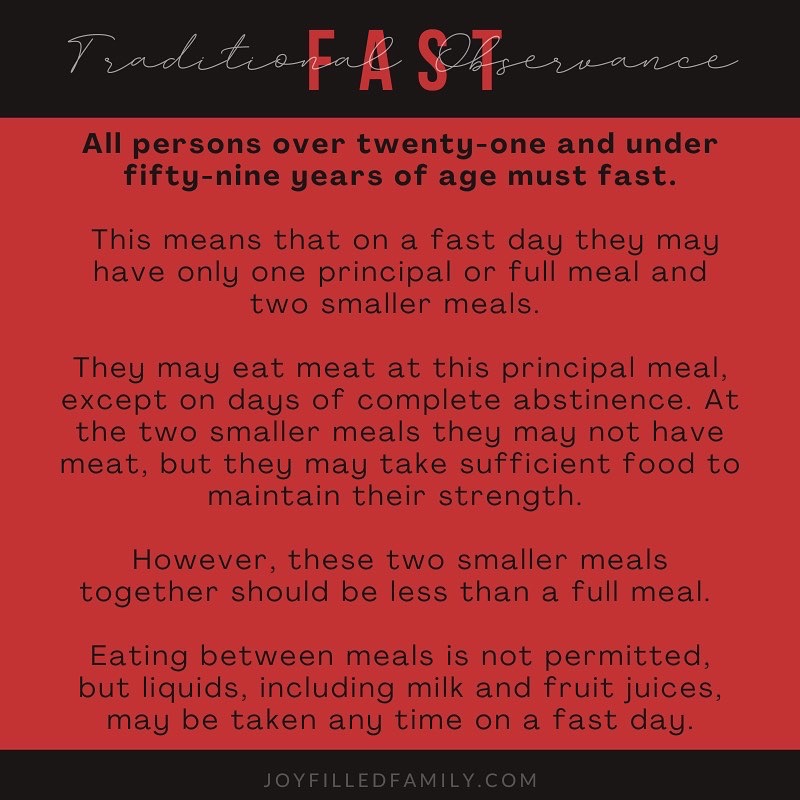
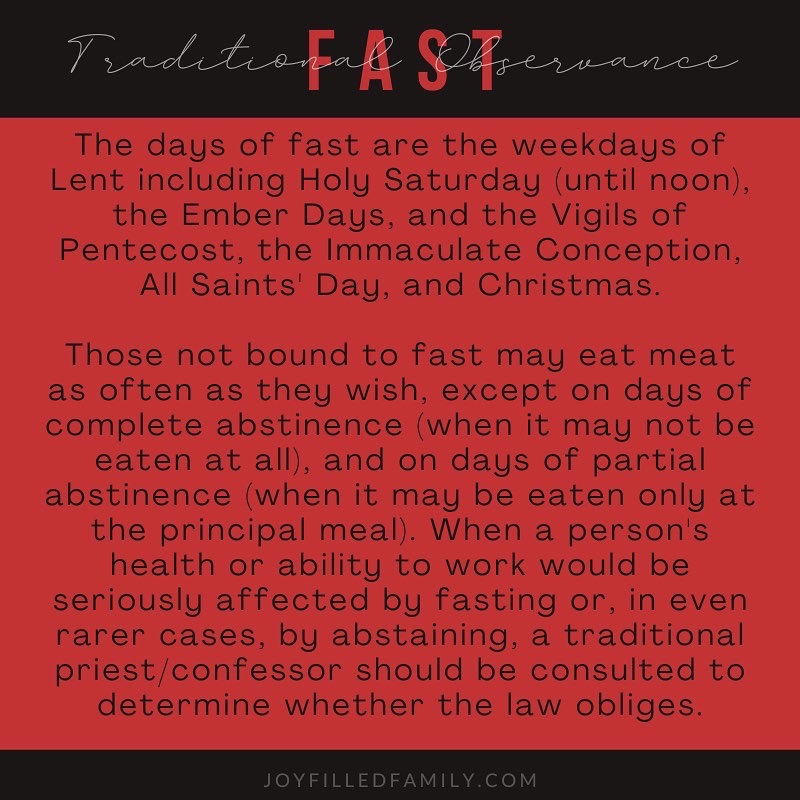
Our goal is to raise children who are both holy and happy, but not in the way the world defines happiness. Instead of participating in Halloween, we focus on preparing for the great feasts of All Saints’ Day and All Souls’ Day. On All Hallows’ Eve, we gather with like-minded families to celebrate with faith-centered festivities. We also observe the traditional fast and partial abstinence on the Vigil of All Saints, as the Church prescribed.

Above all, we honor the holy days by attending Mass on All Saints’ Day, as required by the Church. This approach helps keep our hearts and minds focused on what matters most: growing in holiness and seeking the will of God.

Just to clarify my recent stories/posts: the Church does not have an official teaching regarding the celebration of Halloween. For the past 25 years or so, my family has chosen not to participate in Halloween. As my husband and I deepened our understanding of the Faith, we felt called to change certain practices and align our lives more closely with our beliefs. While I don’t pass judgment on the decisions other families make, I share what has guided and challenged us on our journey to grow in holiness and glorify God.

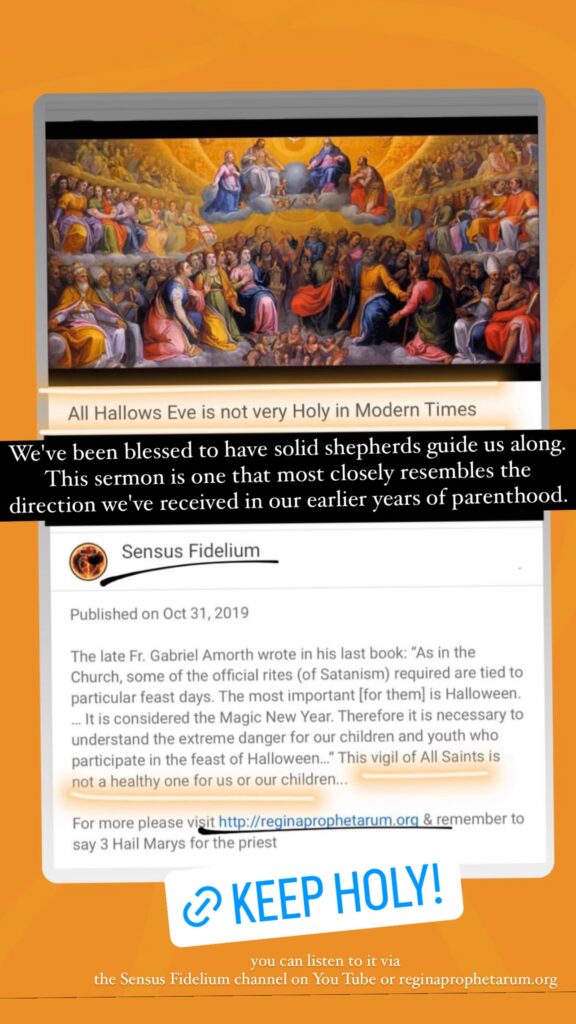
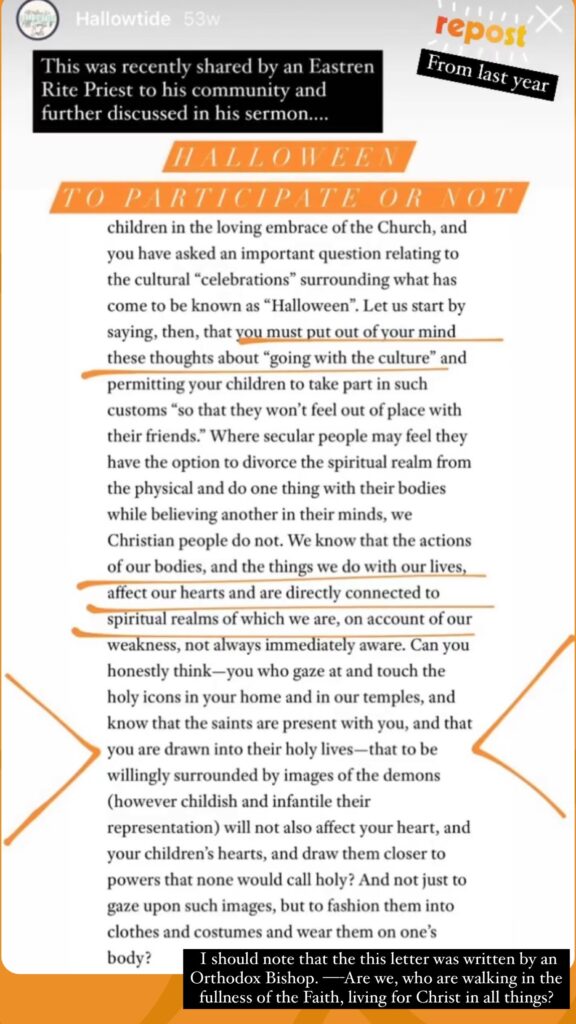
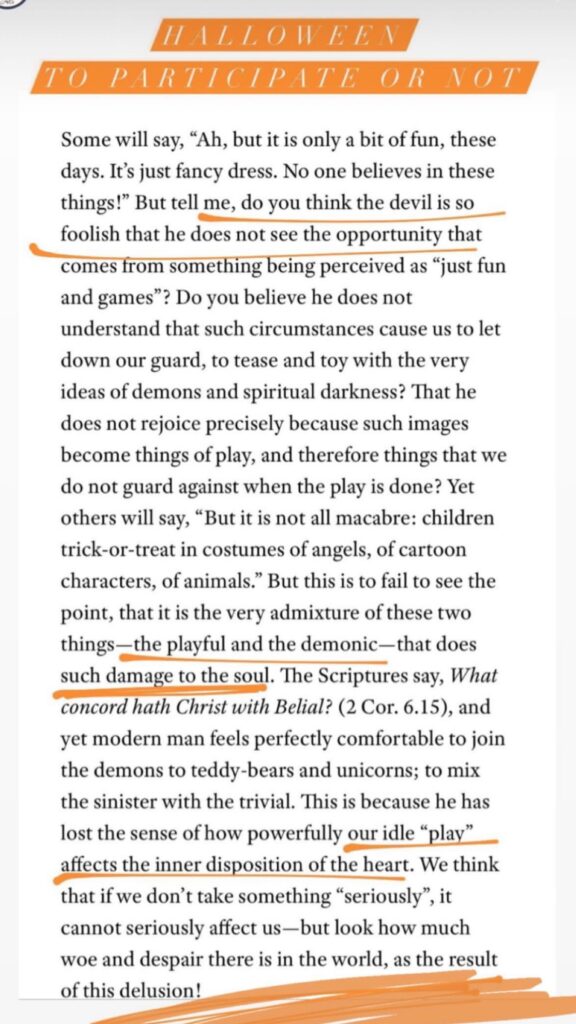
Sermon regarding celebrating Halloween
All Hallows’ Eve Printable

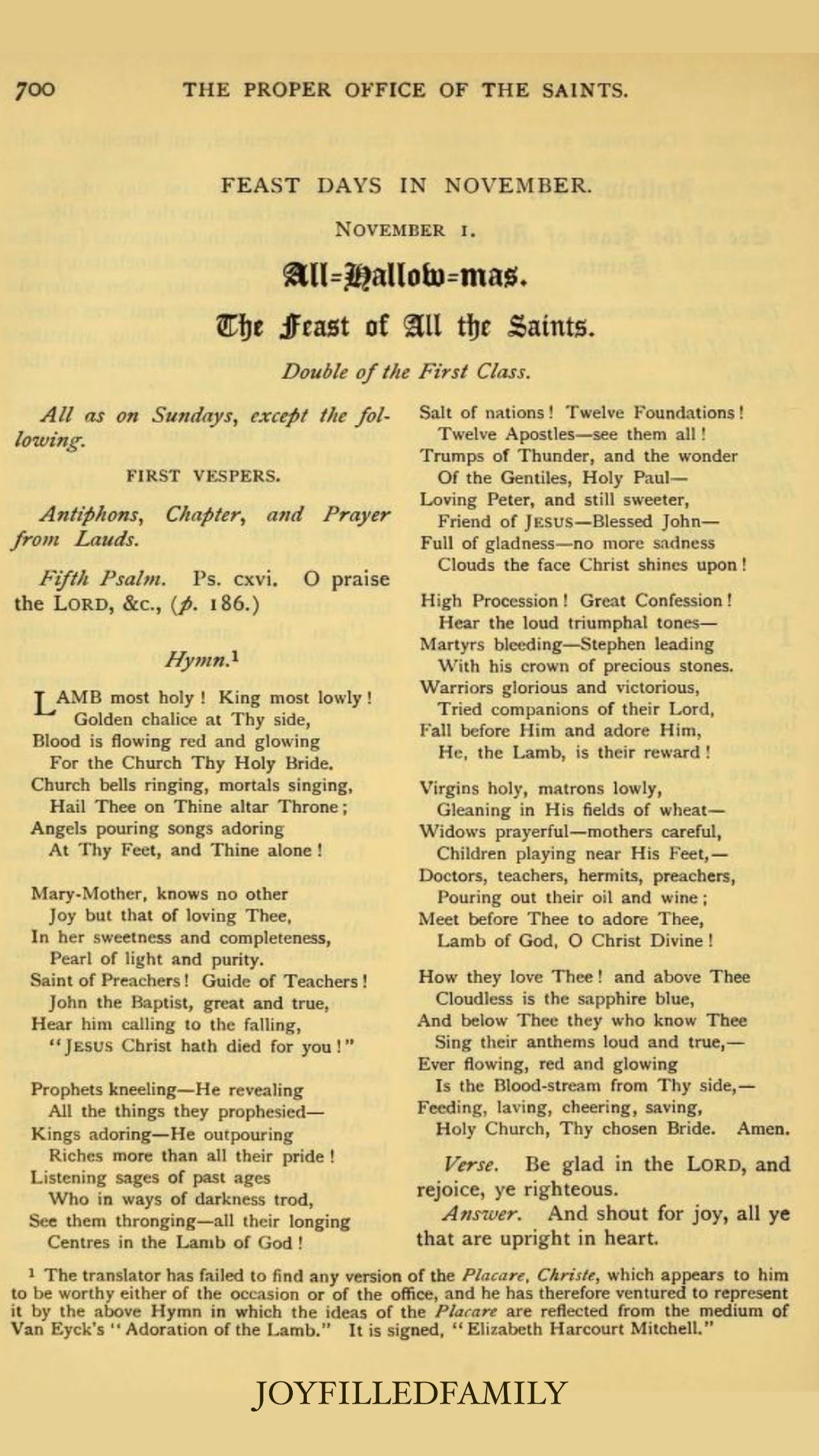
More on Hallowtide

Rev. Fr. Leonard Goffine’s
The Church’s Year

Instruction On The Feast Of All Saints
[November 1]


Why has the Church instituted this festival?

To give praise to God in His saints, (Ps. cl.) and to pay to the saints themselves the honor which they merit for having made it the work of their earthly life to promote the honor of God. 2. To impress vividly upon our minds that we are members of that holy Catholic Church which believes in the communion of saints, that is, in the communion of all true Christians, who belong to the Church triumphant in heaven, to the Church suffering in purgatory, or to the Church militant upon earth; but, more particularly, to cause us earnestly to consider the communion of the saints in heaven with us, who are yet battling on earth.

3. To exhort us to raise our eyes and hearts, especially on this day, to heaven, where before the throne of God is gathered the innumerable multitude of saints of all countries, times, nationalities and ranks of life, who have faithfully followed Christ and left us glorious examples of virtues, which we ought to imitate. This we can do, for the saints, too, were weak men, who fought and conquered only by the grace of God, which will not be denied to us.

4. To honor those saints, for whom during the year there is no special festival appointed by the Church. Finally, that in consideration of so many intercessors God may grant us perfect reconciliation, may permit us to share in their merits, and may grant us the grace to enjoy with them, one day, the bliss of heaven.

Who first instituted this festival?

Pope Boniface IV. first suggested the celebration of this festival, when in 610 he ordered that the Pantheon, a pagan temple at Rome, dedicated to all the gods, should be converted into a Christian church, and the relics of the saints, dispersed through the different Roman cemeteries, taken up and placed therein. He then dedicated the Church to the honor of the Blessed Virgin and all the martyrs, and thus for the first time celebrated the Festival of All Saints, directing that it should be observed in Rome every year. Pope Gregory IV. extended this feast to the whole Catholic Church, and appointed the 1st of November as the day of its celebration.

At the Introit the Church sings: Let us all rejoice in the Lord, celebrating a festival day in honor of all the saints; at whose solemnity the angels rejoice, and give praise to the Son of God. Rejoice in the Lord, ye just: praise becometh the upright. Glory &c.

COLLECT Almighty everlasting God, who givest us to venerate in one solemnity the merits of all Thy saints: we beseech Thee to bestow upon us, through our multiplied intercessors, the fulness of Thy propitiation. Thro’. &c.

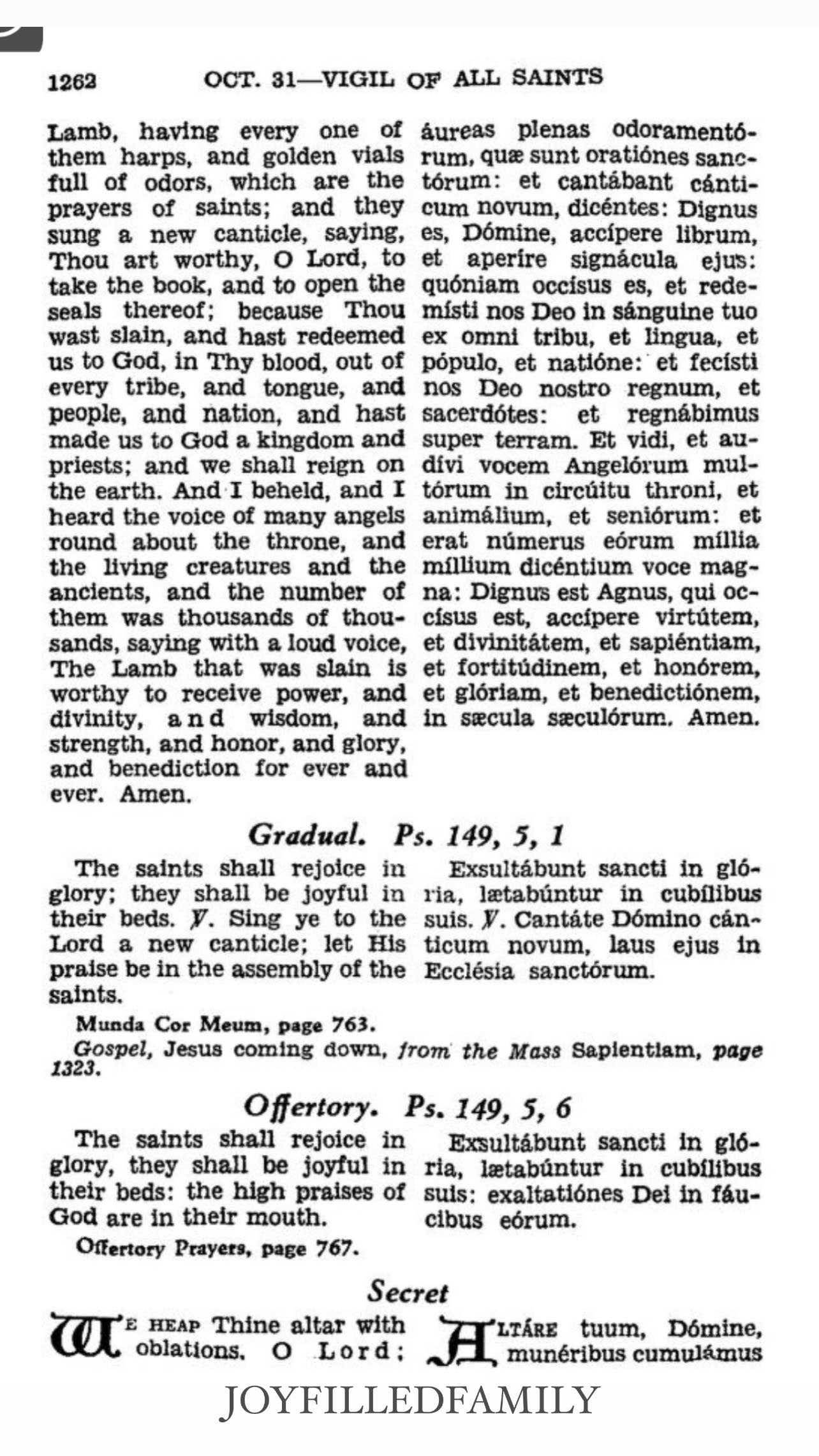
LESSON (Apoc. vii. 2-12.) IN THOSE DAYS, behold, I, John, saw another angel ascending from the rising of the sun, having the sign of the living God: and he cried with a loud voice to the four angels, to whom it was given to hurt the earth and the sea, saying: Hurt not the earth, nor the sea, nor the trees, till we sign the servants of our God in their foreheads. And I heard the number of them that were signed, an hundred and forty-four thousand were signed, of every tribe of the children of Israel. Of the tribe of Juda were twelve thousand signed. Of the tribe of Ruben twelve thousand signed. Of the tribe of Gad twelve thousand signed. Of the tribe of Aser twelve thousand signed. Of the tribe of Nephtali twelve thousand signed. Of the tribe of Manasses twelve thousand signed. Of the tribe of Simeon twelve thousand signed. Of the tribe of Levi twelve thousand signed. Of the tribe1 of Issachar twelve thousand signed. Of the tribe of Zabulon twelve thousand signed. Of the tribe of Joseph twelve thousand signed. Of the tribe of Benjamin twelve thousand signed. After this I saw a great multitude which no man could number, of all nations, and tribes, and peoples, and tongues, standing before the throne and in sight of the Lamb, clothed with white robes, and palms in their hands: and they cried with a loud voice, saying: Salvation to our God who sitteth upon the throne, and to the Lamb. And all the angels stood round about the throne, and the ancients, and the four living creatures; and they fell down before the throne upon their faces, and adored God, saying: Amen. Benediction, and glory, and wisdom, and thanksgiving, honor, and power, and strength to our God for ever and ever. Amen.

EXPLANATION The words of this lesson relate immediately to the divine punishment on Jerusalem and the Jewish people, as they were revealed in spirit to John; in a higher and particular sense they refer to the general judgment. At this judgment there will be chosen ones, from each of the twelve tribes of Israel. But that it might not be thought that the elect are principally Christian converts from Judaism, St. John was shown a countless multitude of Christians from heathen lands, by which it is seen, that it is the pagans who will principally fill the Church of Christ and heaven. This multitude clothed in white and carrying palms in their hands, stand before the throne of God and before the Lamb, that is, Christ. The white robes are tokens of their innocence; the palm is the emblem of their glory and of their victory over the temptations of the world, the flesh and the devil. They shall adore God, and forever sing to Him, in communion with all the heavenly spirits, a canticle of praise for the power and glory which He has bestowed upon them.

Let us strive so to live, that we may one day be among these chosen ones.

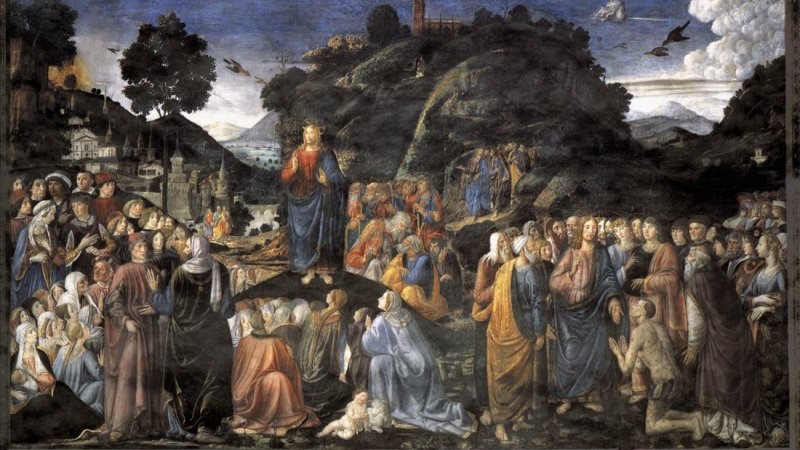
GOSPEL (Matt. v. 1 -12.) AT THAT TIME, Jesus seeing the multitudes, went up into a mountain. And when he was sat down, his disciples came unto him. And opening his mouth, he taught them, saying: Blessed are the poor in spirit, for theirs is the kingdom of heaven. Blessed are the meek, for they shall possess the land. Blessed are they that mourn, for they shall be comforted. Blessed are they that hunger and thirst after justice, for they shall have their fill. Blessed are the merciful, for they shall obtain mercy. Blessed are the clean of heart, for they shall see God. Blessed are the peace-makers, for they shall be called the children of God. Blessed are they that suffer persecution for justice’ sake, for theirs is the kingdom of heaven. Blessed are ye when they shall revile you, and persecute you, and speak all that is evil against you untruly, for my sake: be glad and rejoice, for your reward is very great in heaven.

Why is the Gospel of the Eight Beatitudes read on this day?

Because they form, so to speak, the steps on which the saints courageously ascended to heaven.

If you desire to be with the saints in heaven, you must also mount patiently and perseveringly these steps, then God’s hand will assuredly aid you.

EXPLANATION OF THE EIGHT BEATITUDES.

I. Blessed are the poor in spirit, for theirs is the kingdom of heaven.

THEY are poor in spirit who, like the apostles, leave all temporal things for Christ’s sake and become poor; they who have lost their property by misfortune or injustice, and bear this loss with patience and resignation to the will of God; they who are contented with their poor and lowly station in life, do not strive for greater fortune or a higher position, and would rather suffer want than make themselves rich by unlawful means; they who though rich do not love wealth, nor set their hearts upon it, but use their riches to aid the poor; and especially they who are humble, that is, who have no exalted opinion of themselves, but are convinced of their weakness and inward poverty, have a low estimate of themselves, therefore, feel always their need, and like poor mendicants, continually implore God’s grace and assistance.

II. Blessed are the meek, for they shall possess the land.

He is meek who represses every rising impulse of anger, impatience and desire of revenge, and willingly puts up with every thing that God, to prove him, decrees or permits to happen to him, or men inflict upon him. He who thus controls himself, is like a calm and tranquil sea, in which the image of the divine Sun is ever reflected, clear and unruffled. He who thus conquers himself is mightier than if he besieged and conquered strongly fortified cities, (Prov. xvi. 32.) and will without doubt receive this earth, as well as heaven, as an inheritance, enjoying eternally there the peace (Ps. xxxvi. n.) which is already his on earth.


III. Blessed are they that mourn, for they shall be comforted.

The mourners here mentioned are not those who weep and lament over the death of relatives and friends, or over misfortune or loss of temporal riches, but those who mourn that God is so often offended, so little loved and honored by men, that so many souls, redeemed by the precious blood of Christ, are lost. Among these mourners are also those who lead a strict and penitential life, and patiently endure distress; for sin is the only evil, the only thing to be lamented, and those tears only, which are shed on account of sin, are useful tears, and are recompensed by everlasting joy and eternal consolation.


IV. Blessed are they that hunger and thirst after justice, for they shall have their fill.

Hunger and thirst denote the ardent longing for those virtues which constitute Christian perfection. He who seeks such perfection with ardent desire and earnest striving, will be filled, that is, will be adorned by God with the most beautiful virtues, and will be abundantly rewarded in heaven.

V. Blessed are the merciful, for they shall obtain mercy.

They are merciful who assist the poor according to their means, who practice every possible spiritual and corporal work of mercy, who as far as they can, patiently endure the faults of others, strive always to excuse them, and willingly forgive the injuries they have received. They especially are truly merciful, who are merciful to their enemies, and do good to them, as written: Love your enemies, and do good to them that hate you. (Matt. v. 44.) Well is it for him who is merciful, the greatest rewards are promised him, but a judgment without mercy shall be passed on the unmerciful.

VI. Blessed are the clean of heart, for they shall see God.

They are clean of heart, who carefully preserve the innocence which they received in baptism, and keep their heart and conscience free not only from all sinful words and deeds, but from all sinful thoughts and desires, and in all their omissions and commissions think and desire only good. These while yet on earth see God in all His works and creatures, because their thoughts are directed always to the Highest Good, and in the other world they will see Him face to face, enjoying in this contemplation a peculiar pleasure which is reserved for pure souls only; for as the eye that would see well, must be clear, so must those souls be immaculate who are to see God.

VII. Blessed are the peace-makers, for they shall be called the children of God.

Those are peace-makers who guard their improper desires, who are careful to have peace in their conscience and regulated tranquility in all their actions, who do not quarrel with their neighbors, and are submissive to the will of God. These are called children of God, because they follow God who is a God of peace, (Rom. xv. 33.) and who even gave His only Son to reconcile the world, and bring upon earth that peace which the world does not know and cannot give. (Luke ii. 14.; John xiv. 27.)

VIII. Blessed are they that suffer persecution for justice’ sake, for theirs is the kingdom of heaven.

Those suffer persecution for justice’ sake who by their words, writings, or by their life defend the truth, the faith and Christian virtues; who cling firmly to God, and permit nothing to turn them from the duties of the Christian profession, from the practice of their holy religion, but on its account suffer hatred, contempt, disgrace, injury and injustice from the world. If they endure all this with patience and perseverance, even, like the saints, with joy, then they will become like the saints and like them receive the heavenly crown. If we wish to be crowned with them, we must suffer with them: And all that will live godly in Christ Jesus, shall suffer persecution, (ii. Tim. iii. 12.)


SUPPLICATION. How lovely, O Lord, are Thy tabernacles! My soul longeth for Thy courts. My body and soul rejoice in Thee, most loving God, Thou crown and reward of all the saints, whose temporal pains and sufferings Thou dost reward with eternal joy, filling them with good! How blessed are they who have faithfully served Thee, for they carry Thy name on their forehead, and reign with Thee for all eternity. Grant us, we beseech Thee, O God, by their intercession, Thy grace that we, after their example, may serve Thee in sanctity and justice, in poverty and humility, in meekness and repentance, in the ardent desire for all virtues, by mercy, perfect purity of heart, in peacefulness and patience, following them, and taking part, one day, with them in heavenly joy and happiness. Amen.


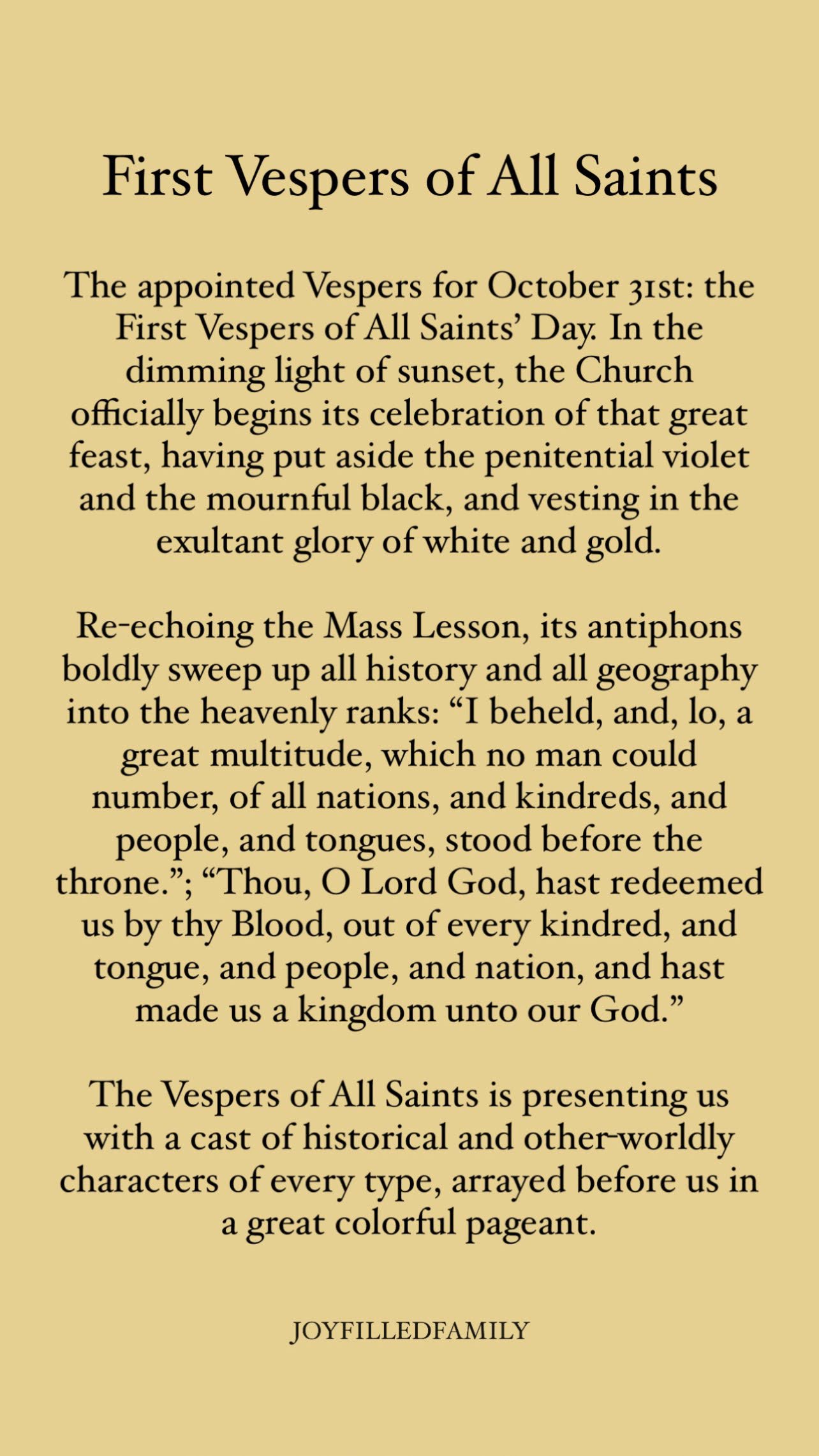
Let us prepare our souls for the graces heaven is about to shower upon the earth in return for its homage.

Tomorrow the Church will be so overflowing with joy, that she will seem to be already in possession of eternal happiness; but today she appears in the garb of penance, confessing that she is still an exile.

Let us fast and pray with her; for are not we too pilgrims and strangers in this world, where all things are fleeting and hurry on to death?

Year by year, as the great solemnity comes round, it has gathered from among our former companions new saints, who bless our tears and smile upon our songs of hope.

Year by year the appointed time draws nearer, when we ourselves, seated at the heavenly banquet, shall receive the homage of those who succeed us, and hold out a helping hand to draw them after us to the home of everlasting happiness.

Let us learn, from this very hour, to emancipate our souls; let us keep our hearts free, in the midst of the vain solicitudes and false pleasures of a strange land: the exile has no care but his banishment, no joy but that which gives him a foretaste of his fatherland.

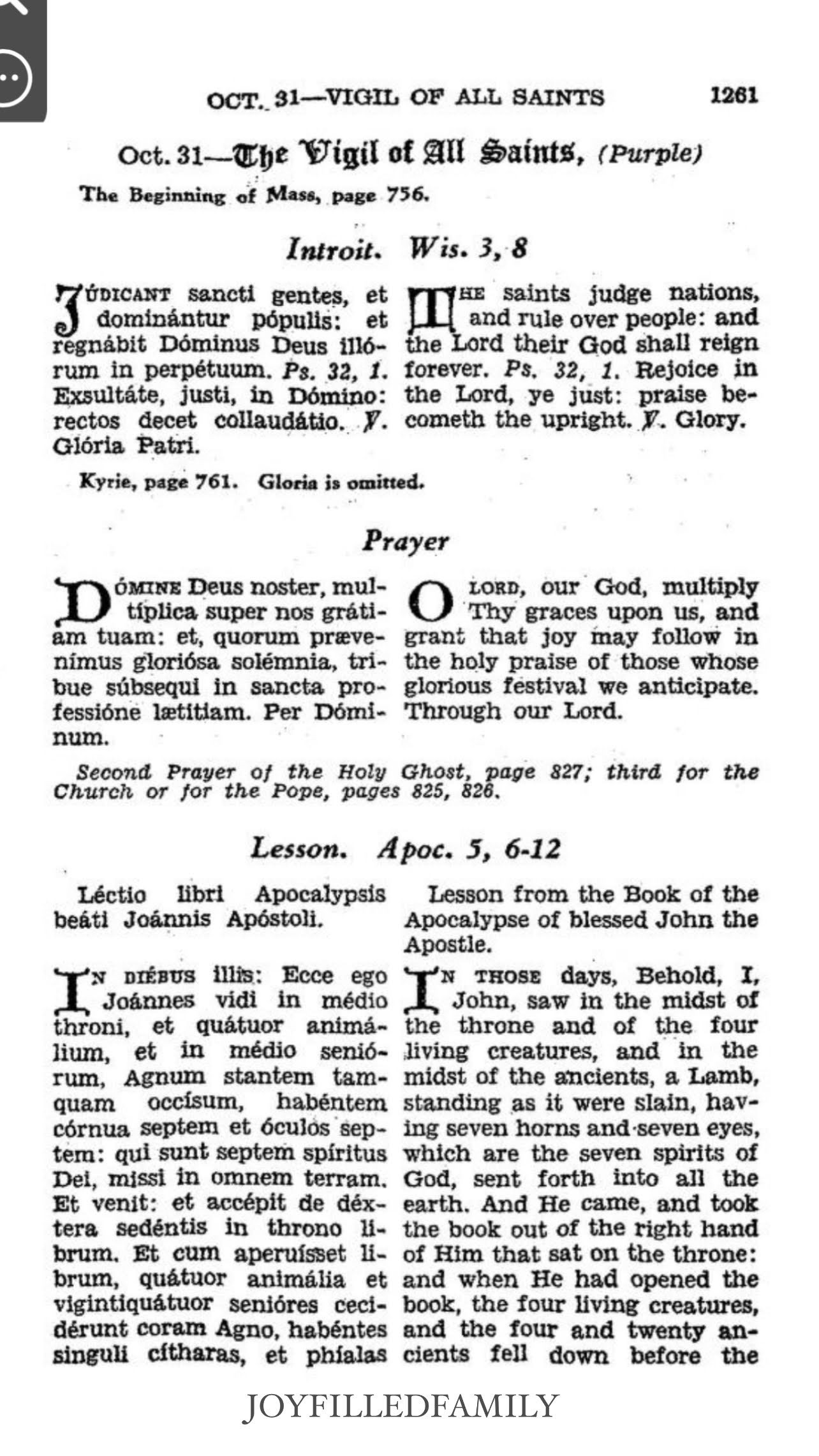
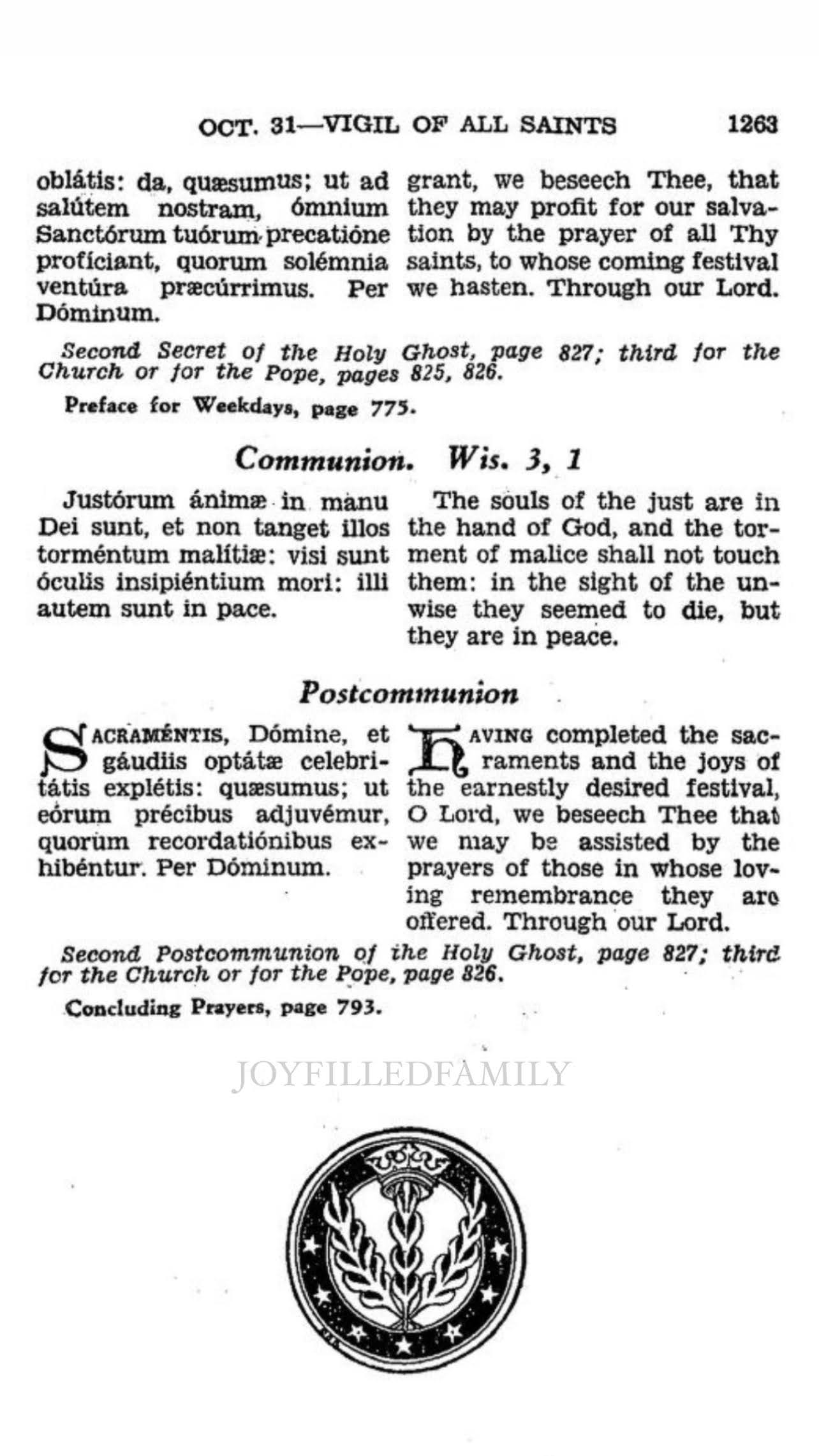
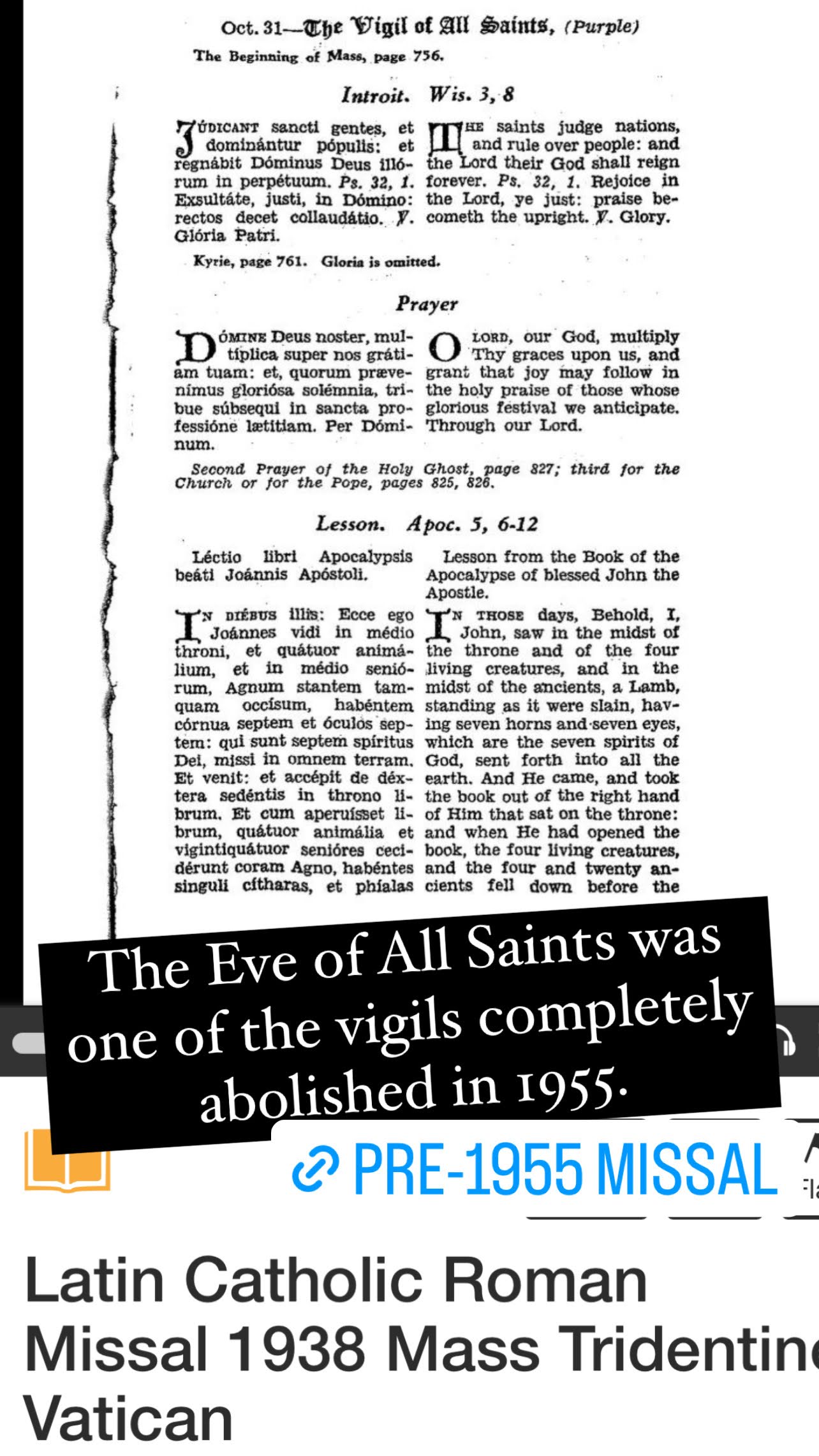
With these thoughts in mind, let us say with the Church the Collect of the vigil.

➕

Domine Deus noster, multiplica super nos gratiam tuam: et, quorum prævenimus gloriosa solemnia, tribue subsequi in sancta professione lætitiam. Per Dominum.

O Lord our God, multiply thy grace upon us; and grant us in our holy profession to follow the joy of those, whose glorious solemnity we anticipate. Through our Lord.

#domprospergueranger #theliturgicalyear #vigilofallsaints

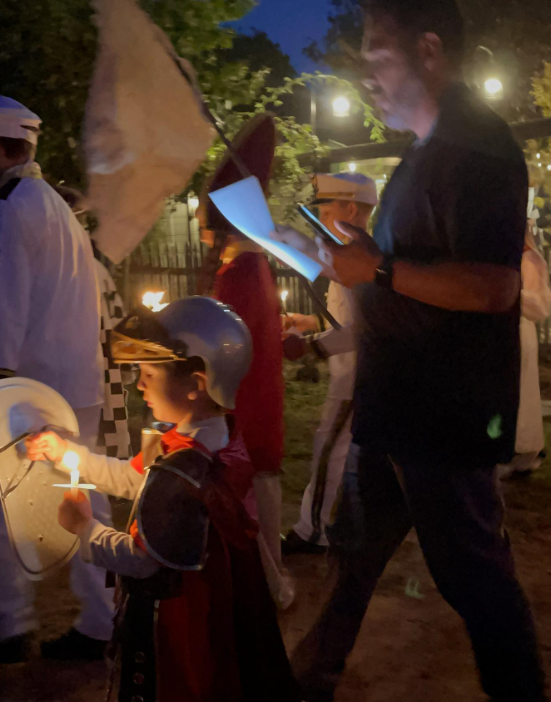
📸procession and litany of the saints #jffallsaintsday

Screenshot

View this post on Instagram

A post shared by Lena | Traditional Catholic (@joyfilledfamily)

Fall Flowers for the feast of St. Therese

October 3, 2022 by Lena {JOYfilledfamily} Filed Under: 10 October Saints, St. Therese Leave a Comment

I rejoice for all those who have received their “sweet rose,” consolation on today’s feast of the beloved Little Flower.

We celebrate by buying our own flowers and decorating for Fall as we invoke the intercession of this meek but fierce saint.

May we, like St. Therese of Lisieux not fear in these difficult days to ask Our Lady for everything: that she permit us to serve her in the defense of the Catholic Cause, that we might be saints, that the Church might be restored, that Her Reign might come, that Her Immaculate Heart be victorious.

➕

Below is a brief mediation from St. Therese.

Jesus set the book of nature before me and I saw that all the flowers he has created are lovely.

The splendor of the rose and the whiteness of the lily do not rob the little violet of its scent nor the daisy of its simple charm.

I realized that if every tiny flower wanted to be a rose, spring would lose its loveliness and there would be no wildflowers to make the meadows gay. It is just the same in the world of souls – which is the garden of Jesus.

He has created the great saints who are like the lilies and the roses, but he has also created much lesser saints and they must be content to be the daisies or the violets which rejoice his eyes whenever he glances down.

Perfection consists in doing his will, in being that which he wants us to be.

Jesus, help me to simplify my life by learning what you want me to be – and becoming that person.

– Saint Therese of Lisieux, from Story of a Soul

We have never received sweet roses or flowers from the beloved St. Therese and that’s ok. We trust that she has been a faithful intercessor to us.

We continue to pray to become “little birdies,” live a life of simplicity, and follow her footsteps to Our Lord.

We will continue to buy our Fall flowers on this glorious feast of the LITTLE FLOWER and give thanks for all of our blessings & the consolations that we have received.

I’d love to hear about your sweet flowers — gifts from St. Therese or purchased. 😉

Happy feastday of St. Therese. May you have a blessed month of The Holy Rosary & Holy Angels.

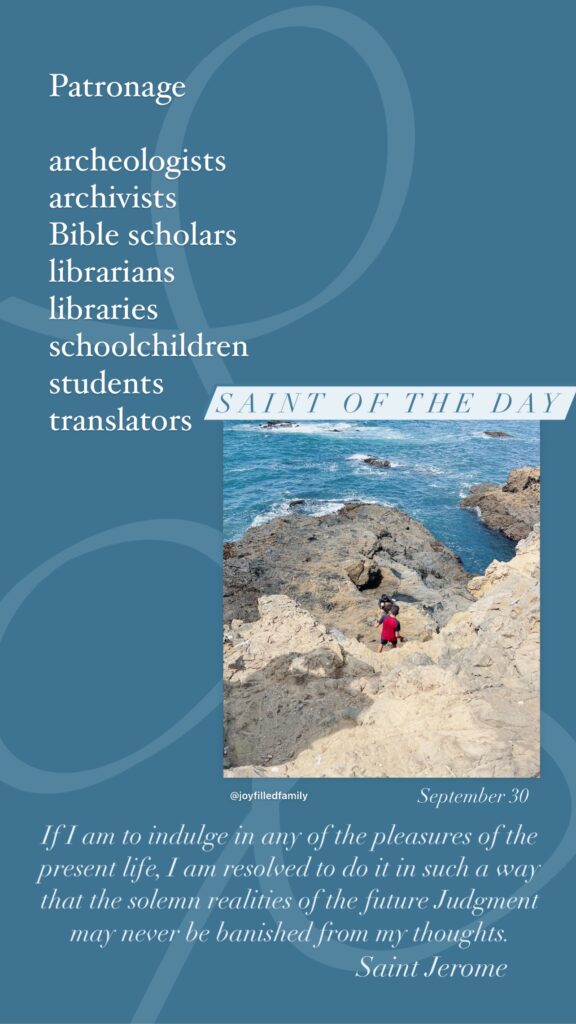
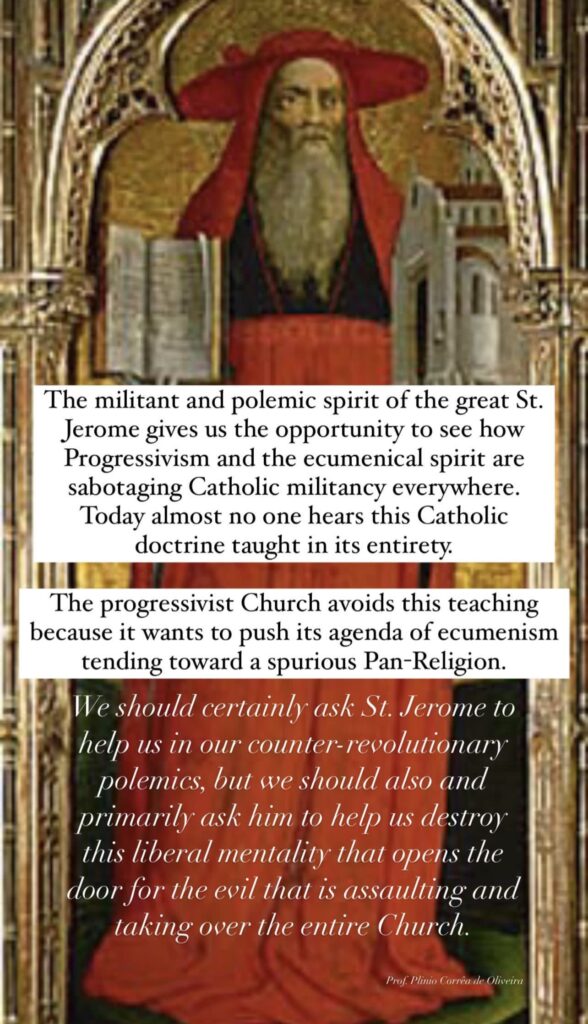
St. Jerome

September 30, 2022 by Lena {JOYfilledfamily} Filed Under: 09 September Saints, Fr. Francis Xavier Weninger, St. Jerome Leave a Comment

Today’s saint, the last for the month of September, impresses upon us the necessity to keep our last judgment on the forefront of our minds and hearts.

Below are practical considerations for St. Jerome from Father Francis Xavier Weninger, DD, SJ., 1876.

➕

Saint Jerome, while in the wilderness, was often disturbed by the recollection of scenes which he had beheld at Rome in the theatre.

Behold what is the fruit of such amusements.

Many have perhaps no evil thoughts so long as they are at such places; the Evil One does not tempt us there in order to induce us to continue to frequent them. But the time will come when this false spirit will bring to our mind everything that we heard and saw in these unchaste plays, and thus, perhaps, lead us to commit great sin. If you desire to escape this danger, avoid all that may occasion it.

“At holy baptism,” says Saint Salvianus, “you renounced the devil and all his works. Frivolous plays and unchaste amusements are works of the devil.” Hence, if you frequent these, you show that you revoke your first renunciation and that you turn again to Satan.

Can you do this without rendering an account of it to God? Much more severe will be your account, if you bring others, perhaps even young children, to such places.

Quintilian writes that, at one time, it was not allowed at Rome, that the young should* visit the theatre, that they might not learn what it was better for them not to know. So solicitous were the heathens for their children. And how do some Christian parents act?

Oh! Parents! Christian parents only in name? How the heathens will bring shame upon you before the judgment-seat of God! How will you justify yourselves?

Saint Jerome prayed and did penance when he was tempted. He also endeavored to fill his mind with other thoughts. May you also act thus in your hours of temptation. Endeavor to think of something else, and avoid idleness.

Saint Jerome was scourged because he found great pleasure in reading a book, although he neither learned from it, nor sought in it anything that was impure or sinful.

Oh! how will those be scourged, how deep will be the wounds they will have to bear, who read all kinds of sensational, scandalous, superstitious and heretical books!

If you wish to escape such a chastisement, throw away books of that kind. “When you read a good book, God converses with you,” says Saint Jerome. Hence, when you read a bad book, Satan converses with you.

➕

Saint Jerome lived many years in great austerity. And why? Fear of the Judgment Day and of hell actuated him; as he unceasingly thought of these.

He believed that he would not be able to justify himself before the Divine Judge and not escape hell, without this severity: or it was at least his opinion that such severity was beneficial to man, in order that he might receive a favorable sentence at the divine judgment and escape hell.

You avoid fasting and every severity, lead a sensual, comfortable life; and yet expect to acquit yourself well at the day of judgment and to escape hell.

Is Jerome, or are you, wrong?

I fear you consider not as earnestly as Saint Jerome did, the awfulness of the last judgment and of hell. You do not think of it so frequently; hence, you do not endeavor more earnestly to find a gracious Judge, and not be banished into hell.

My advice is, that you think oftener and more earnestly of the last day and of hell.

I am sure that you will then not omit to do all that is necessary to justify yourself before the Judgment-seat of God. “Consider frequently and earnestly the approaching day of judgment, and the eternal fire of hell,” says Saint Ambrose. “Those who think, in all their actions, on the day of judgment, will easily be saved,” says Saint Hilary. Tertullian writes: “The contemplation of hell is the beginning of our salvation. It puts an end to sin and prepares the way for grace and pardon.”

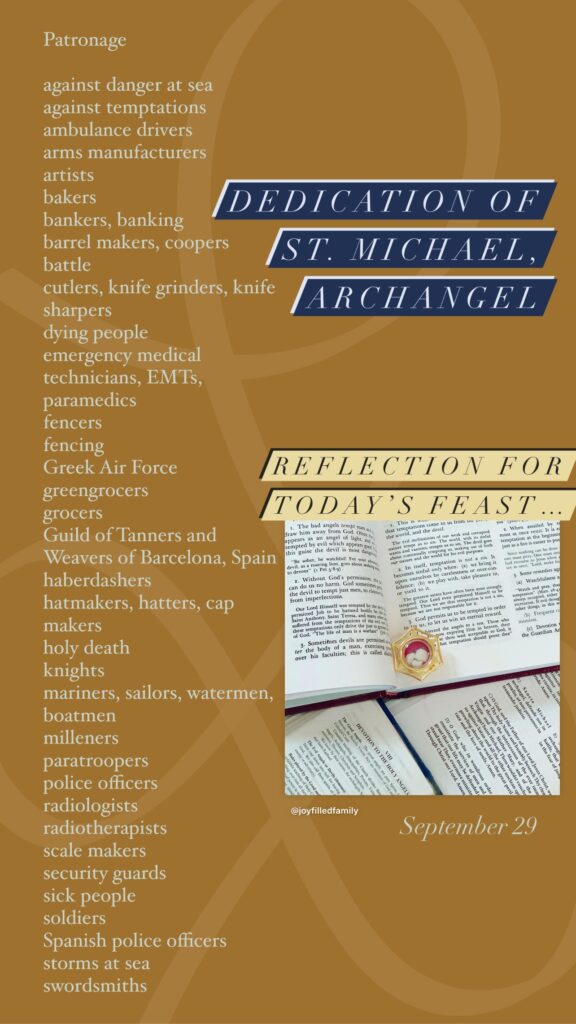
Dedication of St. Michael

September 29, 2022 by Lena {JOYfilledfamily} Filed Under: 09 September Saints, St. Michael Leave a Comment

Happy feast of the Dedication of St. Michael, Archangel (9.29).

Below is a reflection from #SaintsandSaintlyDominicans Hyacinthe-Marie Cormier, O.P., 1915.

➕
Who is like to God? This is Michael’s war-cry.

Hell by its revolt has begun the combat; but the great archangel defends the rights of God with such intelligence, love and energy, that Lucifer, the highest of the angels, is conquered. Henceforth he is but the old serpent, the impure spirit, the father of lies, the universal seducer, and Michael enjoys his supreme rank.

After having been the Patron of the Synagogue Saint Michael is now invoked as Patron of the Church; he is also the special protector of France, whose vocation is to uphold the interests of God amongst the nations.

May all the ministers of Jesus Christ, may all believers in the midst of the present tendencies to the spirit of pride, presumption, independence and revolt, combat for the Church with as much energy as Michael, and as happily conquer.

This was the privilege of Michael Ghislieri, Pope under the name of Saint Pius V. It is said in his office: “This new Michael cast down the furious dragon in the fight; his strength and constancy subjugated heresy and the greatness of his soul resisted all the powers of hell.”

There exists a chaplet called the “angelic,” in honor of Saint Michael which has received the approbation of Pius IX.

➕Prayer

Saint Michael, impart to my soul the power of God.

➕Examen

What is your devotion to God’s cause?

What assistance do you give to its defenders?

Do you fear to compromise yourself or to draw upon yourself the censures of the world by appearing too good a Catholic, too great a friend of true doctrine and solid devotion?

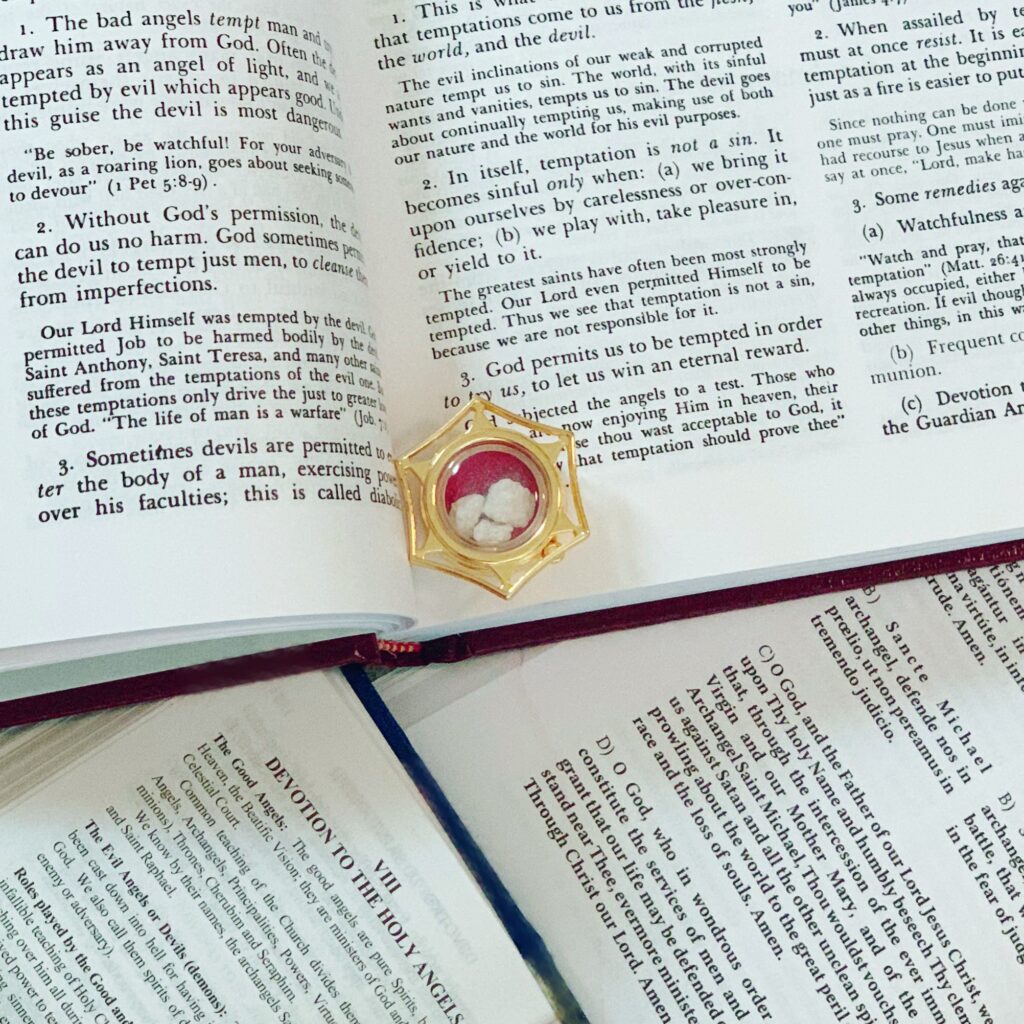
📸Relic of Mount Gargano where St. Michael appeared along with traditional Catholic catechism and books – My Catholic Faith, Council of Trent Catechism, and Christian Warfare.

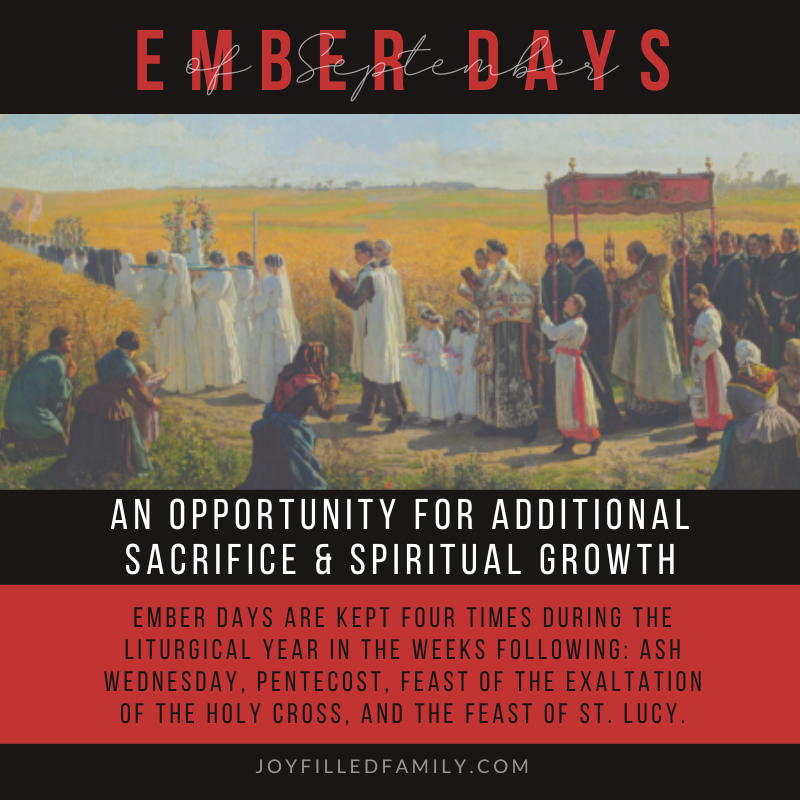
Ember Days of September

September 20, 2022 by Lena {JOYfilledfamily} Filed Under: 09 September Saints, Ember Days, The Liturgical Year Leave a Comment

The Ember Days of September are upon us!

“For the third time this year, Holy Church comes claiming from her children the tribute of Penance, which, from the earliest ages of Christianity, was looked upon as a solemn consecration of the Seasons.” #domprospergueranger #domgueranger

➕

Ember days (corruption from Latin Quatuor Tempora, four times) are the days at the beginning of the seasons ordered by the Church as days of fast and abstinence.

They were definitely arranged and prescribed for the entire Church by Pope Gregory VII (1073-1085) for the Wednesday, Friday, and Saturday after 13 December (S. Lucia), after Ash Wednesday, after Whitsunday, and after 14 September (Exaltation of the Cross).

The purpose of their introduction, besides the general one intended by all prayer and fasting, was to:

• thank God for the gifts of nature
• teach men to make use of them in moderation
• assist the needy

– 1917 Catholic Encyclopedia

St. Raymund Nonnatus

August 31, 2022 by Lena {JOYfilledfamily} Filed Under: 08 August Saints, Fr. Francis Xavier Weninger, St. Raymund Nonnatus Leave a Comment

The words and life of today’s saint are piercing. St. Raymund Nonnatus was delivered via cesarean after his mother had already died in childbirth. In his earliest years, he chose the Queen of Heaven as his mother and clung to her his entire life.

He is the patron of:

• against fever

• babies

• childbirth

• children

• expectant mothers

• falsely accused people

• infants

• midwives

• newborn babies

• obstetricians

• pregnant women

Below is practical consideration from #frWeninger 1976

➕

Saint Raymund, at the close of his days, gave fervent thanks to the Almighty for all favors bestowed upon him, and thus ended his life full of heavenly comfort. To give thanks to God is a duty which we ought to perform every morning and evening; for, no day, no night passes in which we, do not partake of the bounty of the Lord. You thank men who bestow kindness upon you; why then do you not thank God who has overwhelmed you with favors, and still grants them to you daily. Do not forget your duty, but attend to it every day. Give thanks to Him also at the end of each month, in consideration of so many benefits which you have received from Him and for which you did not even ask. Whom have you to thank that you did not die during the past four weeks; that you have dot been condemned to eternal flames, as so many that have been called away? Whence comes it that you were preserved from the dangers and misfortunes that befell so many others? that time and opportunity are left you to work out your salvation, whilst thousands no longer possess them? Most assuredly, these are all benefits of the Almighty which you deserve much less than a great many others. Is it not just that you should give fervent thanks to God at the end of each month? But is your soul in such a condition that you can end this month or close your life, as peacefully as Saint Raymund? Ah! if you had lived as he did, if you had constantly practiced good works, and had borne adversity with his patience, you might be comforted now, as well as at the end of your days. As, however, this is unhappily not the case, repent of your wickedness and indolence with your whole heart, and pray humbly for grace to make better use of the next month. Endeavor to atone, during the same, for your past negligence, that, one day you may not sigh uselessly: “I have had empty months.” (Job 8) “Who will grant me that I might be according to the months past” (Job 29)

Twelfth Sunday After Pentecost

August 28, 2022 by Lena {JOYfilledfamily} Filed Under: 08 August, Dom Gaspar Lefebvre, Time after Pentecost Leave a Comment

Here is a doctor of the law who, tempting our Lord, asks Him questions about eternal life (Gospel – Luke X. 23-37).

But the snare that he spread for Jesus Christ shows how true were the words our Redeemer had just uttered, when He said to His Father: “Thou hast hid these things from the wise and prudent and hast revealed them to little ones.”

Consider how the demons acted with regard to the first man, for when Adam fell into sin they stripped him of all his goods and covered him with wounds. For original sin deprives man of all the gifts of grace and wounds him in his very nature. His intelligence is less alert and his will weaker, for the concupiscence which reigns in his members carries him towards evil. To make him feel his impotence—for, as St. Paul says, our sufficiency is from God (Epistle – II Cor. III. 4-9 )—Almighty God instituted the Mosaic Law which gave him the commandments that faith enabled him to fulfil, but without supplying the sacramental help we enjoy in the New Dispensation.

The Gospel gives practical proof of this in the parable of the Good Samaritan. In the face of the impotence of the priesthood of the Old Law, represented by the priest and the Levite, the Good Samaritan, that is our Lord Himself sets up a new law, different to the first and comes Himself to the help of man. Physician of our souls, He pours into our wounds the ointment of His grace, the oil of His sacraments and the wine of His Eucharist. What God has done for us, we should do for our neighbor, following the example set us by the divine Samaritan. In thanksgiving, the Gradual says: “I will bless the Lord at all times; His praise shall ever be in my mouth.”

domgasparlefebvre #domlefebvre

📸 an adventure with Father #ourladyofbattles

Ninth Sunday after Pentecost

August 7, 2022 by Lena {JOYfilledfamily} Filed Under: 08 August, Archbishop Lefebvre, Fr. Leonard Goffine, St. John Vianney, The Church’s Year, Time After Pentecost Leave a Comment


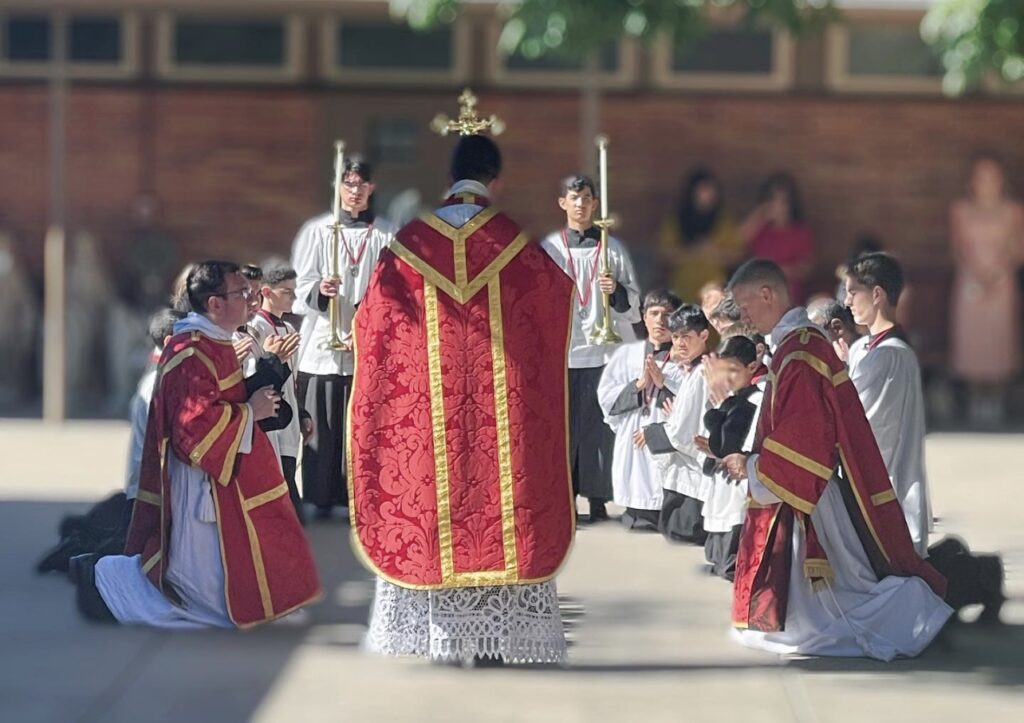
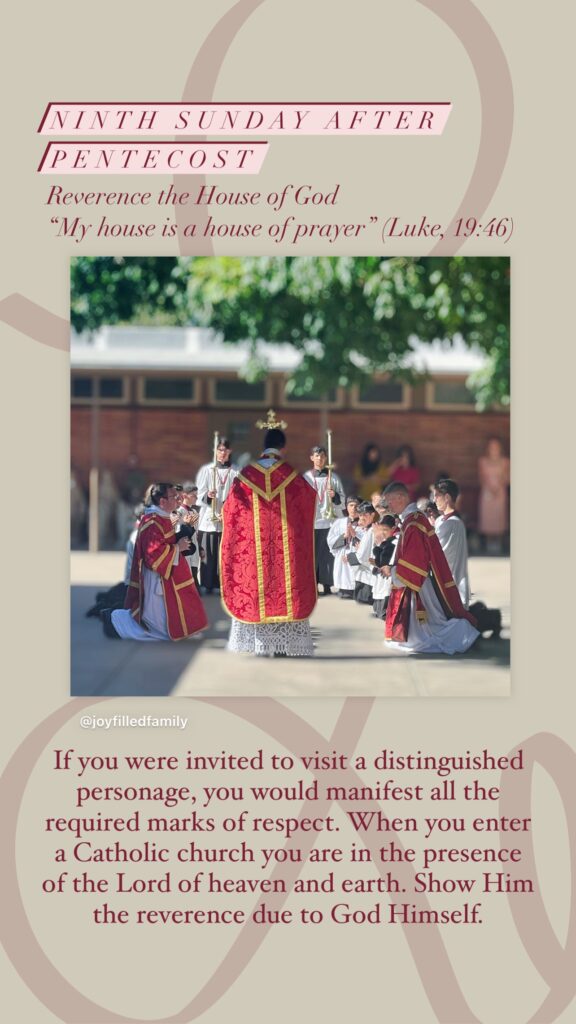
Reverence the House of God
“My house is a house of prayer” (Luke, 19:46)

Sermon from Archbishop Lefebvre


Our Blessed Lord always showed great reverence for the temple of Jerusalem. It was to this majestic edifice that He came at the age of twelve to manifest His reverence for His heavenly Father. Hence, when He found in the temple certain activities repugnant to the respect and the honour due to the house of God He showed justifiable anger in driving out those who were engaged in buying and selling and money-changing. St. John tells us that on this occasion Christ used a whip to put to flight those who were busy with this trafficking (John, 2:15).


If the temple of Jerusalem, where only symbolic sacrifices were offered, mere images of the sacrifice that was to be offered on Calvary, was so worthy of reverence, certainly much more deserving of honour is the Catholic church in which the holy sacrifice of the Mass is daily offered with Christ Himself as the principal Priest and Victim. The Catholic church is not a mere meeting-house where the congregation assembles to listen to a sermon, as is the case with Protestant churches. The Catholic church is the dwelling place of the Son of God, for Christ remains present on the altar night and day under the lowly appearances of bread, that He may give grace and consolation to those who come to kneel before Him.


This is the reason why Catholics manifest such great reverence in their churches. When a Catholic enters the church, his first thought should be that he is coming into the presence of Jesus Christ. His first act of homage should be to the Blessed Sacrament. Before he pays homage to any of the saints, or even to the Blessed Virgin, he should visit the altar on which the Blessed Sacrament is reserved-generally the high altar in our country–and there kneel in adoration. The Church grants an indulgence to those who, on entering a church, proceed immediately to the altar of the Blessed Sacrament and there make even a brief act of adoration (Raccolta, n. 147).


Because of the reverence due to the church, Catholics should not converse unnecessarily, and still less laugh and joke boisterously in church. Such conduct is likely to happen at weddings. Finally, when a Catholic man is passing before the church, he should tip his hat, and a woman should bow as an act of adoration to Our Lord in the Blessed Sacrament. This act is also indulgenced by the Church (Raccolta, n. 146).


Practical Application
If you were invited to visit a distinguished personage, you would manifest all the required marks of respect. When you enter a Catholic church you are in the presence of the Lord of heaven and earth. Show Him the reverence due to God Himself.

Liturgy: Ninth Sunday after Pentecost – Thou Has Not Known the Time of Thy Visitation

Today’s liturgy lays stress on the terrible punishments which will one day be inflicted on those who have denied Christ. They will all perish and not one of them will enter the kingdom of heaven.

Those who have been faithful to Him through all the adversities of this life, will also one day be saved from the hands of their enemies and will follow Him into heaven, whither He went at His Ascension, whose feast the Church celebrates at Paschaltide.

But divine justice is not content with protecting the just against their enemies and with rewarding them for their fidelity; it punishes also those who do evil. The Israelites who tempted Christ by their murmurings perished by fiery serpents (Epistle), and Jerusalem, over which our Lord wept and whose punishment he foretold for its rejection of Himself, was destroyed by war and fire (Gospel).

More than a million Jews perished at the destruction of Jerusalem because they had rejected the Messias, and in the Gospel, our Lord always compared this tragic ending to the catastrophies which will mark the end of all time when God will come to judge the world by fire.

At that moment, the divine judge will accomplish the separation of the good from the evil, rewarding the first and banishing from the kingdom of God all who have denied Him by their unbelief or their sin, just as He drove from the Temple, the type of the Church on earth and in heaven, the traffickers who had transformed that house of God into a den of thieves (Gospel). For then the time of mercy will have passed, and that of justice only will remain. “Wherefore,” says the apostle, “he that thinketh himself to stand, let him take heed lest he fall” (Epistle).

Source: Dom Gaspar Lefebvre, OSB, 1945, adapted and abridged.

A sermon on the Soul for the Ninth Sunday after Pentecost by St. Jean-Marie Vianney

“And when He drew near, seeing the city, He wept over it.” —Luke xix. 41.

When Jesus was about to enter the city of Jerusalem, He wept over it, saying: “If thou wouldst at least have understood the grace I bring thee, and wouldst have derived benefit therefrom, then thou wouldst have still obtained forgiveness; but no, thy blindness has gone so far that all these graces have served only to harden thee, and to increase thy misfortune; thou didst kill the prophets and the children of God, and now thou wilt reach the pinnacle of thy crimes by putting to death the Son of God Himself.” This it was, my dear friends, that caused Jesus to shed copious tears when He was about to enter the city. In the calamity thus foretold, He foresaw and deplored the loss of so many souls, far more guilty than the Jews, because favoured with so many more graces. What moved Him so deeply was that, notwithstanding His merits and His bitter passion, which would have been sufficient to redeem more than a thousand worlds, the greater part of humanity would be lost. Indeed, even among ourselves, He perceived those who despise His graces and employ them only for their own destruction. Who would not tremble, when seriously thinking of saving his soul? Has not Christ warned us under His tears: “If my death and my blood do not serve for thy salvation, they will arouse the everlasting wrath of my Father.”

Is it conceivable, my friends, that in spite of all Jesus has done for the salvation of our soul, we could be indifferent? For the purpose of expelling this indifference from among us, let me endeavour to show you what a soul really is and our obligation toward our soul.

My dear friends, if we would really appreciate the value of our souls, with what care and zeal would we not try to save it! But we never really comprehend its value. To show the great value of a soul is impossible to mortal man. God alone knows the beauties and perfections with which He has adorned a soul. Let me point out to you that God has created heaven and earth, and all they contain, and all these wonders have been created for its benefit. Our catechism gives us an indication of the magnificence of the soul. If you ask a child, “What is understood by saying that ‘man is a creature whose soul is made to the image and likeness of God?’” the child will answer, “That the soul, like God, possesses the faculties to reason, to love, and to act on its own free will.” This, my friends, is the highest testimonial to the qualities with which God has adorned the soul, that it was created by the three persons of the Most Holy Trinity after their own likeness. A spirit like unto God, capable for all eternity of recognizing the sublimities and perfections of God; a soul which is the object of love of the three divine persons, a soul capable of adoring God in all His works; a soul whose whole destiny will be to sing the praises of the Almighty; a soul which has freedom in its actions, so that it may give its affection and its love wheresoever it pleases. It is free to love God or not love Him, but when fortunate enough to turn to God in love, then God Himself seems to be the will of such a soul, and dwells therein in happiness. We may positively state that, since the creation of the world there has never been anything refused to a soul if it was given over entirely to His love. God has instilled our souls with desires which find their gratification not in this world. Give a soul all the joys and treasures of this world, and it will not be satisfied, for the simple reason that God has created the soul for Himself. He alone is capable of satisfying its longings.

Yes, my friends, our soul is capable of loving God, and the love of God alone forms its happiness. If we love Him, all the good and the pleasures which we could ever hope for on earth or in heaven, are ours. We are furthermore enabled to serve God, that is, to glorify Him in our works and actions. There is nothing, down to the most insignificant action, by which it would not be possible for us to glorify the Lord, provided we perform this action out of love for Him. Our occupations upon earth are different from the occupation of the angels in heaven only inasmuch as we cannot as yet behold the Lord with our human eyes, but only with the eyes of faith.

Our soul is so noble, adorned with such beautiful qualities that God entrusted every soul to the care of a prince of His heavenly household, to a guardian angel. Our soul is so precious in the eyes of God, that in His wisdom He could find no worthier food for it than His own divine body, of which the soul may partake as its daily bread, if it so desires. St. Ambrose says, that God esteems our soul so much, that if there had been only one soul in the world, He would not have considered it too great a sacrifice to die for this one soul. He said to St. Teresa: “Thou art so agreeable to me, that, if there had not been a heaven, I would have created one for thee alone.”

“O body, how happy thou art!” exclaims St. Bernard, “to harbor a soul which is adorned with such beautiful graces!” Our soul is something so great, so precious, that nothing but God alone surpasses it. God once showed a soul to St. Catherine. She found it so beautiful that she exclaimed: “Oh, my Lord, if my faith did not teach me that there is only one God, I should believe this soul is another God. I can now understand that Thou hast died for so beautiful a soul!”

Our soul, my dear friends, will be as immortal as God Himself. Can we be surprised, therefore, that God, knowing the value of the soul so well, weeps such bitter tears at the loss of such a soul?

Now, let us consider how much care we must employ to preserve in our soul its great beauties. Oh, my friends, God is so sad over the loss of a soul, that He even wept over it. Already in His prophets, He weeps and bewails the loss of souls. We can see this clearly in the person of the prophet Amos. The prophet says: “When I had retired into solitude and meditated upon the terrible number of crimes which God’s own people committed every day, and when I saw that God’s wrath was ready to descend upon them, and that the abyss of hell was about to open and devour them, then I gathered them together, and said to them, with bitter tears: Oh, my children do you know what my occupation is by day and by night? It is to recall to my mind, in the bitterness of my heart, all your sins. If I fall asleep from exhaustion, I rouse myself immediately, and cry out, my eyes bathed in tears and my heart torn with pain: Oh, my God, my God! is there a soul left in Israel which does not offend Thee? And then, my mind filled with this sad and deplorable state of things, I speak to the Lord and, sighing bitterly in His presence I say: Oh, my God, what must I do to obtain pardon for them? And now listen what the Lord has told me: Prophet, if thou wouldst obtain pardon for these ungrateful people, go into their streets and public places, and let them resound with your lamentations; go into the stores of the merchants, and into the workshops; go into the courts of law; go to the houses of the rich, and the huts of the poor, say to them all, where thou findest them within or without the gates of the city: Woe, woe, unto you, who have sinned against the Lord.”

The prophet Jeremias, dear brethren, goes further still. To show us how grievous the loss of a soul is to God, he exclaims at a moment when he was inspired by the spirit of God: “Ah, my God, what will become of me? Thou hast confided to my care a rebellious people, an ungrateful nation, who will neither listen to Thee nor be subject to Thy guidance. Alas! what shall I do? What resolution shall I take? And the Lord answered me: So as to show them how sorrowfully I am touched at the loss of their souls, take thy hair, tear it from thy head, and throw it far from thee: for the sins of this people has obliged me to forsake them, and my anger is enkindled in the interior of their souls.” When the anger of God is enkindled on account of sin, that is the greatest sickness of the heart. “But, O Lord,” said the prophet, “what shall I do to induce Thee to turn away Thy angry regard from Thy people? Take a sack as raiment, said the Lord to me, strew ashes upon thy head, and weep without ceasing and in such abundance that thy tears will cover thy face, and weep so bitterly that your sins will be drowned in your tears.”

Do you realize, dear brethren, how grievous the loss your souls is to God? You see how miserable we are when we destroy a soul which God has so loved that He, when He had not yet eyes to weep with, borrowed the eyes of the prophet to shed bitter tears at their loss. The Lord says by His prophet Joel: “Weep over the loss of souls, as a young wife who has just lost her husband, who was her only consolation, and who is exposed to all kinds of misfortune.”

If we then consider what it had cost Christ to save our souls; if we consider His whole life, beginning with His lowly birth to His last breath on Calvary, all this suffering of a Godman, infinite in value, will tell us the value of our soul, because all He did was to redeem that soul, was the price paid for our souls.

If, on the other hand, we see what the devil is doing in order to destroy your soul, indeed your soul must be very valuable if he uses all his forces to destroy it. We will, however, not look into this sad picture. Enough to know that he is our greatest enemy, and that we must fight him, and that, with Christ’s grace, we can overcome him.

How true are, therefore, the words of Scripture: What does it profit man to gain the whole world if he lose his soul? O beloved brethren, the knowledge of the value of your soul should move you to guard it as your greatest treasure. Do not allow sin to blemish or to destroy it. As you know that sin will cause the loss of your beautiful soul, guard it, and let this be your resolution on this morning not only to avoid all mortal sin, but even every wilful venial sin, so as to save your soul for heaven, and allow it to reach its destiny, its home, and its reward, the eternal sight of the great glory of God. Amen.


Rev. Fr. Leonard Goffine’s
The Church’s YearINSTRUCTION ON THE NINTH SUNDAY AFTER PENTECOST

Implore God for help and protection against all temptations both visible and invisible, and say with the priest at the Introit:

INTROIT Behold, God is my helper, and the Lord is the protector of my soul: turn back the evils upon my enemies, and cut them off in thy truth, O Lord, my protector. (Ps. LIII.) Save me, O God, by thy name, and deliver me in thy strength. Glory etc.

COLLECT Let the ears of Thy mercy, O Lord, be open to the prayers of Thy suppliants: and that Thou mayest grant them their desires, make them to ask such things as please Thee. Through etc.

EPISTLE (I Cor. X. 6-13.) Brethren, Let us not covet evil things, as they also coveted. Neither become ye idolaters, as some of them: as it is written: The people sat down to eat and drink, and rose up to play. Neither let us commit fornication, as some of them committed fornication, and there fell in one day three and twenty thousand. Neither let us tempt Christ, as some of them tempted, and perished by the serpents. Neither do you murmur, as some of them murmured, and were destroyed by the destroyer. Now all these things happened to them in figure, and they are written for our correction, upon whom the ends of the world are come. Wherefore he that thinketh himself to stand, let him take heed lest he fall. Let no temptation take hold on you, but such as is human: and God is faithful, who will not suffer you to be tempted above that which you are able but will make also with temptation issue that you may be able to bear it.

Can we sin by thought and desire? Yes, if we desire evil and forbidden things, or voluntarily think of them with pleasure, for God prohibits not only evil deeds, but evil thoughts and desires inregard to our neighbor’s wife or goods. (Exod. XX. 17.) Christ says, (Matt. V. 28.) that he who looks upon a woman with evil desire, has already committed adultery. But wicked thoughts and imagination are sinful only when a person consents to, or entertains them deliberately. They become, however, an occasion of gaining merit, if we earnestly strive against them. For this reason God sometimes permits even the just to be tempted by them.

What is meant by tempting God? Demanding presumptuously a mark or sign of divine omnipotence, goodness or justice. This sin is committed when without cause we desire that articles of faith should be demonstrated and confirmed by a new miracle; when we throw ourselves needlessly into danger of body or soul expecting God to deliver us; when in dangerous illness the ordinary and, natural remedies are rejected, and God’s immediate assistance expected.

Is it a great sin to murmur against God? That it is such may be learned from the punishment which God inflicted on the murmuring Israelites; for besides Kore, Dathan, and Abiron whom the earth devoured, many thousands of them were consumed by fire; and yet these had not murmured against God directly, but only against Moses and Aaron whom God had placed over them as their leaders. From this it is seen that God looks upon murmuring against spiritual and civil authority, instituted by Him, as murmuring against Himself. Hence Moses said to the Israelites: Your. murmuring is not against us, but against the Lord. (Exod. XVI. 8.)

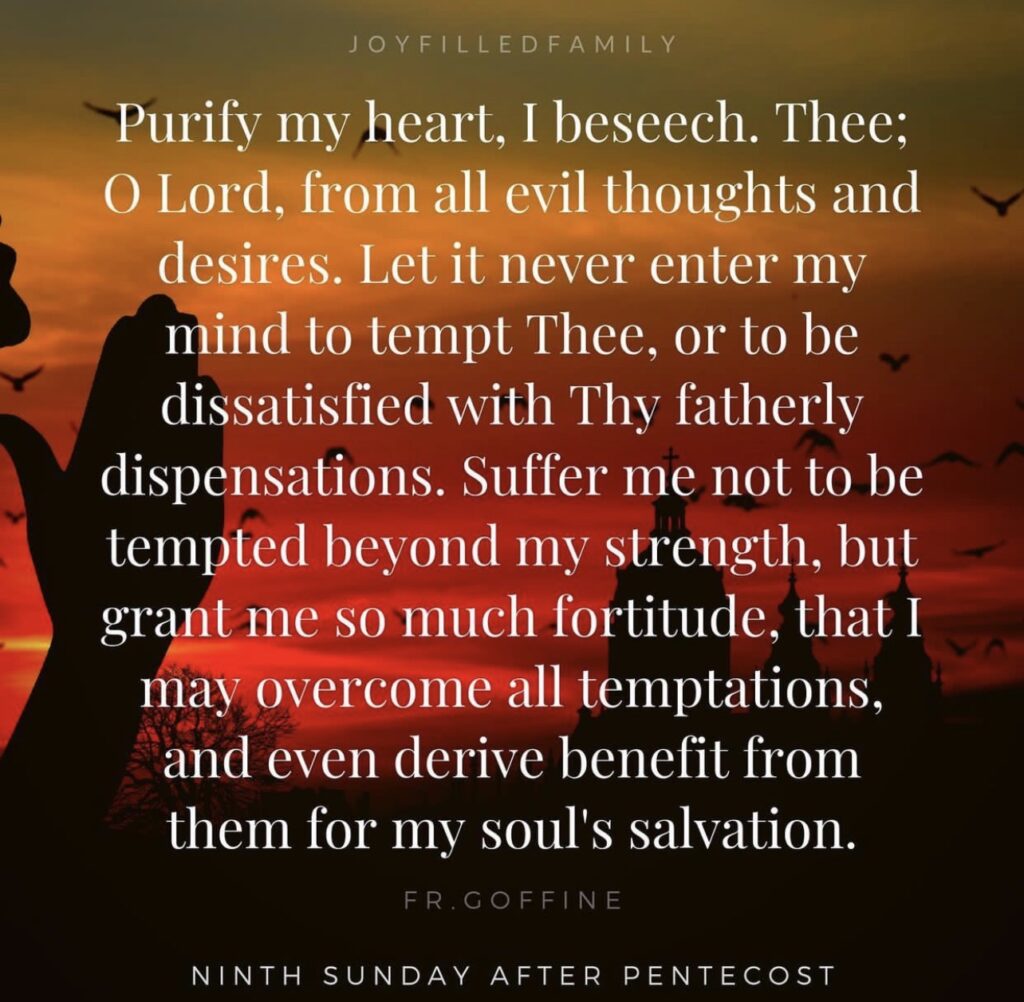
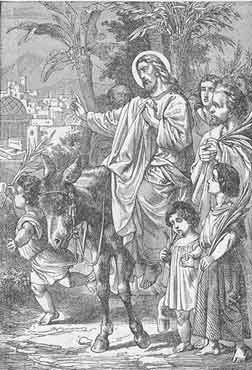
ASPIRATION Purify my heart, I beseech. Thee; O Lord, from all evil thoughts and desires. Let it never enter my mind to tempt Thee, or to be dissatisfied with Thy fatherly dispensations. Suffer me not to be tempted beyond my strength, but grant me so much fortitude, that I may overcome all temptations, and even derive benefit from them for my soul’s salvation.Nineth Sunday After PentecostGOSPEL (Luke XIX. 41-47.) At that time, when Jesus drew near Jerusalem, seeing the city, he wept over it, saying: If thou also hadst known, and that in this thy day, the things that are to thy peace: but now they are hidden from thy eyes. For the days shall come upon thee, and thy enemies shall cast a trench about thee, and compass thee round, and straiten thee on every side, and beat thee flat to the ground, and thy children who are in thee: and they shall not leave in thee a stone upon a stone, because thou hast not known the time of thy visitation. And entering into the temple, he began to cast out them that sold therein, and them that bought, saying to them: It is written, My house is the house of, prayer, but you have made it a den of thieves. And he was teaching daily in the temple.

Why did our Saviour weep over the city of Jerusalem? Because of the ingratitude and obduracy of its inhabitants who would not receive Him as their Redeemer, and who through impenitence were hastening to destruction.

When was the time of visitation? The period in which God sent them one prophet after another who urged them to penance, and whom they persecuted, stoned, and killed. (Matt. XXIII. 34.) It was especially the time of Christ’s ministry, when He so often announced His salutary doctrine in the temple of Jersualem, confirmed it by miracles, proving Himself to be the Messiah, the Saviour of the world, but was despised and rejected by this hardened and impenitent city.

Who are prefigured by this hardened and impenitent city? The hard-hearted, unrepenting sinners who will not recognize the time of God’s visitation, in which He urges them by the mouth of His preachers, confessors, and superiors, and by inward inspiration to reform their lives and seek the salvation of their soul, but who give no ear to these admonitions, and defer conversion to the end of their lives. Their end will be like to that of this impious city; then the enemy, that is, the evil spirit, will surround their soul, tempt, terrify, and drag it into the abyss of ruin. Oh, how foolish it is to squander so lightly, the time of grace, the days of salvation! Oh, how would the damned do penance, could they but return to earth! Oh, how industriously would they employ the time to save their soul! Use, then, my dear Christian, the time of grace which God designs for you, and which, when it is run out or carelessly thrown away, will not be lengthened for a moment.

Will God conceal from the wicked that which serves for their salvation? No; but while they are running after the pleasures of this life, as St. Gregory says, they see not the misfortunes treading in their footsteps, and as consideration of the future makes them uncomfortable in the midst of their worldly pleasures, they remove the terrible thought far from them, and thus run with eyes blindfolded in the midst of their pleasure into eternal flames. Not God, but they themselves hide the knowledge of all that is for their peace, and thus they perish.

ASPIRATION. I beseech Thee, O Lord, who didst weep over the city of Jerusalem, because it knew not the time of its visitation, to enlighten my heart, that I may know and profit by the season of grace.

THE DESTRUCTION OF THE CITY AND TEMPLE OF JERUSALEM

Has our divine Savior’s prophecy concerning, the city of Jerusalem been fulfilled?

Yes, and in the most terrible manner. The Jews, oppressed by the Romans their cruel masters, revolted, killed many of their enemies, and drove them out of Jerusalem. Knowing well that this would not be permitted to pass unavenged, the Jews armed themselves for a desperate resistance. The Emperor Nero sent a powerful army under the command of Vespasian against the city of Jerusalem, which first captured the smaller fortresses of Judea, and then laid siege to the city. The want and misery of the inhabitants had already reached the highest pitch; for within the city ambitious men had caused conflicts; factions had been formed, daily fighting each other, and reddening the streets with blood, while the angry Romans stormed outside. Then a short time of respite was granted to the unfortunate Jews. The Emperor Nero was murdered at Rome in the year of our Lord 68; his successor Galba soon died, and the soldiers placed their beloved commander Vespasian upon the imperial throne. He then left Jerusalem with his army, but in the year he sent his son Titus with a new army to Judea, with orders to capture the city at any price, and to punish its inhabitants.It was the time of Easter, and a multitude of Jews had assembled from all provinces of the land, when Titus appeared with his army before the gates of Jerusalem, and surrounded the city. The supply of food was soon exhausted, famine and pestilence came upon the city and raged terribly. The leader of the savage revolutionists, John of Gischala, caused the houses to be searched, and the remaining food to be torn from the starving, or to be forced from them by terrible tortures: To save themselves from this outrageous tyrant, the Jews took the leader of a band of robbers, named Simon, with his whole gang into the city. John and Simon with their followers now sought to annihilate each other. John took possession of the temple. Simon besieged him; blood was streaming in the temple and in the streets. Only when the battle-din of the Romans was heard from without, did the hostile factions unite, go to meet the enemy, and resist his attack. As the famine increased, many Jews secretly left the city to seek for herbs. But Titus captured them with his cavalry, and crucified those who were armed. Nearly five hundred men, and sometimes more, were every day crucified in sight of the city, so that there could not be found enough of crosses and places of execution; but even this terrible sight did not move the Jews to submission. Incited by their leaders to frenzy, they obstinately resisted, and Titus finding it impossible to take the city by storm, concluded to surround it by walls in order to starve the inhabitants. In three days his soldiers built a wall of about ten miles in circumference, and thus the Saviour’s prediction was fulfilled: Thy enemies shall cast a trench about thee, and compass thee round, and straiten thee on every side.The famine in this unfortunate city now reached its most terrific height; the wretched inhabitants searched the very gutters for food, and ate the most disgusting things. A woman, ravenous from hunger, strangled her own child, roasted it, and ate half of it; the leaders smelling the horrible meal, forced a way into the house, and by terrible threats compelled the woman to show them what she had eaten; she handed them the remaining part of the roasted child, saying.: “Eat it, it is my child; I presume you are not more dainty than a woman, or more tender than a mother.” Stricken with horror they rushed from the house. Death now carried away thousands daily, the streets and the houses were full of corpses: From the fourteenth of April when the siege commenced. to the first of July, there were counted one hundred and fifty-eight thousand dead bodies; six hundred thousand others were thrown over the walls into the trenches to save the city from infection. All who could flee, fled; some reached the camp of the Romans in safety; Titus spared the helpless, but all who fell into his hands armed, were crucified. Flight offered no better security. The Roman soldiers had learned that many Jews had swallowed, gold to secure it from the avarice of the robbers, and therefore the stomachs of many were cut open. Two thousand such corpses were found one morning in the camp of the Romans. The attempts of Titus to prevent this cruelty were unavailing. Finally, when misery had reached its height, Titus succeeded in carrying the fort, Antonia, and with his army forced a passage as far as the temple which had been held by John of Gischala with his famous band. Desirous of saving the temple, Titus offered the revolutionists free passage from it, but his proposition was rejected, and the most violent contest then raged; the Romans trying to enter the temple, and being continually repulsed, at last, one of the soldiers seized a firebrand, and threw it into one of the rooms attached to the temple. The flames in an instant caught the whole of the inner temple, and totally consumed it, so that this prediction of our Lord was also fulfilled. The Romans butchered all the inhabitants whom they met, and Titus having razed the ruins of the temple and city, ploughed it over, to indicate that this city was never to be rebuilt. During the siege one million one hundred thousand Jews lost their lives; ninety-seven thousand were sold as slaves, and the rest of the people dispersed over the whole earth.Thus God punished the impenitent city and nation, over whose wretchedness the Saviour wept so bitterly, and thus was fulfilled the prediction made by Him long before.

What do we learn from this?

That as this prediction so also all other threats and promises of the Saviour will be fulfilled. The destruction of the city and temple of Jerusalem, the dispersion of the Jews, are historical facts which cannot be denied, and testify through all centuries to the truth of our Lord’s word: Heaven and earth shall pass away, but my words shall not pass away. (Matt. XXIV. 35.)

USEFUL LESSONS CONCERNING DEATH-BED REPENTANCE

Can a sinner rely upon his being converted at the end of his life? By no means, for this would be a sin against the mercy of God which is much the same as the sin against the Holy Ghost. “God,” says St. Augustine, “generally so punishes such negligent sinners, that in the end they forget themselves, as in health they forgot Him.” He says: They have turned their back to me, and not their face: and in the time of their affliction they will say: Arise, and deliver us! Where are the gods whom thou hast made thee? Let them arise and deliver thee in the time of thy affliction. (Jer. II. 27-28.) And although we have a consoling example in the case of the penitent thief, yet this, as St. Augustine says, is only one, that the sinner may not despair: and it is only one, so that the sinner may have no excuse for his temerity in putting off his repentance unto the end.

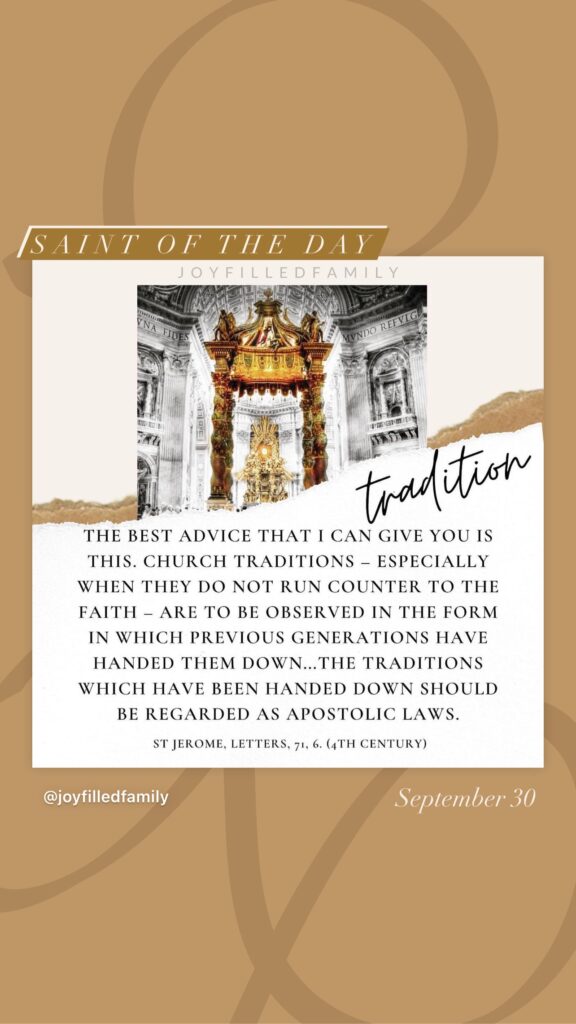
What may we hope of those who are converted at the close of life? Everything that is good if they be truly converted, but this is a very rare thing, as St. Augustine says: “It cannot be asserted with any security, that he who repents at the end has forgiveness;” and St. Jerome writes: “Scarcely one out of thousands whose life was impious, will truly repent at death and obtain forgiveness of sin;” and St. Vincent Ferrer says, “For a man who has lived an impious life to die a good death is a greater miracle than the raising of the dead to life.” We need not be surprised at this, for repentance at the end of life is extorted by the fear of death and the coming judgment. St. Augustine says, that it is not he who abandons sin, but sin abandons him, for he would not cease to offend God, if life were granted him. What can we expect from such a conversion?

When should we repent? While we are in health, in possession of our senses and strength, for according to the words of St. Augustine, the repentance of the sick is a sickly repentance. As experience proves, man while ill is so tormented and bewildered by the pains of sickness and the fear of death, by remorse of conscience, and the temptations of the devil as well as by anxiety for those whom he leaves, that he can scarcely collect his thoughts, much less fit himself for true repentance. Since it is so hard for many to do penance while they are in health, and have nothing to prevent them from elevating their mind to God, how much more difficult will it be for them, when the body is weakened and tortured by the pains of sickness. It has been made known by many persons when convalescent, that they retained not the slightest recollection of anything which occurred during their illness, and although they confessed and received the last Sacraments, they did not remember it. If then you have committed a grievous sin, do not delay to be reconciled as soon as possible by contrition and a sacramental confession. Do not put off repentance from day to day, for thereby conversion becomes more difficult, so much so that without extraordinary grace from God, you cannot repent God does not give His grace to the presumptuous scoffer.

Humanae Vitae Report

July 26, 2022 by Lena {JOYfilledfamily} Filed Under: Uncategorized Leave a Comment

Saint of the Day: St. Henry II, Emperor

July 15, 2022 by Lena {JOYfilledfamily} Filed Under: 07 July Saints, Fr. Francis Xavier Weninger, St. Henry Leave a Comment

Always better than a Friday introduction, a reflection that will take you closer to His holy will.

our daughter captured us in the streets of #beverlyhills while on a mini vacay with our two girls.

Below Father Francis Xavier Weninger, DD, SJ. “Saint Henry, Emperor”. Lives of the Saints, 1876 offers practical application for the saint of the day (7.15), St. Henry II, Emperor of Germany, C. He is a patron of childless people, disabled people, handicapped people, people rejected by religious orders, physically challenged people, against sterility, and more.

➕

Saint Henry prepared himself, first for six days, then six weeks, then six months, and finally, six years for death, as he looked upon the above mentioned words, “After six,” as an announcement of his approaching end.

He acted rightly; for, when death is concerned, no preparation can be too thorough, as our eternity depends upon it.

Have you still to live six years, six months, six weeks, six days? You know not. You are not even assured of six hours; for, the same faith which teaches you that death is certain, teaches you also that the time, manner and place of it are unknown.

Can you believe this, and yet defer to prepare yourself for your departure from this world?

Of course you promise to yourself that you will live many years to come: but how can you promise yourself what is not at all in your power?

Has the Almighty, who alone is Lord over time, life and death, assured you on this point?

Have there not been many deceived who, like yourself, flattered themselves with the hope of a long life?

But even should you still live many years, do you suppose that you would regret having prepared yourself for death, by penance and a Christian life, though you were spared to live longer?

Saint Henry certainly did not regret it. How many thousands suffer in hell, and regret eternally, that deceived by the hope of a long life, they postponed preparing themselves for death.

Taken away suddenly in their sins, they have gone to everlasting destruction.

Whom, then, will you follow, these unhappy ones, or Saint Henry?

“Reform your lives, and prepare yourselves early for death, because the end of our days is unknown.” This admonition comes to us from Saint Augustine.

St. Henry, ora pro nobis.

Saint Henry deprived himself of many things to enrich the house of God. We clothe ourselves in purple and fine linen, and leave Jesus in poverty and neglect. – Pictorial Lives of the Saints

Prayer

Oh, what a royal road do these tread who seek in all things the will of God! (Saint Catherine of Siena).

Practice

Find out and fight to the death the passion that tyrannizes over you; it is tim.e to make an end of it.

– taken from the book Saints and Saintly Dominicans, by Blessed Hyacinthe-Marie Cormier, O.P.

  • « Previous Page
  • 1
  • …
  • 16
  • 17
  • 18
  • 19
  • 20
  • …
  • 124
  • Next Page »

Stay Connected

Search

Categories

Archives

Hi! I'm Lena, mama of JOYfilledfamily.
We are a traditional Catholic family striving to live for Jesus Christ in everything we do. We pray to completely surrender our will to His and to become His servants. Our mission of this blog is to share our JOY.

This blog serves as a journal of us making good memories, living the liturgical year, and our spiritual journey.

Subscribe to our Newsletter

  • Home
  • About
  • Blog

Copyright © 2026 swank WordPress Theme <a PDCD