• Email
  • Facebook
  • Instagram
  • Pinterest
share our JOY

JOY{filled}family

striving to radiate Him always

  • Home
  • Blog
  • Brown Scapular
  • Liturgical Calendars & Planners
  • Wellness
    • Essential Oils
    • Fitness
    • Nutrition
  • Homeschool
  • Sacraments
    • Baptism
    • First Communion
    • Confirmation

St. Patrick

March 15, 2019 by Lena {JOYfilledfamily} Filed Under: 03 March Saints, St. Patrick Leave a Comment

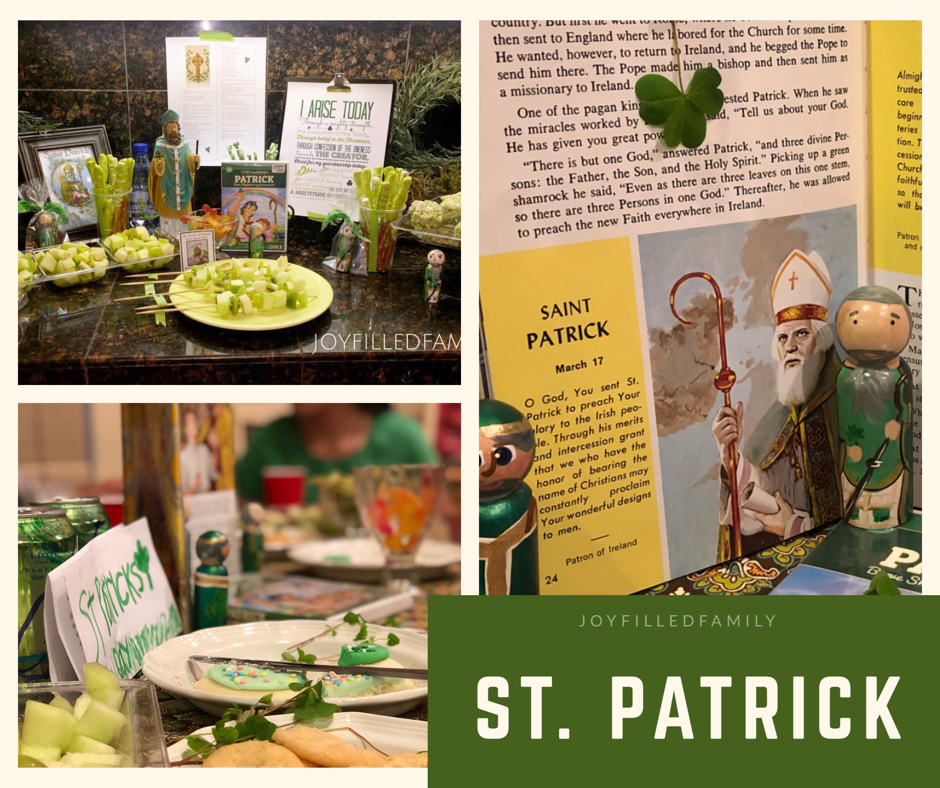
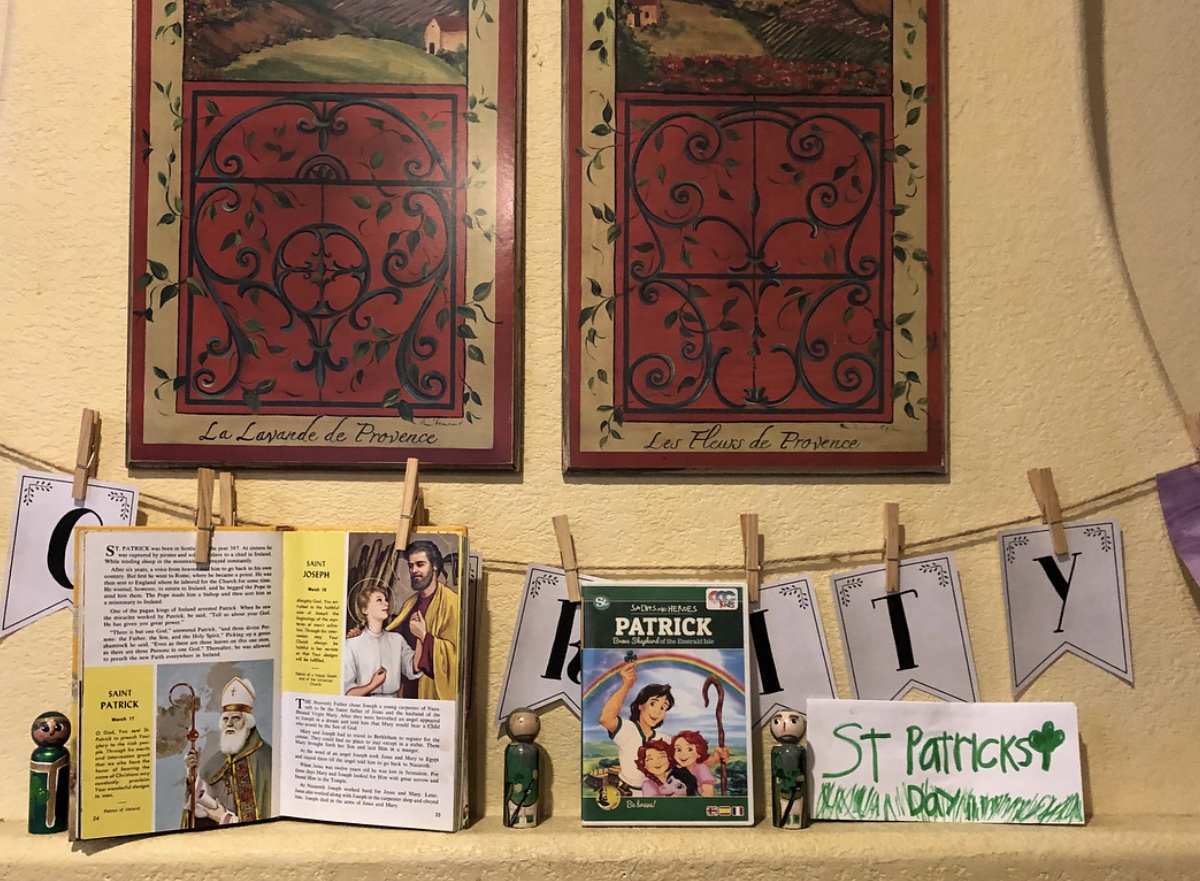
Simple feast day celebrations take on a whole new meaning when they fall in Lent. Below are a few reflections and ideas to celebrate the feast of St. Patrick. (We are able to celebrate as a First Class feast vs. they typical commemoration since he is the patron saint of our diocese. But this year it doesn’t matter since his feast falls on a Sunday.)

SAINT PATRICK

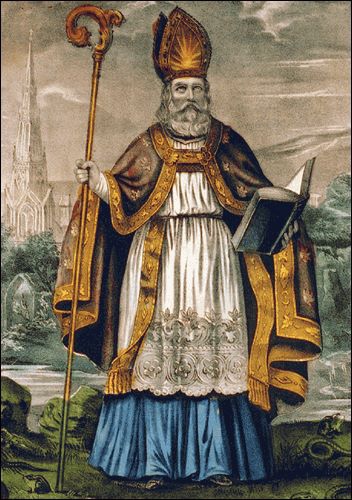
Toward the close of the fourth century, the pagan Irish captured during a slave-hunting raid the Christian youth who would become St. Patrick. The lad was put to work in Ireland as a pigherd for six years. Then he escaped, but with the intention of returning to the land of his captivity as an apostle. The former pigherd was ordained to the priesthood, and in 432 was made a bishop. The Pope himself commissioned Patrick to carry the Faith to Ireland. In his apostolic travels St. Patrick covered the length and breathe of the island. He overcame heartbreaking difficulties and sorrows, because he made Christ his sole changeless friend and helper.

O God, You sent Your blessed confessor bishop Patrick to preach Your glory among the nations. May we fulfill all the duties commanded of us through his merits and intercession. Through Our Lord . . .
 

SAINT PATRICK

Pictorial Lives of the Saints

If the virtue of children reflects an honor on their parents, much more justly is the name of Saint Patrick rendered illustrious by the innumerable lights of sanctity with which the Church of Ireland shone during many ages, and by the colonies of Saints with which it peopled many foreign countries; for, under God, its inhabitants derived from their glorious apostle the streams of that eminent sanctity by which they were long conspicuous to the whole world. Saint Patrick was born towards the close of the fourth century, in a village called Bonaven Taberniae, which seems to be the town of Kilpatrick, on the mouth of the river Clyde, in Scotland, between Dumbarton and Glasgow. He calls himself both a Briton and a Roman, or of a mixed extraction, and says his father was of a good family named Calphurnius, and a denizen of a neighboring city of the Romans, who not long after abandoned Britain, in 409. Some writers call his mother Conchessa, and say she was niece to Saint Martin of Tours.

In his sixteenth year he was carried into captivity by certain barbarians who took him into Ireland, where he was obliged to keep cattle on the mountains and in the forests, in hunger and nakedness, amidst snows, rain, and ice. Whilst he lived in this suffering condition, God had pity on his soul, and quickened him to a sense of his duty by the impulse of a strong interior grace. The young man had recourse to Him with his whole heart in fervent prayer and fasting; and from that time faith and the love of God acquired continually new strength in his tender soul. After six months spent in slavery under the same master, Saint Patrick was admonished by God in a dream to return to his own country, and informed that a ship was then ready to sail thither. He went at once to the sea-coast, though at a great distance, and found the vessel; but could not obtain his passage, probably for want of money. The Saint returned towards his hut, praying as he went, but the sailors, though pagans, called him back, and took him on board. After three days’ sail they made land, but wandered twenty-seven days through deserts, and were a long while distressed for want of provisions, finding nothing to eat. Patrick had often spoken to the company on the infinite power of God, they therefore asked him why he did not pray for relief. Animated by a strong faith, he assured them that if they would address themselves with their whole hearts to the true God, He would hear and succor them. They did so, and on the same day met with a herd of swine. From that time provisions never failed them, till on the twenty-seventh day they came into a country that was cultivated and inhabited.

Some years afterward he was again led captive, but recovered his liberty after two months. When he was at home with his parents, God manifested to him, by divers visions, that He destined him to the great work of the conversion of Ireland. The writers of his life say that after his second captivity he travelled into Gaul and Italy, and saw Saint Martin, Saint Germanus of Auxerre, and Pope Celestine, and that he received his mission and the apostolical benediction from this Pope, who died in 432. It is certain that he spent many years in preparing himself for his sacred calling. Great opposition was made against his episcopal consecration and mission, both by his own relations and by the clergy. These made him great offers in order to detain him among them, and endeavored to affright him by exaggerating the dangers to which he exposed himself amidst the enemies of the Romans and Britons, who did not know God. All these temptations threw the Saint into great perplexities, but the Lord, whose will he consulted by earnest prayer, supported him, and he persevered in his resolution. He forsook his family, sold his birthright and dignity, to serve strangers, and consecrated his soul to God, to carry His name to the ends of the earth. In this disposition he passed into Ireland, to preach the Gospel, where the worship of idols still generally reigned. He devoted himself entirely to the salvation of these barbarians. He travelled over the whole island, penetrating into the remotest corners, and such was the fruit of his preachings and sufferings that he baptized an infinite number of people. He ordained everywhere clergymen, induced women to live in holy widowhood and continence, consecrated virgins to Christ, and instituted monks. He took nothing from the many thousands whom he baptized, and often gave back the little presents which some laid on the altar, choosing rather to mortify the fervent than to scandalize the weak or the infidels. He gave freely of his own, however, both to Pagans and Christians, distributed large alms to the poor in the provinces where he passed, made presents to the kings, judging that necessary for the progress of the Gospel, and maintained and educated many children, whom he trained up to serve at the altar. The happy success of his labors cost him many persecutions. A certain prince named Corotick, a Christian in name only, disturbed the peace of his flock. This tyrant, having made a descent into Ireland, plundered the country where Saint Patrick had been just conferring confirmation on a great number of neophytes, who were yet in their white garments after baptism. Corotick massacred many, and carried away others, whom he sold to the infidel Picts or Scots. The next day the Saint sent the barbarian a letter entreating him to restore the Christian captives, and at least part of the booty he had taken, that the poor people might not perish for want; but was only answered by railleries. The Saint, therefore, wrote with his own hand a letter. In it he styles himself a sinner and an ignorant man; he declares, nevertheless, that he is established bishop of Ireland, and pronounces Corotick and the other parricides and accomplices separated from him and from Jesus Christ, whose place he holds, forbidding any to eat with them, or to receive their alms, till they should have satisfied God by the tears of sincere penance, and restored the servants of Jesus Christ to their liberty. This letter expresses his most tender love for his flock, and his grief for those who had been slain, yet mingled with joy, because they reign with the prophets, apostles, and martyrs. Jocelin assures us that Corotick was overtaken by the divine vengeance.

Saint Patrick held several councils to settle the discipline of the Church which he had planted. Saint Bernard and the tradition of the country testify that Saint Patrick fixed his metropolitan see at Armagh. He established some other bishops, as appears by his Council and other monuments. He not only converted the whole country by his preaching and wonderful miracles, but also cultivated this vineyard with so fruitful a benediction and increase from heaven, as to render Ireland a most flourishing garden in the Church of God, and a country of Saints.

Many particulars are related of the labors of Saint Patrick, which we pass over. In the first year of his mission he attempted to preach Christ in the general assembly of the kings and states of all Ireland, held yearly at Tara, the residence of the chief king, styled the monarch of the whole island, and the principal seat of the Druids or priests, and their paganish rites. The son of Neill, the chief monarch, declared himself against the preacher; however, Patrick converted several, and, on his road to that place, the father of Saint Benignus, his immediate successor in the see of Armagh. He afterward converted and baptized the kings of Dublin and Munster, and the seven sons of the king of Connaught, with the greatest part of their subjects, and before his death almost the whole island. He founded a monastery at Armagh; another called Domnach-Padraig, or Patrick’s Church; also a third, named Sabhal-Padraig, and filled the country with churches and schools of piety and learning, the reputation of which, for the three succeeding centuries, drew many foreigners into Ireland. He died and was buried at Down, in Ulster. His body was found there in a church of his name in 1185, and translated to another part of the same church.

Ireland is the nursery whence Saint Patrick sent forth his missionaries and teachers. Glastonbury and Lindisfarne, Ripon and Malmesbury, bear testimony to the labors of Irish priests and bishops for the conversion of England. Iona is to this day the most venerated spot in Scotland. Columban, Fiacre, Gall, and many others evangelized the “rough places” of France and Switzerland. America and Australia, in modern times, owe their Christianity to the faith and zeal of the sons and daughters of Saint Patrick.

Reflection – By the instrumentality of Saint Patrick the faith is now as fresh in Ireland, even in this cold nineteenth century, as when it was first planted. Ask him to obtain for you the special grace of his children, to prefer the loss of every earthly good to the least compromise in matters of faith.

ST. PATRICK’S TEA

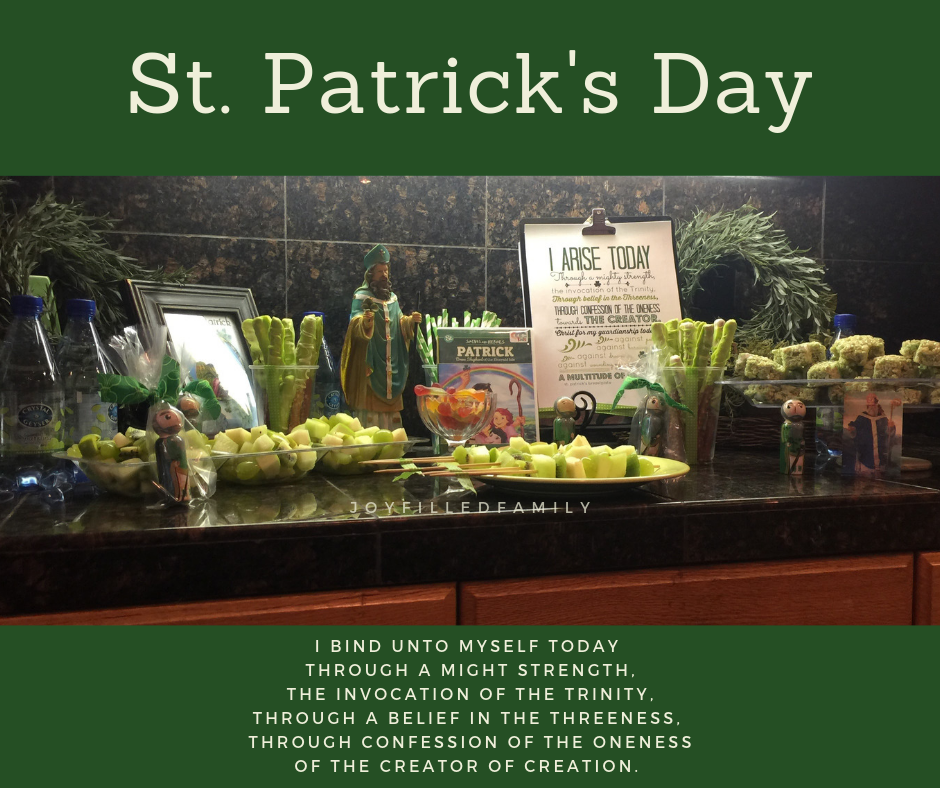
  • Holy Trinity Shamrocks – Green shamrock Rice Krispie treats and cucumber tea sandwiches cut with shamrock cookie cutter
  • St. Patrick’s Staff — Green chocolate dipped pretzel wands
  • Serpents – Gummy worms
  • Green fruit/veggie platter & kabobs
  • Lime Sparkling Water
  • Diffuse Lime, Grapefruit, and Bergamot — a great uplifting oils that radiate spring
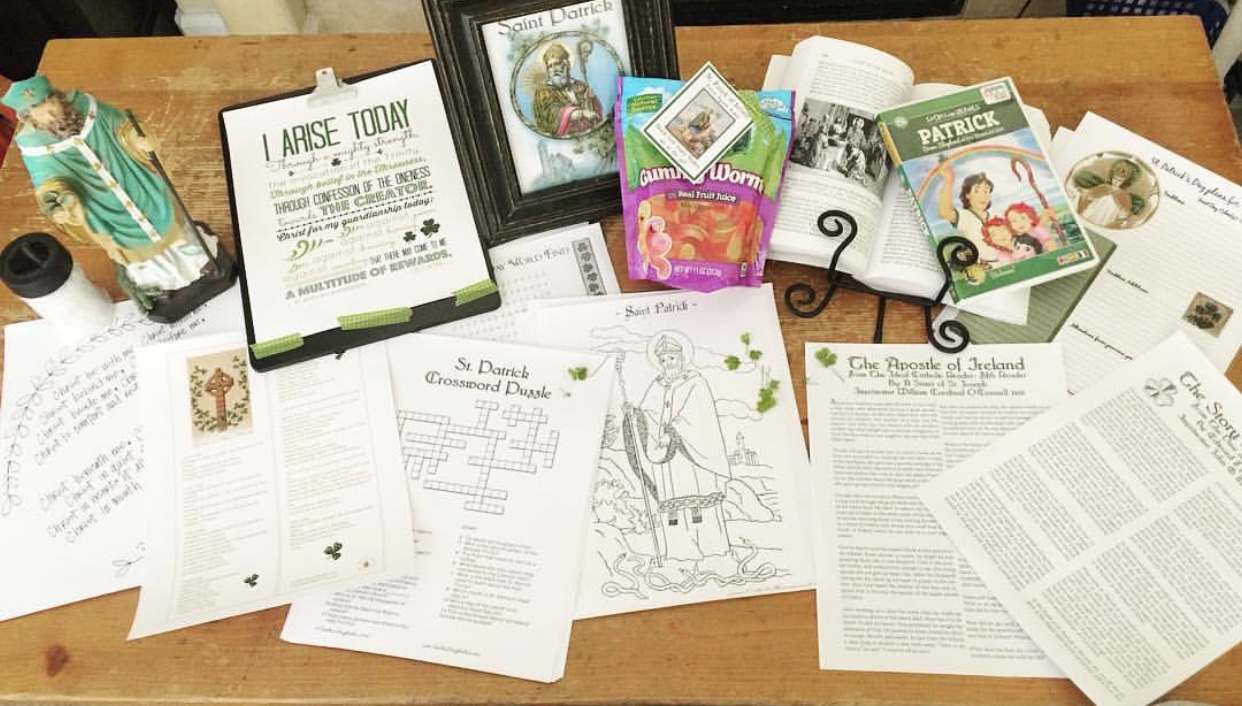
  • St. Patrick printable activities (see links below)
  • View St. Patrick movie

St Patrick’s Breastplate

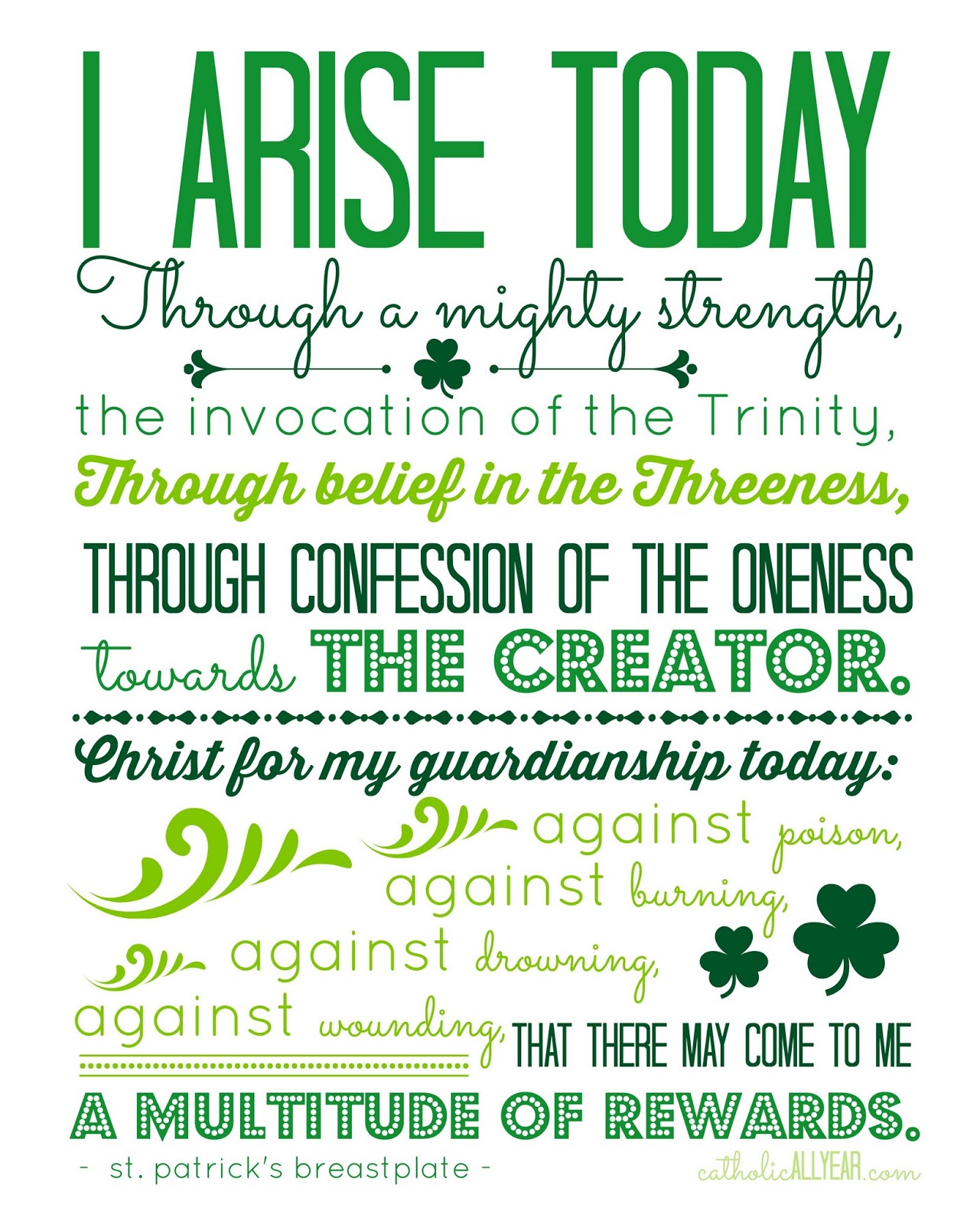
I bind unto myself today 
Through a might strength,
The invocation of the Trinity,
Through a belief in the Threeness, 
Through confession of the Oneness
Of the Creator of creation. 

I bind unto myself today 
The strength of Christ’s birth and His baptism,
The strength of His crucifixion and His burial,
The strength of His resurrection and His ascension,
The strength of His descent for the judgment of doom.
I bind unto myself today
The strength of the love of the Cherubim
The obedience of angels,
The service of archangels,
The hope of resurrection to meet with reward,
The prayers of the patriarchs,
The preaching of the apostles,
The faith of confessors,
The innocence of virgins
The deeds of righteous men.
I bind unto myself today
The strength of heaven;
The light of the sun,
The splendor of fire,
The speed of lightning,
The swiftness of the wind,
The depth of the sea,
The stability of the earth,
The firmness of the rock.
I bind unto myself today
God’s strength to pilot me;
God’s might to uphold me,
God’s wisdom to guide me,
God’s eye to look before me,
God’s ear to hear me,
God’s word to speak for me,
God’s hand to guard me,
God’s way to lie before me,
God’s shield to protect me,
God’s hosts to save me
From the snares of the devil,
From the temptations of vices,
From the lusts of nature
From every one who desires me ill,
Afar and anear,
Alone or in a multitude.
I summon today all these powers
Between me and evil,
Against every cruel merciless power that opposes my body and soul;
Against the incantations of false prophets,
Against the black law of pagandom,
Against the false laws of heretics,
Against the craft of idolatry,
Against spells of women and smiths and wizards,
Against every knowledge that corrupts man’s body and soul.
Christ shield me today
Against poison, against burning,
Against drowning, against wounding,
So that reward may come to me in abundance.
Christ with me, Christ before me,
Christ behind me, Christ in me,
Christ beneath me, Christ above me,
Christ on my right, Christ on my left,
Christ when I lie down, Christ when I sit down,
Christ in the fort, Christ in the chariot,
Christ in the captain’s deck of a ship,
Christ in the heart of every man who thinks of me,
Christ in the mouth of every man who speaks of me,
Christ in the eye that sees me,
Christ in the ear that hears me.
I bind unto myself today
Through a mighty strength,
The invocation of the Trinity,
Though a belief in the Threeness,
Through a confession of the Oneness
Of the Creator of creation.

RESOURCES:

  • St. Patrick Coloring Page – Catholic Playground
  • St. Patrick Printable Holy Card – Holy Reflections
  • St. Patrick Unit Study – Kennedy Adventures
  • St. Patrick Breastplate Printable – Catholic All Year
  • More St. Patrick Inspiration — JOYFILLEDFAMILY Pinterest
  • Blessed Trinity Shamrock – Catechism Lesson/Craft – Shower of Roses
  • St. Patrick and the Easter Fire – Sensus Fidelium
  • Confessions of St. Patrick – This LibriVox recording of this short autobiography by St. Patrick,
  • The Poetic Life of St. Patrick – SSPX
  • St. Patrick Audio Story and Other Saint StoriesRegina Martyrum

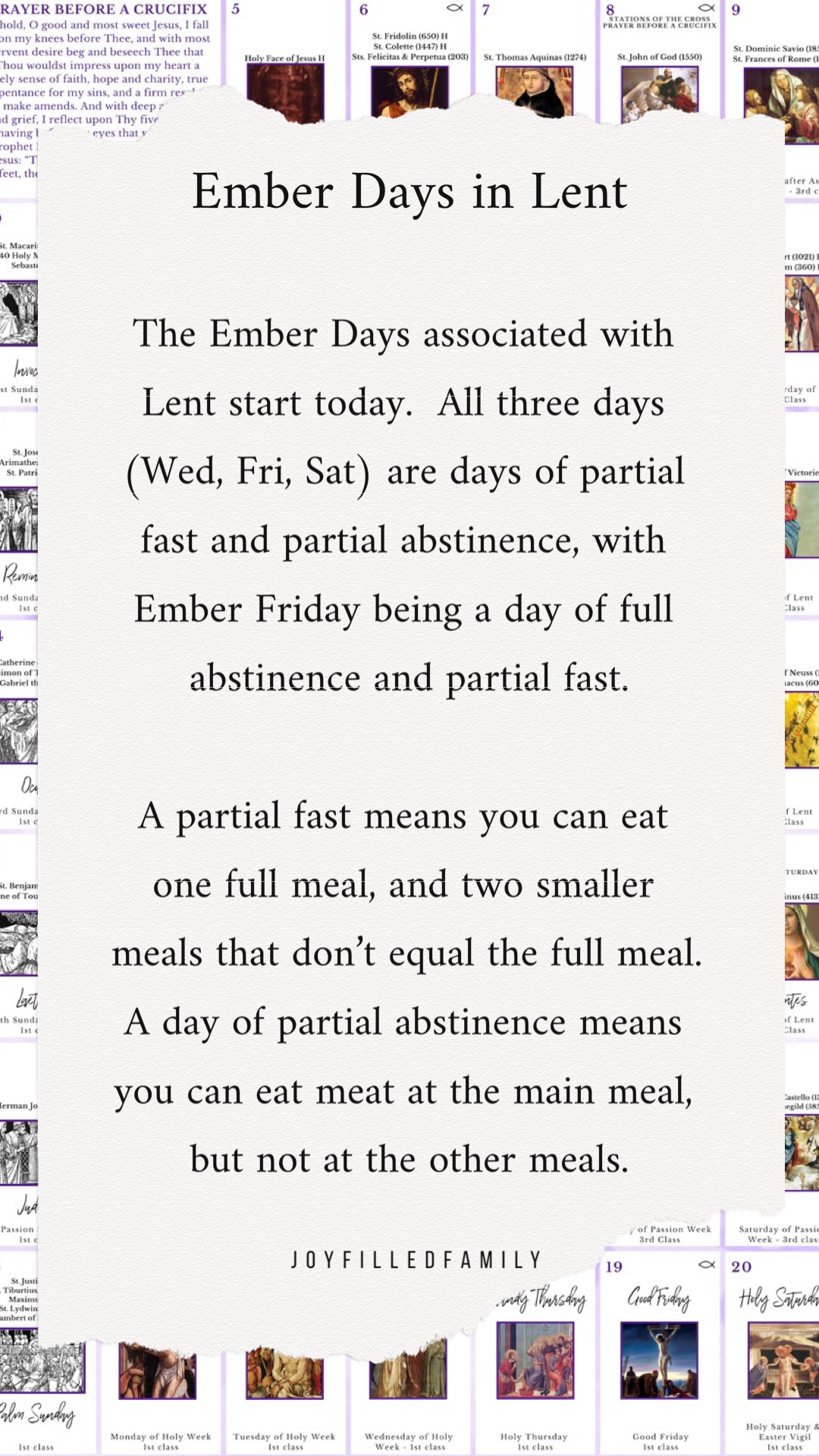
Ember Days in Lent

March 13, 2019 by Lena {JOYfilledfamily} Filed Under: Ember Days, Lent, Lent Ember Day Leave a Comment

The purpose of their introduction, besides the general one intended by all prayer and fasting, was to thank God for the gifts of nature, to teach men to make use of them in moderation, and to assist the needy.

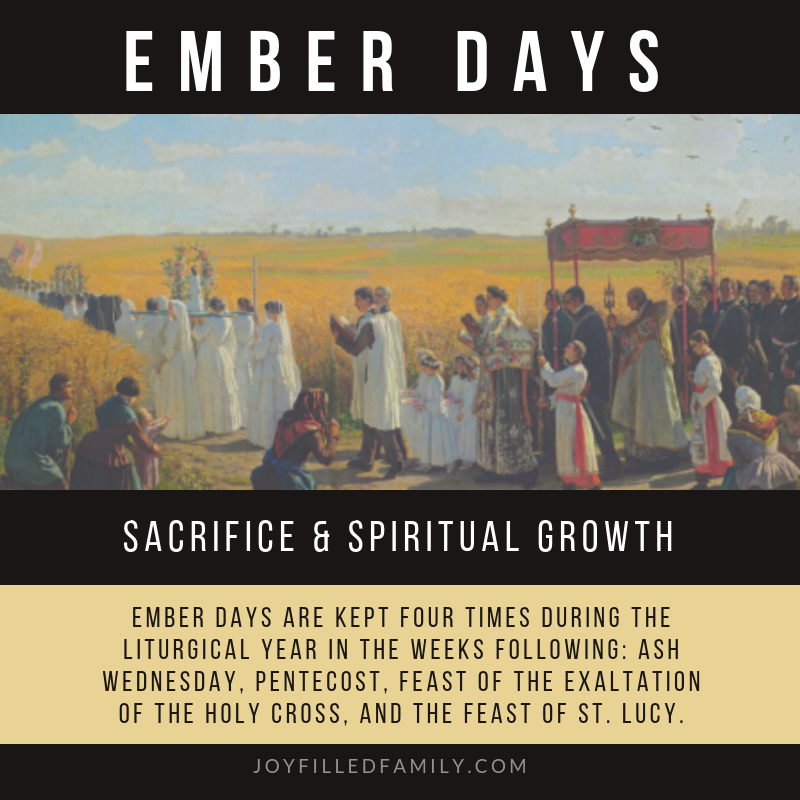
Here’s a catchy rhyme that has been used in English for a couple hundred years to help the faithful remember when four Ember Days occur.

Lenty, Penty, Crucy, Lucy.”

Meaning, the weeks following: Ash Wednesday, Pentecost, Feast of the Exaltation of the Holy Cross, Feast of St. Lucy.

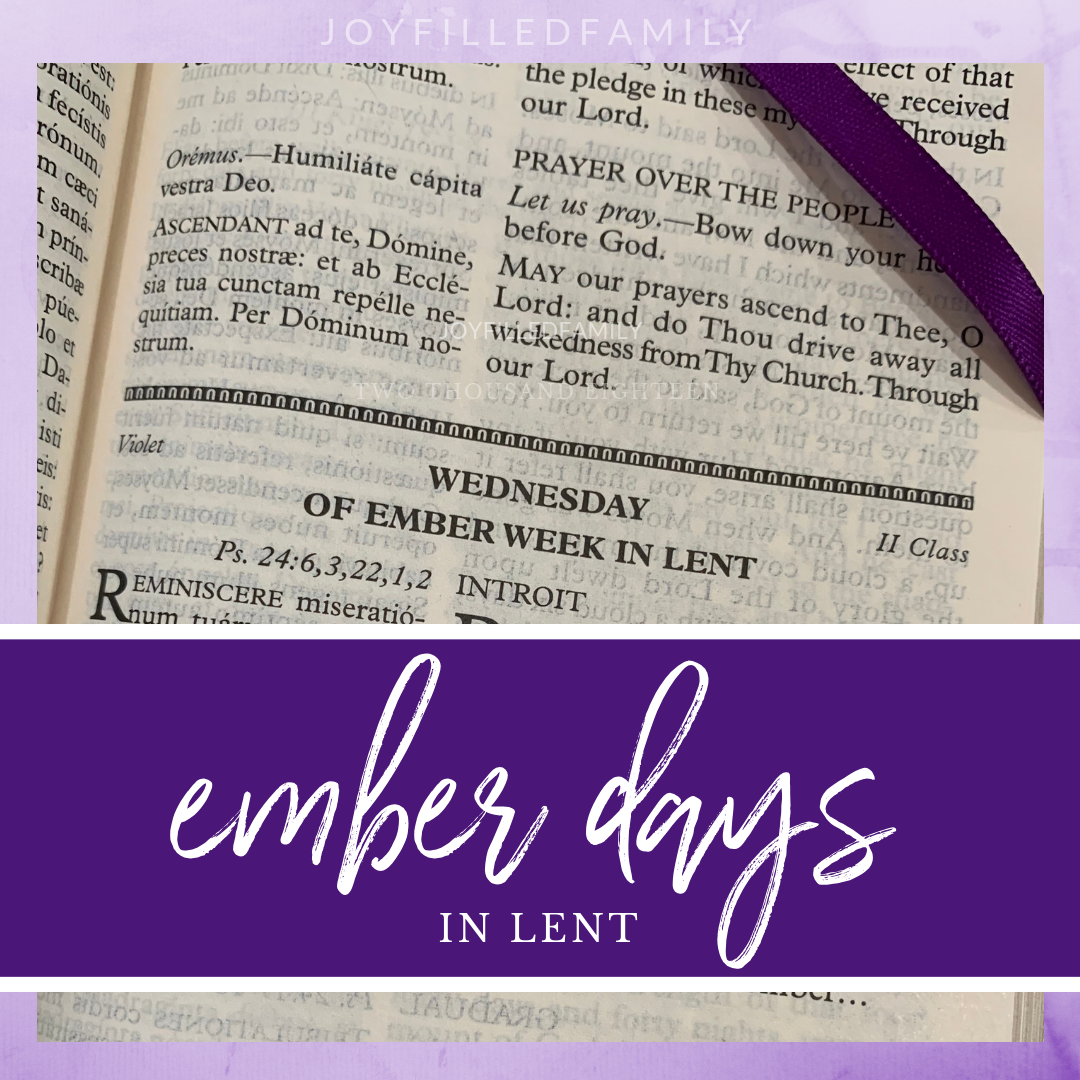
EMBER DAYS IN LENT

The Liturgical Year, Dom Guéranger O.S.B.

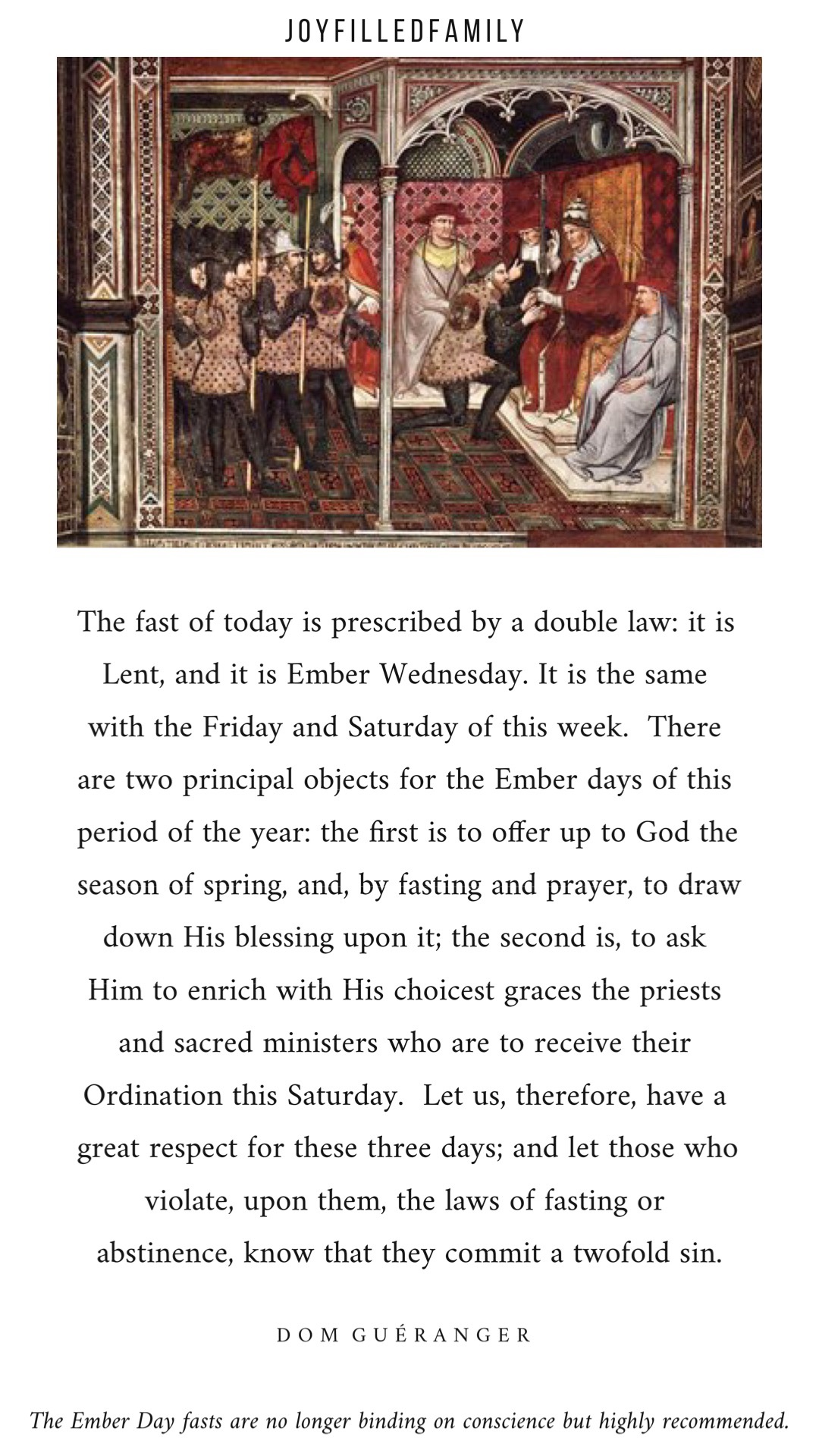
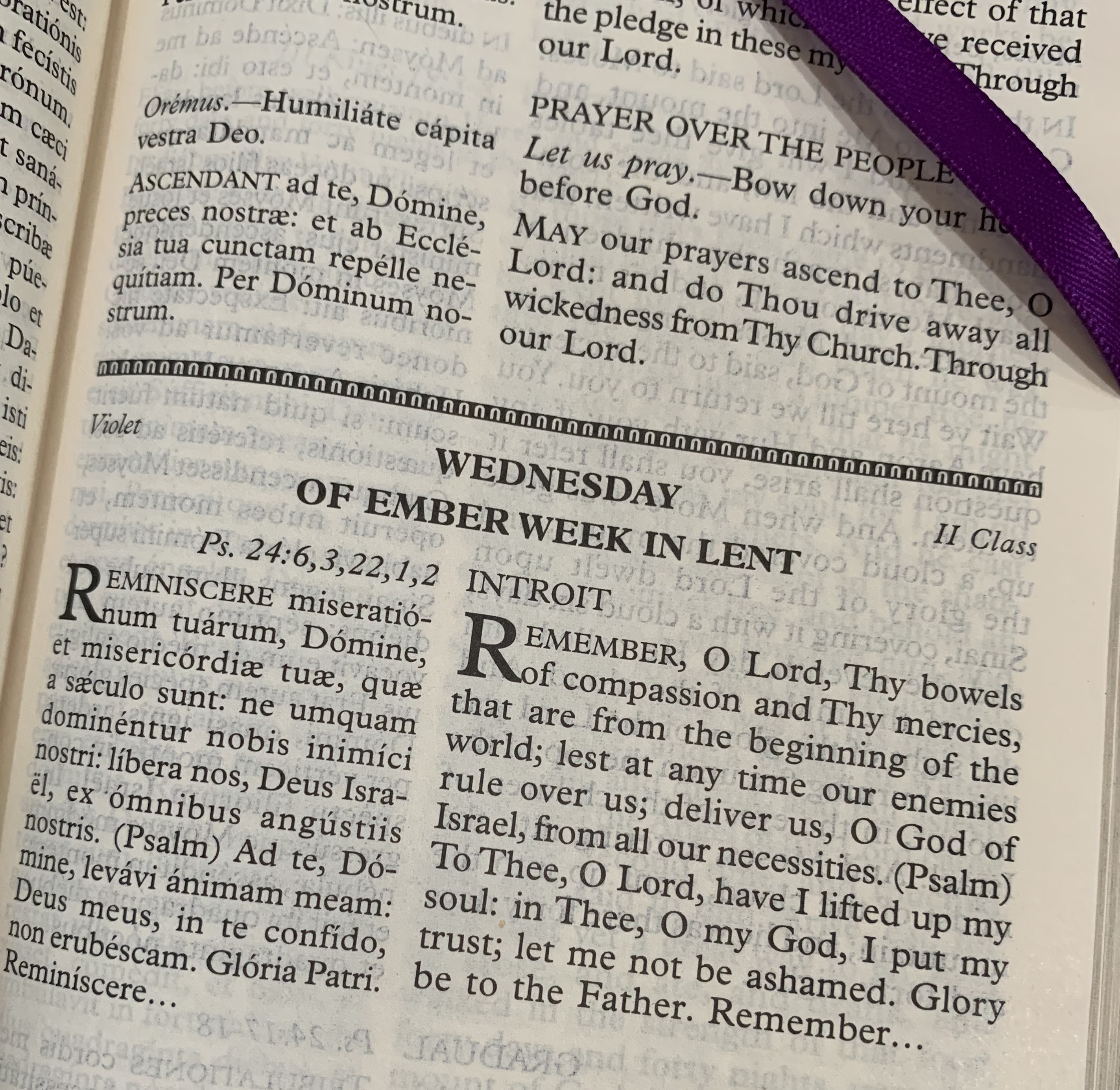
The fast on the Wednesday after the First Sunday of Lent is prescribed by a double law—it is Lent, and it is Ember Wednesday. It is the same with the Friday and Saturday of this week. There are two principal objects for the Ember Days of this period of the year: the first is to offer to God the season of Spring, and, by fasting and prayer, to draw down His blessing upon it; the second is to ask Him to enrich with His choicest graces the priests and sacred ministers who are to receive their Ordination on Saturday. Let us, therefore, have a great respect for these three days; and let those who violate upon them the laws of fast or abstinence, know that they commit a twofold sin.

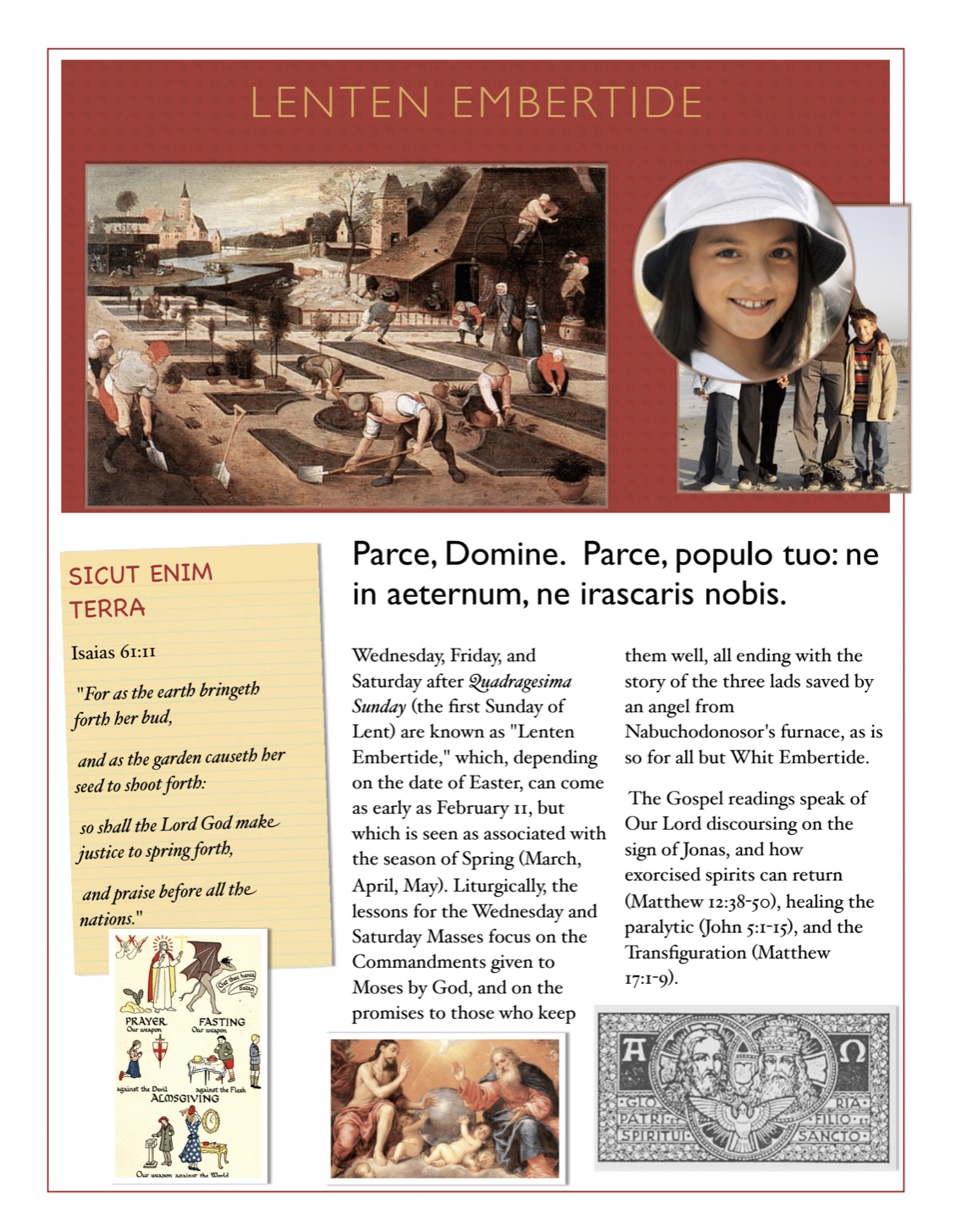
Up to the 11th century the Ember Days of Spring were kept in the first week of March; and those of Summer, in the second week of June. It was Pope St. Gregory VII who fixed them as we now have them; that is, the Ember Days of Spring in the first full week of Lent, and those of Summer during the Octave of Pentecost.

On all the Ember Wednesdays there are read, in place of the Epistle at Mass, two Lessons from Sacred Scripture. Today the Church brings before us the two great types of Lent—Moses in the first Lesson and Elias in the second—in order to impress us with an idea of the importance of this forty days’ fast, which Christ Himself solemnly consecrated when He observed it, thus fulfilling, in His own Person, what the Law and the Prophets had but prefigured.

Moses and Elias fasted for forty days and forty nights, because God bade them come near to Him. Man must purify himself, he must unburden himself, in some measure at least, of the body which weighs him down, if he would enter into communication with Him, Who is the Holy Spirit. And yet the vision of God granted to these two holy personages was very imperfect: they felt that God was near them, but they beheld not His glory. But when the fullness of time came (Gal. 4: 4), God manifested Himself in the flesh: and man saw and heard and touched Him (1 John 1: 1). We indeed are not of the number of those favored ones who lived with Jesus, the Word of Life; but in the Holy Eucharist He allows us to do more than see Him—He enters into our breasts, He is our Food. The humblest member of the Church possesses God more fully then either Moses on Sinai or Elias on Horeb. We cannot, therefore, be surprised that the Church, in order to fit us for this favor at the Easter solemnity, bids us go through a preparation of forty days, though its severity is not to be compared with the rigid fast which Moses and Elias had to observe as the condition of receiving what God promised them.

On Ember Friday we are reminded of the ancient Lenten discipline of the Church. We would frequently be at a loss to understand Her liturgy of this season, unless we picture Her to ourselves as preparing the public penitents for a renewed participation in the Sacred Mysteries. But first they must be reconciled to God, Whom they have offended. Their soul is dead by sin; can it be restored to life? Yes; we have God’s word for it. The Lesson from the prophet Ezechiel, which the Church began yesterday for the catechumens, is continued today for the benefit of the public penitents. If the wicked do penance for all his sins, which he hath committed, and keep all My commandments, and do judgment and justice; living he shall live, and shall not die. But his iniquities are upon him and rise up against him, crying to Heaven for eternal vengeance! And yet God, Who knows all things, and forgets nothing, assures us that He will not remember iniquities which have been redeemed by penance. Such is the affection of His Fatherly Heart, that He will forget the outrage offered Him by His child, if this child will but return to its duty. Thus then the penitents are to be reconciled; and on the Feast of the Resurrection they will be associated with the just, because God will have forgotten their iniquities; they themselves will be just men. Thus it is that the Liturgy, which never changes in its essentials, brings frequently before us the ancient discipline of public penance.

Nowadays, sinners are not visibly separated from the faithful; the Church doors are not closed against them; they frequently stand near the holy altar, in the company of the just; and when God’s pardon descends upon them, the faithful are not made cognizant of the grace by any special and solemn rite. Let us here admire the wonderful mercy of our Heavenly Father, and profit by the indulgent discipline of our Holy Mother the Church. The lost sheep may enter the fold at any hour and without any display; let him take advantage of the condescension thus shown him, and never more wander from the Shepherd, Who thus mercifully receives him. Neither let the just man be puffed up with self-complacency, by preferring himself to the lost sheep; let him rather reflect on those words of today’s lesson: If the just man turn himself away from his justice, and do iniquity… the justices which he hath done shall not be remembered. Let us, therefore tremble for ourselves, and have compassion on sinners. One of the great means on which the Church rests Her hopes for the reconciliation of sinners is the fervent prayers offered up for them by the faithful during Lent.

The Gospel of today tells of the cure of the infirm man who had waited 38 years at the Probatica pool—a figure of the Sacrament of Penance. How was his cure wrought? First of all, the infirm man says to Jesus: I have no man, when the water is troubled, to put me into the pond. The water would have cured him; but observe, he has need of some Man to lead him to the water. This Man is the Son of God, and He became Man in order to heal us. As Man, He has received power to forgive sins, and before leaving this earth, He gave that same power to other men, and said to them: Whose sins ye shall forgive, they are forgiven them (John 20: 23). The penitents, then, are to be reconciled with God by virtue of this supernatural power; and the infirm man, who takes up his bed and walks, is a figure of the sinner, whose sins have been forgiven him by the Church, by the divine power of the keys.

In the third century, a heretic named Novatian taught that the Church has not the power to forgive sins committed after Baptism. This doctrine was condemned by the Councils and the holy Doctors of the Church; and in order to offer to the faithful some outward expression of the power given to the Son of Man of forgiving sins to such as repent, there was painted on the walls of the places where the Christians used to assemble, the infirm man of the Gospel, walking with his bed upon his shoulders. This consoling symbol is frequently met with in the frescoes which were painted, even in the age of the Martyrs, in the Roman catacombs. They show us how the early Christians were taught to understand this passage of the Gospel, which the Church, so many centuries ago, assigned to this day.

The Water of the Probatica was also a symbol; and here the Gospel conveyed a special instruction to the Catechumens. It was by Water that they were to be made whole, and by Water endowed with a supernatural virtue. The miraculous pond of Jerusalem could only cure the body, and that at rare intervals, and the favor could only be conferred upon a single individual; but now that the Angel of the Great Counsel has come down from Heaven and sanctified the waters of the Jordan, the Probatica is everywhere—it is giving health to the souls of man without any limitation either of time or number.  Man is the minister of this grace; but it is the Son of God, become the Son of Man, that works by the human minister.

Let us also consider the multitude of sick, who, as the Gospel tells us, were waiting for the moving of the water. They represent the various classes of sinners, who are seeking, during this holy time, to be converted to their God. There are the Sick, or as the Latin word has it, the Languid—these are the torpid, who never thoroughly give up their evil habits; there are the Blind—these are they whose spiritual eye is dead; there are the Lame—who limp and falter in the path to salvation; and lastly there are the Withered—who seem incapable of doing a single good action. All are waiting for the favorable moment. Jesus will soon be with them, and will say to each of them: Wilt thou be made whole? Let them answer this question with love and confidence, and they will be healed.

The Station for every Ember Saturday is, as we have seen, in the Basilica of St. Peter—the Vatican—where the people were wont to assemble toward evening, that they might be present at the Ordination of the Priests and Sacred Ministers. This day was called Twelve-Lesson-Saturday, because, formerly, twelve passages from Holy Scripture used to be read. (The number now is seven—five Lessons, the Epistle and the Gospel.) The Mass during which the Ordinations were given, was celebrated during the night; so that by the time it was over, the Sunday had begun. Later on the Ordination Mass was celebrated early on Saturday, but, in memory of the ancient practice, the Gospel for Saturday is repeated on Sunday—in this case, the Gospel of the Transfiguration. The following is the interpretation given by the ancient Liturgists, among whom we may especially mention the learned Abbot Rupert:

“The Church would have us think upon the sublime dignity which has been conferred upon the newly ordained Priests. They are represented by the three Apostles, who were taken by Jesus to the high mountain, and favored with the sight of His glory. The rest of the Disciples were left below: Sts. Peter, James and John were the only ones permitted to ascend Tabor; and they, when the time should come, were to tell their fellow Apostles, and the whole world, how they had seen the glory of their Master and heard the words of the Father declaring the Divinity of the Son of Man.  This voice, says St. Peter, coming down to Him from the excellent glory: This is My Beloved Son, in Whom I am well pleased; hear ye Him. And this voice we heard, brought from Heaven, when we were with Him on the holy mount (2 Peter 1: 17, 18). In like manner, these priests who have just been ordained, and for whom you have been offering up your prayers and fasts, will enter into the cloud with the Lord. They will offer up the Sacrifice of your salvation in the silence of the sacred Canon. God will descend into their hands, for your sake; and though they are mortal and sinners, yet will they, each day, be in closest communication with the Divinity. The forgiveness of your sins, which you are now preparing to receive from your heavenly Father, is to come to you through their hands; their superhuman power will bring it down from Heaven upon your souls. It is thus that God has cured our pride. The serpent said to us through our first parents: Eat of this fruit, and you shall be as gods. We unfortunately believed the tempter, and the fruit of our transgression was death. God took pity on us, and resolved to save us; but it is by the hands of men that He would save us, and this in order to humble our haughtiness. His own eternal Son became Man, and He left other men after Him, to whom He said: As the Father has sent Me, I also send you (John 20: 21). Let us, then, show honor to these men, who have, this very day, been raised to so high a dignity. One of the duties imposed on us by our holy religion is respect to the Priesthood.”

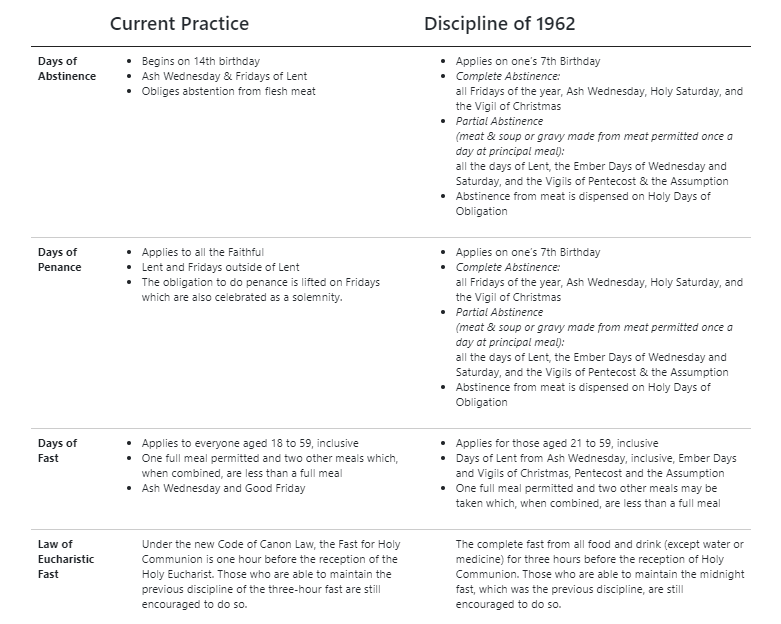
Fasting & Abstinence

Current Practice vs. 1962 Discipline

As a help in understanding the Church’s discipline of fast and abstinence, the following summary of the requirements, both current and those in force in 1962, has been excerpted from the Liturgical Ordo published by the Priestly Fraternity of St. Peter.

History of the Ember Days

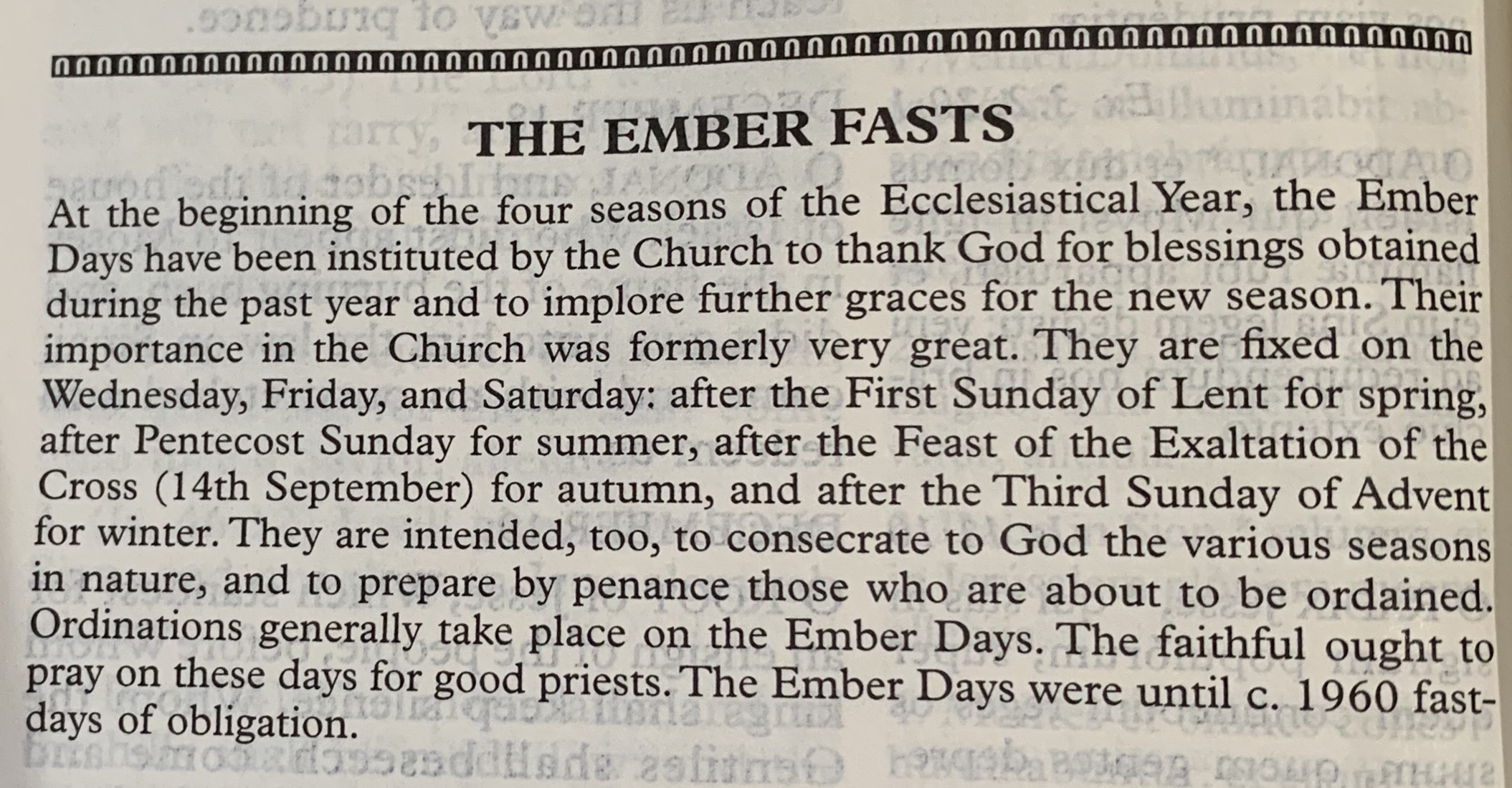
The Ember Days, which were historically kept four times during the liturgical year, have a venerable history. Here is the explanation from the 1917 Catholic Encyclopedia.

The purpose of their introduction, besides the general one intended by all prayer and fasting, was to thank God for the gifts of nature, to teach men to make use of them in moderation, and to assist the needy. The immediate occasion was the practice of the heathens of Rome. The Romans were originally given to agriculture, and their native gods belonged to the same class. At the beginning of the time for seeding and harvesting religious ceremonies were performed to implore the help of their deities: in June for a bountiful harvest, in September for a rich vintage, and in December for the seeding; hence their feriae sementivae, feriae messis, and feri vindimiales. The Church, when converting heathen nations, has always tried to sanctify any practices which could be utilized for a good purpose. At first the Church in Rome had fasts in June, September, and December; the exact days were not fixed but were announced by the priests. The “Liber Pontificalis” ascribes to Pope Callistus (217-222) a law ordering the fast, but probably it is older. Leo the Great (440-461) considers it an Apostolic institution. When the fourth season was added cannot be ascertained, but Gelasius (492-496) speaks of all four. This pope also permitted the conferring of priesthood and deaconship on the Saturdays of ember week–these were formerly given only at Easter. Before Gelasius the ember days were known only in Rome, but after his time their observance spread. They were brought into England by St. Augustine; into Gaul and Germany by the Carlovingians. Spain  adopted  them with the Roman  Liturgy in the eleventh century. They were introduced by St. Charles Borromeo into Milan. The Eastern Church does not know them. The present Roman Missal, in the formulary for the Ember days, retains in part the old practice of lessons from Scripture in addition to the ordinary two: for theWednesdays three, for the Saturdays six, and seven for the Saturday in December. Some of these lessons contain promises of a bountiful harvest for those that serve God.

Keeping with Tradition

Catholics who have access to the traditional liturgy outside of Sundays are encouraged to make a special point to assist at Mass on Wednesday, Friday, and Saturday of this week. In addition to keeping the fasting and abstinence prescriptions on these days, the faithful should be attentive to the special collects and readings that are assigned on these days.

Lenten Ember Day Propers:

  • Ember Wednesday of Lent Propers
  • Ember FRIDAY of Lent Propers
  • Ember SATURDAY of Lent Propers

“Unless you do penance, you shall likewise perish.” (Lk. 13:5)

Resources:

  • Ember Days of Lent – FSSP

  • Ember Days – FSSP
  • Ember & Rogation Days Sermon Audio – Fr Ripperger
  • Rogation Days – JOYfilledfamily
  • Ember Days – Fish Eaters
  • Ember Days – Catholic Encyclopedia
  • The Golden Legend: The Ember Days – Fordam University
  • Reparation:  Bishop Morlino Calls fo Ember Days Prayer & Fasting 

  • September Ember Days – Fr. Ripperger, FSSP
  • Ember Wednesday of Advent Propers
  • Ember Friday of Advent Propers
  • Ember Saturday of Advent Propers

  • On the Laws of Fasting – FSSP
  • Fasting & Abstinence Simplified

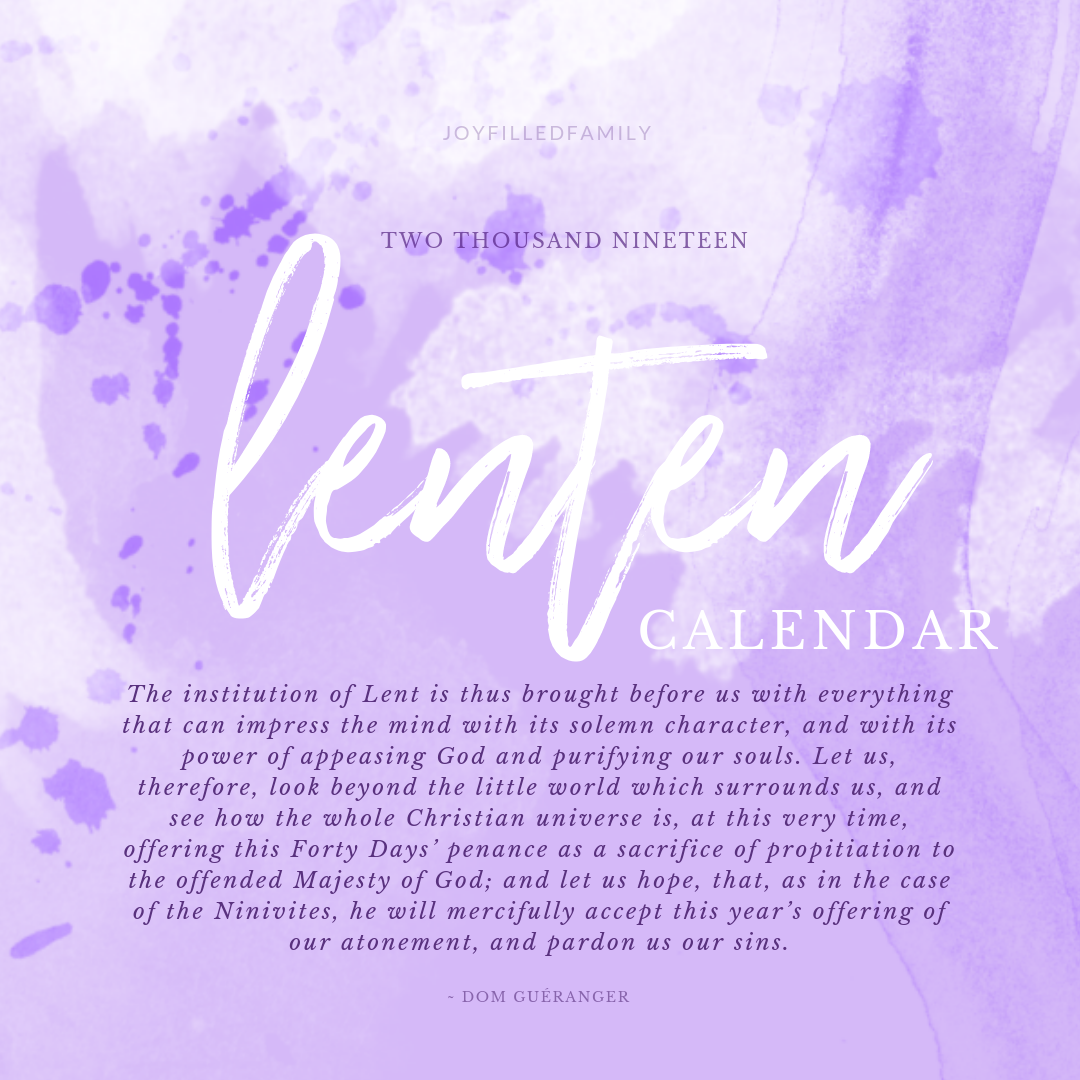
Lenten Calendar 2019

March 1, 2019 by Lena {JOYfilledfamily} Filed Under: Lent, Lenten Calendar, Uncategorized Leave a Comment

Almighty God! I unite myself at the beginning of this holy season of penance with the Church militant, endeavoring to make these days of real sorrow for my sins and crucifixion of the sensual man. O Lord Jesus! in union with Thy fasting and passion, I offer Thee my fasting in obedience to the Church, for Thy honor, and in thanksgiving for the many favors I have received, in satisfaction for my sins and the sins of others, and that I may receive the grace to avoid such and such a sin, N. N. and to practice such and such a virtue, N. N.

Lent has a late start this year, beginning on March 6. This Lenten Calendar has become a beloved addition to our home during Lent. It’s a labor of love that my children insist I complete each year, a great way to help me prepare for Lent during Septuagesima. I share each year in hope that it may help others along their Lenten journey.

This Lenten Calendar follows the Traditional Calendar (1962) of the Extraordinary Form of the Liturgy with  Historical (H) feast days noted.  It extends from Shrove Tuesday to Holy Saturday/Easter Vigil.

We only celebrate First Class Feasts during Lent.  The other saints are included for private devotion and are called upon for intercessory prayers.

⋅⋅⋅⋅⋅⋅

Here’s a look at the Lenten calendars posted in our home over the years.

⋅⋅⋅⋅⋅⋅

This year’s calendar prints best as 20×30 and 12×18.  Costco Photo has been my best option for speedy and inexpensive printing.  Prints at Costco range from $1.49 to $9.99.

I have set a suggested donation amount to the calendar this year — $2. It’s a small something that goes a long way to support this humble family ministry (of sharing the riches of our Faith and Traditional Latin Mass.) If you are unable to pay, please do not let that stop you from using this resource. Simply enter the coupon code, paxchristi for a free download.

  • You may download and print the calendar for your personal use.
  • You may also link to this post but please do not link directly to the file download.
  • Email me at JOYfilledfamily{at}gmail{dot}com if you need my assistance.  

⋅⋅⋅⋅⋅⋅

Includes variations of the 2019 Lenten Calendar and more!

O most benign Jesus! who didst so desire to suffer for us, grant, that we may willingly suffer for love of Thee; that we may hate and flee from the detestable pleasures of the world and the flesh, and practice penance and mortification, that by so doing we may merit to be released from our spiritual blindness to love Thee more and more ardently, and finally possess Thee forever.

⋅⋅⋅⋅⋅⋅

2019 Lenten Calendar Guide

  • The bottom portion of each day represents the feasts and ferias proper to the season for the Extraordinary Form
  • Saints listed without notation are from the Extraordinary Form liturgy
  • Saints listed with “H” are from the Historical calendar
  • Each saint featured by a picture is identified by the name immediately above the image
  • This calendar is the work of a lay Catholic for one’s personal observance of Lent and private devotions

⋅⋅⋅⋅⋅⋅

Family Favorite Lenten Resources for Children:

  • Bury the Alleluia
  • Printable Blank Lenten Plan
  • Lent Planning Worksheet – Rorate Caeli
  • Lent Planning Worksheet for Children – Raising Little Saints
  • 2019 Printable Lenten Calendar Journey – Ponder In My Heart
  • Stations of the Cross for Children & Stations of the Cross Box – Family, Feast, and Feria
  • Stations of the Cross Coloring Booklet – Catholic Playground
  • Stations of the Cross Coloring Page – Catholic Playground
  • Empty Tomb Garden 
  • Lenten Family Joy Journal
  • Stations of the Cross Candles 
  • Resurrection Eggs

Lenten Resources:

  • Fr Goffine’s The Church’s Year
  • Septuagesima Sunday 
    • Septuagesima: Planning for Lent – Audio Sermon
    • Septuagesima Sunday – Audio Sermon
  • Sexagesima Sunday
    On the power of God’s word
    • Sexagesima: Noah & Peter – Audio Sermon
    • Sexagesima: the 4 Layers of Soil – Audio Sermon
  • Quinquagesima Sunday
    Instruction on Lent
    • Quinquagesima: Prayer, Fasting, & Almsgiving During Lent – Audio Sermon
    • Quinquagesima: Lent, Our Spiritual Tithe – Audio Sermon
    • Quinquagesima Lent: Prayer, Fasting, Charity – Audio Sermon
    • Why Lent? – Audio Sermon 
    • Growing in Virtue by Small, Sustained Mortifications – Audio Sermon
    • Quinquagesima Sunday — Grow in Charity During Lent – Audio Sermon
    • We Must Fast to do Reparation – Audio Sermon
    • Embrace Lent: No Short Cuts, No Compromise – Audio Sermon
  • Ash Wednesday
    • Ash Wednesday – Audio Sermon
    • Fasting Becoming Holy | Exorcist Fr Ripperger – Audio Sermon
    • Ash Wednesday, Lent, & Spiritual Armor – Audio Sermon
    • The Love of God Must Motivate Us During Lent – Audio Sermon
  • First Sunday in Lent
    • Instruction on temptation
    • First Sunday of Lent — The Fewness of the Saved – Audio Sermon
    • For This Purpose the Son of God Appeared – Audio Sermon
    • Temptation is a Gift From God ~ Fr Isaac Mary Relyea – Audio Sermon
    • The Temptation of Our Lord & Sins Against the 1st Commandment – Audio Sermon
  • Second Sunday in Lent
    • Transfiguration – Audio Sermon
  • Third Sunday in Lent
    • Mysteries of Christ in Scripture & Liturgy – Audio Sermon
    • The Main Means to Overcome Satan – Audio Sermon
    • Courage! Courage! Courage! – Audio Sermon
  • Fourth Sunday in Lent
    Consolation in poverty
    Instruction on preparation for Easter
  • Fifth Sunday in Lent
    Consolation under calumny
    • The Passion – Audio Sermon
  • Palm Sunday
    • Our Lady of Sorrows | Fr. Chad Ripperger – Audio Sermon
    • Beasts of Burden – Audio Sermon
    • Faithless Friends – Audio Sermon
  • Monday after Palm Sunday
  • Tuesday after Palm Sunday
  • Wednesday after Palm Sunday
  • Holy Thursday
  • Good Friday
  • Holy Saturday
  • Easter Sunday: On The Miserable State Of Relapsing Sinners (19 Minutes)
  • Fasting & Abstinence ~ Sight of Angels
  • Seven Penitential Psalms
  • The Gospels for Lent and the Passion of Christ : readings at divine service during the forty days of Lent with short meditations for the faithful
  • Lent and Holy Week : chapters on Catholic observance and ritual
  • Meditations for Lent from St. Thomas Aquinas
  • Homilies for Lent from the Church Fathers – audio: part 1, part 2, part 3, part 4, part 5
  • FREE Traditional Catholic Books
  • The Virtue of Charity | Fr. Chad Ripperger – Audio Sermon

Feast of the Purification of the Blessed Virgin Mary {Candlemas}

February 2, 2019 by Lena {JOYfilledfamily} Filed Under: 02 February Saints, Candlemas, Chruching of Women, Purification of the Blessed Virgin Mary Leave a Comment

The Feast of the Purification of Our Lady is popularly known as Candlemas because of the rite of blessing and processing with candles, which represent Christ the Light of the Gentiles.

To honor this feast, here is a poetic tribute, some sacred music selections and related Scriptural references.

Lumen ad revelationem Gentium (antiphon sung during distribution of blessed candles)

Lumen ad revelationem Gentium (antiphon sung during distribution of blessed candles)

  • Gregorian chant

Nunc dimitis (Prophecy of Simeon)

  • Gyorgy Orban
  • Rachmaninov (in Old Slavonic)
  • Arvo Part
  • Palestrina

My eyes have seen Thy salvation: Holy Writ

Behold I send my angel, and he shall prepare the way before my face. And presently the Lord, whom you seek, and the angel of the testament, whom you desire, shall come to his temple. Behold he cometh, saith the Lord of hosts. Malachias 3:1; cf. Matthew 11:10

And after the days of her purification, according to the law of Moses, were accomplished, they carried him to Jerusalem, to present him to the Lord: As it is written in the law of the Lord: Every male opening the womb shall be called holy to the Lord: And to offer a sacrifice, according as it is written in the law of the Lord, a pair of turtledoves, or two young pigeons. Luke 2:22-24; cf. Leviticus 12

Now thou dost dismiss thy servant, O Lord, according to thy word in peace; because my eyes have seen thy Salvation, which thou hast prepared before the face of all peoples: a Light to the revelation of the Gentiles, and the Glory of thy people Israel. Luke 2:29-32; cf. Isaias 49:6


What charitable humility!

Lo!
what Charity…
the Lamb of God,[1]
Prince of Peace,[2]
Lord of lords,[3]
King of kings,[4]
Light of the world,[5]
Temple of
the Living God[6]
presents Himself
in His temple…
simple,
as a dove;[7]
the mystery,
the sublimity…
the Only-Begotten[8]
of the Father,
full of grace
and truth,[9]
in Whom
the Father
is well pleased,[10]
of Whom
said He,
“Thou art My Son,
this day have I
begotten Thee.
Ask of Me,
and I will give Thee
the Gentiles
for Thine inheritance,
and the utmost parts
of the earth,
for thy possession
,”[11]
offers Himself
in loving submission…
O ineffable Charity!
so low, the King,
humbly stooping…
stupendous Presentation!

Lo!
what humility…
the Lamb’s ewe,
Queen of Peace,
Queen of Angels,
Queen of all Saints,
Holy Mother of God,
Holy Virgin of virgins,
Mother of Christ,
Mother of Divine Grace,
Mother most pure,
Mother most chaste,
Mother inviolate,
Mother undefiled,
Ark of the Covenant,
Garden enclosed,[12]
Fountain sealed,[13]
Purity of purity,
Virgin lilywhite,
Candle of Divine Light,
Mother and
lover of poverty
St. Joseph,
present the true Lamb,
unblemished,
she His Temple…
simple,
as two turtle doves,
the sword
of Simeon’s prophecy
pierces her
Immaculate Heart.[14]

Immaculate Mother
of sinful nation,
humbles herself—
O! the thought,
such humiliation—
to the law of
Purification.

Woe!
what misery…
For…
who am I?
A worm,
and no man.[15]
Not worthy
to stand
before the
Son of Man;
the latchet
of His shoes,
I am not worthy
to loose;[16]
His feet,
I am not worthy
to kiss;[17]
Upon His face,
I am not worthy
to gaze.

And, Thou…
my sweet Mother,
the undefiled:
I, Thy prodigal child,
didst wallow
in the pigsty,
a life of disgrace. [18]
Still…
with Thine assistance,
O Full of Grace,[19]
I desire
to debase, to efface,
to humble myself
in imitation of Christ,
the Holy Incarnation,
in total subjection
to my Lord and my God,[20]
and Thee…
Immaculate Conception.


  • FOOTNOTES
    • 1 John 1:29, 36.

    • 2 Isaias 9:6.

    • 3 Apocalypse 19:16.

    • 4 Ibid.

    • 5 John 1:4, 9, 8:12.

    • 6 Ibid. 2:19-22.

    • 7 Matthew 3:16; Mark 1:10; Luke 3:22; John 1:32.

    • 8 John 1:14, 18, 3:16.

    • 9 Ibid. 1:14.

    • 10 Matthew 3:17, 17:5; Mark 1:11; Luke 3:22; 2 Peter 1:17.

    • 11 Psalm 2:7-8.

    • 12 Canticles 4:12.

    • 13 Ibid.

    • 14 Luke 2:35.

    • 15 Psalm 21:7.

    • 16 John 1:27.

    • 17 Luke 7:37-38.

    • 18 Ibid. 15:13-15.

    • 19 Ibid. 1:28.

    • 20 John 20:28.

    The Feast of the Holy Family

    January 12, 2019 by Lena {JOYfilledfamily} Filed Under: 01 January Saints, Holy Family Leave a Comment

    Per the traditional liturgical calendar, the first Sunday after Epiphany Day is designated as the Feast of the Holy Family. This feast commemorates the household life of the Child Jesus, His Blessed Virgin Mother and Foster-Father. The feast presents some familial lessons that never cease in application throughout the year. Here are remarks from Pope Leo XIII:
     

    Is it not fitting to celebrate the royal birth of the Son of the supreme Father, of the house of David and the glorious names of that ancient line? Yet it is more consoling for us to call to memory the little house at Nazareth and the humble life lived there; thus celebrating the hidden life of our Lord. For there the divine Child received his training in Joseph’s humble trade; there hidden and sheltered, He grew up and showed Himself ready to share the toil of a carpenter’s life. ‘Let the moisture,’ he seemed to say, ‘trickle over my limbs before they are drenched with the torrent of my blood, and the pain of this labor shall go to atone for the sins of men.’ Close to the divine Child is His tender Mother; close to Joseph stands his devoted wife, happy to relieve their toil and suffering by her loving care: O Thou, who wast not free from toil and care and who hast known adversity, come to the aid of the unfortunate, crippled by poverty and struggling against the difficulties of life.”

    The special devotion which proposes the Holy Family of Jesus, Mary, and Joseph as the model of virtue of all Christian households began in the XVIIth century. It started almost simultaneously in Canada and France. — The Association of the Holy Family being founded in Montreal in 1663, and the Daughters of the Holy Family in Paris in 1674. Numerous other congregations and associations under the Patronage of the Holy Family have been established, since that time, and they are spread over the world. The Archconfraternity was established by Pius IX in 1847. In 1893 Leo XIII approved a feast for Canada, and Pope Benedict XV extended the Feast of the Holy Family to the whole Church and ordered its celebration to be kept on the Sunday after the Epiphany.

    Prayer to the Holy Family

    This prayer is taken from Prayer Book for Religious, compiled by Fr. F. X. Lasance, S.J. (Benziger Brothers, 1904)

    O most loving Jesus, Who by Thy sublime and beautiful virtues of humility, obedience, poverty, modesty, charity, patience and gentleness, and by the example of Thy domestic life, didst bless with peace and happiness the family Thou didst choose on earth, in Thy clemency look down upon this household, humbly prostrate before Thee and imploring Thy mercy. Remember that this family belongs to Thee; for to Thee we have in a special way dedicated and devoted ourselves. Look upon us in Thy loving kindness; preserve us from danger; give us help in time of need, and grant us the grace to persevere to the end in the imitation of Thy Holy Family; that having revered Thee and loved Thee faithfully on earth, we may bless and praise Thee eternally in heaven. 

    O Mary, most sweet Mother, to thy intercession we have recourse, knowing that thy Divine Son will hear thy prayers. 

    And do thou, O glorious Patriarch, St. Joseph, assist us by thy powerful mediation, and offer, by the hands of Mary, our prayers to Jesus. Amen. 

    Sancta Familia ~ ora pro nobis


    • « Previous Page
    • 1
    • …
    • 74
    • 75
    • 76
    • 77
    • 78
    • …
    • 233
    • Next Page »

    Hi! I'm Lena, mama of JOYfilledfamily.
    We are a traditional Catholic family striving to live for Jesus Christ in everything we do. We pray to completely surrender our will to His and to become His servants. Our mission of this blog is to share our JOY.

    This blog serves as a journal of us making good memories, living the liturgical year, and our spiritual journey.

    Subscribe to our Newsletter

    • Home
    • About
    • Blog

    Copyright © 2026 swank WordPress Theme <a PDCD