• Email
  • Facebook
  • Instagram
  • Pinterest
share our JOY

JOY{filled}family

striving to radiate Him always

  • Home
  • Blog
  • Brown Scapular
  • Liturgical Calendars & Planners
  • Wellness
    • Essential Oils
    • Fitness
    • Nutrition
  • Homeschool
  • Sacraments
    • Baptism
    • First Communion
    • Confirmation

First Sunday in Advent

December 1, 2019 by Lena {JOYfilledfamily} Filed Under: Advent, First Sunday in Advent, The Church’s Year Leave a Comment

Veni, Veni, Emmanuel

Anticipating the birth of Our Lord, the liturgy reminds us also of His second coming.

FIRST SUNDAY IN ADVENT

Fr. Goffine

The first Sunday in Advent is the first day of the Church Year, and the beginning of the holy season of Advent. The Church commences on this day to contemplate the coming of the Redeemer, and with the prophets to long for Him; during the entire season of Advent she unites her prayers with their sighs, in order to awaken in her children also the desire for the grace of the Redeemer; above all to move them to true penance for their sins, because these are the greatest obstacles in the path of that gracious Advent; therefore she prays at the Introit of the day’s Mass:

INTROIT To Thee, O Lord, have I lifted up my soul: in Thee, O my God, I put my trust; let me not be ashamed: neither let my enemies laugh at me: for none of them that wait on Thee shall be confounded. Show me, O Lord, Thy ways, and teach me Thy paths (Ps. 24). Glory be to the Father.

COLLECT Raise up, we beseech Thee, O Lord, Thy power, and come; that by Thy protection we may deserve to be rescued from the threatening dangers of our sins, and to be saved by Thy deliverance. Through our Lord.

EPISTLE (Rom. 13:11‑14). Brethren, knowing the time, that it is now the hour for us to rise from sleep: for now our salvation is nearer than when we believed. The night is past, and the day is at hand. Let us therefore cast off the works of darkness, and put on the armor of light. Let us walk honestly, as in the day: not in rioting and drunkenness, not in chambering and impurities, not in contention and strife; but put ye on the Lord Jesus Christ.

What does St. Paul teach us in this epistle?

After fully explaining the duties of a Christian life to the Romans who were converted mainly by St. Peter, he exhorts them to hesitate no longer to fulfil these duties, and he seeks to move their hearts by this time of grace, presented them by the Christian dispensation, and by the shortness of the time of grace.

What is here meant by sleep?

The stupidity and blindness of the soul that, forgetting her God, is sunk in a lukewarm, effeminate, slothful and lustful life, which, when it is gone, leaves nothing more than a dream.

Why does St. Paul say, “salvation is nearer”?

He wishes to impress upon the Romans that they now have far greater hope of salvation than when they first became Christians, and that they should secure it by a pious life, because death, and the moment on which depended their salvation, or eternal reward, was drawing near. “What is our life,” says St. Chrysostom, “other than a course, a dangerous course to death, through death to immortality?”

What is the signification of day and night?

The night signifies the time before Christ, a night of darkness, of infidelity and of injustice; the day represents the present time, in which by the gospel Christ enlightens the whole world with the teachings of the true faith.

What are “the works of darkness”?

All sins, and especially those which are committed in the dark, to shun the eye of God and man.

What is the “armor of light”?

That faith, virtue and grace, the spiritual armor, with which we battle against our three enemies, the world, the flesh, and the devil, and in which armor we should walk honestly before all men. A Christian who in baptism has renounced the devil and all his pomps, must not live in vice, but must put on Christ Jesus, that is, must by the imitation of Christ’s virtues adorn his soul, as it were, with a beautiful garment. This text (verse 13) moved St. Augustine to fly from all works of uncleanness in which he had been involved, and to lead a pure life which he had before thought difficult.

ASPIRATION Grant, O Lord, that we may rise by penance from the sleep of our sins, may walk in the light of Thy grace by the performance of good works, may put on Thee and adorn our souls with the imitation of Thy virtues. Amen.

GOSPEL (Lk. 21:25‑33). At that time, Jesus said to his disciples: There shall be signs in the sun, and in the moon, and in the stars: and upon the earth distress of nations, by reason of the confusion of the roaring of the sea and of the waves, men withering away for fear and expectation of what shall come upon the whole world. For the powers of heaven shall be moved; and then they shall see the Son of man coming in a cloud with great power and majesty. But when these things begin to come to pass, look up and lift up your heads, because your redemption is at hand. And he spoke to them a similitude: See the fig tree, and all the trees; when they now shoot forth their fruit, you know that summer is nigh. So you also, when you shall see these things come to pass, know that the kingdom of God is at hand. Amen I say to you, this generation shall not pass away till all things be fulfilled. Heaven and earth shall pass away, but my words shall not pass away.


Why does the Church cause the gospel of the Last Judgment to be read on this day?

To move us to penance, and to induce us to prepare our souls for the coming of Christ, by placing the Last Judgment before our minds. Should not the thought of this terrible judgment, when all good and all evil will be revealed, and accordingly be rewarded or punished in the presence of the whole world‑should not this thought strengthen us in virtue!

What signs will precede the Last Judgment?

The sun will be obscured, the stars will lose their light and disappear in the firmament (Is. 13:10), lightning and flames will surround the earth, and wither up every thing; the powers of heaven will be moved, the elements brought to confusion; the roaring of the sea with the howling of the winds and the beating of the storms will fill man with terror and dread. Such evil and distress will come upon the world, that man will wither away for fear, not knowing whither to turn. Then will appear the sign of the Son of man in heaven, the holy cross, the terror of the sinners who have scorned it, the consolation of the just who have loved it (Mt. 24:30).

Why will all this come to pass?

Because as the people love the creatures of God so inordinately, more than the Creator, and use them only to His dishonor, He will destroy them in this terrible manner, arming all creatures for vengeance against His enemies (Wis. 5:8‑24, and showing by the manner of their destruction the evils which will fall upon all sinners. The darkness of the sun will indicate the darkness of hell; the blood-red moon, the anger and wrath of God; the disappearance and falling of the stars, will represent the fall of sinners into the abyss of hell and their disappearance from earth; and the madness of the elements, will exhibit the rage of the beasts of hell. Sinners will then vainly, and too late, repent that they have attached their hearts to things which will end so horribly, and that only increase their torments.

Why does Christ nevertheless command: “Lift up your heads, for your redemption is at hand”?

These words are spoken to the just who as long as they live on earth are like prisoners and exiles, but who at the Last Judgment will be taken body and soul into their long desired fatherland, the kingdom of heaven: into the freedom of the children of God. These will have reason to raise their heads, now bowed in mourning, and to rejoice.

How will the Last Judgment commence?

By the command of God the angels will sound the trumpets, summoning all men from the four parts of the earth to come to judgment (I Thess. 4:15). Then the bodies of the dead will unite with their souls, and be brought to the valley of Josaphat, and there placed, the just on the right, the wicked on the left (Mt. 25:33). Then the devils as well as the angels will appear; Christ Himself will be seen coming in a cloud, in such power and majesty that the sinners will be filled with terror. They will not dare to look at Him, and will cry to the mountains to fall upon them, and to the hills to cover them (Lk. 23:30).

How will the judgment be held?

The book of conscience, upon which all men are to be judged, and which closed with this life, will be opened. All good and evil thoughts, words, deeds and motives, even the most secret, known only to God, will then be as plainly revealed to the whole world as if they were written on each one’s forehead; by these each one will be judged, and be eternally rewarded, or eternally punished.

O God! If we must then give an account of every idle word (Mt. 12:36), how can we stand in the face of so many sinful words and actions!

Why will God hold a universal public Judgment?

Although immediately after death, a special private judgment of each soul takes place, God has ordained a public and universal judgment for the following reasons: First, that it may be clearly shown to all how just has been His private judgment, and also that the body which has been the instrument of sin or of virtue may share in the soul’s punishment or reward; secondly, that the justice which they could by no means obtain in this life, may be rendered before the whole world to the oppressed poor, and to persecuted innocence, and that the wicked who have abused the righteous, and yet have been considered honest and good, may be put to shame before all; thirdly, that the graces and means of salvation bestowed upon each, may be made known; fourthly, that the blessed providence of God which often permitted the righteous to suffer evil while the wicked prospered, may be vindicated, and it be shown on that day that His acts are acts of the greatest wisdom; fifthly, that the wicked may learn the goodness of God, not for their comfort or benefit, but for their greater sorrow, that they may see how He rewards even the slightest work performed for His love and honor; finally, that Christ may be exalted before the wicked on earth as before the good in heaven, and that the truth of His words may solemnly be made manifest.

ASPIRATION Just art Thou O God, and just are Thy judgments. Ah, penetrate my soul with holy fear of them, that I may be kept always in awe, and avoid sin. Would that I could say with the penitent St. Jerome: “Whether I eat or drink, or whatever I do, I seem to hear the awful sound of the trumpet in my ears: `Arise ye dead, and come to judgment.”‘

Instructions on Advent

November 30, 2019 by Lena {JOYfilledfamily} Filed Under: 12 December, Advent, The Church’s Year Leave a Comment

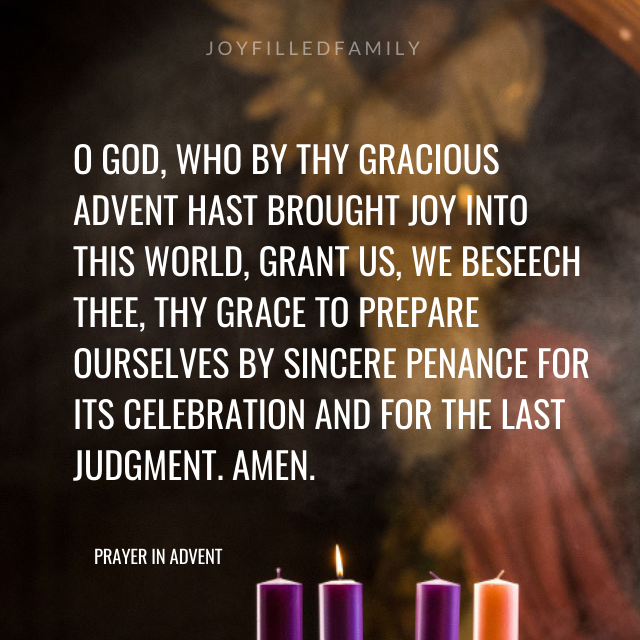
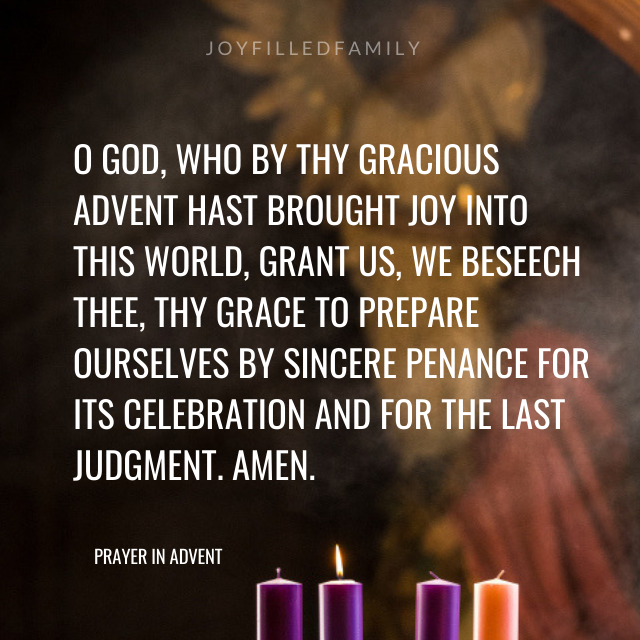
Prayer in Advent O God, who by Thy gracious Advent hast brought joy into this world, grant us, we beseech Thee, Thy grace to prepare ourselves by sincere penance for its celebration and for the Last Judgment. Amen.

INSTRUCTIONS ON ADVENT

Fr. Goffine

What is the meaning of Advent, and what do we understand by the term?

The word Advent signifies coming, and by it is understood the visible coming of the Son of God into this world, at two different times.

It was when the Son of God, conceived of the Holy Ghost in the womb of the immaculate Virgin Mary, was born, according to the flesh, in the fullness of time, and sanctified the world by His coming, for which the patriarchs and prophets had so longed (Gen. 49:10; Is. G4:1; Lk. 10:24).

Since Christ had not yet come, how could the Just of the Old Law be saved?

Immediately after their sin, God revealed to our first parents that His only-begotten Son would become man and redeem the world (Gen. 3:15). In the hope of this Redeemer and through His merits, all in the old covenant who participated in His merits by innocence or by penance, and who died in the grace of God, were saved, although they were excluded from heaven until the Ascension of Christ.

When will the second coming of Christ take place?

At the end of the world when Christ will come, with great power and majesty, to judge both the living and the dead.

What is Advent, and why has the Church instituted it?

Advent is that solemn time, immediately preceding Christmas, instituted by the Church in order that we should, in the first place, meditate on the Incarnation of Christ, the love, patience and humility which He has shown us, and prove our gratitude to Him, because He came from the bosom of His heavenly Father into this valley of tears, to redeem us; secondly, that we may prepare ourselves by sincere repentance, fasting, prayer, alms-deeds, and other works pleasing to God, for the coming of Christ and His birth in our hearts, and thus participate in the graces which He has obtained for us; finally, that He may be merciful to us, when He shall come again as judge of the world. “Watch ye, for ye know not at what hour your Lord will come” (Mt. 5:42). “Wherefore be you also ready; because at what hour you know not, the Son of man will come” (Mt. 24:44).

How was Advent formerly observed?

Very differently from now. It then commenced with the Feast of St. Martin, and was observed by the faithful like the Forty Days’ Fast, with strict penance and devotional exercises, as even now most of the religious communities do to the present day. The Church has forbidden all turbulent amusements, weddings, dancing and concerts, during Advent. Pope Sylverius ordered that those who seldom receive Holy Communion should, at least, do so on every Sunday in Advent.

How should this solemn time be spent by Christians?

They should recall, during these four weeks, the four thousand years in which the just under the Old Law expected and desired the promised Redeemer, think of those days of darkness in which nearly all nations were blinded by saran and drawn into the most horrible crimes, then consider their own sins and evil deeds and purify their souls from them by a worthy reception of the Sacraments, so that our Lord may come with His grace to dwell in their hearts and be merciful to them in life and in death. Further, to awaken in the faithful the feelings of repentance so necessary for the reception of the Savior in their hearts, the Church orders that besides the observance of certain fast days, the altar shall be draped in violet, that Mass shall be celebrated in violet vestments, that the organ shall be silent and no Gloria sung. Unjust to themselves, disobedient to the Church and ungrateful, indeed, to God are those Christians who spend this solemn time of grace in sinful amusements without performing any good works, with no longing for Christ’s Advent into their hearts.

What are Rorate High Masses, and why are they celebrated?

They are the solemn high Masses celebrated in some countries in commemoration of the tidings brought to the Blessed Virgin by the Archangel Gabriel, announcing to her that she was to become the Mother of God; they derive their name from the words of the Introit in the Votive Mass, Rorate coeli desuper. They are celebrated very early in the morning because the Blessed Virgin preceded our Lord, as the aurora precedes the rising sun

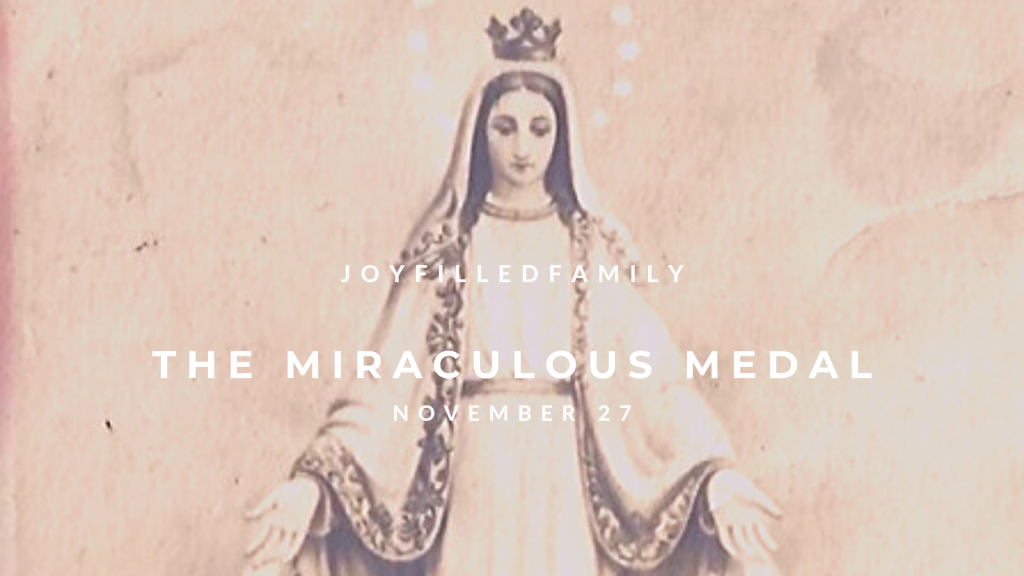
The Miraculous Medal

November 27, 2019 by Lena {JOYfilledfamily} Filed Under: 11 November, 11 November Saints, Marian, Miraculous Medal 2 Comments

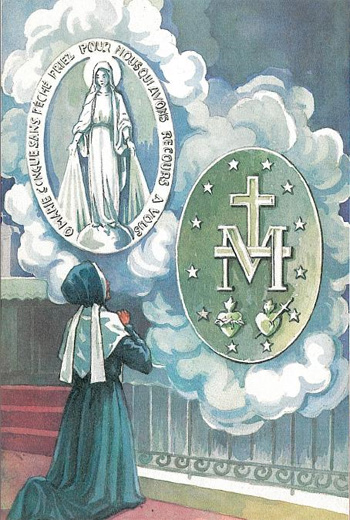
On November 27, 1830, the Most Blessed Virgin Mary appeared to Catherine Labouré, a young Sister of Charity in Paris at the rue du Bac. At that time, she was a novice from the Daughters of Charity of Saint Vincent de Paul. Sister Labouré had three apparitions of Our Lady at Rue de Bac 140 in Paris. During the second apparition, Immaculata instructed Catherine to mint and distribute the Miraculous Medal after the pattern revealed.

The Vision of the Miraculous Medal

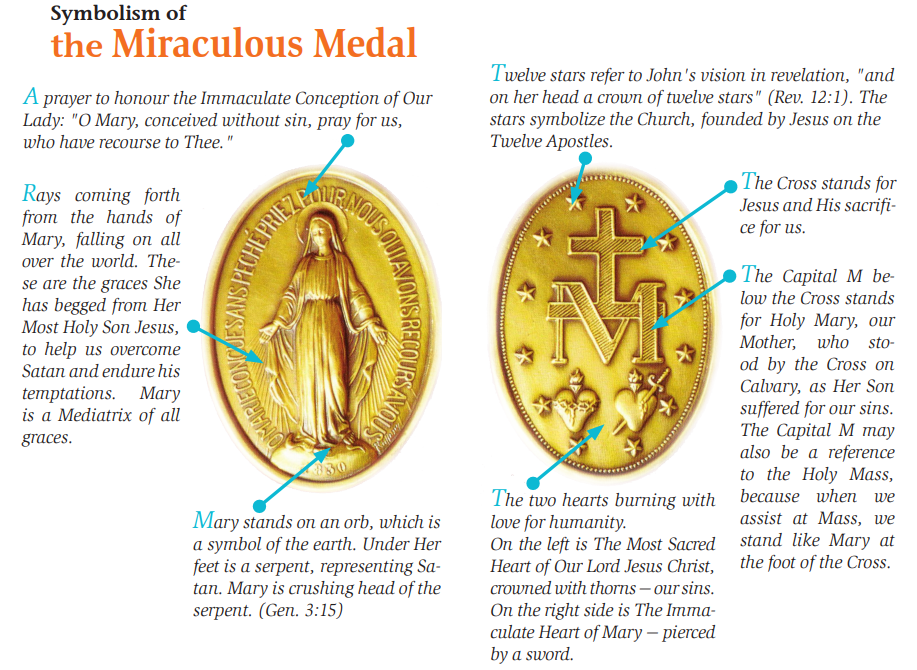
Prayer in English: O Mary, conceived without sin, pray for us, who have recourse to Thee.

Prayer in Latin: O Maria, sine labe concepta, ora pro nobis, qui ad Te recurrimus.

In this brief prayer we find the truth of the Immaculate Conception of Mary, and Mary’s intercessory power with God for us who ask for her aid.

“All those who wear it, will receive great graces especially if they wear it around the neck. Those who repeat this prayer with devotion will be in a special way under the protection of the Mother of God. Graces will be abundantly bestowed upon those who have confidence.”

Our Lady during Second Apparition to St. Catherine Labouré (November 27, 1830)
St Catherine Labouré

RESOURCES:

  • Miraculous Medal Craft – Catholic Playground
  • Miraculous Medal Coloring Page – formatted to have the front and back of the Medal on 1 page – JOYfilledfamily
  • DIY Miraculous Medal Ornament – JOYfilledfamily
  • Learn more about the Miraculous Medal and request a free & blessed Miraculous Medal – FSSPX St. Thomas Aquinas Seminary
miraculous medal coloring page

OUR LADY OF THE MIRACULOUS MEDAL 
(1830) – White
Nov. 27

The Blessed Virgin Mary appeared to the young Sister Catherine Laboure while she was at prayer with the Sisters in a chapel in Paris. Our Lady appeared in an oval frame, standing on a globe of the world. She was dressed in a white robe with a blue cloak edged with silver, having as it were diamonds in Her hands from which fell streams of golden rays upon the earth. A voice was heard saying: “These rays are the graces that Mary obtains for men.” Then golden words formed around the oval: “O Mary, conceived without sin, pray for us who have recourse to Thee!” The oval picture then turned around, and on the reverse side the Sister saw the letter M, with a cross above it, having a crosspiece at its base, and below the letter the Hearts of Jesus and Mary, the former surrounded by a crown of thorns, and the latter pierced with a sword. Then the voice said: “A medal must be struck on this pattern; the persons who shall carry it with indulgences attached to it, and shall offer the above prayer, shall enjoy a very special protection from the Mother of God.”


The medal was struck and spread all over the world, and immediately the most wonderful conversions and cures attested to its miraculous efficacy. Devout Catholics everywhere attest to its wonder-working power!


INTROIT Ex 13:9

It shall be a sign in thy hand, and as a memorial before thine eyes, and that the law of the Lord be always in thy mouth.Ps. 104. O give thanks unto the Lord, and call upon His name; tell forth His deeds among the nations.Glory be . . .


COLLECT

O Lord Jesus Christ, who wast pleased that the most Blessed Virgin Mary Thy Mother, immaculate from her first conception, should shine resplendent with miracles beyond number; grant, that, ever imploring her patronage, we may attain the joys of everlasting life; Who livest and reignest . . .


LESSON Apoc. 12:1-16

And a great sign appeared in heaven: A woman clothed with the sun, and the moon under her feet, and on her head a crown of twelve stars. And being with child, she cried travailing in birth: and was in pain to be delivered. And there was seen another sign in heaven. And behold a great red dragon, having seven heads and ten horns and on his heads seven diadems. And his tail drew the third part of the stars of heaven and cast them to the earth. And the dragon stood before the woman who was ready to be delivered: that, when she should be delivered, he might devour her son. And she brought forth a man child, who was to rule all nations with an iron rod. And her son was taken up to God and to his throne. And the woman fled into the wilderness, where she had a place prepared by God, that there they should feed her, a thousand two hundred sixty days. And there was a great battle in heaven: Michael and his angels fought with the dragon, and the dragon fought, and his angels. And they prevailed not: neither was their place found any more in heaven. And that great dragon was cast out, that old serpent, who is called the devil and Satan, who seduceth the whole world. And he was cast unto the earth: and his angels were thrown down with him. And I heard a loud voice in heaven, saying: Now is come salvation and strength and the kingdom of our God and the power of his Christ: because the accuser of our brethren is cast forth, who accused them before our God day and night. And they overcame him by the blood of the Lamb and by the word of the testimony: and they loved not their lives unto death. Therefore, rejoice, O heavens, and you that dwell therein. Woe to the earth and to the sea, because the devil is come down unto you, having great wrath, knowing that he hath but a short time. And when the dragon saw that he was cast unto the earth, he persecuted the woman who brought forth the man child. And there were given to the woman two wings of a great eagle, that she might fly into the desert, unto her place, where she is nourished for a time and times, and half a time, from the face of the serpent. And the serpent cast out of his mouth, after the woman, water, as it were a river: that he might cause her to be carried away by the river. And the earth helped the woman: and the earth opened her mouth and swallowed up the river which the dragon cast out of his mouth.


GRADUAL Ps. 104

Remember the marvelous works which He hath done; His wonders, and the judgment of His mouth. He placed in them the words of His signs, and of His wonders in the land.


Alleluia, alleluia. Ps. 18

His going forth is from the end of heaven; nor is there any that can hide from His heat. Alleluia.


GOSPEL John 2:1-11

At that time there was a marriage in Cana of Galilee: and the mother of Jesus was there. And Jesus also was invited, and his disciples, to the marriage. And the wine failing, the mother of Jesus saith to him: “They have no wine.” And Jesus saith to her: “Woman, what is that to me and to thee? My hour is not yet come.” His mother saith to the waiters: “Whatsoever he shall say to you, do ye.” Now there were set there six waterpots of stone, according to the manner of the purifying of the Jews, containing two or three measures apiece. Jesus saith to them: “Fill the waterpots with water.” And they filled them up to the brim. And Jesus saith to them: “Draw out now and carry to the chief steward of the feast.” And they carried it. And when the chief steward had tasted the water made wine and knew not whence it was, but the waiters knew who had drawn the water: the chief steward calleth the bridegroom, And saith to him: “Every man at first setteth forth good wine, and when men have well drunk, then that which is worse. But thou hast kept the good wine until now.” This beginning of miracles did Jesus in Cana of Galilee and manifested his glory. And his disciples believed in him.


OFFERTORY ANTIPHON John 19

Jesus said to the disciple: Behold thy mother. And from that hour the disciple took her to his own.


SECRET

Moved by the petition of the Blessed Virgin Mary, in answer to whose prayers Jesus Christ Thy Son worked His first miracle, enable us, Lord God, to minister the Sacrament of the Body and Blood of this Thy Son with pure hearts, and thus be counted worthy of Thy eternal banquet. Through the same our Lord . . .


COMMUNION ANTIPHON Eccl. 36

Renew Thy signs, and work new miracles; glorify Thine hand and Thy right arm; hasten the time, and remember the end, that they may declare Thy wondrous works.


POSTCOMMUNION

O Lord God almighty, who givest us all things through the Immaculate Mother of Thy Son, enable us by the aid of this mighty Mother to escape the dangers of this time and come to life everlasting. Through the same . . .

Last Sunday After Pentecost

November 24, 2019 by Lena {JOYfilledfamily} Filed Under: 11 November, Pentecost, The Last Sunday After Pentecost, Time after Pentecost Leave a Comment

“Amen, I say to you, that this generation shall not pass till all these things be done: heaven and earth shall pass, but My words shall not pass, saith the Lord.”

Twenty-Fourth Sunday After Pentecost – Fr. Goffine

(The Mass of this Sunday is always the last, even if there are more than twenty-four Sundays after Pentecost; in that case the Sundays remaining after Epiphany, which are noticed in the calendar, are inserted between the twenty-third and the Mass of the twenty-fourth Sunday.)

The Introit of the Mass is the same as that said on the twenty-third Sunday after Pentecost.

The Introit of the Mass consoles and incites us to confidence in God who is so benevolent towards us, and will not let us pine away in tribulation. The Lord saith: I think thoughts of peace, and not of affliction: you shall call upon me, and I will hear you: and I will bring back your captivity from all places. (Fer. XXIX. 11. 12. 14.) Lord, thou hast blessed thy land: thou hast turned away the captivity of Jacob. (Ps. LXXXIV.) Glory etc.

COLLECT – Quicken, we beseech Thee, 0 Lord, the wills of Thy faithful: that they, more earnestly seeking after the fruit of divine grace, may more abundantly receive the healing gifts of Thy mercy. Thro’.

EPISTLE (Col. I. 9—14.) – Brethren, We cease not to pray for you, and to beg that you may be filled with the knowledge of the will of God, in all wisdom and spiritual understanding: that you may walk worthy of God, in all things pleasing, being fruitful in every good work, and increasing in the knowledge of God: strengthened with all might according to the power of his glory, in all patience and long-suffering with joy, giving thanks to God the Father, who hath made us worthy to be partakers of the lot of the saints in light; who hath delivered us from the power of darkness, and hath translated us into the kingdom of the Son of his love, in whom we have redemption through his blood, the remission of sins.

EXPLANATION – In this epistle St. Paul teaches us to pray for our neighbor, and to thank God especially for the light of the true, only saving faith. Let us endeavor to imitate St. Paul in his love and zeal for the salvation of souls, then we shall also one day partake of his glorious reward in heaven.

GOSPEL (Matt. XXIV. 15—35.) – At that time, Jesus said to his disciples: When you shall see the abomination of desolation, which was spoken of by Daniel the prophet, standing in the holy place: he that readeth, let him understand: then they that are in Judea, let them flee to the mountains: and he that is on the house-top, let him not come down to take anything out of his house: and he that is in the field, let him not go back to take his coat. And woe to them that are with child, and that give suck, in those days. But pray that your flight be not in the winter, or on the Sabbath. For there shall be then great tribulation, such as hath not been from the beginning of the world until now, neither shall be: and unless those days had been shortened, no flesh should be saved: but for the sake of the elect, those days shall be shortened. Then, if any man shall say to you: Lo, here is Christ, or there: do not believe him: for there shall arise false Christs and false prophets, and shall show great signs and wonders, insomuch as to deceive (if possible) even the elect. Behold, I have told it to you before hand: if therefore they shall say to you: Behold, he is in the desert, go ye not out; Behold, he is in the closets, believe it not. For as lightning cometh out of the east, and appeareth even into the west, so shall also the coming of the Son of man be. Wheresoever the body shall be, there shall the eagles also be gathered together. And immediately after the tribulation of those days, the sun shall be darkened, and the moon shall not give her light, and the stars shall fall from heaven, and the powers of the heavens shall be moved: and then shall appear the sign of the Son of man in heaven, and then shall all the tribes of the earth mourn, and they shall see the Son of man coming in the clouds of heaven with much power and majesty: and he shall send his an­gels with a trumpet and a great voice, and they shall gather together his elect from the four winds, from the farthest parts of the heavens to the utmost bounds of them. And from the fig-tree learn a parable: when the branch thereof is now tender, and the leaves come forth, you know that summer is nigh. So you also, when you shall see all these things, know ye that it is nigh, even at the doors. Amen I say to you, that this generation shall not pass till all these things be done. Heaven and earth shall pass, but my words shall not pass.

EXPLANATION – When you shall see the abomination of desolation. The abomination of desolation of which Daniel (IX. 27.) and Christ here speak, is the desecration of the temple and the city of Jerusalem by the rebellious Jews by perpetrating the most abominable vices, injustices and robberies, &c., but principally by the pagan Romans by putting up their idols. This destruction which was accomplished in the most fearful manner about forty years after the death of Christ, was foretold by Him according to the testimony of St. Luke. (XXI. 20.) At the same time He speaks of the end of the world and of His coming to judgment, of which the desolation of Jerusalem was a figure.

Pray that your flight be not in the winter or on the Sabbath. Because, as St. Jerome says, the severe cold which reigns in the deserts and mountains would pre­vent the people from going thither to seek security, and because it was forbidden by the law for the Jews to travel on the Sabbath.

There shall rise false Christs and false prophets. According to the testimony of the Jewish historian Josephus, who was an eyewitness of the destruction of Jerusalem, Eleazar, John, Simon, &c., were such false prophets who under the pretence of helping the Jews, brought them into still greater misfortunes; before the end of the world it will be Antichrist with his followers, whom St. Paul calls the man of sin and the son of perdition, (II Thess. II. 3.) on account of his diabolical malice and cruelty. He will rise up, sit in the temple, proclaim himself God, and kill all who will not recognize him as such. His splendor, his promises and his false miracles will be such that even the holy and just will be in danger of being seduced, but for their sake God will shorten these days of persecution.

Wheresoever the body shall be, there shall the eagles also be gathered together. That is, where the wicked are, who have aimed at spiritual corruption, there punishment will overtake and destroy them.

This generation shall not pass till all these things be done. By these words Christ defines the time of the destruction of Jerusalem, and says that many of His hearers would live to see it, which also happened. But when the end of the world will come, He says, not even the angels in heaven know. (Matt. XXIV. 36.) Let us endeavor to be always ready by leading a holy life, for the coming of the divine Judge, and meditate often on the words of our di­vine Lord: Heaven and earth shall pass, but my words shall not pass.

PRAYER – Remove from us, O Lord, all that is calculated to rob us of Thy love. Break the bonds with which we are tied to the world, that we may not be lost with it. Give us the wings of eagles that we may soar above all worldly things by the contemplation of Thy sufferings, life and death, that we may hasten towards Thee now, and gather about Thee, that we may not become a prey to the rapacious enemy on the day of judgment. Amen.


INSTRUCTION CONCERNING PERJURY
Amen, I say to you.(Matt. XXIV. 34.)

The Son of God here, and elsewhere in the gospel, con­firms His word by an oath, as it were, for swearing is nothing else than to call upon God, His divine veracity, His justice, or upon His creatures in the name of God, as witness of the truth of our words. — Is swearing, then, lawful, and when? — It is lawful when justice or necessity or an important advantage requires it, and the cause is true and equitable. (Jer. IV. 2.) Those sin grievously, there­fore, who swear to that which is false and unjust, because they call upon God as witness of falsehood and injustice, by which His eternal truthfulness and justice is desecrated; those sin who swear in a truthful cause without necessity and sufficient reason, because it is disrespectful to call upon God as witness for every trivial thing. In like manner, those sin grievously and constantly who are so accustomed to swearing as to break out into oaths, without knowing or considering whether the thing is true or false, whether they will keep their promise or not, or even if they will be able to keep it; such expose themselves to the danger of swearing falsely. “There is no one,” says St. Chrysostom, “who swears often, who does not sometimes swear falsely, just as he who speaks much, sometimes says unbecoming and false things.” Therefore Christ tells those who seek perfection, not to swear at all, (Matt. V. 34.) that they might not fall into the habit of swearing and from that into perjury. He who has the habit of swearing should, therefore, take the greatest pains to eradicate it; to accomplish which it will be very useful to reflect that if we have to render an account for every idle word we speak, (Matt. XII. 36.) how much more strictly will we be judged for unnecessary false oaths! God’s curse accompanies him who commits perjury, in all his ways, as proved by daily experience. He who commits perjury in court, robs himself of the merits of Christ’s death and will be consumed in the fire of hell, which is represented by the crucifix and burning tapers, in presence of which the oath (in some places) is taken. If you have had the misfortune to be guilty of perjury, at once be truly sorry, weep for this terrible sin which you have committed, frankly confess it, repair the injury you may have caused by it, and chastise yourself for it by rigorous penance.

He Who Came in Mercy Shall Return in Justice

Twenty-Third Sunday After Pentecost

November 16, 2019 by Lena {JOYfilledfamily} Filed Under: 11 November, Time after Pentecost, Twenty-third Sunday after Pentecost Leave a Comment

Talitha Cumi: Maiden, Arise

(If from Pentecost until Advent there be only twenty-three Sundays, the following one is omitted, and the Mass of the twenty-fourth is said.)

The Introit of the Mass consoles and incites us to confidence in God who is so benevolent towards us, and will not let us pine away in tribulation. The Lord saith: I think thoughts of peace, and not of affliction: you shall call upon me, and I will hear you: and I will bring back your captivity from all places. (Fer. XXIX. 11. 12. 14.) Lord, thou hast blessed thy land: thou hast turned away the captivity of Jacob. (Ps. LXXXIV.) Glory etc.

COLLECT Absolve, we beseech Thee, 0 Lord, Thy people from their offences: that through Thy bountiful goodness we may be freed from the bonds of those sins which through our frailty we have contracted. Thro’,

EPISTLE (Philipp. III 17-21.: IV, 1-3.) Brethren, Be followers of me, and observe them who walk so as you have our model. For many walk, of whom I have told you often (and now tell you weeping), that they are enemies of the cross of Christ: whose end is destruction, whose God is their belly, and whose glory is in their shame, who mind earthly things. But our conversation is in heaven: from whence also we look for the Saviour, our Lord Jesus Christ, who will reform the body of our lowness, made like to the body of his glory, according to the operation whereby also he is able to subdue all things unto himself. Therefore, my dearly beloved brethren, and most desired, my joy and my crown: so stand fast in the Lord, my dearly beloved. I beg of Evodia, and I beseech Syntyche, to be of one mind in the Lord. And I entreat thee also, my sincere companion, help those women who have labored with me in the gospel with Clement and the rest of my fellow-laborers, whose names are in the book of life.

EXPLANATION There are unhappily many Christians, who, as St. Paul complains, are, declared enemies of Christ’s cross, who do not wish to mortify their senses, who only think of gratifying their lusts, and, as it were, find their only pleasure, even seek their honor, in despising the followers of Jesus and His saints on the narrow path of the cross, of mortification and humiliation. What will be the end of these people? Eternal perdition! For he who does not crucify the flesh, does not belong to Christ. (Gal. V. 24.) He who does not bear the marks of the mortification of Jesus in his body, in him the life of Christ shall not be manifested. (II Cor. IV. 10.) He who does not walk in heaven during his life-time, that is, who does not direct his thoughts and desires heavenward, and despise the world and its vanities, will not find admission there after his death. 

ASPIRATION Would to God , I could say with St. Paul: The world is crucified to me, and I to the world. (Gal. VI. 14.)

GOSPEL (Matt. IX. 18-26.) At that time, As Jesus was speaking to the multitudes, behold, a certain ruler came up, and adored him, saying: Lord , my daughter is even now dead: but come, lay thy hand upon her, and she shall live. And Jesus, rising up, followed him, with his disciples. And behold, a woman, who was troubled with an issue of blood twelve years, came behind him, and touched the hem of his garment. For she said within herself: If I shall touch only his garment, I shall be healed. But Jesus turning and seeing her, said: Be of good heart, daughter: thy faith hath made thee whole. And the woman was made whole from that hour. And when Jesus was come into the house of the ruler, and saw the minstrels and the multitude making a tumult, he said: Give place: for the girl is not dead, but sleepeth. And they laughed him to scorn. And when the multitude was put forth, he went in, and took her by the hand. And the maid arose. And the fame hereof went abroad into all that country.

INSTRUCTIONS I. Filial was the faith, unbounded the confidence, profound the humility of this woman and therefore she received health also. Learn from this, how pleasing to the Lord is faith, confidence and humility; let your prayer always be penetrated by these three virtues, and you will receive whatever you ask.

II. The devout Louis de Ponte compares the conduct of this woman to our conduct at holy Communion, and says: Christ wished to remain with us in the most holy Eucharist, clothed with the garment of the sacramental species of bread, that he who receives His sacred flesh and blood,  may be freed from evil concupiscence. If you wish to obtain the health of your soul, as did this woman the health of the body, imitate her. Receive the flesh and blood of Jesus with the most profound humility, with the firmest confidence in His power and goodness, and like this woman you too will be made whole.

III. Jesus called three dead persons to life, the twelve-year-old daughter of Jairus, ruler of the synagogue, of whom there is mention made in this gospel, the young man at Naim, (Luke VII. 14.) and Lazarus. (John. XI- 43.) By these three dead persons three classes of sinners may be understood: the maiden signifies those who sin in their youth through weakness and frailty, but touched by the grace of God, perceive their fall and easily rise again through penance; by the young man at Naim those are to be understood who sin repeatedly and in public, these require greater grace, more labor and severer penance; by Lazarus, the public and obdurate habitual sinners are to be understood who can be raised to spiritual life only by extraordinary graces and severe public penance.

IV. Christ did not raise the maiden until the minstrels and noisy multitude were removed, by which He wished to teach us that the conversion of a soul cannot be accomplished in the midst of the noise and turmoil of temporal cares, idle pleasures and associations.

INSTRUCTION CONCERNING RIDICULE AND DERISION

And they laughed him to scorn. (Matt IX. 24.)

When Jesus told the minstrels and the crowd that the girl was not dead, but sleeping, they laughed at Him, because they understood not the meaning of His words. Sensually-minded men generally act in the same manner towards the priests and ministers of God, who by their word and example admonish them to despise honors, riches and pleasures, and to embrace the love of poverty, humility and mortification. This is an unintelligible and hateful language to them which they ridicule and mock just as they do when they hear that death is a sleep, from which we shall one day awake and be obliged to appear before the judgment-seat of God. Woe to such scoffers by whose ridicule so many souls are led from the path of virtue! What the devil formerly accomplished by tyrants in estranging men from God and a lively faith in Him and His Church, he seems to wish to accomplish in our days by the mockery, scoffs, and blasphemies of wicked men; for at no period have piety and virtue, holy simplicity and childlike faith, adherence to the holy Roman Church and her laws, reverence for her head, her ministers and priests, been more mocked, derided and blasphemed. Unhappily many permit themselves to be induced by mockery to abandon piety, to omit the public practice of their faith, to conceal their Catholic conviction, and to lead a lukewarm, careless, indeed, sinful life. Woe to the scoffers! they are an abomination to the Lord (Prov. III. 32.) who will one day require from their hands all the souls perverted by them. Do not permit yourself to be led astray by those who ridicule your faith and zeal for virtue; remember the words of Jesus: He that shall deny me before men, I will also deny him before my Father who is in heaven. (Matt. X. 33.) Let Jesus be your consolation, He was scoffed and blasphemed for your sake, and often say within yourself:

I know, my most amiable Jesus, that the servant cannot be more than his master. Since Thou wert so often sneered at, mocked and blasphemed, why should I wonder if I am derided for my faith in Thee and Thy Church, and for the practice of virtue!

“When the ruler begs Jesus to raise his daughter from the dead, an eighth miracle begins. But lo!, a woman troubled with an issue of blood slips across the path of the procession and is healed, so that the ruler’s daughter loses this place and becomes the ninth miracle. Now, while our Lord was on His way to one person, He healed another. The apostles acted in the same way when they told the Jews, “To you it behooved us first to speak the word of God, but because you reject it and judge yourselves worthy of eternal life, behold we turn to the Gentiles.”

St. Jerome
  • « Previous Page
  • 1
  • …
  • 71
  • 72
  • 73
  • 74
  • 75
  • …
  • 233
  • Next Page »

Hi! I'm Lena, mama of JOYfilledfamily.
We are a traditional Catholic family striving to live for Jesus Christ in everything we do. We pray to completely surrender our will to His and to become His servants. Our mission of this blog is to share our JOY.

This blog serves as a journal of us making good memories, living the liturgical year, and our spiritual journey.

Subscribe to our Newsletter

  • Home
  • About
  • Blog

Copyright © 2026 swank WordPress Theme <a PDCD