• Email
  • Facebook
  • Instagram
  • Pinterest
share our JOY

JOY{filled}family

striving to radiate Him always

  • Home
  • Blog
  • Brown Scapular
  • Liturgical Calendars & Planners
  • Wellness
    • Essential Oils
    • Fitness
    • Nutrition
  • Homeschool
  • Sacraments
    • Baptism
    • First Communion
    • Confirmation

Third Sunday in Advent

December 15, 2019 by Lena {JOYfilledfamily} Filed Under: 12 December, Advent, The Church’s Year, Third Sunday in Advent, Third Sunday in Advent, Third Week of Advent 1 Comment

Gaudete, Rejoice in the Lord Always
THIRD SUNDAY IN ADVENT

Fr. Goffine

On this Sunday again, the Church calls on us to rejoice in the Advent of the Redeemer, and at the Introit sings:

INTROIT Rejoice in the Lord always; again I say, rejoice. Let your modesty be known to all men: for the Lord is nigh. Be nothing solicitous; but in every thing by prayer let your requests be made known to God (Phil. 4). Lord, thou hast blessed thy land; thou hast turned away the captivity of Jacob (Ps. 84). Glory be to the Father.

COLLECT Incline Thine ear, O Lord, we beseech Thee, unto our prayers: and enlighten the darkness of our mind by the grace of thy visitation. Through our Lord.

EPISTLE (Phil. 4:4-7). Brethren, rejoice in the Lord always; again I say, rejoice. Let your modesty be known to all men. The Lord is nigh. Be nothing solicitous; but in everything, by prayer and supplication with thanksgiving, let your petitions be made known to God. And the peace of God, which surpasseth all understanding, keep your hearts and minds in Christ Jesus our Lord.
What is meant by “rejoicing in the Lord”?

By “rejoicing in the Lord” is meant rejoicing in the grace of the true faith we have received, in the hope of obtaining eternal happiness; rejoicing in the protection of the most High under which we stand; and in the persecution for justice’s sake in which Christ Himself exhorts us to rejoice, and in which the Apostle Paul gloried (II Cor. 7:4).

What else does St. Paul teach in this epistle?

He exhorts us to give all a good example by a modest and edifying life, to which we should be directed by the remembrance of God’s presence and His coming to judgment (Chrysostom. 33, in Joann.); he warns us against solicitude about temporal affairs, advising us to cast our care on God, who will never abandon us in our needs, if we entreat Him with confidence and humility.
In what does “the Peace of God” consist?

It consists in a good conscience (Ambrose), in which St. Paul gloried and rejoiced beyond measure (II Cor. 1:12). This peace of the soul sustained all the martyrs, and consoled many others who suffered for justice’s sake. Thus St. Tibertius said to the tyrant: “We count all pain as naught, for our conscience is at peace.” There cannot be imagined a greater joy than that which proceeds from the peace of a good conscience. It must be experienced to be understood.

ASPIRATION The peace of God, that surpasseth all understanding, preserve our hearts in Christ Jesus. Amen.
 

COMFORT AND RELIEF IN SORROW

“Is any one troubled, let him pray” (Jas. 5:13).

There is no greater or more powerful comfort in sorrow than in humble and confiding prayer, to complain to God of our wants and cares, as did the sorrowful Anna, mother of the prophet Samuel, (I Kings 10) and the chaste Susanna when she was falsely accused of adultery and sentenced to death (Dan. 13:35). So the pious King Ezechias complained in prayer of the severe oppression with which he was threatened by Senacherib (IV Kings 19:14). So also King Josaphat made his trouble known to God only, saying: But as we know not what to do, we can only turn our eyes on Thee (11 Para. 20:12). They all received aid and comfort from God. Are you sad and in trouble? Lift up your soul with David and say: To Thee I have lifted up my eyes, who dwellest in heaven. Behold as the eyes of servants are on the hands of their masters, as the eyes of the handmaid are on the hands of her mistress: so are our eyes unto the Lord our God, until He shall have mercy on us (Ps. 122:1-3). Give joy to the soul of Thy servant, for to Thee, O Lord, I have lifted up my soul (Ps. 85:4).
GOSPEL (Jn. 1:19-28). At that time the Jews sent from Jerusalem priests and Levites to John, to ask him, Who art thou? And he confessed, and did not deny; and he confessed: I am not the Christ. And they asked him, What then? Art thou Elias? And he said: I am not. Art thou the prophet? And he answered, No. They said therefore unto him, Who art thou, that we may give an answer to them that sent us? what sayst thou of thyself? He said, I am the voice of one crying in the wilderness, Make straight the way of the Lord, as said the prophet Isaias. And they that were sent were of the Pharisees. And they asked him, and said to him: Why then dost thou baptize, if thou be not Christ, nor Elias, nor the prophet? John answered them, saying: I baptize with water: but there hath stood one in the midst of you, whom you know not: the same is he that shall come after me, who is preferred before me, the latchet of whose shoe I am not worthy to loose. These things were done in Bethania beyond the Jordan, where John was baptizing.
Why did the Jews send messengers to St. John to ask him who he was?

Partly because of their curiosity, when they saw St. John leading such a pure, angelic and penitential life; partly, as St. Chrysostom says, out of envy, because St. John preached with such spiritual force, baptized and exhorted the people to penance, that the inhabitants of Jerusalem came to him in great numbers; partly, and principally, they were impelled by the providence of God to demand publicly of St. John, if he were the Messiah, and thus be directed to Christ that they might be compelled to acknowledge Him as the Messiah, or have no excuse for rejecting Him.

Why did the Jews ask St. John, if he were not Elias or the prophet?

The Jews falsely believed that the Redeemer was to come into this world but once, then with great glory, and that Elias or one of the old prophets would come before Him, to prepare His way, as Malachias (4:5) had prophesied of St. John; so when St. John said of himself that he was not the Messiah, they asked him, if he were not then Elias or one of the prophets. But Elias, who was taken alive from this world in a fiery chariot, will not reappear until just before the second coming of Christ.

Why did St. John say, he was not Elias or the Prophet?

Because he was not Elias, and, in reality, not a prophet in the Jewish sense of the word, but more than a prophet, because he announced that Christ had come, and pointed Him out.

Why does St. John call himself “the voice of one crying in the wilderness”?

Because in his humility, he desired to acknowledge that he was only an instrument through which the Redeemer announced to the abandoned and hopeless Jews the consolation of the Messiah, exhorting them to bear worthy fruits of penance.

How do we bear worthy fruits of penance?

We bear fruits of penance, when after our conversion, we serve God and justice with the same zeal with which we previously served the devil and iniquity; when we love God as fervently as we once loved the flesh – that is, the desires of the flesh – and the pleasures of the world; when we give our members to justice as we once gave them to malice and impurity (Rom. 6:19), when the mouth that formerly uttered improprieties, when the ears that listened to detraction or evil speech, when the eyes that looked curiously upon improper objects, now rejoice in the utterance of words pleasing to God, to hear and to see things dear to Him; when the appetite that was given to the luxury of eating and drinking, now abstains; when the hands give back what they have stolen; in a word, when we put off the old man, who was corrupted, and put on the new man, who is created in justice and holiness of truth (Eph. 4:22-24).
What was the baptism administered by St. John, and what were its effects?

The baptism administered by John was only a baptism of penance for forgiveness of sins (Lk. 3:3). The ignorant Jews not considering the greatness of their transgressions, St. John came exhorting them to acknowledge their sins, and do penance for them; that being converted, and truly contrite, they might seek their Redeemer, and thus obtain remission of their offences. We must then conclude, that St. John’s baptism was only a ceremony or initiation, by which the Jews enrolled themselves as his disciples to do penance, as a preparation for the remission of sin by means of the second baptism, viz., of Jesus Christ.

What else can be learned from this gospel?

We learn from it to be always sincere, especially at the tribunal of penance, and to practice the necessary virtue of humility, by which, in reply to the questions of the Jews, St. John confessed the truth openly and without reserve, as shown by the words: The latchet of whose shoe I am not worthy to loose, as the lowest of Christ’s servants, giving us an example of humility and sincerity, which should induce us always to speak the truth, and not only not to seek honor, but to give to God all the honor shown us by man. Have you not far more reason than John, who was such a great saint, to esteem yourself but little, and to humble yourself before God and man? “My son,” says Tobias (4:14), “never suffer pride to reign in thy mind, or in thy words: for from it all perdition took its beginning.”

ASPIRATION O Lord, banish from my heart all envy, jealousy and pride. Grant me instead, to know myself and Thee, that by the knowledge of my nothingness, misery and vices, I may always remain unworthy in my own eyes, and that by the contemplation of Thy infinite perfections, I may seek to prize Thee above all, to love and to glorify Thee, and practice charity towards my neighbor. Amen.
Advent Tradition

December 14, 2019 by Lena {JOYfilledfamily} Filed Under: Advent, Rorate Leave a Comment

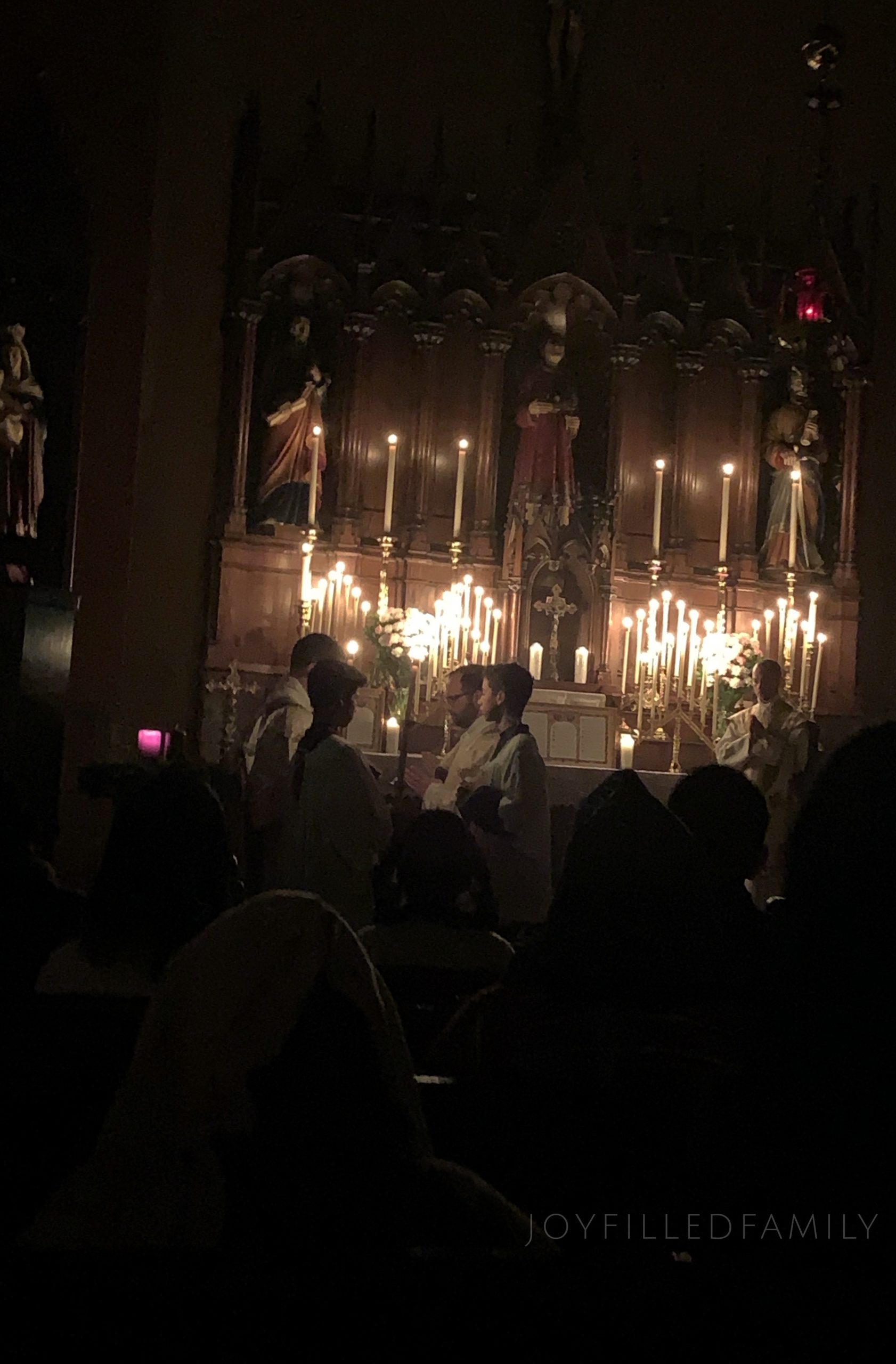
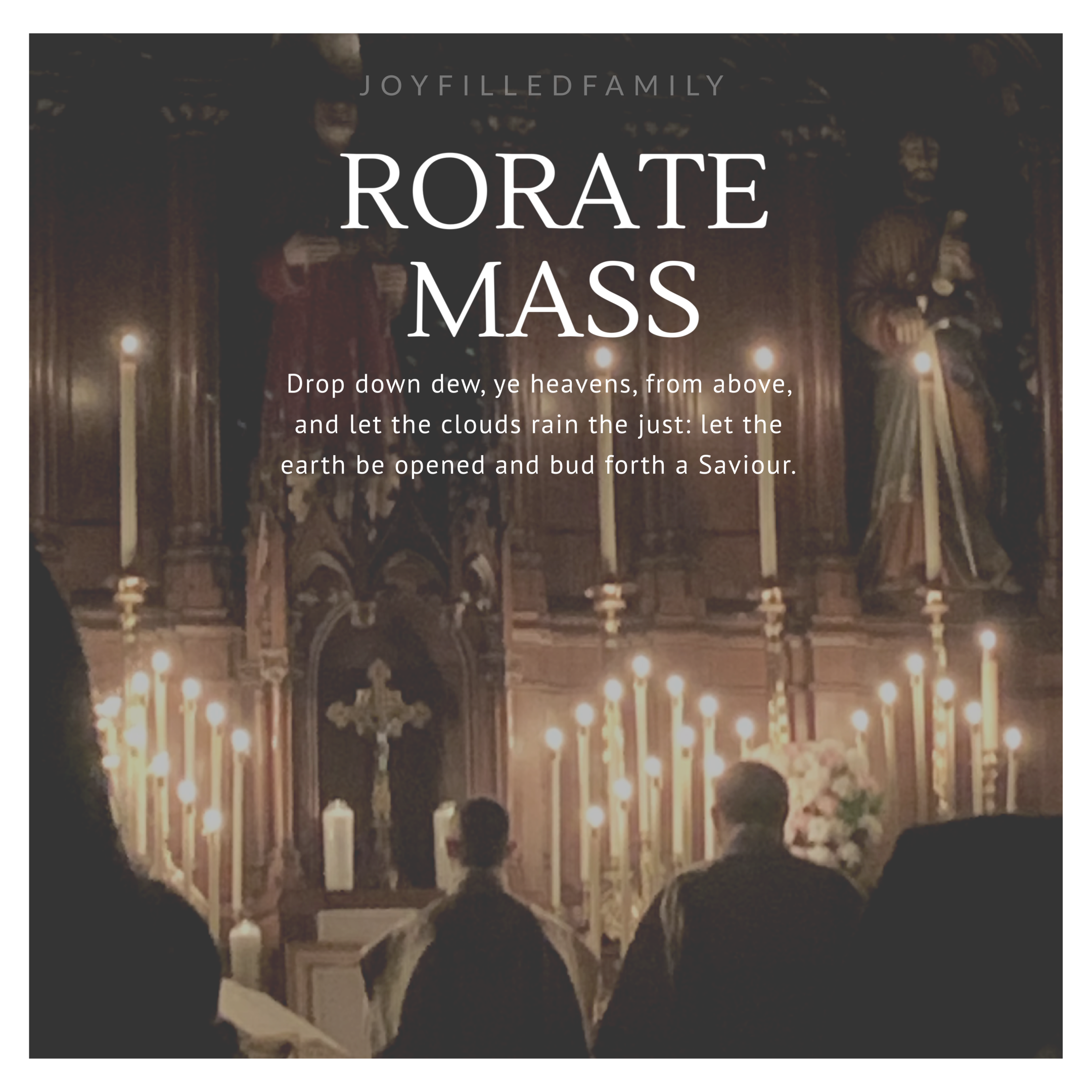
The Rorate Mass is a special votive mass for Our Lady during Advent, traditionally celebrated by candlelight in the early morning.  As the Mass ends the sky is just starting to glow with the new day and we journey from darkness to light and the coming of the Word Made Flesh in the womb of the Virgin Mother is upon us.

I usually keep watch at home with littles but this year my husband was ill so I was able to attend this solemn Mass for our Lady.

My girls were ready at 2am and we departed at 4:20am.

The beauty and austerity of the morning can not be put into words. The senses are drawn in more than ever before.

Our Pastor instructs us about the darkness that we are surrounded with in the Church, the world, and that which is placed before us for this Holy Mass. We are reminded to trust in the maternal love of Our Lady for all our needs as we prepare for Holy Mass.

Holy Mass begins and all the worries fade. The darkness is almost unnoticeable as all the senses are drawn into the true light. It’s all a beautiful preparation for the Christchild.

There is no exercise which is more pleasing to God, or more meritorious, or which has greater influence in infusing solid piety into the soul, than the assisting at the holy sacrifice of the Mass. If this be true at all the various seasons of the Christian year, it is so, in a very special manner, during the holy time of Advent. The faithful, therefore, should make every effort in order to enjoy this precious blessing, even on those days when they are not obliged to it by the precept of the Church. ~Dom Gueranger

Divine Infant King Jesus, come down into our hearts!

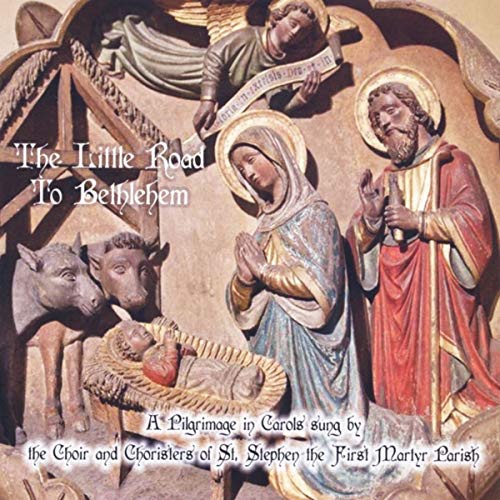
“Gabriel’s Message,” is the song played in the video of the Rorate Mass from parish in 2012 . It is a traditional Basque Advent carol sung by the Choir and Choristers of St. Stephen the First Martyr Parish. My eldest daughter was honored to be a chorister member for the production. The entire album, “The Little Road to Bethlehem” can be purchased from Amazon as a MP3 download. It is a wonderful addition for any family desiring to go deeper into the Advent season.

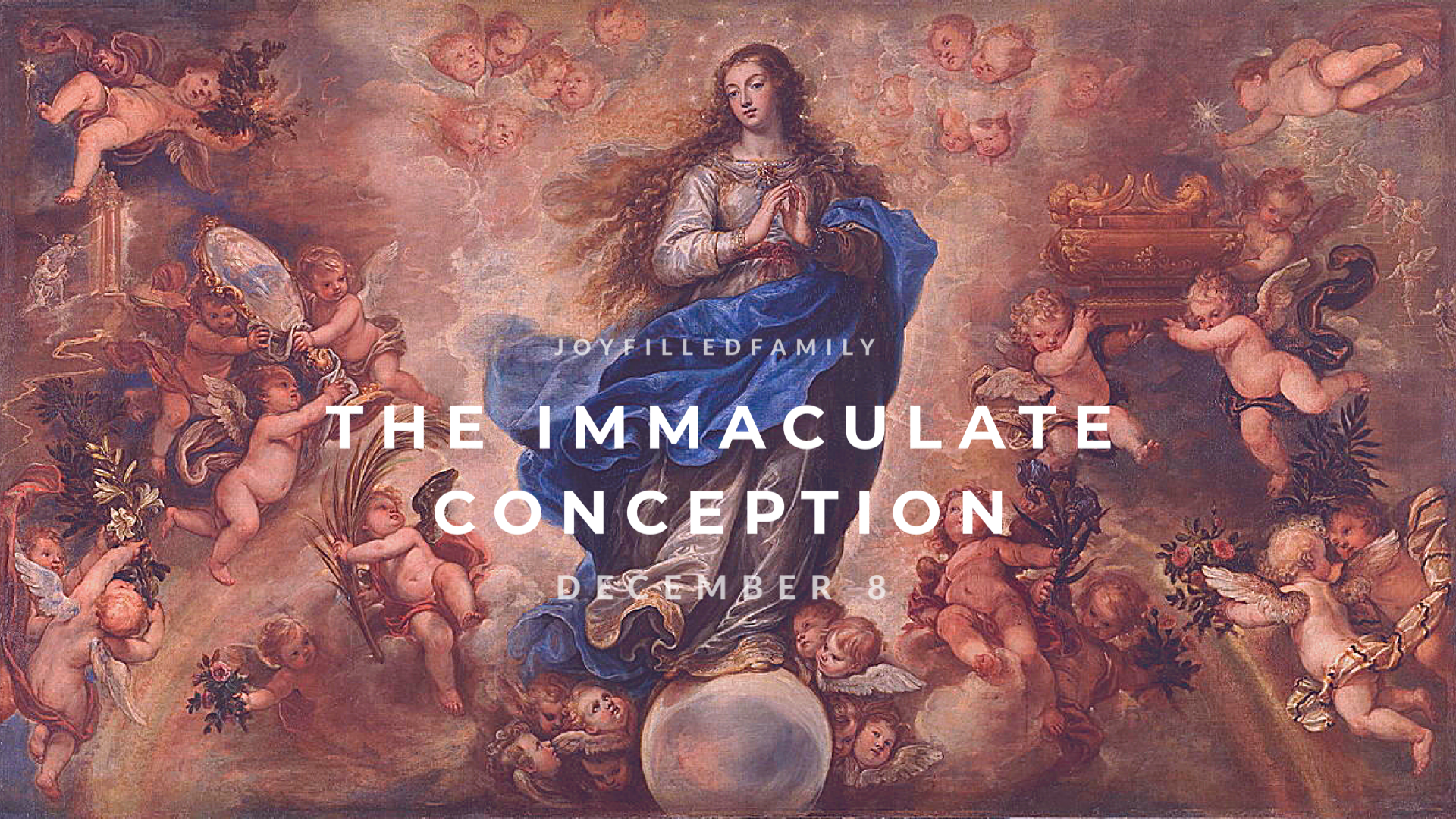
The Immaculate Conception of the Blessed Virgin Mary

December 7, 2019 by Lena {JOYfilledfamily} Filed Under: 12 December Saints, Advent, Holy Day of Obligation, Immaculate Conception, The Church’s Year Leave a Comment

O Mary, conceived without sin, pray for us who have recourse to thee!

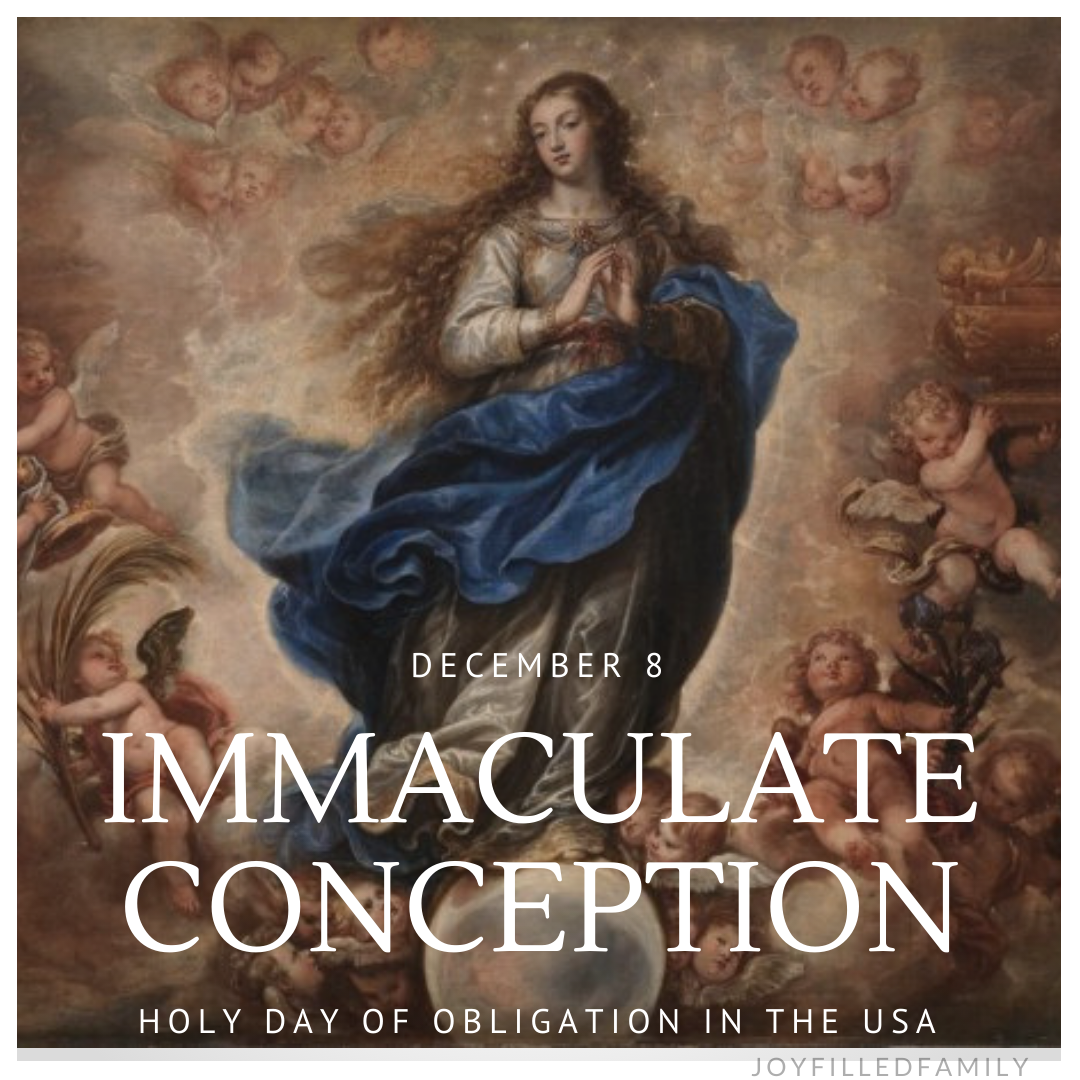
THE FEAST OF THE IMMACULATE CONCEPTION OF THE BLESSED VIRGIN MARY

(Takes precedence over an Advent Sunday)

Fr. Goffine, The Church’s Year

On this day and the ensuing eight days, the Catholic Church celebrates with special solemnity the Immaculate Conception of the Blessed Virgin Mary.

What does the Catholic Church understand by the Immaculate Conception?

By the Immaculate Conception she does not understand that great grace by which Mary preserved herself pure from every, even the least, actual sin; for, as concerns this, the Church has long since declared that Mary never sinned: nor does she understand by it her continual virginity, for it has been for a long time a doctrine of faith that both before and after the birth of her divine Son Mary remained a pure virgin; nor yet that she was sanctified before birth,; as were the Prophets Jeremias and John the Baptist, who were both conceived in sin, but by a special grace of God were released from it before their birth; neither does she understand by it the conception of Christ from the Holy Ghost, that is, that Mary unstained conceived the Son of God of the Holy Ghost; and without the assistance of man, for this was always the unalterable doctrine of the Church: she does understand by it that exalted favor, that unshared privilege, by which the Blessed Virgin Mary, in the first moments of her conception, by a special grace and favor on the part of God in reference to the merits of Jesus, our Saviour, was preserved from every stain of original sin.

What has until now been held by the Church in regard to this privilege?

Adam and Eve are banished from the Garden of EdenThe Catholic Church has always been of the pious opinion that Mary, the blessed Mother of the Redeemer, was conceived immaculate, that her most pure soul had never from the first moment of her existence the least shadow of sin. This doctrine was embraced by all the saints, the most learned and most faithful children of the Church. We have testimony of this, as far back as the times of the apostles, in a document concerning the sufferings of St. Andrew, in which it is said: “As the first man was created from the spotless earth, so was it necessary that the perfect man (Christ Jesus) should be born of an immaculate virgin.” St. Justin, who died a martyr in the year 167 after Christ, compares the Blessed Virgin to Eve, before she sinned and while she was still a virgin. St. Amphilochus says: “He who created the first Eve free from shame, created the second without spot or stain.” Origen, one of the Fathers of the Church, writes that she was neither surprised by the personated serpent, nor infected by his poison, and calls her a pure and immaculate mother. St. Ephrem calls her the undefiled, the strong, the inviolate, the most chaste virgin, far removed from all spot and stain. The Abbot St. Sabbas says of Mary: “On thee who never took part in any guile, I place my hope. No one but thou, O Lady, is without fault, and besides thee no one is unsullied and spotless.” St. Ambrose calls Mary a virgin who by the grace of God remained always free from all shadow of sin. St. Augustine says: “When there is mention made of sin, the Virgin of whom on account of our Lord no question is to be asked, must be excepted.” St. Proclus says, “that the holy Mother of God was made by the purest God free from all stain.” St. Fulgentius says: “The wife of the first man was led astray and her soul soiled toy the malice of sin, but in the mother of the second (Christ) the grace of God preserved the soul as well as the body inviolate.” St. Paschasius Radbertus testifies: “It is certain that Mary was free from original sin;” and St. Peter Barman says: “The flesh of the Virgin taken from Adam, would not submit to the stain of Adam,” and before him the pious Doctor Alcuin wrote of Mary: “Thou art beautiful as the moon and free from all spot and every shadow of changeableness!” And St. Ildephonsus says: “It is certain that Mary was free from original sin.” An immense number of saintly men and theologians maintained the same. Many of them argued with the greatest keenness and the most indefatigable zeal the part of the Blessed Virgin; the teachers at the universities of Paris, Salamanca, Coimbra, Naples, Cologne, Mayence, Ingolstadt, &c., made it their duty by vows to inculcate this great privilege of the most favored Virgin, and to defend it by speech and by writings. Celebrated orders of monks, especially the orders of St. Benedict, St. Francis and St. Ignatius, made it their duty to advance this pious faith of the Immaculate Conception among the people. A great number of popes and bishops also honored the Immaculate Conception, and forbade the contrary doctrine to be taught. Even kings, princes and emperors counted it a great honor to pay homage to the Immaculate Conception of the Queen of Heaven. Finally, the Catholic Church gave definite expression to this universal belief, by declaring in the Council of Trent, that in the resolutions relating to original sin, the Virgin Mary was not included, and she confirmed the festival of the Immaculate Conception, introduced in the tenth century by St. Anselm, the worthy son of the great St. Benedict, and since that time observed in all the Churches.

This veneration for the Immaculate Conception, this pious view held by the whole Catholic Church was not yet a matter of faith, that is, the Catholic Church had not yet laid down this great privilege of the Mother of God as a dogma. We were not commanded to believe it, although to preach or teach against it was forbidden. But when, in the course of time, a large number of the faithful, among whom were archbishops, bishops, whole religious orders, as well as great monarchs, besought the pope as head of the Church to pronounce concerning the Immaculate Conception of the Blessed Virgin, that is, to elevate the belief so widely spread throughout the Catholic Church to a dogma, the pope could no longer hesitate to raise his voice in regard to this most important affair.

What did the supreme pastor of the Church, the pope, then do in regard to the Immaculate Conception of the Blessed Virgin?

Pope Pius IX. who, as he himself testified, had in many ways experienced the assistance of the great Queen of Heaven, was urged by his love and childlike veneration for the Blessed Mother of our Lord, to set the last brilliant diamond in her crown of glory by declaring the Immaculate Conception an article of faith. Not wishing to be precipitate, he first addressed a circular to all the primates, patriarchs, archbishops and bishops, of the whole Catholic world, February 2, 1849, requesting them to send him reports of the devotion of their clergy and the faithful concerning the Immaculate Conception, and the extent of their desire in the matter, that the case might be decided by the Apostolic See; at the same time he urged them to pray with him that God would give him the necessary enlightenment, and to call upon the clergy and the faithful for their prayers. When this was done, five hundred bishops in different parts of the world declared that they and their flocks firmly believed that Mary, the most favored Virgin, was preserved from every stain of original sin, and that they earnestly desired that the pope might raise this pious opinion to a dogma of the Church. Then the holy father, filled with delight, invited the bishops of the different countries to Rome, to consult with him upon the matter. About one hundred and fifty bishops, and a large number of learned men and superiors of spiritual orders, met at Rome and the whole subject was once more maturely examined; and at last, the 8th of December, 1854, the day on which the Church celebrates the feast of the Immaculate Conception, was appointed as the day on which the pope, the supreme head of the Church, the mouth of the apostles, should solemnly announce the dogma of the Immaculate Conception.

On this day the holy father ascended the Apostolic Chair in the splendid Church of St. Peter at Rome, and surrounded by the assembled cardinals, archbishops, and bishops, the clergy and the people he once more invoked the light of the Holy Ghost, and amid the perfect silence which reigned in that immense church, the holy father in a loud voice and with the most profound reverence and emotion read the decree by which he solemnly pronounced and established, that:

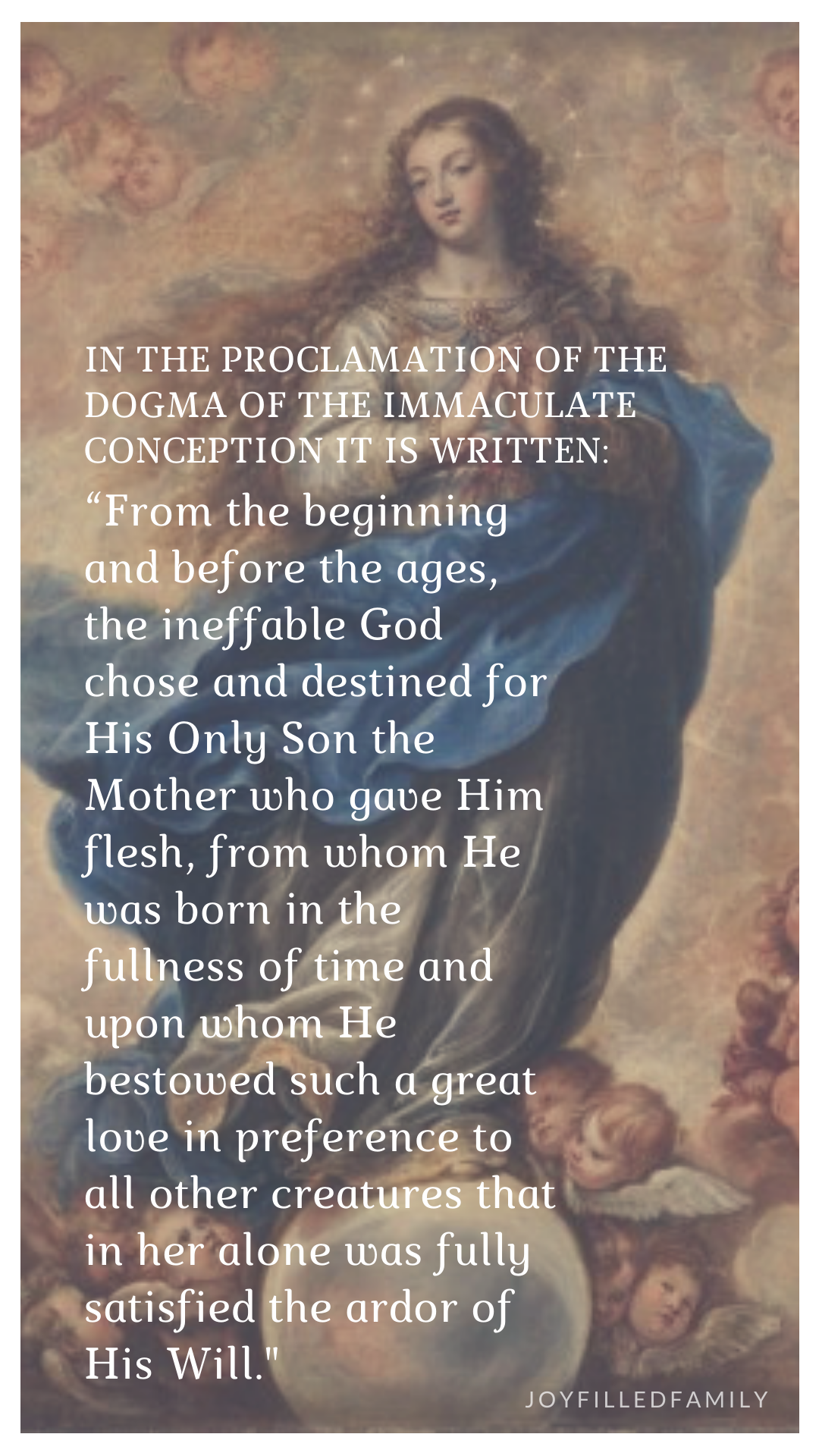
“It is an article of faith that the Blessed Virgin Mary by a special grace and privilege of God, on account of the merits of Jesus Christ, the Redeemer of mankind, was from the first instant of her conception protected and preserved from every stain of original sin.”

Thus has the head of Catholic Christianity drawn aside the veil, which until then obscured the full glory of the Queen of Heaven, which now shines in stainless loveliness radiant over the whole world. The truth that the Blessed Virgin Mary was conceived immaculate is no longer a pious opinion, but an article of faith which every Catholic who wishes to remain a child of the Church, must profess with heart and with lips.

But, perhaps the decision of the pope concerning the Immaculate Conception is a new doctrine?

By no means; it is an old belief, established upon the holy Scriptures and laid down in the bosom of the Church, but not solemnly pronounced and made public previously. The pope cannot make a new article of faith, but he can and must announce that, as a revealed truth, which is established by the holy Scriptures and has been everywhere and at all times believed as a revealed truth by all true Christians. But if there is a truth founded on the holy Scriptures and tradition, of which the pope, the representative of Christ on earth, speaks officially, then every Catholic is bound to believe and openly to acknowledge the same. As we have already seen, the doctrine of the Immaculate Conception has been believed since the time of the apostles, and it is also established by the Scriptures. In the oldest of the sacred Books, in the Book of Genesis, (iii. 15.) is one of the most weighty passages on this subject which reads: I will put enmities between thee and the woman, and thy seed and her seed; she shall crush thy head, and thou shalt lie in wait for her heel. After the fall of the first man, God spoke to the serpent, Satan, announcing that a woman would come and crush his head, that is, destroy his power; and all Catholic interpreters and holy Fathers agree that this woman is the Blessed Virgin. Mary is, therefore, placed by God Himself as Satan’s enemy, and must have been free from original sin from the first moment of her conception, otherwise she would have been, as St. Paul, the Apostle, says, a child of God’s wrath and under the power of Satan. In the gospel of St. Luke, (i. 28.) it is further said: And the Angel being come in, said unto her: Hail full of grace: the Lord is with thee: blessed art thou amongst women. The angel, by the direction of God, called Mary full of grace, that is, more than any of the just endowed with God’s sanctifying grace, as the holy Fathers agree. But would Mary be full of sanctifying and all other graces, had she for one moment of her life been without grace and burdened with sin? Would God have permitted the Blessed Mother of His only begotten Son, from whom He received flesh, to be touched by sin, even though for an instant, and be in the power of Satan? No; God’s hand preserved her; by His grace and by the infinite merits of her divine Son she remained free from every stain of sin, and the Church most justly applies to her the words of holy Scripture: Thou art all fair, O my love, and there is not a spot in thee. (Cant. iv. 7.)

What instructive meaning has the Immaculate Conception of the Blessed Virgin for every Catholic?

The Immaculate Conception teaches Catholics to know in some measure the infinite sanctity of the holy Trinity which makes sin so hateful and detestable to Him. The Heavenly Father could not see His beloved daughter for one moment stained by sin. The Divine Son could not wish to choose for His mother a virgin upon whose soul there was a vestige of sin. The Holy Ghost whose most pure bride Mary is, was not willing that her heart, His dwelling-place, should ever be for one instant soiled by sin. Behold how God detests sin! The Immaculate Conception also teaches us the inestimable treasure of sanctifying grace. Mary received this priceless treasure from God even in the first moment of her conception, without it she would never have become the Mother of the Saviour. Thou, my Christian, hadst not this treasure at thy conception, it is true, but thou didst receive it in holy baptism; there God’s hand arrayed thee in the white garment of innocence; there He sanctified thy soul, and the Holy Ghost selected it for His dwelling-place. Mary preserved this inestimable treasure until death, she was always blooming as a pure lily, the breath of sin never soiled her loveliness. Ask thyself: Do I still possess this treasure, which was given to me in holy baptism; have I preserved my soul’s beauty from the poison of sin, have I soiled it, destroyed it, lost it? Oh, if thou hast lost this precious gift, how unhappy art thou! if thou hast had this great misfortune to have stained thy garment of baptismal innocence by sin, Mary, the peerless virgin, has borne for thee the Saviour whose precious blood cleanses from every sin, whose infinite merits will restore to thee sanctifying grace, if thou art contrite and dost confess thy sin. But for the Saviour this treasure would be forever lost to thee, and thy soul forever forfeited. But for this Saviour Mary would not have been preserved from original sin, would not have received sanctifying grace at her conception. We can here learn the necessity of salvation through Christ, gratefully thank God who has given it to us, and praise Mary who had the grace to conceive and give birth to Him. In the Immaculate Conception, O Christian, thou canst learn to know something of the priceless value of virginity. Jesus chose a pure and immaculate virgin for His mother, who should be the mirror of all virginal souls, her most pure and immaculate image should be continually presented to the corrupted world to show how virginity is esteemed in the eyes of our Lord.

INTROIT I will greatly rejoice in the Lord, and my soul shall be joyful in my God: for He hath clothed me with the garments of salvation: and with the robe of justice He hath covered me, as a bride adorned with her jewels. (Isai. Ixi. 10.) I will extol Thee, O Lord, for Thou hast upheld me: and hast not made my Enemies to rejoice over me. f/fr.xxix.) Glory etc.

COLLECT O God, who by the Immaculate Conception of the Virgin, didst prepare a worthy habitation for Thy Son: we beseech Thee, that as Thou didst through the foreseen death of Thy same Son, preserve her from all stain, so Thou wilt also grant that we may reach Thee cleansed through her intercession. Through the same Jesus etc.

LESSON (Prov. viii. 22—35.) The Lord possessed me in the beginning of his ways, before he made any thing, from the beginning. I was set up from eternity, and of old, before the earth was made. The depths were not as yet, and I was already conceived: neither had the fountains of waters as yet sprung out: the mountains with their huge bulk had not as yet been established: before the hills I was brought forth: he had not yet made the earth, nor the rivers, nor the poles of the world. When he prepared the heavens, I was present; when, with a certain law and compass, he enclosed the depths; when he established the sky above, and poised the fountains of waters; when he compassed the sea with its bounds, and set a law to the waters, that they should not pass their limits; when he balanced the foundations of the earth. I was with him, forming all things, and was delighted every day, playing before him at all times, playing in the world; and my delights were to be with the children of men. Now, therefore, ye children, hear me: Blessed are they that keep my ways. Hear instruction, and be wise, and refuse it not. Blessed is the man that heareth me, and that watcheth daily at my gates, and waiteth at the posts of my door. He that shall find me shall find life, and shall have salvation from the Lord.

EXPLANATION AND APPLICATION This lesson is first a panegyric on the divine, uncreated Wisdom, the eternal Son of God, who at all times and before all things was with God and in God, by whom was made everything that was made, ordered and preserved; who rejoices in His works, loves them, and who admonishes man to love and imitate Him, and promises him eternal and temporal happiness. The Church causes this lesson to be read on this day, because the greater part of it can be applied to Mary; for it can truly be said of her, that she, as the most holy and excellent of all creatures, possessed the first place in the heart of God. For this reason the Church applies to her the words of the wise man: I came out of the mouth of the most High, the first-born before all creatures. (Ecclus. xxiv. 5.) For, as St. Richard says, she is the most worthy of all; no one has received so full a measure of purity, and of all supernatural gifts; in no creature are the marvels of divine goodness so visible as in her. Admire, devout soul, this master-piece of Almighty God, and make frequent use of the words of St. Chrysostom:

“Hail Mother of God and our Mother! Hail O Heaven in which God Himself dwells! O Throne of grace from which the Lord distributes His graces! Pray always to Jesus for us, that on the Day of Judgment we may receive forgiveness and eternal salvation.”

GOSPEL. (Luke i. 26—28.) at that time, The angel Gabriel was sent from God into a city of Galilee, called Nazareth, to a virgin espoused to a man whose name was Joseph, of the house of David, and the virgin’s name was Mary. And the Angel being come in, said unto her: Hail, full of grace, the Lord is with thee; blessed art thou amongst women.

Why is this gospel read today?

Because it has a significant relation to the Immaculate Conception, and proclaims the great honor shown to the Blessed Virgin by these words: Hail, full of grace, the Lord is with thee; blessed art thou amongst women.

Why did the angel call Mary full of grace?

Because Mary was filled with grace, even before she came into this world; because she always increased in grace; because she was to bear the Author of all grace; that we may consider how Mary obtains for us the treasures of divine grace.

Mary was filled with grace even before her birth. As we are all conceived in sin, being children of a sinful ancestor, we are, therefore, burdened by sin before our birth. Mary was free by the privilege of the Immaculate Conception from all sin; her soul, pure and adorned with sanctifying grace, came forth from the hands of the Creator, and without the least prejudice to its purity and sanctity was united to her most pure body, from which the Saviour was to take His humanity. She could not from the first instant of her existence be wanting in that original sanctity and justice, which were the most beautiful adornments of our natural ancestress, Eve.

But Mary from the first moment of her conception was not only in grace but full of grace, because God appointed her for the highest dignity, of being the Mother of His only-begotten Son, and had consequently endowed her with the full measure of corresponding plenitude of graces and gifts of the Holy Ghost; according to the opinion of many learned men, the measure of grace which the Blessed Virgin received at her Immaculate Conception, was greater than that which all the angels and blessed possess now in glory. Mary ever increased in grace: But the path of the just, as a shining light, goeth forward and increaseth even to perfect day. (Prov. iv. 18.) These words of the Holy Ghost are verified especially in the life of the Blessed Virgin. What abundance of grace did she not receive, when the Holy Ghost overshadowed her, and the divine Son, who is Himself the infinite plenitude of grace, was conceived in her most pure body! Above all this, there yet came that rich supply of grace by which her zealous, constant, perfect and faithful cooperation made Mary increase every moment in grace. Thus St. Bonaventure says: “As all the waters meet in the sea, so all the graces were united in Mary.”

Why did the angel say to Mary: The Lord is with thee?

Because God is with the Blessed Virgin in an extraordinary manner. It is well to notice particularly, that the archangel Gabriel did not say to Mary as the angel did to Gideon: The Lord be with thee, (Judges vi. 12.) but: The Lord is with thee. These words are not, therefore, the wish that the favor, the blessing, the protection of God may be with Mary, but the positive declaration that the Lord really is with her, not simply because of His omnipotence and omnipresence by which He is with all His creatures, nor merely because of His goodness, love and intimacy by which He is with all the just. He is with her in a peculiar manner, since she by her dignity of being the Mother of God came into such close relationship with the Triune God that our intellect can conceive nothing nearer. She became the chosen Mother of the Son of God, the dearest, the most favored daughter of the Heavenly Father, and the pure, beloved bride of the Holy Ghost. “God the Father was with her,” says St. Bonaventure, “as with His most noble Daughter; God the Son was with her as with His most worthy Mother; God the Holy Ghost was with her as with His most pure Bride.”

Why did the angel say to Mary: Blessed art thou amongst women?

Because he desired to honor her as the most blessed of her sex, since she alone was chosen of all the others to be the Mother of God; because the first woman brought the curse, but Mary, the salvation of the world.

Mary, Mother of God! An honor, indeed, which in its exaltation is second only to divinity. Mary, the Virgin Mother of God! Mother and Virgin at the same time, what a wonderful prerogative! Though the greatest and most glorious of all mothers, she is the purest and most spotless of virgins, the queen of virgins.

But not only on account of her double glory as Mother of God and as a Virgin, Mary is the most blessed of her sex, but because it was given to her to mediate for us and for the whole world. She is that woman, promised to our first and sinful parents in Paradise, who would crush the serpent’s head; she gave to her Son the body with which He, by His death on the cross, accomplished the great work of salvation.

ACT OF PRAISE “Praised and blessed be the holy and Immaculate Conception of the Blessed Virgin Mary!”

(Pope Pius VI. granted an indulgence of one hundred days to those who, with contrition and devotion repeat the above act of praise.)

Second Sunday in Advent

December 7, 2019 by Lena {JOYfilledfamily} Filed Under: Advent, Second Sunday in Advent, Second Week of Advent, The Church’s Year Leave a Comment

John Sent Two of His Disciples to Christ

SECOND SUNDAY IN ADVENT

Fr. Goffine

On this day the Church not only makes mention in the office of the priest, but also in the Mass, of the two different Advents of Christ, that by His first gracious advent may be gladdened, and by His last terrible coming at the day of judgment we may be impressed with salutary fear. With this intention she cries out at the Introit:

INTROIT People of Sion, behold the Lord shall come to save the nations; and the Lord shall make the glory of his voice to be heard in the joy of your heart (Is. 30:30). Give ear, O thou that rulest Israel: thou that leadest Joseph like a sheep (Ps. 79). Glory be to the Father.

COLLECT Stir up our hearts, O Lord, to prepare the ways of Thine only-begotten Son: that through His advent we may be worthy to serve Thee with purified minds; who livest and reignest with God the Father, in union with the Holy Ghost, God for ever and ever. Amen.

EPISTLE (Rom. 15:4‑13). Brethren, what things soever were written, were written for our learning, that through patience and the comfort of the scriptures, we might have hope. Now the God of patience and of comfort grant you to be of one mind one towards another, according to Jesus Christ: that with one mind, and with one mouth, you may glorify God and the Father of our Lord Jesus Christ. Wherefore receive one another, as Christ also hath received you unto the honor of God. For I say that Christ Jesus was minister of the circumcision for the truth of God, to confirm the promises made unto the fathers. But that the Gentiles are to glorify God for his mercy, as it is written: Therefore will I confess to thee, O Lord, among the Gentiles, and will sing to thy name. And again he saith: Rejoice, ye Gentiles, with his people. And again: Praise the Lord, all ye Gentiles, and magnify him, all ye people. And again, Isaias saith: There shall be a root of Jesse, and he that shall rise up to rule the Gentiles, in him the Gentiles shall hope. Now the God of hope fill you with all joy and peace in believing, that you may abound in hope, and in the power of the Holy Ghost.

What does St. Paul teach in this epistle?

The Jews and Gentiles who had been converted to the Christian faith were disputing among themselves at Rome, in regard to abstinence and the use of certain kinds of food, reproaching each other severely; the Jews boasted that the Savior, according to promise, was born of their nation, thus claiming Him from the Gentiles, who, in their turn, reproached the Jews for their ingratitude in having crucified Him. To restore harmony St. Paul shows that each had reason, the Jews and Gentiles alike, to praise God, to whose grace and goodness they owed all; that each had in Him a Redeemer in whom they could hope for salvation; and he warns them not to deprive themselves of that hope by contentions. By these words the Apostle also teaches that we too, have great reason to praise God, and to thank Him for calling us, whose forefathers were heathens, to the Christian faith, and to guard against losing our salvation by pride, envy, impurity, etc.

Why should we read the Scriptures?

That we may know what we are to believe, and do in order to be saved, as all Scripture inspired by God is profitable to teach, to reprove, to correct, to instruct in justice (11 Tim. 3:16); that we may learn from what Christ has done for us, and the saints for Christ, to be patient in our sufferings, and to be consoled and encouraged by their example. To derive this benefit from the Scriptures, the Catholic must read them by the light of that Spirit through whose assistance they came into existence, who lives and remains for ever with the Church: that is, the light of the Holy Ghost must be sought, that their meaning may be read according to the sense of the Church and not be explained according to the reader’s judgment. For he who reads the holy Scriptures by the light of his own private judgment, must, as experience shows, of necessity diverge from the right path, become entangled in manifold doubts, and at last, lose the faith entirely. For this reason the Catholic Church has very properly limited the reading of the Bible, not as has been falsely asserted, unconditionally forbidden it, but she allows the reading of those editions only, which are accompanied by notes and explanations that the unity of faith may not be disturbed, and that among Catholics there may not be the terrible bewilderment of the human intellect which has taken place among the different heretical sects who have even declared murder, bigamy and impurity to be permissible on the authority of the Bible. We are to consider also, that Christ never commanded the Bible to be written or read, and that not the readers but the hearers and the followers of the word of God by which is meant those who hear the word of God in sermons, and keep it, will be saved!

Further instruction in regard to the doctrine of faith on this subject will be found in the “Instruction for Easter Tuesday.”

Why is God called a God of patience, of consolation, and of hope?

He is called a God of patience because He awaits our repentance, of consolation, because He gives us grace to be patient in crosses and afflictions, and so consoles us inwardly, that we become not faint‑hearted; of hope, because He gives us the virtue of hope, and because He desires to be Himself the reward we are to expect after this life.

ASPIRATION O God of patience, of consolation and of hope, fill Our hearts with peace and joy, and grant that we may become perfect in all good, and by faith, hope and charity, attain the promised salvation.

GOSPEL  (Mt. 11:2‑10). At that time, when John had heard in prison the works of Christ, sending two of his disciples, he said to him: Art thou he that art to come, or do we look for another? And Jesus making answer, said to them: Go and relate to John what you have heard and seen. The blind see, the lame walk, the lepers are cleansed, the deaf hear, the dead rise again, the poor have the gospel preached to them: and blessed is he that shall not be scandalized in me. And when they went their way, Jesus began to say to the multitudes concerning John, What went you out into the desert to see? a reed shaken with the wind? But what went you out to see? a man clothed in soft garments? Behold, they that are clothed in soft garments are in the houses of kings. But what went you out to see? a prophet? yea I tell you, and more than a prophet. For this is he of whom it is written, Behold, I send my Angel before thy face, who shall prepare thy way before thee.

Why was John in prison?

He was in prison, and lost his life, because he had rebuked king Herod for his adulterous marriage with his brother’s wife (Mt. 14:310). Truth, as the proverb says, is certainly a very beautiful mother, but she usually bears a very ugly daughter: Hatred. St. John experienced that speaking the truth very often arouses hatred and enmity against the speaker. Let us learn from him to speak the truth always, when duty requires it, even if it brings upon us the greatest misfortunes, for, if with St. John we patiently bear persecution, with St. John we shall become martyrs for truth.

Why did St. John send his disciples to Christ?

That they should learn from Christ, who had become illustrious by His teachings and miracles, that He was really the promised Messiah, the Savior of the world, whom they should follow.

Why did Christ say to the disciples of St. John: “Go and say to John, the blind see, the lame walk, etc.”?

That they should, by His miracles, judge Him to be the Messiah because the prophets had predicted that He would work such miracles (Is. 35:5‑6). “Christ,” says St. Cyril, “proved that He was the Messiah by the grandeur as well as by the number of His miracles.”

Why does Christ add: “And blessed is he who shall not be scandalized in me”?

Christ used these words in reference to those who would be scandalized by His poverty, humility and ignominious death on the cross, and who for these reasons would doubt and despise Him, and cast Him away; though “man,” as St. Gregory says, “owes all the more love to the Lord, his God, the more humiliations He has borne for him.”

What was our Lord’s object in the questions He asked concerning St. John?

His object was to remove from St. John all suspicion of failing in faith in Him; and to praise the perseverance with which, although imprisoned and threatened with death, he continued to fill his office of preacher, thus constituting him an example to all preachers, confessors and superiors, that they may never be deterred by human respect, or fear of man, or other temporal considerations, from courageously fulfilling their duties. Our Lord commended also rigorous penance, exhibited by St. John’s coarse garments and simple food, that we may learn, from his example, penance and mortification.

Why does Christ say that John was “more than a prophet”?

Because St. John was foretold by the prophet Malachias as was no other prophet; because of all the prophets he was the only one who with his own eyes saw Christ and could point Him out, and was the one to baptize Him: and because like an angel, a messenger of God, he announced the coming of the Savior, and prepared the way for the Lord.

How did St. John prepare the way for the Savior?

By his sermons on penance, and by his own penitential life He endeavored to move the hearts of the Jews, that by amending their lives, they might prepare to receive the grace of the Messiah, for God will not come with His grace into our hearts if we do not prepare His way by true repentance.

ASPIRATION O Lord Jesus, by the praise Thou didst accord to Thy forerunner St. John, for his firmness and austerities, inflame our hearts with love to imitate his steadfastness and penance, that we may never do anything to please man which may be displeasing to Thee; grant us also Thy grace that we too, like St. John, may have those who are confided to our care, instructed in the Christian doctrine.

CONSOLATION IN SUFFERING
“The God of patience and of comfort, the God of hope fill you with all joy and peace in believing” (Rom. 15:5,13).

What gives us the greatest consolation in adversities?

The strong and fervent belief that each and every thing that happens to us, comes to us for our own good from God, and that whatever evil befalls us, is by the will or permission of God. Good things and evil, life and death, poverty and riches, are from God (Ecclus. 11:14). If we have received good things at the hand of God (Job 2:10), saith the pious job in his affliction, “why should we not receive evil?”

We should be fully convinced that without the permission of God not a single hair of our head shall perish (Lk. 21:18), much less can any other evil be done to us by man or devil (Job 1); we should have a steadfast confidence that if we ask Him, God can and will assist us in our sufferings, if it be for our salvation. Can a woman forget her infant, so as not to have pity on the son of her womb? And if she should forget, yet will not I forget thee. Behold, I have graven thee in my hands (Is. 49:15‑16); we should hope for abundant reward in the future life, which we will merit by patience in our sufferings, for that which is at present momentary and light of our tribulation, worketh for us above measure exceedingly an eternal weight of glory (II Cor. 4:17); we should remember that all complaints and murmurs against the dispensation of God are useless, and lead only to harm and shame; Who hath resisted Him, and hath had peace? (Job 9:4) we should have a vivid remembrance of our sins, for which we have long since deserved the eternal punishments of hell – hence the well-known saying of St. Augustine: O Lord, here cut, here burn, but spare me in eternity. No other way leads to the kingdom of heaven than the way of the cross, which Christ Himself, His sorrowing mother, and all the saints had to tread. Ought not Christ to have suffered these things, and so to enter into His glory? (Lk. 24:26) Through many tribulations we must enter into the kingdom of God (Acts 14:21). And we should not forget that sorrows and adversities are signs of God’s love, and manifest proofs of being His chosen ones. Whom the Lord loveth He chastiseth, and He scourgeth every son whom He receiveth (Heb. 12:6. compare 7-11).

PRAYER IN SORROW O almighty, kind and merciful God! who hast said: “Call upon me in the day of trouble, I will deliver thee, and thou shalt glorify me” (Ps. 49:15), behold relying upon Thy word, I take refuge in Thee in my trouble. Give honor to Thy name, therefore, and deliver me, if it be pleasing to Thee and beneficial for me, that all may know, Thou art our only help. Amen.

Tuesday of the First Week in Advent

December 3, 2019 by Lena {JOYfilledfamily} Filed Under: Advent, First Week of Advent, Tuesday of the First Week in Advent Leave a Comment

TUESDAY OF THE FIRST WEEK IN ADVENT

Regem venturum Dominum, venite, adoremus.    

Come, let us adore the King our Lord, who is to come.


De Isaia Propheta.

Cap. ii.

Verbum, quod vidit Isaias filius Amos, super Juda et Jerusalem. Et erit in novissimis diebus praeparatus mons domus Domini in vertice montium, et elevabitur super colles: et fluent ad eum omnes Gentes. Et ibunt populi multi, et dicent: Venite, et ascendamus ad montem Domini et ad domum Dei Jacob: et docebit nos vias suas: et ambulabimus in semitis ejus, quia de Sion exibit lex, et verbum Domini de Jerusalem.

From the Prophet Isaias.

Ch. ii.

The word that Isaias the son of Amos saw concerning Juda and Jerusalem. And in the last days the mountain of the house of the Lord shall be prepared on the top of mountains, and it shall be exalted above the hills: and all nations shall flow unto it. And many people shall go, and say: Come and let us go up to the mountain of the Lord, and to the house of the God of Jacob : and he will teach us his ways: and we will walk in his paths, for the law shall come forth from Sion, and the word of the Lord from Jerusalem.

How the Church loves to hear and say these grand words of the prophet: Come, let us go up to the mountain of the Lord! She repeats them in the Lauds of every feria in Advent; and her children bless the Lord, who, that we might have no difficulty in finding Him, has made Himself like to a high mountain; high, indeed, yet can we all ascend it. It is true that, at first, this mountain is, as we learn from another prophet, a small stone which is scarcely perceptible, and this to show the humility of the Messias at His birth ; but it soon becomes great, and ail people see it, and are invited to dwell on its fertile slopes, yea, to go up to its very summit, bright with the rays of the Sun of justice. It is thus, O Jesus, that Thou callest us all, and that Thou approachest towards all, and the greatness and sublimity of Thy mysteries are put within the reach of our littleness. We desire to join, without delay, that happy multitude of people which is journeying on towards Thee ; we are already with them; we are resolved to fix our tent under Thy shadow, 0 Mountain ever blessed ! There shelter us, and let us be out of reach of the noise of the world beneath us. Suffer us to go so far up, that we may lose all sight of that same world's vanities. May we never forget those paths which lead even to the blissful summit, where the mountain, the figure, disappears, and the soul finds herself face to face with Him, whose vision eternally keeps the angels in rapture, and whose delight is to be with the children of men ! [Prov. viii. 31.]

HYMN FOR THE TIME OF ADVENT

(Composed in the ninth century, and taken from the hymnarium of B. Joseph-Maria Tommasi)

Sol, astra, terra, sequoia, Adventum Dei altissimi, Prolem exc&Isi germisis, Dives et mops concrepent:

Olim promissum patribus Partum puellae inclytum, Natum ante luciferam, Dei potentis Filium.

Venturum Regem glorise, Deum regnare regibus;

Hos tern calcare improbum, Mundum sanare languidum.

Lsotentur simul angel i, Omnes exsultent populi: Excelsns venit humilis, Salvare quod perierat.

Deus et homo oritur, Sanctaque regnat Trinitas; Cosevus Patri Filius, Terris descendit Dominus.

Clament prophetse ©t pro-phetent: Emmanuel jam prope est; Mutorum linguae jam sonent, Claudi in occursum pergite.

Agnus et fera bestia Simul manducent paleas: Agnoscat bos et asinus Jacentem in prsesepio.

Signum regale emicans Sacrum prseeedit Verticem; Regali nato nobili, Beges parate munera.

O quam beatum nuntium Virgo Maria audiit! Credendo mater foeta fit, Et virgo virum nesciit.

Omnes gentes et insula, Magnum triumphum plau-dite,

Cursu cervorum eurrite: Redemptor ecce jam venit.

Discant caecorum oeuli, Clauso sedentes lumine, Noctis tenebras solvere, Lumen verum pereipere.

Gens Galilsea et Graecia Credat, Persa et India : Dignando Deus homo fit, Et Verbum cum Patre manet.

Laus, honor, virtus, g] Deo Patri, et Filio, Una cum sancto Spiritu, In sempiterna ssecula.

Amen.    

May the sun, and stars, and land, and sea, sound forth the coming of the most high God: may the rich and poor unite their songs of praise to the Son of the supreme Creator !

He is the Saviour promised to our fathers; the glorious offspring of a Virgin: the Son of the mighty God bom of him before the morning star. He is the King of glory, and is coming to rale as God

over kings, trample our wicked enemy beneath his feet, and heal this sick world of ours.

Let the angels rejoice x let all nations exult; he tlM is high is coming in lowliness to save what had been lost.

A God-Man is born, and the holy Trinity reigns; the Son co-eternal with the Father, our Lord, descends upon our earth.

Let the prophets cry out, and prophesy: Emmanuel is nigh unto us. Let the tongues of the dumb speak, and ye, poor lame ones, run to meet him.

Let the lamb and the wild beast feed with each other: let the ox and the ass know him that lies in the manger.

The royal glittering standard ushers in our divine Chief: ye kings prepare your gifts for the noble and royal Babe.

O the blessed message sent to the Virgin Mary ! By believing she conceives; she is a Mother, and a Virgin knowing not man.

All ye nations and islands applaud this grand triumph. Run swiftly as the stag, lo ! the Redeemer is coming.

Let the eyes of the blind, who have been sitting in darkness, now learn to throw off the murky night, and open to the true light.

Let Galilee, and Greece, and Persia, and India, receive the faith: a God deigns to become man, and remains the Word with the Father.

Praise, honour, power, glory, be to God the Father, and to the Son, together with the Holy Ghost, for eternal ages.

Amen.

PRAYER FROM THE GALLICAN MISSAL

(In Adventu Domini, Contestatio)

Deus, cui proprram est ac singular©, quod bonus es, et nulla unquam a te es commutation© diversus; propitiare supplicationibus nostris; et EcclesisB tufe misericor-diam tuam, quam confitemur, ostende, manifestans plebi tuas Unigeniti tui mirabile Saeramentum: ut universitate nationum perficiatur, quod per Verbi tui Evangelium promisisti; et habeat plenitudo adoptionis, quod prsetulit testificatio veritatis. Per Christum Dominum nostrum. Amen.

O God, whose nature and property is goodness, and with whom there is no change, be propitious to our prayers, and show to thy Church that mercy of thine which we confess; show to thy people the wonderful mystery of thy only-begotten Son; that thus, what thou hast promised by the Gospel of thy Word, may be fulfilled by all nations coming to the faith, and the testimony of truth may be verified by the completion of adoption. Through Christ our Lord. Amen.
  • « Previous Page
  • 1
  • …
  • 7
  • 8
  • 9
  • 10
  • 11
  • …
  • 20
  • Next Page »

Hi! I'm Lena, mama of JOYfilledfamily.
We are a traditional Catholic family striving to live for Jesus Christ in everything we do. We pray to completely surrender our will to His and to become His servants. Our mission of this blog is to share our JOY.

This blog serves as a journal of us making good memories, living the liturgical year, and our spiritual journey.

Subscribe to our Newsletter

  • Home
  • About
  • Blog

Copyright © 2026 swank WordPress Theme <a PDCD