• Email
  • Facebook
  • Instagram
  • Pinterest
share our JOY

JOY{filled}family

striving to radiate Him always

  • Home
  • Blog
  • Brown Scapular
  • Liturgical Calendars & Planners
  • Wellness
    • Essential Oils
    • Fitness
    • Nutrition
  • Homeschool
  • Sacraments
    • Baptism
    • First Communion
    • Confirmation

St. Cajetan

August 7, 2019 by Lena {JOYfilledfamily} Filed Under: 08 August, 08 August Saints, Patron Saint, St. Cajetan, St. Gaetano Leave a Comment

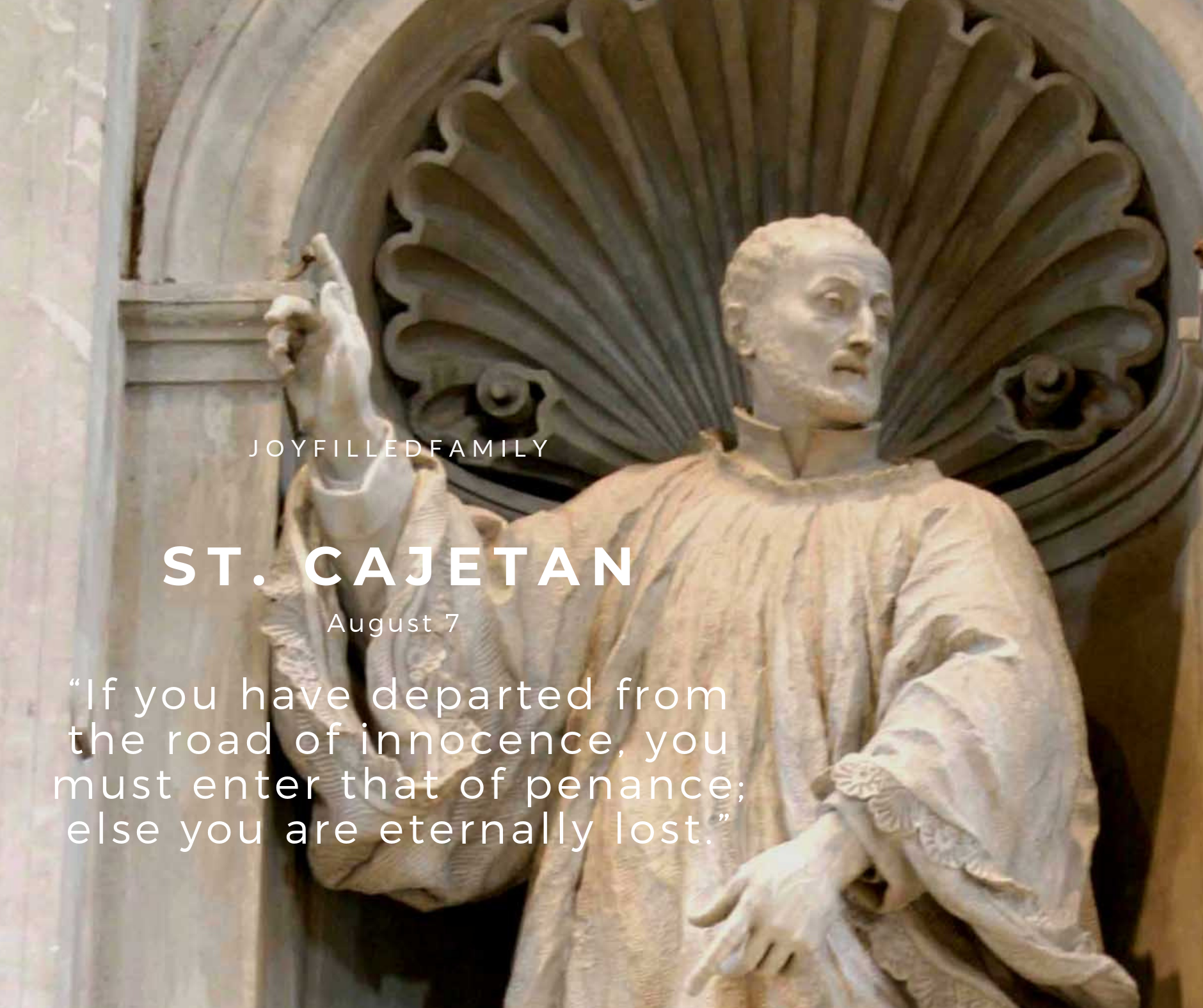
“There is no road leading to Heaven but that of innocence or repentance. He who has departed from the first, must take the second; else he is eternally lost.” -St. Cajetan

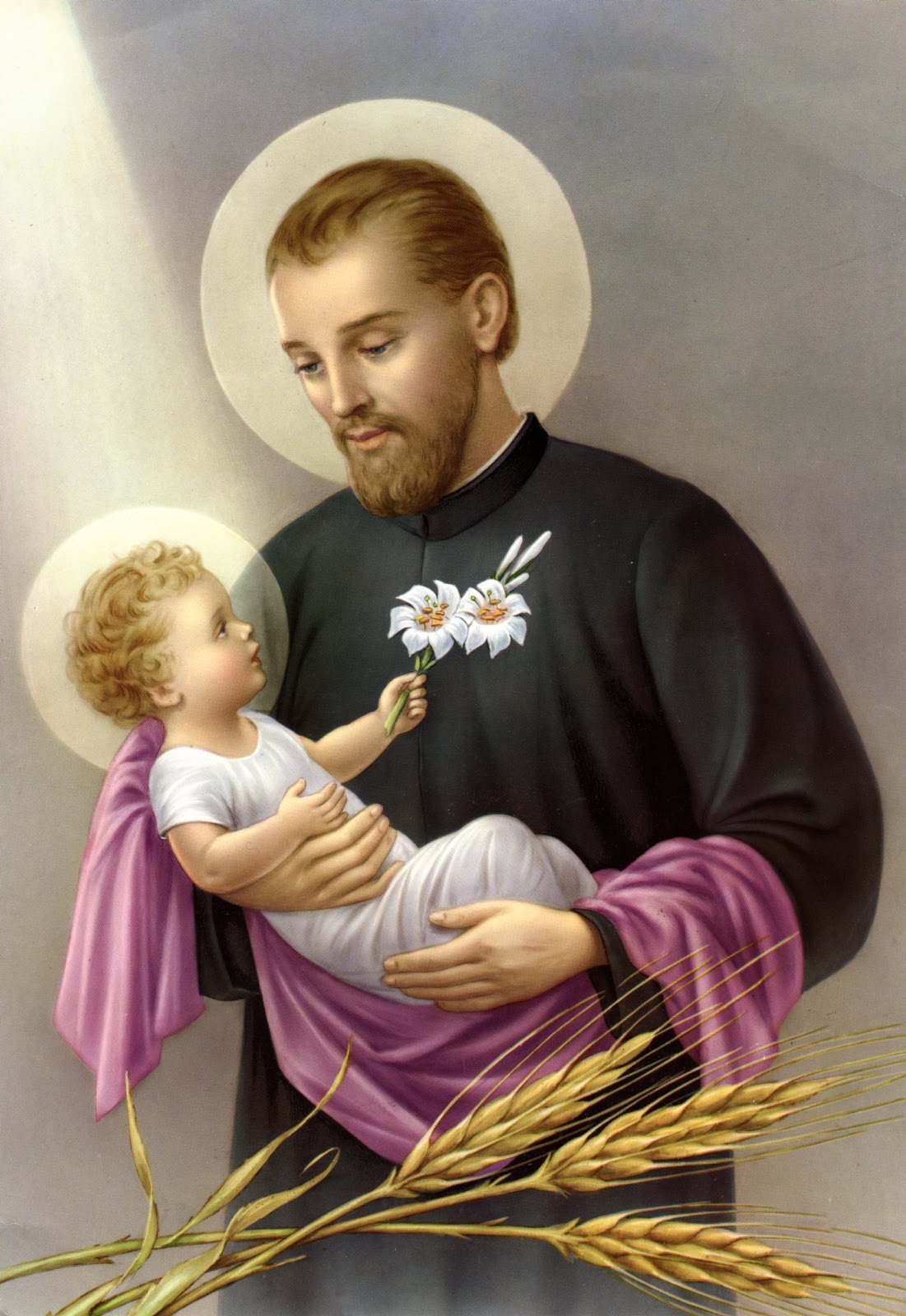
Today, August 7 is the feast day of St. Cajetan, the patron and namesake of our fourth son. We named our son after this beloved saint as our devotion to him grew in my early pregnancy. God had allowed us to be stripped after making a major life move with great discernment. St. Cajetan is the is patron for jobseekers and the unemployed.

St. Cajetan of Thiene brought poverty to its unimaginable limits.

St. Cajetan, ora pro nobis

Saint Donatus

SAINT CAJETAN

Confessor

SAINT DONATUS

Bishop and Martyr

DOUBLE / WHITE

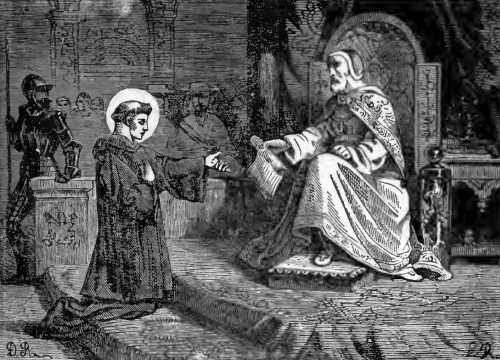
The son of noble and wealthy parents, Cajetan (1480-1547) practiced law for some time, but later spent his considerable fortune in building hospitals in which he himself nursed the plague-stricken. After his ordination to the priesthood, he founded the first community of Regular Clerks, known as Theatines. They imitated the manner of life of the early Christians, trusting entirely in God for their daily bread. Cajetan’s tireless zeal for the salvation of his fellow men caused him to be called the “hunter of souls.”

INTROIT Ps. 36:30-31

The mouth of the just shall meditate wisdom, and his tongue shall speak judgment: the law of God is in his heart.

Be not emulous of evildoers: nor envy them that work iniquity.

Glory be . . .

Mass of a CONFESSOR OF THE FAITH, except

COLLECT

O God, you blessed the holy confessor Cajetan with the grace to lead the life of an apostle. may the prayers and intercession of this saint help us to trust in you always and desire only the things of heaven. Through our Lord . . .

Commemoration of SAINT DONATUS

Donatus, bishop of Arezzo in Tuscany, was arrested and beheaded during the rule of Julian the Apostate about the year 362.

O God, You are the glory of all Your priests. May we sensibly feel the help of Your martyr bishop Donatus whose feast we celebrate today. through our Lord . . .

Lesson

Lesson from the book of Ecclesiasticus

Ecclus 31:8-11

Happy the man found without fault, who turns not aside after gain, nor puts his trust in money nor in treasures! Who is he, that we may praise him? For he has done wonders in his life. He has been tested by gold and come off safe, and this remains his glory forever; he could have sinned but did not, could have done evil but would not, so that his possessions are secure in the Lord, and the assembly of the Saints shall recount his alms.

R. Thanks be to God.

Gradual

Ps 91:12, 14.

The just man shall flourish like the palm tree, like a cedar of Lebanon shall he grow in the house of the Lord.

Ps 91:3

V. To proclaim Your kindness at dawn and Your faithfulness throughout the night. Alleluia, alleluia.

James

1:12

V. Blessed is the man who endures temptation; for when he has been tried, he will receive the crown of life. Alleluia. 

GOSPEL Matt. 6:24-33

At that time, Jesus said to His disciples: “No man can serve two masters. For either he will hate the one, and love the other: or he will sustain the one, and despise the other. You cannot serve God and mammon. Therefore I say to you, be not solicitous for your life, what you shall eat, nor for your body, what you shall put on. Is not the life more than the meat: and the body more than the raiment? Behold the birds of the air, for they neither sow, nor do they reap, nor gather into barns: and your heavenly Father feedeth them. Are not you of much more value than they? And which of you by taking thought, can add to his stature one cubit? And for raiment why are you solicitous? Consider the lilies of the field, how they grow: they labour not, neither do they spin. But I say to you, that not even Solomon in all his glory was arrayed as one of these. And if the grass of the field, which is to day, and to morrow is cast into the oven, God doth so clothe: how much more you, O ye of little faith? Be not solicitous therefore, saying: What shall we eat: or what shall we drink, or wherewith shall we be clothed? For after all these things do the heathens seek. For your Father knoweth that you have need of all these things. Seek ye therefore first the kingdom of God, and his justice, and all these things shall be added unto you.”

SECRET 

Accept this offering which we humbly present in honor of Your saints, O God, and through it purify our bodies and our souls. Through our Lord . . .

Commemoration of SAINT DONATUS

We dedicate these offerings to Your holy name, O Lord, in honor of Your blessed martyr bishop Donatus; may they increase the fruits of our piety and devotion through the intercession of this saint. Through our Lord . . .

POSTCOMMUNION 

Almighty God, we pray that the reception of this Bread of Heaven may strengthen us against all adversity through the intercession of Your blessed confessor Cajetan. Through our Lord . . .

Commemoration of SAINT DONATUS

O Almighty and merciful God, You have made us both partakers and ministers of Your Sacraments. May the intercession of Your martyr bishop Donatus help us profit from the fact that we share his faith and his apostolate. Through our Lord .

Saint Cajetan of Thiene  (also known as Saint Gaetano), was born October, 1487 at Vicenza in Venetian territory and he died at Naples in 1547.  Under the care of a pious mother he passed a studious and exemplary youth, and took his degree as doctor utriusque juris at Padua in his twenty-fourth year.

by Father Francis Xavier Weninger, 1876

Saint Cajetan, founder of the holy order, whose members are called Theatines, was born in 1487, at Vicenza, in Lombardy, of noble and pious parents. Immediately after his baptism, his mother consecrated him to the Blessed Virgin, humbly begging her to guard him and take his spiritual welfare under her motherly protection. His entire after life proved how effectual his mother’s prayers had been. He was never, even in his most tender years, like other children; his greatest pleasure consisted in praying, building small altars, giving alms to the poor, and being most perfect in his obedience to his parents. His whole conduct was such, that even in childhood, he was called a saint He afterwards went to the University, and always made it his greatest care to preserve his innocence unspotted among so many temptations. Having received, at Padua, the degree of civil and canon laws, he repaired to Rome, where he was ordained priest, and preferred by Pope Julius II to a high ecclesiastical position. After the death of the Pope, he resigned his dignity and returned to his home, desiring to work more effectually for the salvation of souls. He served the sick in and out of the hospitals, with untiring charity, in the time of pestilence. His labors were at first, confined to his native town; later, however, he went to Venice. His principal aim was to save souls. The sick, he persuaded by kind and gentle exhortations; and others he moved to virtue by his earnest sermons. The popular saying was, that Cajetan looked like a seraph when standing before the altar, and like an Apostle when in the pulpit. His devotion when he said mass, was equalled by his fervor and zeal while preaching. Whenever he had the opportunity, he tried to win a soul for the Almighty. After some time, he went again to Rome, where, inspired by God, and with the co-operation of three other pious and learned men, he founded an Order for such priests as desired to live an apostolic life, to reform the negligence of the clergy, and the corrupt morals of the people of the world; to observe carefully the sacred ceremonies of the church; restore the observance of pious conduct in the temples dedicated to the worship of the Most High; to labor in opposition to the heretics; assist the sick and dying, and in a word, to promote the welfare of men to the best of their ability. He imposed a special obligation on the members in regard to the vow of poverty; they were not only forbidden to have annual revenues, but even to ask alms. They had to leave the whole care of their subsistence to God, and wait patiently for what Providence would send them. Hard as this seemed to be, still many were found willing to bear such abject poverty. The first house of the order was at Rome; but it was abandoned after the first year, on account of an inroad of imperial soldiers, who also treated Cajetan with great cruelty. Among these soldiers there was ‘One who had formerly been acquainted with the Saint at Vicenza, and knew that, at that time, he was very rich. Believing that he still possessed great treasures* he tried to force them from him, by maltreating him most brutally, and several times casting him into prison. From Rome, the holy founder went to Venice, where he again nursed those stricken down with pestilence. He was then ordered by the Pope to Naples, to found a new house for his Order. This city had to thank the vigilance of this Saint, under God, for its preservation from heresy; for, several disciples of Luther, who at that time disseminated his poisonous doctrines in Germany, had come to Naples and begun privately, as well as publicly, to maintain, under the name of “Evangelical liberty,’* the teachings of Luther. They had also brought with them several books which contained the Lutheran doctrines, designing to give them to the people, and thus contaminate the city with the doctrines they contained. When Saint Cajetan was informed of this, and had, moreover, seen the Evil One standing in the pulpit beside Bernardin Ochino, one of Luther’s disciples, whispering into his ear every word that he preached, he notified the ecclesiastical authorities of these facts, and preached so zealously against the new heresy, that the heretical books were all given up and burnt, and the inhabitants of the city were preserved in the true faith. The Saint rendered the same service to several other cities in Italy.

The holy man was exceedingly severe towards himself. He never divested himself of his rough hair-shirt. Almost daily he scourged himself most mercilessly. In partaking of nourishment he was so temperate, that his life might justly be called a continual fast. He spent most of his nights in devout exercises, taking but a short rest upon straw. He never spoke except to honor God or benefit man. He was indefatigable in his exertions for the salvation of souls, and hence it is not surprising that God bestowed many graces upon him. One Christmas Eve, when he was passing the night in the Church of Saint Mary Major, the Holy Child appeared to him, and the Blessed Virgin, who carried Him, laid Him. into the Saint’s arms, filling his soul with heavenly consolation. The holy man had many other visions during his life, and was often seen in a state of ecstacy during his prayers. He also possessed the gift of prophecy, and miraculously cured a great many sick. There was a priest of his Order, whose foot was to be amputated. The evening before the operation was to be performed, the Saint examined the foot, which was extremely swollen and affected with gangrene; he kissed it, made the holy sign of the cross over it, bandaged it anew, exhorting the sufferer to put his trust in God and to ask the intercession of Saint Francis. After this he turned to God m prayer. When on the following day, the surgeon came to perform the painful and dangerous amputation, they found, to their amazement, that the foot was healed.

When Saint Cajetan sailed from Venice to Naples, a terrible storm arose, and all on board expected the boat to sink every moment. Cajetan took his Agnus Dei and threw it into the sea, which immediately became calm. His life is filled with similar events; we, however, having no space for more of them, will only relate how happily and with what heroic charity he ended his earthly career.

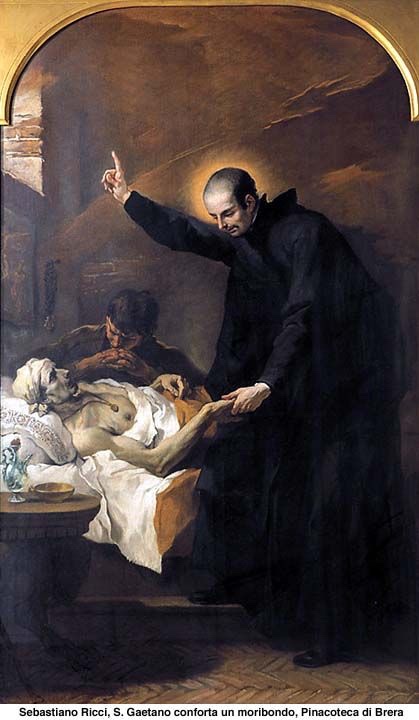
The authorities at Naples, civil as well as ecclesiastical, had resolved to institute the Inquisition in the city, to guard the faithful more thoroughly against heresy. The people were, however, opposed to it to such an extent, that a revolt was feared, and neither the exhortations and persuasions of Saint Cajetan nor of other men were of any avail. The holy man was deeply distressed at the danger of so great a city and still more of so many souls. Hence he offered his life as a sacrifice to appease the wrath of the Almighty, praying that God would accept of it, restore peace, and spare the city and its inhabitants. The following event will show how pleased the Almighty was with this sacrifice. Soon after the Saint had offered himself to Heaven, he became dangerously sick, and repeating his offer, died a most peaceful and holy death, having had the privilege of seeing Christ and the Blessed Virgin. The Saviour assured him of his salvation, the Divine Mother of her protection until his death. And yet he would not die in any other manner than as a penitent; for when the physician said he needed a more comfortable bed, he protested most emphatically against it, saying that he would not, in his last hour, allow his body any comfort, but that he would be laid in his penitential robes upon ashes on the ground, adding: “There is no road leading to Heaven but that of innocence or repentance. He who has departed from the first, must take the second; else he is eternally lost.” He received the last Sacraments with great devotion, turned his eyes towards Heaven, and rendered up his soul tranquilly to God, in the year of our Lord 1547. The strife in the city soon after ceased and peace was restored, as if God had wished to show that He had accepted the life of Saint Cajetan as a peace offering for the salvation of innumerable souls. Many miracles were wrought by the Almighty to recompense the great faith which Saint Cajetan manifested in the Divine Providence, when he instituted such complete poverty in his new order. After his death also, God honored him by working many miracles through his intercession.

Practical Considerations

I particularly desire that the last maxim which Saint Cajetan gave on his death-bed should sink deeply into your heart. “There is no road to Heaven but that of Innocence or Penance.” This is a truth which is founded upon Holy Writ. If then it is your earnest wish to go to Heaven, examine yourself carefully, and see if you are walking in the right path. How is it with your innocence? How with your penance? I leave it to you to answer these questions, and will only say, in the words of Saint Cajetan: “If you have departed from the road of innocence, you must enter that of penance; else you are eternally lost.” Having said this much to you, I will give you a few instructions on the life of this great servant of God.

• Saint Cajetan placed a special trust in God in regard to the necessaries of life. Many persons are too much concerned about their temporal matters; others, too little; the latter lead an idle life, take no care of their homes, do not work according to their station in life, or squander their earnings or inheritance. But by far the greater number are too greedy of wealth. Their thoughts, from early morning till late at night, are occupied with their temporal affairs. They do not even take time to say a morning prayer or to assist at Holy Mass, because they fear to miss some hing by it, or think they neglect their household duties. They give not one thought to God or to their soul during the whole day. In short, they are as much absorbed in their temporal affairs, as if riches were the sole aim and object of their existence. They expect everything from their own exertions, not remembering that all success depends on the Almighty. May you not belong to either of these classes. Work for your livelihood according to your position; avoid idleness; but above all, trust in God, who will assuredly not forsake you, if you do your duty. “Behold the birds of the air; for, they neither sow nor do they reap, nor gather into barns; and your heavenly Father feeds them. Are you not of much more value than they? And for raiment why are you solicitous? Consider the lilies of the field how they grow; they labor not, neither do they spin. And if the grass of the field, which is today, and to-morrow is cast into the oven, God does so clothe; how much more you, O ye of little faith? Seek therefore first the kingdom of God and his justice, and all things shall be added unto you.” (Matthew 6:2) Saint Cajetan never suffered from want. God frequently assisted him by miracle. With many men it is quite different. They are often in want, and God does not assist them. For some, it is their own fault; for others, it is a trial. The latter must console themselves with the thought that this want serves them to obtain salvation. God wishes to lead them, like Lazarus, through poverty, into Heaven. Had Lazarus possessed worldly goods like the rich man, perhaps he would have had to suffer in hell like him. Therefore, they must not grieve over their poverty, but bear it with resignation. They must endeavor to lead a Christian life and put entire trust in God, and He will surely not forsake them. But those who have come to poverty, because they have been idle, or worked on Sundays or holidays without necessity, or sought for gain by unlawful means, should not be surprised, if they suffer want; for, how can they reasonably expect to be blessed by the Almighty, if they so often, without shame or fear, transgress His commandments? Do they not know that God’s curse threatens him who transgresses His laws?
“Cursed shalt you be in the city, cursed in the field. Cursed shall be thy barn and cursed thy stores. Cursed shall be the fruit of thy womb and the fruit of thy ground, the herds of thy oxen and the flocks of thy sheep,” etc. But the Almighty also promises His blessing to those who keep His commandments “Blessed shalt thou be in the city and in the fields; blessed shall be the fruit of thy womb and of thy ground, and the fruits of thy oxen and the droves of thy herds. Blessed thy barns,” etc. (Deuteronomy 27) If men desire that God should help them in their poverty, they must resolve to keep His commandments better, to work according to their station, and take sufficient care of their affairs. “Be- hold, says He, this day I have set before you life and death, blessing and cursing. Choose therefore life.”

Pictorial Lives of the Saints

SAINT CAJETAN

Cajetan was born at Vicenza, in 1480, of pious and noble parents, who dedicated him to our Blessed Lady. From childhood he was known as the Saint, and in later years as “the hunter of souls.” A distinguished student, he left his native town to seek obscurity in Rome, but was there forced to accept office at the court of Julius II. On the death of that Pontiff, he returned to Vicenza, and disgusted his relatives by joining the Confraternity of Saint Jerome, whose members were drawn from the lowest classes; while he spent his fortune in building hospitals, and devoted himself to nursing the plague-stricken. To renew the lives of the clergy, he instituted the first community of Regular Clerks, known as Theatines. They devoted themselves to preaching, the administration of the Sacraments, and the careful performance of the Church’s rites and ceremonies. Saint Cajetan was the first to introduce the Forty Hours’ Adoration of the Blessed Sacrament, as an antidote to the heresy of Calvin. He had a most tender love for our Blessed Lady, and his piety was rewarded; for one Christmas eve she placed the Infant Jesus in his arms. When the Germans, under the Constable Bourbon, sacked Rome, Saint Cajetan was barbarously scourged, to extort from him riches which he had long before securely stored in heaven. When Saint Cajetan was on his death-bed, resigned to the will of God, eager for pain to satisfy his love, and for death to attain to life, he beheld the Mother of God, radiant with splendor and surrounded by ministering seraphim. In profound veneration, he said, “Lady, bless me!” Mary replied, “Cajetan, receive the blessing of my Son, and know that I am here as a reward for the sincerity of your love, and to lead you to Paradise.” She then exhorted him to patience in fighting an evil who troubled him, and gave orders to the choirs of angels to escort his soul in triumph to heaven. Then, turning her countenance full of majesty and sweetness upon him, she said, “Cajetan, my Son calls thee. Let us go in peace.” Worn out with toil and sickness, he went to his reward in 1547.
Reflection – Imitate Saint Cajetan’s devotion to our Blessed Lady, by invoking her aid before every work.

RESOURCES:

  • Homily on St. Cajetan
  • Novena to St. Cajetan

Our Lady of the Snows

August 5, 2019 by Lena {JOYfilledfamily} Filed Under: 08 August, 08 August Saints, Marian, Our Lady of the Snows Leave a Comment

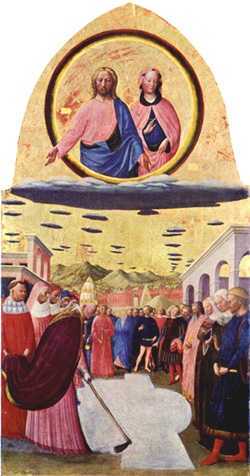
Pope Liberius defines in the snow the future site of Santa Maria Maggiore Masolino da Panicale, c. 1400

DEDICATION OF THE CHURCH OF OUR LADY OF THE SNOWS (ST. MARY MAJOR); SAINT OSWALD (A.D. 642) King, Martyr

GREATER DOUBLE / WHITE

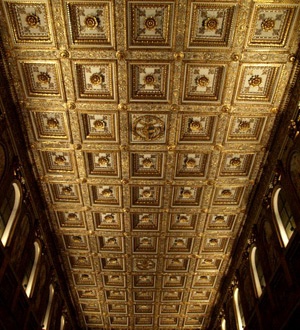
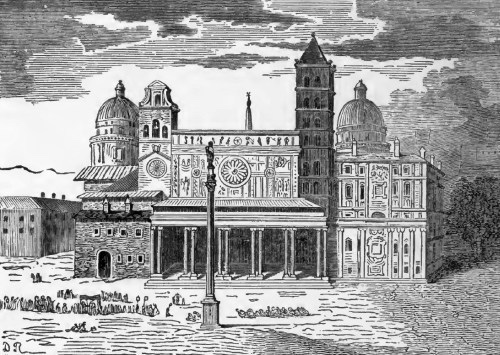
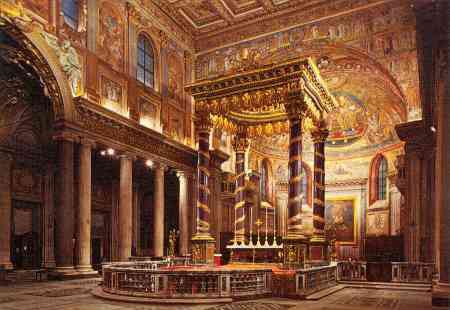
This church is also called St. Mary Major because it is, both in antiquity and dignity, the most eminent among churches in Rome dedicated to God in honor of the Blessed Virgin. A popular legend relates that the Mother of God herself chose the site of this church, indicating it by a miraculous fall of snow on this spot in summer. By the generosity of the devout Spanish sovereigns, the ceiling of the great nave of the church is covered with the first gold brought from the New World.

The ceiling of the Basilica is gilded with the first gold from the Americas

INTROIT

Hail, holy Parent, that didst bring forth the King who ruleth Heaven and earth for ever and ever.

Ps. 44:2. My heart hath uttered a good word: I speak of my works to the King.

V. Glory be . . .

COLLECT

Grant Your servants continual health of mind and body, O Lord God, and let the intercession of the blessed ever-Virgin Mary gain for us freedom from our present sorrow so that we may enjoy everlasting happiness. Through our Lord . . .

Commemoration of SAINT OSWALD

St. Oswald, king of Northumbria, assisted St. Aidan in spreading the Faith of Christ among his people. He died on the battlefield, when his country was invaded by the pagan Mercians, A.D. 642.

Almighty and everlasting God, who hast made holy the sweet and blessed happiness of this day by the martyrdom of the blessed king Oswald, grant to our hearts an increase of Thy love, so that we may imitate his steadfastness unto death, whose glorious struggle for the faith we admire. Through our Lord . . . 

LESSON Eccl. 24:14-16 [Sirach]From the beginning, and before the world, was I created, and unto the world to come I shall not cease to be, and in the holy dwelling place I have ministered before him. And so was I established in Sion, and in the holy city likewise I rested, and my power was in Jerusalem. And I took root in an honourable people, and in the portion of my God his inheritance, and my abode is in the full assembly of saints.

GRADUAL

Blessed and venerable art thou, O Virgin Mary, who without loss of purity wert found to be the Mother of our Savior. Virgin Mother of God, He whom the whole world cannot hold enclosed Himself in thy womb, and became man.

Alleluia, alleluia!

After His birth a Virgin entire thou didst remain, O Mother of God, intercede for us. Alleluia!

GOSPEL Luke 11:27-28

And it came to pass, as he spoke these things, a certain woman from the crowd, lifting up her voice, said to him: “Blessed is the womb that bore thee and the paps that gave thee suck.” But he said: “Yea rather, blessed are they who hear the word of God and keep it.”

OFFERTORY ANTIPHON Luke 1:28, 42

Hail Mary, full of grace, the Lord is with thee: blessed art thou among women and blessed is the fruit of thy womb.

SECRET PRAYER

O Lord, through Your mercy and the intercession of the Blessed Ever-Virgin Mary, let this offering bring us prosperity and peace now and forever. Through our Lord . . .

Commemoration of SAINT OSWALD

Receive our gifts and our prayers, we beseech Thee, O Lord, cleanse us by the heavenly Mysteries and mercifully hear us. Through our Lord . . .  

COMMUNION ANTIPHON

Blessed is the womb of the Virgin Mary, which bore the Son of the Eternal Father.

POSTCOMMUNION

O Lord, grant that we who have received the Sacrament of our salvation may be protected through the intercession of the Blessed Ever-Virgin Mary, in whose honor we have offered this Sacrifice to Your majesty. Through our Lord . . .

Commemoration of SAINT OSWALD

Grant, we beseech Thee, o Lord, our God, that as we rejoice on earth in keeping the memory of Thy saints, so also we may enjoy their company for evermore. Through our Lord . . . 

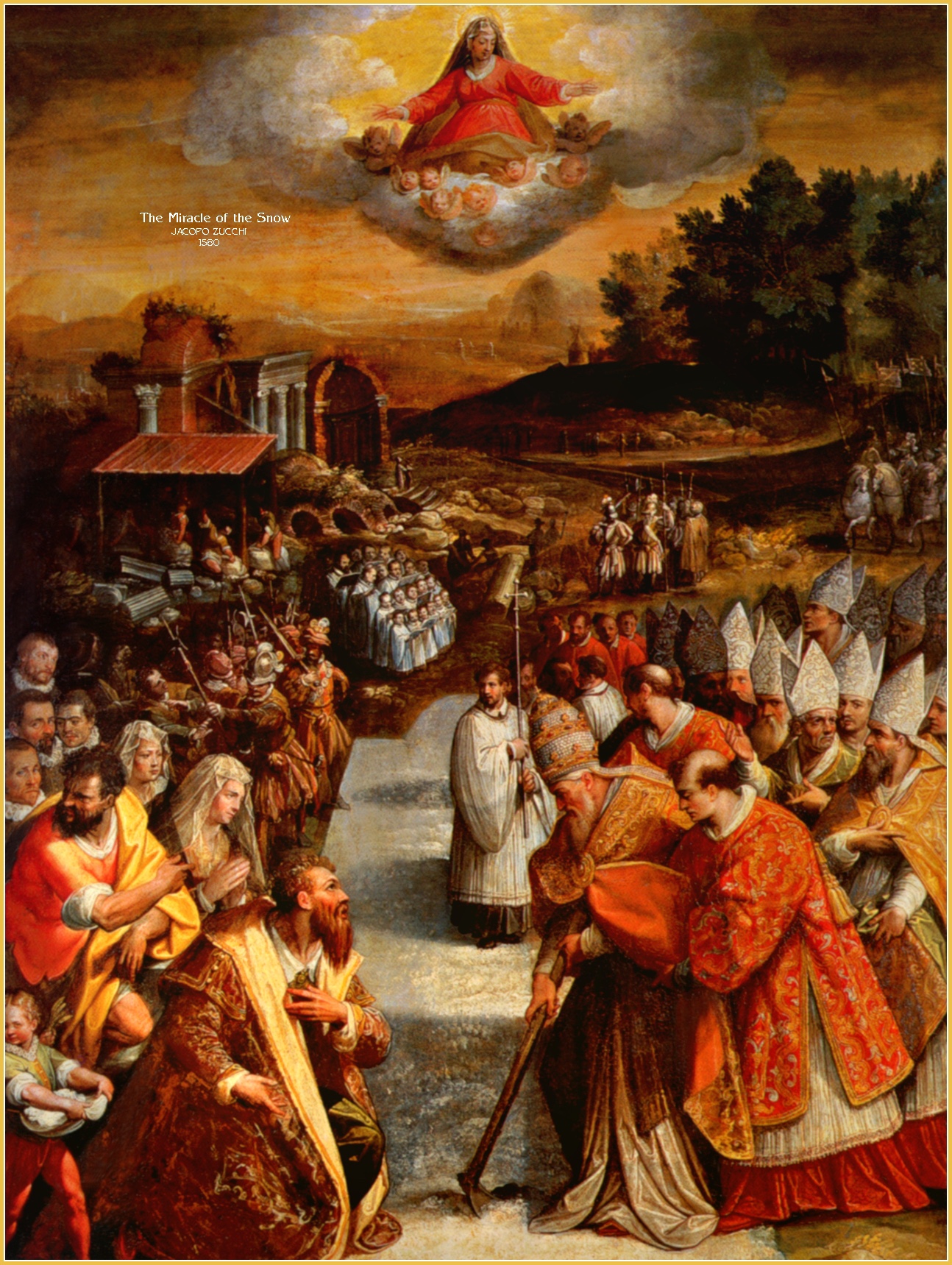
The Miracle of the Snows, by Jacopo Zucchi, ca. 1580; from the Vatican Museums.

The Dedication of Saint Mary Ad Nives

The Catholic Church celebrates today the annual feast of the dedication of a very remarkable church at Rome, called Saint Mary Ad Nives – a Saint Mary of the Snow,” or “Saint Mary Major.” The origin of this church is as follows: In the middle of the fourth century, at the time of Pope Liberius, there resided at Rome a nobleman named John. Although rich in temporal goods, he was still wealthier in those which are not of this world, and his wife was his equal in birth, riches and virtue. They had been married many years without having been blessed with children, although they had often prayed to God for them. At last, they resigned themselves to the will of Providence, and resolved to employ all their wealth in honor of the Blessed Virgin, and make her heir to it, as they had always entertained great devotion for her.

They were, as yet, uncertain as to the manner in which they should carry out their intention. They both sought refuge in prayer and alms, begging the Blessed Virgin to teach them how they might best appropriate their possessions to her honor.

Mary, the Divine Mother, deigned to make her wishes known to them. Appearing to them both in the night, she told them to go, on the following day, which was the fifth of this month, to the Aisquiline mount, in Rome, and to build a church in her honor on the spot which they would find covered with snow. This, she added, would be more agreeable to her than anything else they could do. When they awoke next morning and told each other their dream or rather their vision, they were filled with inexpressible joy, and immediately repaired to Pope Liberius to hear his opinion on the subject As the Pope had had the same vision the same night, there was no longer reason to doubt the truth of the revelation. Assembling the clergy and people without delay, the Pontiff formed a procession to go to the appointed spot. When they arrived there, they saw, in truth, a place large enough for a church, covered with snow. All were greatly surprised at this, which they could not but consider a miracle, since it was in the midst of summer, on the fifth of August, when neither in Rome nor within many miles of it, any snow could naturally have fallen. The pious couple drew from this fact the greatest comfort, as it was an indication that the Almighty and the Blessed Virgin were pleased with their intention. Therefore, hesitating no longer, they forthwith made all the necessary preparations for building a magnificent temple. The building was begun and very soon completed. All that was needed for its erection, as well as for its maintenance, was joyfully furnished. Pope Liberius most solemnly consecrated the new temple; and all the faithful went to it to venerate the Queen of Heaven. At first, this church was called the Basilica, signifying a palace, or the Liberian Basilica, on account of its royal magnificence. It was also called Saint Mary ad Nives, for the reason mentioned above. Today it is known as the Saint Mary Major, or the Great, as it is the greatest of all the churches of Rome built in honor of the Blessed Virgin, on account of its origin, magnificence and rich endowment. It is also called Saint Mary ad Praesepe – Saint Mary of the Manger – because in one cf its chapels, the crib or manger, in which the new-born Saviour was placed by his virgin mother, is kept. Pope Gregory the Great, in 509, formed and led the great procession, celebrated in the annals of the church, to implore God, through the intercession of Mary, to avert the dreadful pestilence which ravaged Rome. Its fury somewhat abated, but as it was still in the city, the Pope, in the following year, formed a second procession, headed by the picture of the Blessed Virgin painted by Saint Luke, which is kept in the church of Saint Mary ad Nives. During the procession, the pestilence left all those houses by which the picture passed, until, at last, when the faithful dispersed, the whole city was free from the terrible scourge. Another miraculous event occurred during the procession, which must not be omitted. Angels were heard singing: “Rejoice, O Queen of Heaven, Alleluia. He whom you did deserve to bear. Alleluia! is risen as He said, Alleluia!” The holy Pope, prostrating himself with all the people, finished the angels’ hymn of praise with the words: “Pray for us to God, Alleluia!” When the procession had reached the Mausoleum, or tomb of the Emperor Adrian, the Pope saw upon its summit an angel sheathing his sword, as a sign that the wrath of the Almighty was appeased by the intercession of Mary, and that the pestilence which had so long ravaged the city, would disappear. The rejoicing of the people, and the devotion which was from that time shown to the miraculous picture of the Blessed Virgin, cannot be worthily described.
Practical Considerations

• Those who are not Catholics and who blame us for our veneration of the Queen of Heaven and for the churches built in her honor, may see by the origin of the church of Saint Mary ad Nives, how ancient this pious practice is, and how agreeable to God. The building of this celebrated church took place in the fourth century, at a time when Protestants themselves say that the Catholic Church was still the true Church of God Even at that re- mote period, Mary was venerated and churches were built in her honor. The church approved of it, and God confirmed it by special miracles. Who dares say that the Church of Christ erred, and that God himself confirmed that error by a miracle? Even in countries where the population has ceased to be Catholics, we find ancient churches which were built in honor of the Blessed Virgin. Surely, if all Catholics were silent on the subject, the very stones of these sacred edifices would prove the devotion of the early ages to the Divine Mother. Would any one dare to accuse the pious Christians, who built these churches, of having erred? This would be no less foolish than arrogant. Why then do they oppose the church of ancient date? My Catholic reader, take my advice, tet no one disconcert you in your devotion to the Queen of Heaven, and never become cold in her service.
Father Francis Xavier Weninger, DD, SJ. “The Dedication of Saint Mary Ad Nives”. , 1876.

The Dedication of Saint Mary ad Nives”. Pictorial Lives of the Saints, 1922

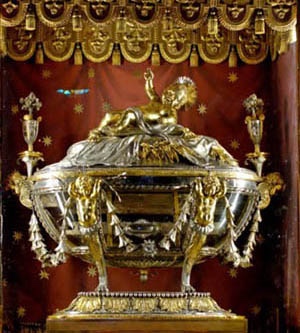
There are in Rome three patriarchal churches, in which the Pope officiates on different festivals. These are the Basilics of Saint John Lateran, Saint Peter’s on the Vatican Hill, and Saint Mary Major. This last is so called because it is, both in antiquity and dignity, the first church in Rome among those that are dedicated to God in honor of the Virgin Mary. The name of the Liberian Basilic was given it because it was founded in the time of Pope Liberius, in the fourth century; it was consecrated, under the title of the Virgin Mary, by Sixtus III, about the year 435. It is also called Saint Mary ad Nives, or at the snows, from a popular tradition that the Mother of God chose this place for a church under her invoAugust cation by a miraculous snow that fell upon this spot in summer, and by a vision in which she appeared to a patrician named John, who munificently founded and endowed this church in the pontificate of Liberius. The same Basilic has sometimes been known by the name of Saint Mary ad Prcesepe, from the holy crib or manger of Bethlehem, in which Christ was laid at His birth. It resembles an ordinary manger, is kept in a case of massive silver, and in it lies an image of a little child, also of silver. On Christmas Day the holy manger is taken out of the case and exposed. It is kept in a sumptuous subterraneous chapel in this church.

Reflection – To render our supplications the more efficacious, we ought to unite them in spirit to those of all ferent penitents and devout souls, in invoking this advocate for sinners.

Watch Solemn Pontifical Mass on the Feast of Our Lady of The Snows

THE BASILICA TODAY

The present-day church is one of the largest basilicas in the world and its Patronal Festival is held on  August 5 in remembrance of the miracle of the snow. During this celebration hundreds of white blossoms are showered from the dome of the chapel. Not to be missed are the thirteenth-century mosaics on biblical themes and the frescoes by Reni and Della Porta. There is an imposing Romanesque belltower erected in 1377.

The sacra culla, the sacred crib that holds the wood of Our Lord’s Manger

Santa Maria Maggiore has a further claim to fame. In the seventh century a relic was brought from Bethlehem and traditionally venerated as the manger in which the Christ Child was laid at the first Christmas. And so another name for the great basilica is St. Mary of the Crib.

One of the most spectacular sights which meets today’s pilgrim is the triumphal arch which extends to almost 66 feet. It is decorated in four horizontal sections. In the middle at the top God’s throne is set in a circle, with St. Peter and St. Paul on either side. Above this mosaic are the symbols of the four Gospel writers.

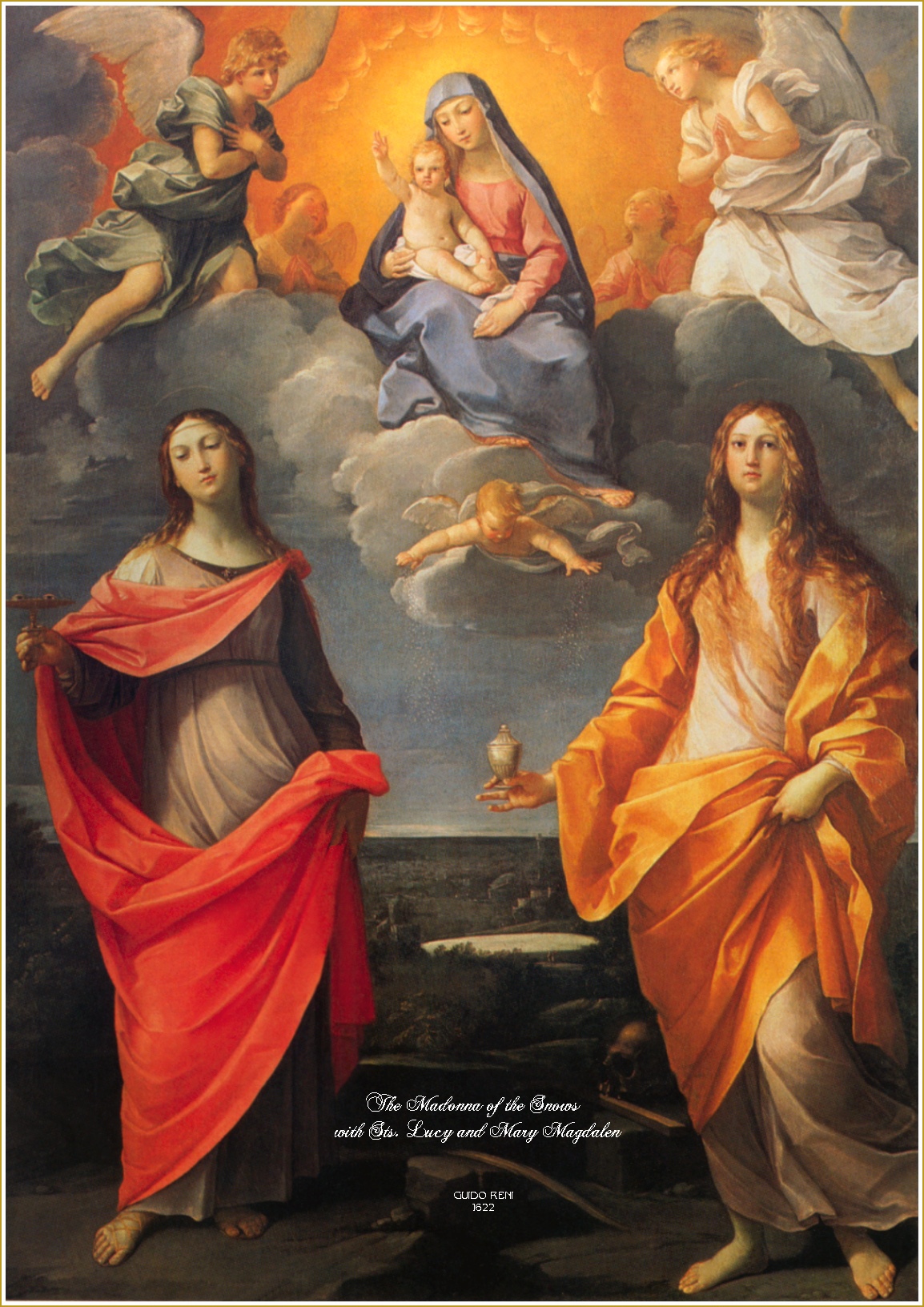
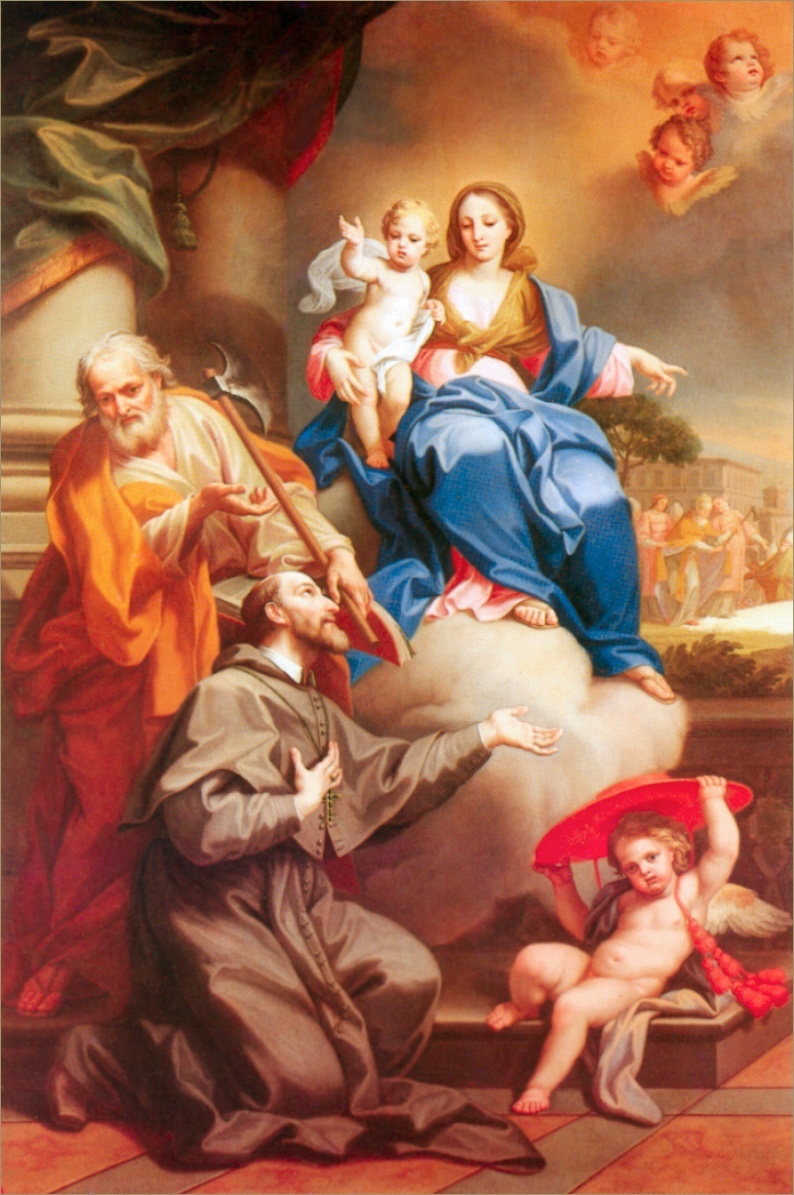
The Madonna of the Snows GAETANO LAPIS 1720

Prayer to Our Lady of the Snows

Our Lady of the Snows, Immaculate Queen of the Universe, from this privileged sanctuary, Thou has bestowed so many countless graces and pledges of love upon the hearts and souls of millions. O Mother, from this cradle of Christianity, this Mother Church of all churches, deign to shower forth the graces of thine Immaculate Heart upon the remnant Faithful throughout the world, wherever they may be, and grant them the graces of a childlike love and unwavering fidelity to the holy truths of our Faith. Grant, good Mother, to the faithful Bishops of the Church the grace to defend Her Sacred Teachings, and to persevere courageously against all the enemies of the Holy Church. Amen.

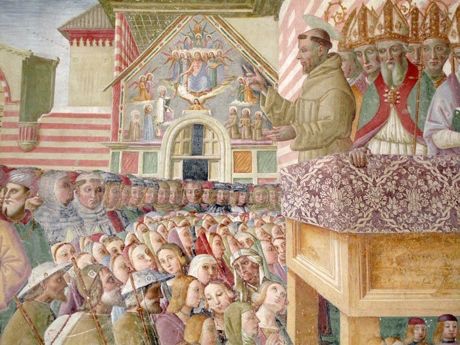
Portiuncula Indulgence

August 2, 2019 by Lena {JOYfilledfamily} Filed Under: 08 August, 08 August Saints, Indulgences Leave a Comment

The same that Christ says to the man sick of the palsy, the priest says to every contrite sinner in the confessional, and thus remits the crime or the guilt of his sins, and the eternal punishment, by virtue of the authority given him by God. But since sins not only bring with them guilt and eternal punishment, but also temporal and indeed spiritual or supernatural punishment, such as, painful conditions of the soul, as well in this world as in purgatory, and natural ones, as: poverty, disease, all sorts of adversities and accidents, we should endeavor to liberate ourselves from them by means of indulgences. – Fr. Leonard Goffine

The following is an excerpt from Major Life of St. Francis by St. Bonaventure

” The Portiuncula was an old church dedicated to the Virgin Mother of God which was abandoned . Francis had great devotion to the Queen of the world and when he saw that the church was deserted, he began to live there constantly in order to repair it. He heard that the Angels often visited it, so that it was called Saint Mary of the Angels, and he decided to stay there permanently out of reverence for the angels and love for the Mother of Christ.

He loved this spot more than any other in the world. It was here he began his religious life in a very small way; it is here he came to a happy end. When he was dying, he commended this spot above all others to the friars, because it was most dear to the Blessed Virgin.

This was the place where Saint Francis founded his Order by divine inspiration and it was divine providence which led him to repair three churches before he founded the Order and began to preach the Gospel.

This meant that he progressed from material things to more spiritual achievements, from lesser to greater, in due order, and it gave a prophetic indication of what he would accomplish later.

As he was living there by the church of Our Lady, Francis prayed to her who had conceived the Word, full of grace and truth, begging her insistently and with tears to become his advocate. Then he was granted the true spirit of the Gospel by the intercession of the Mother of mercy and he brought it to fruition.

He embraced the Mother of Our Lord Jesus with indescribable love because, as he said, it was she who made the Lord of majesty our brother, and through her we found mercy. After Christ, he put all his trust in her and took her as his patroness for himself and his friars.”

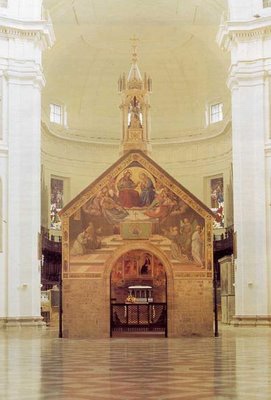
Today the chapel of Portiuncula is situated inside the Basilica of Saint Mary of the Angels roughly 5 km from Assisi, Italy.

“The Portiuncula indulgence is the first plenary indulgence that was ever granted in the Church. There were indeed indulgences at all times, but they were only partial, and only a partial remission of the temporal punishments could be obtained by them. But, as already remarked, he who gains the Portiuncula indulgence is freed from all temporal punishments and becomes as pure as after holy baptism. This was also the reason why Pope Honorius was astonished when St. Francis petitioned for the confirmation of this indulgence, for such an indulgence, up to that time, had been entirely unknown. It was only after he had come to the conviction that Jesus Christ himself wished it, that he granted the petition of the saint and confirmed the indulgence” (Source)

PORTIUNCULA INDULGENCE

August 1st & 2nd

From noon of Aug 1 until midnight of Aug 2 the faithful can gain a plenary indulgence applicable to themselves or the souls in purgatory at the usual conditions:

1. Be in the state of grace.

2. Confession (8 days before or after).

3. Holy Communion.

4. Prayers for the intention of the Pope (usually Our Father, Hail Mary & Glory be.)

5. And by visiting a cathedral, parochial, quasi-parochial or Franciscan church and there praying at least one Our Father & one Creed.

In addition it is necessary to have the intention of gaining the indulgence and to be detached from all affection to sin even venial, otherwise the indulgence is gained partially.

The intentions of the Pope are:

1. The exaltation of the Church

2. The propagation of the faith.

3. The extirpation of heresy

4. The conversion of sinners

5. Concord between Christian princes

6. All other goods of the Christian people.

The Portiuncula is a little town situated about three quarters of a mile from Assisi and is officially known as Santa Maria degli Angeli, which has grown around the basilica of Our Lady of the Angels and the adjoining Franciscan monastery. It was here that on February 24 1208, St Francis of Assisi recognized his vocation; here was for the most part his permanent abode, after the Benedictines had presented it to him with the little chapel Portiuncula (i.e. a little portion of land) erected at the time of Pope Liberius (352-66); here also he died on Saturday October 3 1226.

The Portiuncula indulgence could at first be gained only in the Portiuncula between the afternoon of Aug. 1 and sunset on Aug. 2. It was gradually extended to all Franciscan churches and finally to the present discipline.

Since the reform of Paul VI we can only gain one plenary indulgence per day.

Seven Holy Maccabees

August 1, 2019 by Lena {JOYfilledfamily} Filed Under: 08 August, 08 August Saints, Seven Holy Maccabees

HOLY MACCABEES
Martyrs

SAINT PETER’S CHAINS

[Commemoration]

SAINT PAUL

GREATER DOUBLE / WHITE

After King Herod Agrippa had put to death St. James the Greater ten years after Christ’s crucifixion, he decided to placate the Jews still more by arresting Peter, Prince of the Apostles. The Acts tell us that while Peter was in prison, “prayer was being made to god for him by the Church without ceasing.” Finally, one night, an angel awakened the prisoner. The chains fell from his hands, he followed the angel safely past the sentries, and the iron gate of the jail opened of its own accord. This miracle confirmed the divine promise: “If two of you shall agree on earth about anything at all for which they ask, it shall be done for them by My Father in heaven” (Matt. 18:19). It is these chains, now preserved in Rome, that are venerated today.

INTROIT Acts 12:11

Now I know for certain that the Lord has sent His angel and rescued me from all that the Jewish people were expecting. Ps. 138:1-2. O Lord, You have proved me and You know me; You know when I sit and when I stand. V. Glory be . . .

COLLECT

O God, You freed the blessed apostle Peter from his chains and sent him forth unharmed. Free us from the bonds of our sins and in Your mercy shield us from all harm. Through our Lord . . .

Commemoration of SAINT PAUL, Apostle

St. Peter, one of the two apostles of Rome, is never celebrated without St. Paul, the other. Moreover, four links of St. Paul’s chains are preserved with those of St. Peter.

O God, You have instructed many nations through the preaching of the blessed Apostle Paul. Let the power of his intercession with You help us who venerate his memory this day.

Commemoration of the HOLY MACHABEES

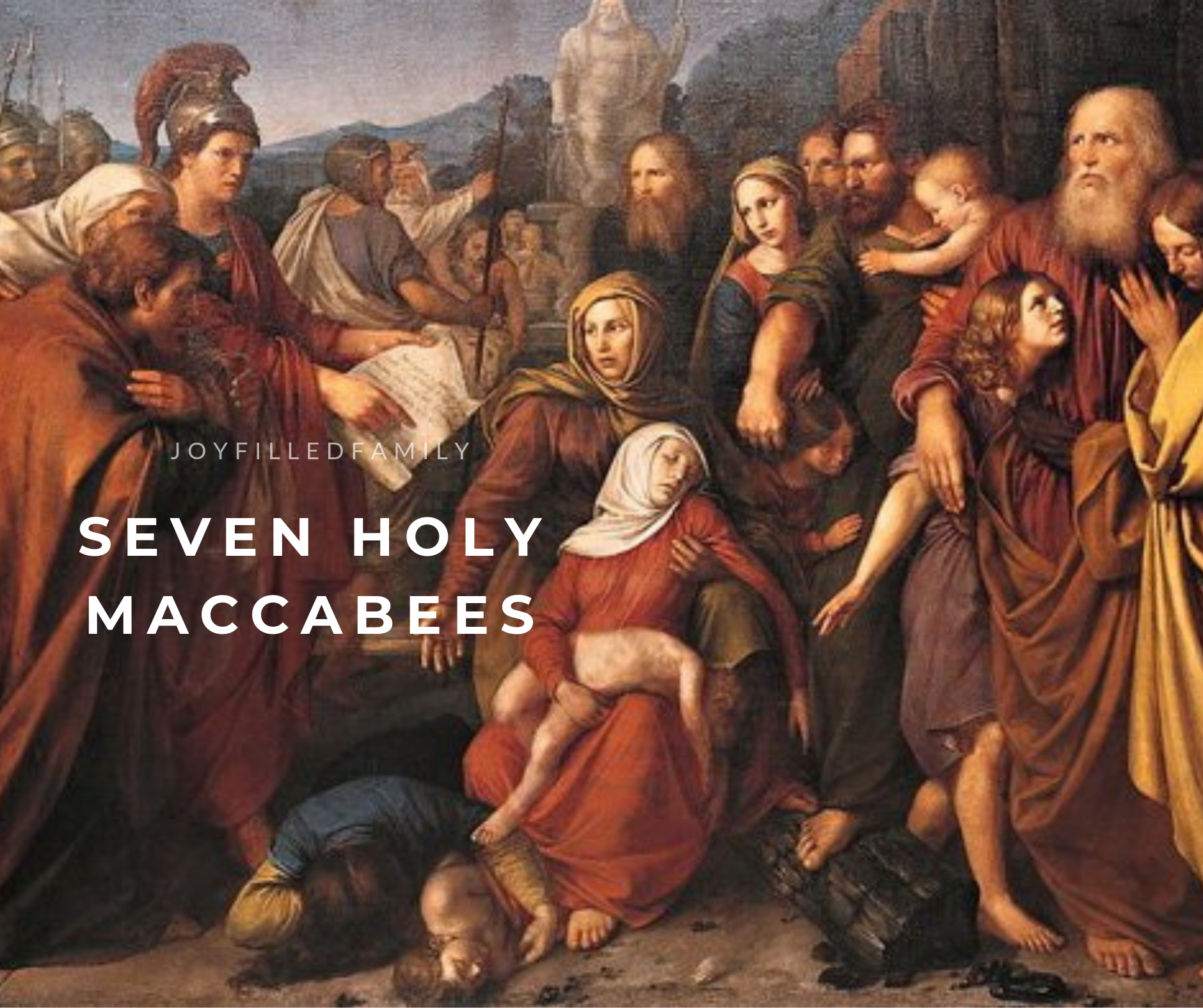
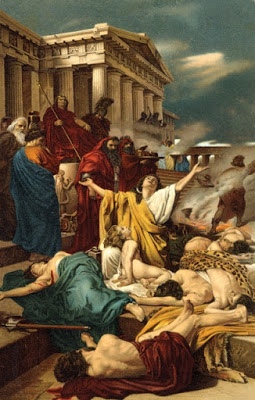
Seven brothers known as the Machabees were martyred together with their heroic mother during the second century B.C. They are the only martyrs of the Old Testament honored by a feast of universal observance in the Church.

O Lord, may the martyrdom of these brothers warm our hearts with joy, enliven our faith by an increase of virtue, and comfort us by the added number of intercessors we have in heaven. Through our Lord . . .

EPISTLE Acts 12: 1-11

In those days, Herod the king stretched forth his hands, to afflict some of the church. And he killed James, the brother of John, With the sword. And seeing that it pleased the Jews, he proceeded to take up Peter also. Now it was in the days of the Azymes. And when he had apprehended him, he cast him into prison, delivering him to four files of soldiers, to be kept, intending, after the pasch, to bring him forth to the people. Peter therefore was kept in prison. But prayer was made without ceasing by the church unto God for him. And when Herod would have brought him forth, the same night, Peter was sleeping between two soldiers, bound with two chains: and the keepers before the door kept the prison. And behold an angel of the Lord stood by him and a light shined in the room. And he, striking Peter on the side, raised him up, saying: “Arise quickly.” And the chains fell off from his hands. And the angel said to him: “Gird thyself and put on thy sandals.” And he did so. And he said to him: “Cast thy garment about thee and follow me,” And going out, he followed him. And he knew not that it was true which was done by the angel: but thought he saw a vision. And passing through the first and the second ward, they came to the iron gate that leadeth to the city which of itself opened to them. And going out, they passed on through one street. And immediately the angel departed from him. And Peter coming to himself, said: “Now I know in very deed that the Lord hath sent his angel and hath delivered me out of the hand of Herod and from all the expectation of the people of the Jews.”

GRADUAL Ps. 44:17-18

You shall make them prices through all the land; they shall remember Your name, O Lord.

V. To take the place of your fathers, sons shall be born to you; therefore peoples shall praise you.

Alleluia, alleluia! V.At the bidding of God, loosen the chains of the world, Peter, you who open the kingdom to the blessed. Alleluia!

GOSPEL Matt. 16:13-19

At that time, Jesus came into the quarters of Cesarea Philippi: and he asked his disciples, saying: “Whom do men say that the Son of man is?” But they said: “Some John the Baptist, and other some Elias, and others Jeremias, or one of the prophets.” Jesus saith to them:”But whom do you say that I am?” Simon Peter answered and said: “Thou art Christ, the Son of the living God.” And Jesus answering said to him: “Blessed art thou, Simon Bar-Jona: because flesh and blood hath not revealed it to thee, but my Father who is in heaven. And I say to thee: That thou art Peter; and upon this rock I will build my church, and the gates of hell shall not prevail against it.And I will give to thee the keys of the kingdom of heaven. And whatsoever thou shalt bind upon earth, it shall be bound also in heaven: and whatsoever thou shalt loose on earth, it shall be loosed also in heaven.”

OFFERTORY ANTIPHON Ps. 44:17-18

You shall make them princes throughout the land; they shall remember Your name, O Lord, in every generation and age.

SECRET

May the sacrifice we offer You, O Lord, bring us new life and keep us safe through the intercession of blessed Peter, Your apostle. Through our Lord . . .

Commemoration of SAINT PAUL

O Lord, sanctify the offerings of Your people through the intercession of the blessed apostle Paul. The sacrifice we offer is already acceptable to You because You instituted it; may it become even more pleasing to You through the prayers of Your saint.

Commemoration of the HOLY MACHABEES

O Lord, grant that we may celebrate these sacred mysteries with devotion to honor Your holy martyrs, so that through this sacrifice we may have new help and a deeper joy. Through our Lord . . .

COMMUNION ANTIPHON Matt. 16:18

Thou art Peter, and upon this rock I will build My Church.

POSTCOMMUNION

We are refreshed by the Sacrifice of Your Sacred Body and Precious Blood, O Lord our God. may our devout celebration of these divine Mysteries insure our salvation. Through our Lord . . .

Commemoration of SAINT PAUL

We who have received your Sacrament, O Lord, look hopefully for the prayers of Your blessed Paul. May the Sacred Rite that we have celebrated in his honor bring us healing for our own sinfulness.

Commemoration of the HOLY MACHABEES

O Almighty God, grant that we may grow in grace by emulating the faith of these martyrs whose memory we honor by the reception of Your Sacrament. through our Lord . . .

“Truly it is worthy and just, meet and profitable to salvation, that we, o Lord, in honor of Thy name, in the yearly feast of Thy Holy Martyrs the Maccabees, should celebrate with all wonderment those who, being brothers by birth, were companions in martyrdom. Their glorious mother conceived them in body and in spirit, so that those whom she had born into this world according to the flesh, she might also beget for glory unto almighty God, in spiritual fecundity. For those who were born according to the flesh that they might die, died piously unto life. Their tongues were cut our, their scalps taken, but in the midst of these things, these most glorious youths did not grieve for the cruelty of their torments, but exsulted that they died all the more gloriously, that they might each be a comfort and example to the others. After the rest, their mother by both blood and faith followed them at last, not that she might be last, but that before herself she might send to God the fruits of her womb, and so in peace follow her beloved sons. What then can we say, and with what exsultation, for the fact that on the day of their passion, there passed from this world to the seat of eternity the witness of the faith and confessor of the truth Eusebius? who on that very day, on which the martyrs of the Old Law suffered, as a champion of the New Testament was also taken to heaven. The former departed observing the commandments of the Jewish law; the latter fell asleep, affirming the unity of the undivided Trinity. Through Christ our Lord etc…”

AUGUST 1 – THE SEVEN HOLY MACCABEES

Dom Prosper Guéranger

The August heavens glitter with the brightest constellations of the sacred cycle. Even in the sixth century, the Second Council of Tours remarked that this month was filled with the feasts of Saints. “My delights are to be with the children of men,” says Wisdom, and in the month which echoes with her teachings, she seems to have made it her glory to be surrounded with blessed ones who, walking with her in the midst of the paths of judgement, have in finding her found life and salvation from the Lord. This noble court is presided over by the Queen of all grace, whose triumph consecrates this month and makes it the delight of that Wisdom of the Father who, once enthroned in Mary, never quitted her. What a wealth of divine favours do the coming days promise to our souls! Never were our Father’s barns so well filled as at this season when the earthly as well as the heavenly harvests are ripe.

While the Church on Earth inaugurates these days by adorning herself with Peter’s chains as with a precious jewel, a constellation of seven stars appears for the third time in the heavens. The seven brothers Maccabees preceded the sons of Symphorosa and Felicitas in the blood-stained arena. They followed divine Wisdom even before she had manifested her beauty in the flesh. The sacred cause of which they were the champions, their strength of soul under the tortures, their sublime answers to the executioners, were so evidently the type reproduced by the later Martyrs, that the Fathers of the first centuries with one accord claimed for the Christian Church these heroes of the synagogue who could have gained such courage from no other source than their faith in the Christ to come. For this reason they alone of all the holy persons of the ancient covenant have found a place on the Christian cycle. All the Martyrologies and Calendars of East and West attest the universality of their cultus, while its antiquity is such as to rival that of St. Peter’s chains in that same basilica of Eudoxia where their precious relics lie.

At the time when in the hope of a better resurrection they refused under cruel torments to redeem their lives, other heroes of the same blood, inspired by the same faith, flew to arms and delivered their country from a terrible crisis. Several children of Israel, forgetting the traditions of their nation, had wished it to follow the customs of strange peoples, and the Lord in punishment had allowed Judea to feel the whole weight of a profane rule to which it had guiltily submitted. But when king Antiochus, taking advantage of the treason of a few and the carelessness of the majority, endeavoured by his ordinances to blot out the divine law which alone gives power to man over man, Israel, suddenly awakened, met the tyrant with the double opposition of revolt and martyrdom. Judas Maccabeus in immortal battles reclaimed for God the land of his inheritance, while by the virtue of their generous confession, the seven, brothers also, his rivals in glory, recovered, as the Scripture says, “the law out of the hands of the nations, and out of the hands of the kings” (1 Maccabees ii. 48). Soon afterwards, craving mercy under the hand of God and not finding it, Antiochus died devoured by worms, just as later on were to die the first and last persecutors of the Christians, Herod Agrippa and Galerius Maximian.

The Holy Ghost, who would Himself hand down to posterity the acts of the Protomartyr of the New Law, did the same with regard to the passion of Stephen’s glorious predecessors in the ages of expectation. Indeed it was he who then, as under the law of Love, inspired with both words and courage these valiant brothers, and their still more admirable mother who, seeing her seven sons one after the other suffering the most horrible tortures, uttered nothing but burning exhortations to die. Surrounded by their mutilated bodies, she mocked the tyrant who in false pity wished her to persuade at least the youngest to save his life. She bent over the last child of her tender love and said to him: “My son, have pity on me, that bore you nine months in my womb, and gave you suck three years, and nourished you, and brought you up to this age. I beseech you, my son, look upon Heaven and Earth, and all that is in them: and consider that God made them out of nothing and mankind also: so you will not fear this tormentor, but being made a worthy partner with your brethren, receive death, that in that mercy I may receive you again with your brethren (2 Maccabees vii. 27, 28, 29). And the intrepid youth ran in his innocence to the tortures, and the incomparable mother followed her sons.

https://youtu.be/CSOYjOwBDl0

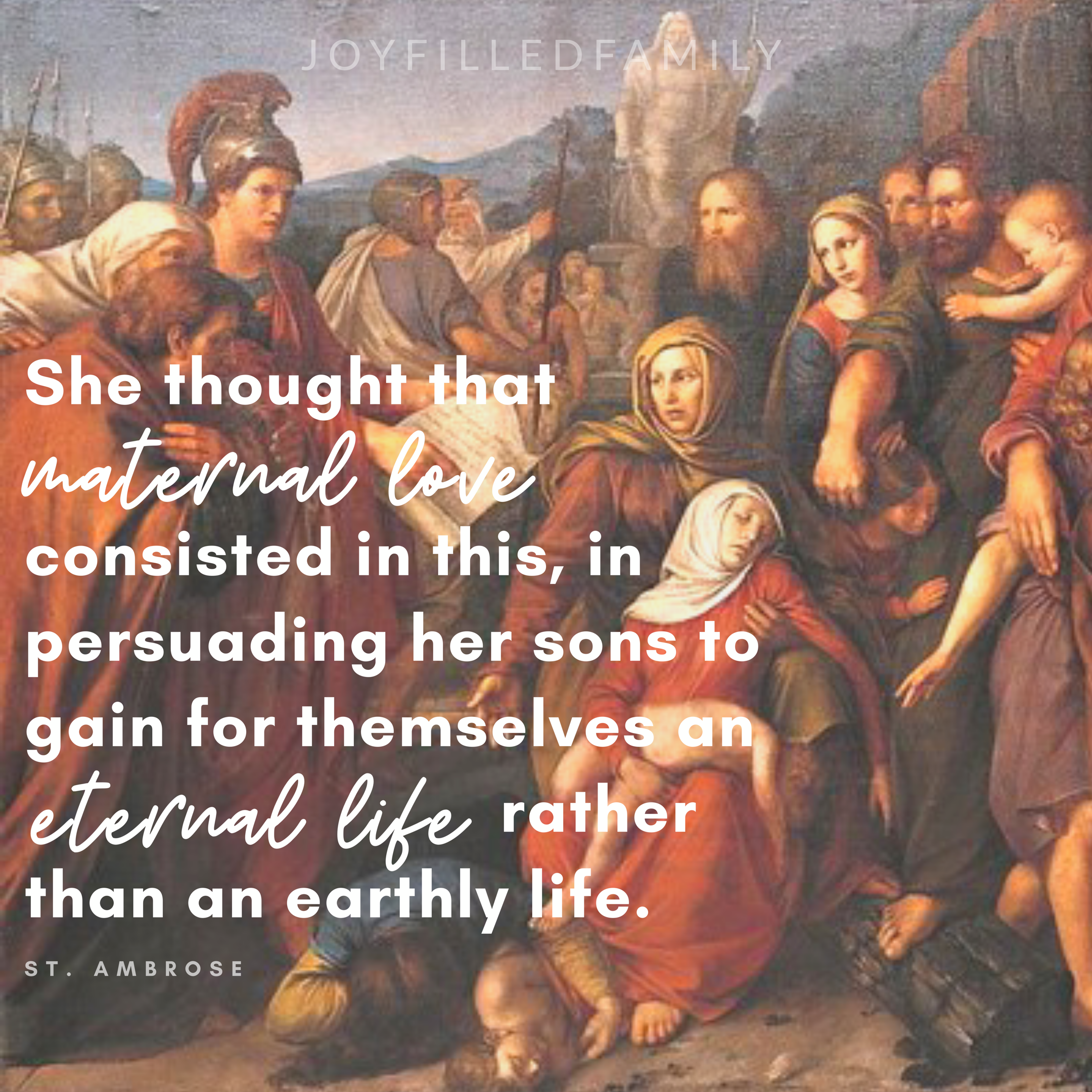
The words of the holy woman return to our minds, who said to her sons: “I gave birth to you, and poured out my milk for you: do not lose your nobility.” Other mothers are accustomed to pull their children away from martyrdom, not to exhort them to martyrdom. But she thought that maternal love consisted in this, in persuading her sons to gain for themselves an eternal life rather than an earthly life. And thus the pius mother watched the torment of her sons … But her sons were not inferior to such a mother: they urged each other on, speaking with one single desire and, I would say, like an unfurling of their souls in a battle line. ~St. Ambrose, De Iacob et vita beata II,12 (On Jacob and the Blessed Life)

St. Ignatius of Loyola

July 31, 2019 by Lena {JOYfilledfamily} Filed Under: 07 July, 07 July Saints, Patron Saint, St. Ignatius of Loyola, Uncategorized

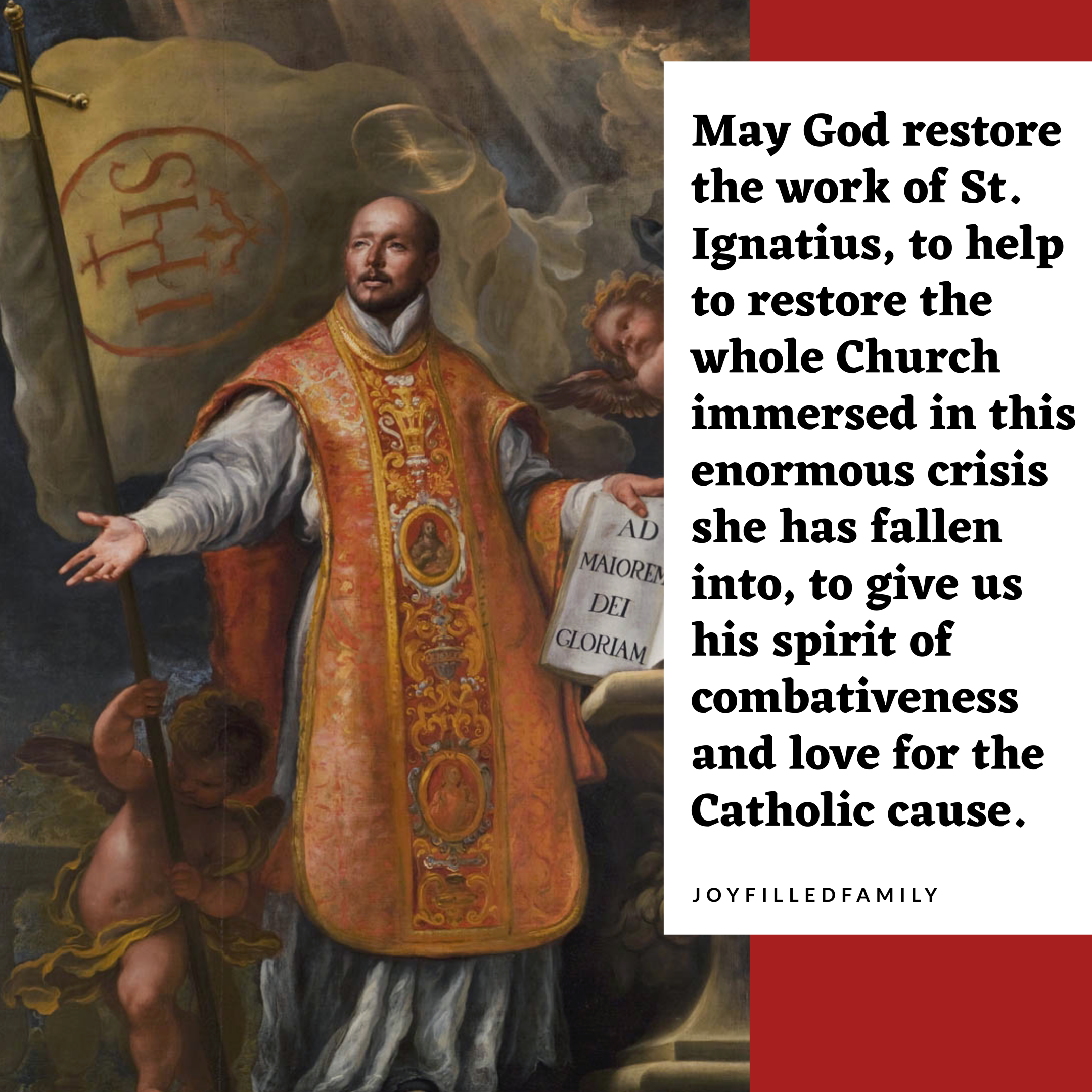
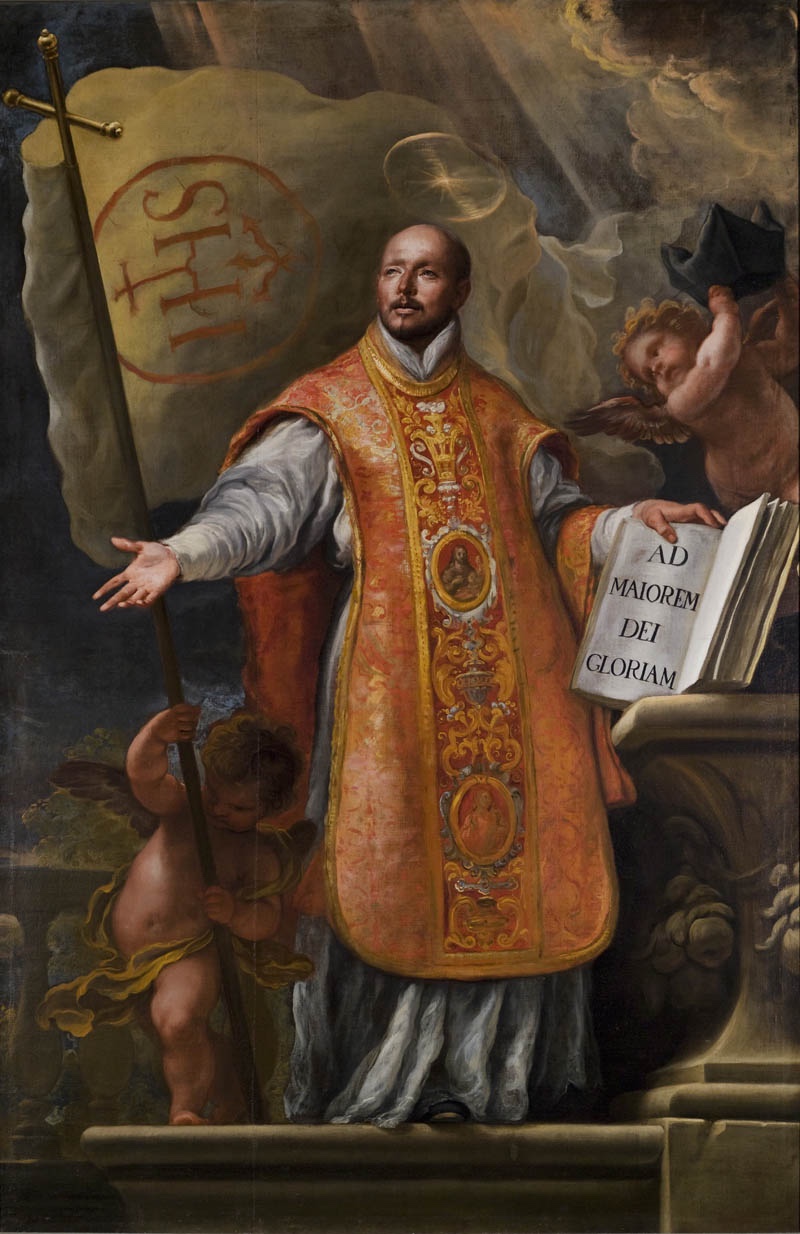
AMDG stands for Ad Majorem Dei Gloriam, which translated means “For the Greater Glory of God.” 

~ St. Ignatius of Loyola’s Motto

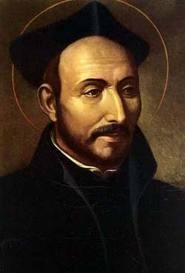
Ignatius-Loyola

SAINT IGNATIUS OF LOYOLA
Confessor 

Feast Day: July 31

Commemoration of SAINT IGNATIUS

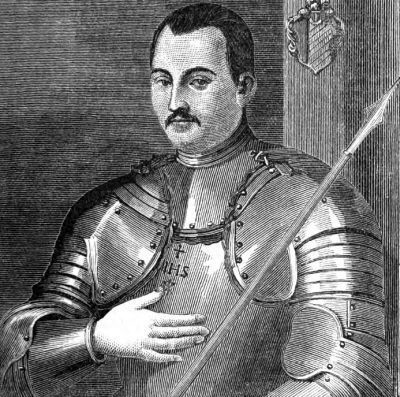
In the year 1521 a cannon ball fractured the left leg of Captain Ignatius Loyola, the future founder of the Jesuits. While he was convalescing, Ignatius read about Christ and His saints and thus turned wholly to God. He then undertook to equip himself for Christ’s service by acquiring a good classical and theological education. On the feast of the Assumption, 1534, the seven pioneer Jesuits pronounced their vows in Paris. The members of the Society of Jesus became the shock troops of the Church in the battle against the spread of Protestantism in Europe, as well as one of the greatest foreign mission organizations that the world has known. Ignatius died on July 31, 1556.

O God, in order to promote the greater glory of Your name, You fortified Your Church militant with a new army through the work of blessed Ignatius. may his help and example bring us through our battle on earth to be crowned with him in heaven. Through our Lord . . .

~~~

Patron: Basque country; Jesuit Order; Jesuits; retreats; soldiers; Spiritual Exercises (by Pope Pius XI).

Symbols: Book; chausible; Holy Communion; a rayed IHC or IHS; heart with crown of thorns; sword and lance upon an altar; book with words Ad Maiorem Dei Gloriam.

~~~

Pictorial Lives of the Saints 1922

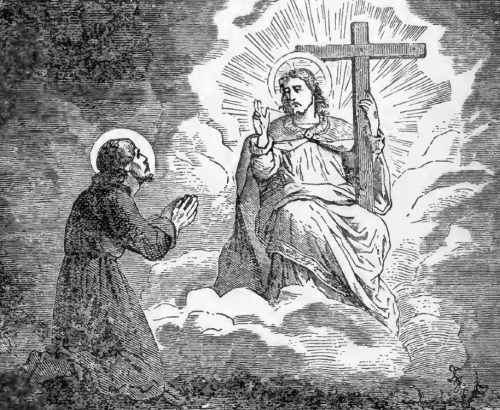
Saint Ignatius was born at Loyola in Spain, in the year 1491. He served his king as a courtier and a soldier till his thirtieth year. At that age, being laid low by a wound, he received the call of divine grace to leave the world. He embraced poverty and humiliation, that he might become more like to Christ, and won others to join him in the service of God. Prompted by their love for Jesus Christ, Ignatius and his companions made a vow to go to the Holy Land, but war broke out, and prevented the execution of their project. Then they turned to the Vicar of Jesus Christ, and placed themselves under his obedience. This was the beginning of the Society of Jesus. Our Lord promised Saint Ignatius that the precious heritage of His Passion should never fail his Society, a heritage of contradictions and persecutions. Saint Ignatius was cast into prison at Salamanca, on a suspicion of heresy. To a friend who expressed sympathy with him on account of his imprisonment, he replied, “It is a sign that you have but little love of Christ in your heart, or you would not deem it so hard a fate to be in chains for His sake. I declare to you that all Salamanca does not contain as many fetters, manacles, and chains as I long to wear for the love of Jesus Christ.” Saint Ignatius went to his crown on the 31st July, 1556.

Reflection – Ask Saint Ignatius to obtain for you the grace to desire ardently the greater glory of God, even though it may cost you much suffering and humiliation.

“Saint Ignatius Loyola”. Illustrated Catholic Family Annual. 1874

Don Ignacio Loyola’s Vigil in the Chapel of Our Lady of Montserrat

When at thy shrine, most holy Maid,
The Spaniard hung his votivetblade,
   And bared his helmed brow –
Not that he feared war’s visage grim,
Or that the battle-field for him
   Had aught to daunt, I trow –

“Glory!” he cried, “with thee I’ve done!
Fame! thy bright theatres I shun.
   To tread fresh pathways now:
To track thy footsteps, Saviour God!
With throbbing heart, with feet unshod:
   Hear and record my vow.

“Yes, thou shalt reign! Chained to thy throne,
The mind of man thy sway shall own,
   And to its Conqueror bow.
Genius his lyre to thee shall lift,
And intellect its choicest gift
   Proudly on thee bestow.”

Straight on the marble floor he knelt,
And in his breast exulting felt
   A vivid furnace-glow;
Forth to his task the giant sped,
Earth shook abroad beneath his tread,
   And idols were laid low.

India repaired half Europe’s loss;
O’er a new hemisphere the cross
   Shone in the azure sky,
And, from the isles of far Japan
To the broad Andes, won o’er man
   A bloodless victory!

St. Ignatius
The Liturgical Year by Abbot Gueranger O.S.B.,

SAINT IGNATIUS—CONFESSOR

Feast: July 31

Although the cycle of the time after Pentecost has shown us many times already the solicitude of the Holy Spirit for the defense of the Church, yet to-day the teaching shines forth with a new lustre. In the sixteenth century Satan made a formidable attack upon the Holy City, by means of a man who, like himself, had fallen from the height of heaven, a man prevented in early years by the choice graces which lead to perfection, yet unable in an evil day to resist the spirit of revolt. As Lucifer aimed at being equal to God, Luther set himself up against the Vicar of God, on the mountain of the covenant, and soon, falling from abyss to abyss he drew after him the third part of the stars of the firmament of Holy Church. How terrible is that mysterious law whereby the fallen creature, be he man or angel, is allowed to keep the same ruling power for evil which he would otherwise have exercised for good. But the designs of eternal Wisdom are never frustrated: against the misused liberty of the angel or man is set up that other merciful law of substitution, by which St. Michael was the first to benefit. 

The development of Ignatius’ vocation to holiness followed step by step the defection of Luther. In the spring of 1521 Luther had just quitted Worms, and was defying the world from the Castle of Wartburg, when Ignatius received at Pampeluna the wound which was the occasion of his leaving the world and retiring to Manresa.(1) Valiant as his noble ancestors, he felt within him from his earliest years the warlike ardor which they had shown on the battlefields of Spain. But the campaign against the Moors closed at the very time of his birth.(2) Were his chivalrous instincts to be satisfied with petty political quarrels? The only true King worthy of his great soul revealed Himself to him in the trial which put a stop to his worldly projects: a new warfare was opened out to his ambition; another crusade was begun; and in the year 1522, from the mountains of Catalonia to those of Thuringia, was developed that divine strategy of which the angels alone knew the secret.

In this wonderful campaign it seemed that hell was allowed to take the initiative, while heaven was content to look on, only taking care to make grace abound the more where iniquity strove to abound. As in the previous year Ignatius received his first call three weeks after Luther had completed his rebellion, so in this year, at three weeks’ distance, the rival camps of hell and heaven each chose and equipped its leader. Ten months of diabolical manifestations prepared Satan’s lieutenant, in the place of his forced retreat, which he called his Patmos; and on March 5 the deserter of the altar and of the cloister left Wartburg.

On the 25th of the same month, the glorious night of the Incarnation, the brilliant soldier in the armies of the Catholic kingdom, the descendant of the families of Ognes and Loyola, clad in sackcloth, the uniform of poverty, to indicate his new projects, watched his arms in prayer at Montserrat; then hanging up his trusty sword at Mary’s altar, he went forth to make trial of his future combats by a merciless war against himself.

In opposition to the already proudly floating standard of the free-thinkers, he displayed upon his own this simple device: <To the greater glory of God!> At Paris, where Calvin was secretly recruiting the future Huguenots, Ignatius, in the name of the God of armies, organized his vanguard, which he destined to cover the march of the Christian army, to lead the way, to bear the brunt, to deal the first blows. On August 15, 1534, five months after the rupture of England from the Holy See, these first soldiers sealed at Montmartre the definitive engagement which they were afterwards solemnly to renew at St. Paul’s outside the walls. For Rome was to be the rallying place of the little troop which was soon to increase so wonderfully, and which was, by its special profession, to be ever in readiness, at the least sign from the Head of the Church, to exercise its zeal in whatever part of the world he should think fit, in the defense or propagation of the faith, or for the progress of souls in doctrine and Christian life.(3)

An illustrious speaker of our own day(4) has said: ‘What strikes us at once in the history of the Society of Jesus is that it was matured at its very first formation. Whosoever knows the first founders of the Company knows the whole Company, in its spirit, its aim, its enterprises, its proceedings, its methods. What a generation was that which gave it birth! What union of science and activity, of interior life and military life! One may say they were universal men, men of a giant race, compared with whom we are but insects: <de genere giganteo, quibus comparati quasi locustae, videbamur.>(5)

All the more touching, then, was the charming simplicity of those first Fathers of the Society, making their way to Rome on foot, fasting and weary, but their hearts overflowing with joy, singing with a low voice the Psalms of David.(6) When it became necessary, on account of the urgency of the times, for the new institute to abandon the great traditions of public prayer, it was a sacrifice to several of these souls; Mary could not give way to Martha without a struggle; for so many centuries the solemn celebration of the Divine Office had been the indispensable duty of every religious family, its primary social debt, and the principal nourishment of the individual holiness of its members.

But new times had come, times of decadence and ruin, calling for an exception as extraordinary as it was grievous to the brave company that was risking its existence amid ceaseless alarms and continual sallies upon hostile territory. Ignatius understood this; and to the special aim imposed upon him, he sacrificed his personal attraction for the sacred chants; nevertheless, to the end of his life, the least note of the psalmody falling on his ears drew tears of ecstasy from his eyes.(7)

After his death, the Church, which had never known any interest to outbalance the splendour of worship due to her Spouse, wished to return from a derogation which so deeply wounded the dearest instincts of her bridal heart; Paul IV revoked it absolutely, but St. Pius V, after combating it for a long time, was at last obliged to give in. In the latter ages so full of snares the time had come for the Church to organize special armies. But while it became more and more impossible to expect from these worthy troops, continually taken up with outside combats, the habits of those who dwelt in security, protected by the ancient towers of the Holy City, at the same time Ignatius repudiated the strange misconception which would try to reform the Christian people according to this enforced but abnormal manner of life. The third of the eighteen rules which he gives as the crowning of the Spiritual Exercises, <to have in us the true sentiments of the orthodox Church>, recommends to the faithful the chants of the Church, the Psalms, and the different Canonical Hours at their appointed times. And at the beginning of this book, which is the treasure of the Society of Jesus, where he mentions the conditions for drawing the greatest fruit from the Exercises, he ordains in his twentieth annotation that he who can do so should choose for the time of his retreat a dwelling from whence he can easily go to Matins and Vespers as well as to the holy Sacrifice. What was our saint here doing, but advising that the Exercises should be practiced in that same spirit in which they were composed in that blessed retreat of Manresa, where the daily attendance at solemn Mass and the evening offices had been to him the source of heavenly delights?

But it is time to listen to the Church’s account of the life of this great servant of God: Ignatius, by nation a Spaniard, was born of a noble family at Loyola, in Cantabria. At first he ‘attended the court of the Catholic king, and later on embraced a military career. Having been wounded at the siege of Pampeluna, he chanced in his illness to read some pious books, which kindled in his soul a wonderful eagerness to follow in the footsteps of Christ and the saints. He went to Montserrat, and hung up his arms before the altar of the Blessed Virgin; he then watched the whole night in prayer, and thus entered upon his knighthood in the army of Christ. Next he retired to Manresa, dressed as he was in sackcloth, for he had a short time before given his costly garments to a beggar. Here he stayed for a year, and during that time he lived on bread and water, given to him in alms; he fasted every day except Sunday, subdued his flesh with a sharp chain and a hair-shirt, slept on the ground and scourged himself with iron disciplines. God favored and refreshed him with such wonderful spiritual lights, that afterwards he was wont to say that even if the sacred Scriptures did not exist, he would be ready to die for fee faith, on account of those revelations alone which the Lord had made to him at Manresa. It was at this time that he, a man without education, composed that admirable hook of the Exercises, which has been approved by the judgment of the Apostolic See, and by the benefit reaped from it by all.

However, in order to make himself more fit for gaining souls, he determined to procure the advantages of education, and began by studying grammar among children. Meanwhile he relaxed nothing of his zeal for the salvation of others, and it is marvelous what sufferings and insults he patiently endured in every place, undergoing the hardest trials, even imprisonment and stripes almost unto death. But he ever desired to suffer far more for the glory of his Lord. At Paris he was joined by nine companions from that University, men of different nations, who had taken their degrees in Arts and Theology; and there at Montmartre he laid the first foundations of the order, which he was later on to institute at Rome. He added to the three usual vows a fourth concerning missions, thus binding it closely to the Apostolic See. Paul III first welcomed and approved the Society, as did later other Pontiffs and the Council of Trent. Ignatius sent St. Francis Xavier to preach the Gospel in the Indies, and dispersed others of his children to spread the Christian faith in other parts of the world, thus declaring war against paganism, superstition, and heresy. This war he carried on with such success that it has always been the universal opinion, confirmed by the word of pontiffs, that God raised up Ignatius and the Society founded by him to oppose Luther and the heretics of his time, as formerly he had raised up, other holy men to oppose other heretics.

He made the restoration of piety among Catholics his first care. He increased the beauty of the sacred buildings, the giving of catechetical instructions, the frequentation of sermons and of the sacraments. He everywhere opened schools for the education of youth in piety and letters. He founded at Rome the German College, refuges for women of evil life, and for young girls who were in danger, houses for orphans and catechumens of both sexes and many other pious works. He devoted himself unweariedly to gaining souls to God: Once he was heard saying that if he were given his choice he would rather live uncertain of attaining the Beatific Vision, and in the meanwhile devote himself to the service of God and the salvation of his neighbor, than die at once certain of eternal glory. His power over the demons was wonderful. St. Philip Neri and others saw his countenance shining with heavenly light. At length in the sixty-fifth year of his age he passed to the embrace of his Lord, whose greater glory he had ever preached and ever sought in all things. He was celebrated for miracles and for his great services to the Church, and Gregory XV enrolled him amongst the saints; while Pius XI, in response to the prayers of the episcopate, declared him heavenly patron of all Spiritual Exercises.

<This is the victory which overcometh the world, our faith.>8 And thou didst prove this truth once more to the world, O thou great conqueror of the age in which the Son of God chose thee to raise up again His ensign that had been humbled before the standard of Babel. Against the ever-increasing battalions of the rebels thou didst long stand almost alone, leaving it to the God of armies to choose His own moment for engaging thee against Satan’s troops, as He chose His own for withdrawing thee from human warfare. If the world had then been told of thy designs, it would have laughed them to scorn; yet now, no one can deny that it was a decisive moment in the history of the world when, with as much confidence as the most illustrious general concentrating his forces, thou gayest the word to thy nine companions to proceed three and three to the Holy City. What great results were obtained in the fifteen years during which this little troop, recruited by the Holy Ghost, had thee for its first General! Heresy was trampled out of Italy, confounded at Trent, checked everywhere, paralyzed in its very centre; immense conquests were made in new worlds, as a compensation for the losses suffered in our West, Sion herself, renewing the beauty of her youth, saw her people and her pastors raised up again, and her sons receiving an education befitting their heavenly destiny; in a word, all along the line, where he had rashly cried victory, Satan was now howling, overcome once more by the name of Jesus, which makes every knee to bow, 1 St. John v. 4 in heaven, on earth, and in hell! Hadst thou ever O Ignatius, gained such glory as this in the armies of earthly kings?

From the throne thou hast won by so many valiant deeds, watch over the fruits of thy works, and prove thyself always God’s soldier. In the midst of the contradictions which are never wanting to them, uphold thy sons in their position of honor and prowess which makes them the vanguard of the Church. May they be faithful to the spirit of their glorious Father; ‘having unceasingly before their eyes: first, God; next, as the way leading to Him, the form of their institute, consecrating all their powers to attain this end marked out for them by God; yet each following the measure of grace he has received from the Holy Ghost, and the particular degree of his vocation.'(9) Lastly, O head of such a noble lineage, extend thy love to all religious families, whose lot in these times of persecution is so closely allied with that of shine own sons; bless, especially, the monastic order whose ancient branches overshadowed thy first steps in the perfect life, and the birth of that illustrious Society which will be thy everlasting crown in heaven. Have pity on France, on Paris, whose University furnished thee with foundations for the strong, unshaken building raised by thee to the glory of the Most High. May every Christian learn of thee to fight for the Lord, and never to betray his standard may all men, under thy guidance, return to God, their beginning and their end.

Endnotes

1. The Diet of Worms which conde used Luther was held in April, and on May 20 St. Ignatius received the wound which led to his conversion.

2. 1491.

3. Litt. Pauli III, Regimini militantis Ecclesiae; Julii III. Exposcit debitum, etc.

4. CARDINAL PIE, Homily delivered on the feast of the beatification of B. Peter Faber.

5. Num. Xiii. 34.

6. P. RIBADENEIRA, Vita Ignatii Loiolae, lib. ii, cap. vii.

7. J. RNOUS, in variis virtutnun historiis, lib. iii., cap. ii.

8. St. John v. 4.

9. Litt. Apos. primae Instituti approbationis, Pauli III, Rogimini militantis.

~~~

Resources:ignatius4

Coming soon

~~~

ignatius1“Take, Lord, receive all my liberty, my memory, my under-standing, and my entire will, all that I have and possess. You have given all to me. To you, Lord, I return it. All is yours, dispose of it wholly, according to Your will. Give me your love and your grace, for this is sufficient for me.” ~St. Ignatius of Loyola


Good Shepherd Sunday

May 5, 2019 by Lena {JOYfilledfamily} Filed Under: Easter, Good Shepherd Leave a Comment

Second Sunday After Easter

White – Semi-double

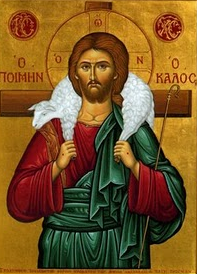
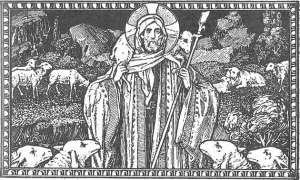
This Sunday is often called Good Shepherd Sunday: the Gospel tells us of the Good Shepherd. Jesus is indeed the Good Shepherd of our souls. He came to give His life for us.

INTROIT Ps. 32. 5, 6 – The earth is full of the goodness of the Lord, alleluia: by the word of the Lord were the heavens made, alleluia, alleluia. — (Ps. 32. 1). Rejoice in the Lord, O ye righteous: praise is comely for the upright. V.: Glory to the Father . . . — The earth is full of the goodness of the Lord . . .

EPISTLE ¤ I. Peter 2. 21-25 – [St. Peter, Head and Pastor of the Church of Christ, tells us in his Epistle that Jesus is the Shepherd of our souls, which were as sheep going astray.]

Dearly beloved, Christ suffered for us, leaving you an example, that you should follow His steps who did no sin, neither was guile found in His mouth. Who when He was reviled, did not revile: when He suffered, He threatened not, but delivered Himself to him that judged Him unjustly: who His own self bore our sins in His body upon the tree: that we, being dead to sins, should live to justice; by whose stripes you were healed. For you were as sheep going astray: but you are now converted to the Shepherd and Bishop of your souls.

GOSPEL John 10:11-16. – At that time, Jesus said to the Pharisees: “I am the good shepherd. The good shepherd lays down his life for the sheep. He who is a hired hand and not a shepherd, who does not own the sheep, sees the wolf coming and leaves the sheep and flees, and the wolf snatches them and scatters them. He flees because he is a hired hand and cares nothing for the sheep.

“I am the good shepherd. I know my own and my own know me, just as the Father knows me and I know the Father; and I lay down my life for the sheep. And I have other sheep that are not of this fold. I must bring them also, and they will listen to my voice. So there will be one flock, one shepherd.”

~~~

Fr. Gabriel of St. Mary Magdalen, O.C.D. Divine Intimacy

The Good Shepherd

Second Sunday after Easter Presence of God

I come to You, O Jesus, my Good Shepherd; lead me to the pastures of eternal life.

Meditation

1. The liturgy today sums up in the gentle figure of the Good Shepherd all that Jesus has done for our souls.

The shepherd is everything to his flock; their life, their sustenance, and their care is entirely in his hands, and if the shepherd is good, they will have nothing to fear under his protection, and they will want for nothing.

Jesus is preeminently the Good Shepherd: He not only loves, feeds and guards His sheep, but He also gives them life at the cost of His own. In the mystery of the Incarnation, the Son of God comes to earth in search of men who, like stray sheep, have wandered away from the sheepfold and have become lost in the dark valley of sin. He comes as a most loving Shepherd who, in order to take better care of His flock, is not afraid to share their lot. Today’s Epistle (1 Peter 2:21-25) shos Him to us as He takes our sins upon Himself that He may heal us by His Passion: “Who His own self bore our sins in His Body upon the tree that we, being dead to sin, should live to justice; by whose stripes you were healed. For you were as sheep going astray; but you are now converted to the Shepherd and Bishop of your souls.” (1 Peter 2:24-25) Jesus said, “I am the Good Shepherd, and I give my life for my sheep” and in the Office for Paschal time, the Church chants many times: “The Good Shepherd is risen, He who gave His life for His sheep and who died for His flock.” What could be a better synthesis of the whole work of the Redemption? It seems still more wonderful when we hear Jesus declare: “I am come that they may have life and may have it more abundantly.” (John 10:10) In truth, He could well repeat to each one of us: “What more could I have done for you that I have not done?” (cf. Isaiah 5:4) Oh, would that our generosity in giving ourselves to Him had no limits, after the pattern of HIs own liberality in giving Himself to us!

2. Again Jesus said: “I know Mine, and Mine know Me, even as the Father knows Me and I know the Father” (Gospel: John10:11,16) Although there is no question here of equality, but merely that of a simple comparison, it is nevertheless very consoling and glorious for us to see how Jesus likes to compare His relations with us to those He has with His Father. At the Last Supper also, He said: “As the Father hath loved Me, I also have love you,” and again: “as Thou, Father, in Me, and I in Thee; that they also may be one in Us” (John15:9; 17:21) This shows that between us, the sheep, and Jesus, our Shepherd, there is not only a relation of acquaintance, but also one of love, and better still, of a communion of life, similar to that which exists between the Son and the Father. It is by means of the grace, faith and charity, which the Good Shepherd acquired for us by His death, that we arrive at such intimacy with our God – so deep that it makes us share in His own divine life.

A close relationship of loving knowledge is here established between the Good Shepherd and His sheep — one so intimate that the Shepherd knows His sheep one by one and can call them by name; and they recognize His voice and follow Him with docility. Each sould can say: “Jesus knows me and loves me, not in a general abstract way, but in the concrete aspects of my needs, of my desires, and of my life; for Him to know me and to love is to do me good, to encompass me more and more with His grace, and to sanctify me. Precisely because He loves me, Jesus calls me by name: He calls me when in prayer He opens to me new horizons of the spiritual life, or when he enables me to know my faults and weaknesses better; He calls me when He reprimands me or purifies me by aridity, as well as when He consoles and encourages me by filling me with new fervour; He calls me when He makes me feel the need of greater generosity, and when He asks me for sacrifices or gives me joys, and still more, when He awakens in me a deeper love for Him. Hearing His call, my attitude should be that of a loving little sheep who recognizes the voice of its Shepherd and follows Him always.

Colloquy

“O Lord, You are my Shepherd, I shall not want; You make me lie down in green pastures, You lead me to the water of refreshment, You convert my soul and lead me on the paths of justice. Even though I walk in the ravines, in the dark valleys, I shall fear no evil, for You are with me. Your rod and Your staff are my comfort. You prepare a table before me in the presence of my enemies. You anoint my head with oil, my cup runs over.” (cf. Psalm 22 O Lord, my Good Shepherd, what more could You have done for me that You have not done? What could You have given to me that You have not given? You willed to be my food and drink. What more delightful and salutary, nourishing and strengthening pasture could You have found than Your own Body and Blood?

O good Lord Jesus Christ, my sweet Shepherd, what return shall I make to You for all that You have given me? What shall I give You in exchange for Your gift of Yourself to me? Even if I could give myself to You a thousand times, it would still be nothing, since I am nothing in comparison in comparison with You. You, so great, have loved me so much and so gratuitously, I who am so small, so wicked and ungrateful! I know, O Lord, that Your love tends toward the immense, the infinite, because You are immense and infinite. Please tell me, O Lord, how I ought to love You.

“My love, O Lord, is not gratuitous, it is owed to You…. Although I cannot love You as much as I should, You accept my weak love. I can love You more when You condescend to increase my virtue, but I can never give You what You deserve. Give me then, Your most ardent love by which, with Your grace, I shall love You, please You, serve You, and fulfil Your commands. May I never be separated from You, either in time or in eternity, but abide united to You in love, forever and ever.” (Ven. R. Jourdain)

~~~

Resources:

  • Good Shepherd Sunday Sermons
  • Good Shepherd for Children & Coloring Page
  • Good Shepherd Coloring Page

~~~

Good Shepherd, who lays down His Life for His sheep, nourish Your people with the Bread of Life, that we may reflect Your likeness and enjoy the spring of Living Water that never ends. Amen.

St. Patrick

March 15, 2019 by Lena {JOYfilledfamily} Filed Under: 03 March Saints, St. Patrick Leave a Comment

Simple feast day celebrations take on a whole new meaning when they fall in Lent. Below are a few reflections and ideas to celebrate the feast of St. Patrick. (We are able to celebrate as a First Class feast vs. they typical commemoration since he is the patron saint of our diocese. But this year it doesn’t matter since his feast falls on a Sunday.)

SAINT PATRICK

Toward the close of the fourth century, the pagan Irish captured during a slave-hunting raid the Christian youth who would become St. Patrick. The lad was put to work in Ireland as a pigherd for six years. Then he escaped, but with the intention of returning to the land of his captivity as an apostle. The former pigherd was ordained to the priesthood, and in 432 was made a bishop. The Pope himself commissioned Patrick to carry the Faith to Ireland. In his apostolic travels St. Patrick covered the length and breathe of the island. He overcame heartbreaking difficulties and sorrows, because he made Christ his sole changeless friend and helper.

O God, You sent Your blessed confessor bishop Patrick to preach Your glory among the nations. May we fulfill all the duties commanded of us through his merits and intercession. Through Our Lord . . .
 

SAINT PATRICK

Pictorial Lives of the Saints

If the virtue of children reflects an honor on their parents, much more justly is the name of Saint Patrick rendered illustrious by the innumerable lights of sanctity with which the Church of Ireland shone during many ages, and by the colonies of Saints with which it peopled many foreign countries; for, under God, its inhabitants derived from their glorious apostle the streams of that eminent sanctity by which they were long conspicuous to the whole world. Saint Patrick was born towards the close of the fourth century, in a village called Bonaven Taberniae, which seems to be the town of Kilpatrick, on the mouth of the river Clyde, in Scotland, between Dumbarton and Glasgow. He calls himself both a Briton and a Roman, or of a mixed extraction, and says his father was of a good family named Calphurnius, and a denizen of a neighboring city of the Romans, who not long after abandoned Britain, in 409. Some writers call his mother Conchessa, and say she was niece to Saint Martin of Tours.

In his sixteenth year he was carried into captivity by certain barbarians who took him into Ireland, where he was obliged to keep cattle on the mountains and in the forests, in hunger and nakedness, amidst snows, rain, and ice. Whilst he lived in this suffering condition, God had pity on his soul, and quickened him to a sense of his duty by the impulse of a strong interior grace. The young man had recourse to Him with his whole heart in fervent prayer and fasting; and from that time faith and the love of God acquired continually new strength in his tender soul. After six months spent in slavery under the same master, Saint Patrick was admonished by God in a dream to return to his own country, and informed that a ship was then ready to sail thither. He went at once to the sea-coast, though at a great distance, and found the vessel; but could not obtain his passage, probably for want of money. The Saint returned towards his hut, praying as he went, but the sailors, though pagans, called him back, and took him on board. After three days’ sail they made land, but wandered twenty-seven days through deserts, and were a long while distressed for want of provisions, finding nothing to eat. Patrick had often spoken to the company on the infinite power of God, they therefore asked him why he did not pray for relief. Animated by a strong faith, he assured them that if they would address themselves with their whole hearts to the true God, He would hear and succor them. They did so, and on the same day met with a herd of swine. From that time provisions never failed them, till on the twenty-seventh day they came into a country that was cultivated and inhabited.

Some years afterward he was again led captive, but recovered his liberty after two months. When he was at home with his parents, God manifested to him, by divers visions, that He destined him to the great work of the conversion of Ireland. The writers of his life say that after his second captivity he travelled into Gaul and Italy, and saw Saint Martin, Saint Germanus of Auxerre, and Pope Celestine, and that he received his mission and the apostolical benediction from this Pope, who died in 432. It is certain that he spent many years in preparing himself for his sacred calling. Great opposition was made against his episcopal consecration and mission, both by his own relations and by the clergy. These made him great offers in order to detain him among them, and endeavored to affright him by exaggerating the dangers to which he exposed himself amidst the enemies of the Romans and Britons, who did not know God. All these temptations threw the Saint into great perplexities, but the Lord, whose will he consulted by earnest prayer, supported him, and he persevered in his resolution. He forsook his family, sold his birthright and dignity, to serve strangers, and consecrated his soul to God, to carry His name to the ends of the earth. In this disposition he passed into Ireland, to preach the Gospel, where the worship of idols still generally reigned. He devoted himself entirely to the salvation of these barbarians. He travelled over the whole island, penetrating into the remotest corners, and such was the fruit of his preachings and sufferings that he baptized an infinite number of people. He ordained everywhere clergymen, induced women to live in holy widowhood and continence, consecrated virgins to Christ, and instituted monks. He took nothing from the many thousands whom he baptized, and often gave back the little presents which some laid on the altar, choosing rather to mortify the fervent than to scandalize the weak or the infidels. He gave freely of his own, however, both to Pagans and Christians, distributed large alms to the poor in the provinces where he passed, made presents to the kings, judging that necessary for the progress of the Gospel, and maintained and educated many children, whom he trained up to serve at the altar. The happy success of his labors cost him many persecutions. A certain prince named Corotick, a Christian in name only, disturbed the peace of his flock. This tyrant, having made a descent into Ireland, plundered the country where Saint Patrick had been just conferring confirmation on a great number of neophytes, who were yet in their white garments after baptism. Corotick massacred many, and carried away others, whom he sold to the infidel Picts or Scots. The next day the Saint sent the barbarian a letter entreating him to restore the Christian captives, and at least part of the booty he had taken, that the poor people might not perish for want; but was only answered by railleries. The Saint, therefore, wrote with his own hand a letter. In it he styles himself a sinner and an ignorant man; he declares, nevertheless, that he is established bishop of Ireland, and pronounces Corotick and the other parricides and accomplices separated from him and from Jesus Christ, whose place he holds, forbidding any to eat with them, or to receive their alms, till they should have satisfied God by the tears of sincere penance, and restored the servants of Jesus Christ to their liberty. This letter expresses his most tender love for his flock, and his grief for those who had been slain, yet mingled with joy, because they reign with the prophets, apostles, and martyrs. Jocelin assures us that Corotick was overtaken by the divine vengeance.

Saint Patrick held several councils to settle the discipline of the Church which he had planted. Saint Bernard and the tradition of the country testify that Saint Patrick fixed his metropolitan see at Armagh. He established some other bishops, as appears by his Council and other monuments. He not only converted the whole country by his preaching and wonderful miracles, but also cultivated this vineyard with so fruitful a benediction and increase from heaven, as to render Ireland a most flourishing garden in the Church of God, and a country of Saints.

Many particulars are related of the labors of Saint Patrick, which we pass over. In the first year of his mission he attempted to preach Christ in the general assembly of the kings and states of all Ireland, held yearly at Tara, the residence of the chief king, styled the monarch of the whole island, and the principal seat of the Druids or priests, and their paganish rites. The son of Neill, the chief monarch, declared himself against the preacher; however, Patrick converted several, and, on his road to that place, the father of Saint Benignus, his immediate successor in the see of Armagh. He afterward converted and baptized the kings of Dublin and Munster, and the seven sons of the king of Connaught, with the greatest part of their subjects, and before his death almost the whole island. He founded a monastery at Armagh; another called Domnach-Padraig, or Patrick’s Church; also a third, named Sabhal-Padraig, and filled the country with churches and schools of piety and learning, the reputation of which, for the three succeeding centuries, drew many foreigners into Ireland. He died and was buried at Down, in Ulster. His body was found there in a church of his name in 1185, and translated to another part of the same church.

Ireland is the nursery whence Saint Patrick sent forth his missionaries and teachers. Glastonbury and Lindisfarne, Ripon and Malmesbury, bear testimony to the labors of Irish priests and bishops for the conversion of England. Iona is to this day the most venerated spot in Scotland. Columban, Fiacre, Gall, and many others evangelized the “rough places” of France and Switzerland. America and Australia, in modern times, owe their Christianity to the faith and zeal of the sons and daughters of Saint Patrick.

Reflection – By the instrumentality of Saint Patrick the faith is now as fresh in Ireland, even in this cold nineteenth century, as when it was first planted. Ask him to obtain for you the special grace of his children, to prefer the loss of every earthly good to the least compromise in matters of faith.

ST. PATRICK’S TEA

  • Holy Trinity Shamrocks – Green shamrock Rice Krispie treats and cucumber tea sandwiches cut with shamrock cookie cutter
  • St. Patrick’s Staff — Green chocolate dipped pretzel wands
  • Serpents – Gummy worms
  • Green fruit/veggie platter & kabobs
  • Lime Sparkling Water
  • Diffuse Lime, Grapefruit, and Bergamot — a great uplifting oils that radiate spring
  • St. Patrick printable activities (see links below)
  • View St. Patrick movie

St Patrick’s Breastplate

I bind unto myself today 
Through a might strength,
The invocation of the Trinity,
Through a belief in the Threeness, 
Through confession of the Oneness
Of the Creator of creation. 

I bind unto myself today 
The strength of Christ’s birth and His baptism,
The strength of His crucifixion and His burial,
The strength of His resurrection and His ascension,
The strength of His descent for the judgment of doom.
I bind unto myself today
The strength of the love of the Cherubim
The obedience of angels,
The service of archangels,
The hope of resurrection to meet with reward,
The prayers of the patriarchs,
The preaching of the apostles,
The faith of confessors,
The innocence of virgins
The deeds of righteous men.
I bind unto myself today
The strength of heaven;
The light of the sun,
The splendor of fire,
The speed of lightning,
The swiftness of the wind,
The depth of the sea,
The stability of the earth,
The firmness of the rock.
I bind unto myself today
God’s strength to pilot me;
God’s might to uphold me,
God’s wisdom to guide me,
God’s eye to look before me,
God’s ear to hear me,
God’s word to speak for me,
God’s hand to guard me,
God’s way to lie before me,
God’s shield to protect me,
God’s hosts to save me
From the snares of the devil,
From the temptations of vices,
From the lusts of nature
From every one who desires me ill,
Afar and anear,
Alone or in a multitude.
I summon today all these powers
Between me and evil,
Against every cruel merciless power that opposes my body and soul;
Against the incantations of false prophets,
Against the black law of pagandom,
Against the false laws of heretics,
Against the craft of idolatry,
Against spells of women and smiths and wizards,
Against every knowledge that corrupts man’s body and soul.
Christ shield me today
Against poison, against burning,
Against drowning, against wounding,
So that reward may come to me in abundance.
Christ with me, Christ before me,
Christ behind me, Christ in me,
Christ beneath me, Christ above me,
Christ on my right, Christ on my left,
Christ when I lie down, Christ when I sit down,
Christ in the fort, Christ in the chariot,
Christ in the captain’s deck of a ship,
Christ in the heart of every man who thinks of me,
Christ in the mouth of every man who speaks of me,
Christ in the eye that sees me,
Christ in the ear that hears me.
I bind unto myself today
Through a mighty strength,
The invocation of the Trinity,
Though a belief in the Threeness,
Through a confession of the Oneness
Of the Creator of creation.

RESOURCES:

  • St. Patrick Coloring Page – Catholic Playground
  • St. Patrick Printable Holy Card – Holy Reflections
  • St. Patrick Unit Study – Kennedy Adventures
  • St. Patrick Breastplate Printable – Catholic All Year
  • More St. Patrick Inspiration — JOYFILLEDFAMILY Pinterest
  • Blessed Trinity Shamrock – Catechism Lesson/Craft – Shower of Roses
  • St. Patrick and the Easter Fire – Sensus Fidelium
  • Confessions of St. Patrick – This LibriVox recording of this short autobiography by St. Patrick,
  • The Poetic Life of St. Patrick – SSPX
  • St. Patrick Audio Story and Other Saint StoriesRegina Martyrum

Ember Days in Lent

March 13, 2019 by Lena {JOYfilledfamily} Filed Under: Ember Days, Lent, Lent Ember Day Leave a Comment

The purpose of their introduction, besides the general one intended by all prayer and fasting, was to thank God for the gifts of nature, to teach men to make use of them in moderation, and to assist the needy.

Here’s a catchy rhyme that has been used in English for a couple hundred years to help the faithful remember when four Ember Days occur.

Lenty, Penty, Crucy, Lucy.”

Meaning, the weeks following: Ash Wednesday, Pentecost, Feast of the Exaltation of the Holy Cross, Feast of St. Lucy.

EMBER DAYS IN LENT

The Liturgical Year, Dom Guéranger O.S.B.

The fast on the Wednesday after the First Sunday of Lent is prescribed by a double law—it is Lent, and it is Ember Wednesday. It is the same with the Friday and Saturday of this week. There are two principal objects for the Ember Days of this period of the year: the first is to offer to God the season of Spring, and, by fasting and prayer, to draw down His blessing upon it; the second is to ask Him to enrich with His choicest graces the priests and sacred ministers who are to receive their Ordination on Saturday. Let us, therefore, have a great respect for these three days; and let those who violate upon them the laws of fast or abstinence, know that they commit a twofold sin.

Up to the 11th century the Ember Days of Spring were kept in the first week of March; and those of Summer, in the second week of June. It was Pope St. Gregory VII who fixed them as we now have them; that is, the Ember Days of Spring in the first full week of Lent, and those of Summer during the Octave of Pentecost.

On all the Ember Wednesdays there are read, in place of the Epistle at Mass, two Lessons from Sacred Scripture. Today the Church brings before us the two great types of Lent—Moses in the first Lesson and Elias in the second—in order to impress us with an idea of the importance of this forty days’ fast, which Christ Himself solemnly consecrated when He observed it, thus fulfilling, in His own Person, what the Law and the Prophets had but prefigured.

Moses and Elias fasted for forty days and forty nights, because God bade them come near to Him. Man must purify himself, he must unburden himself, in some measure at least, of the body which weighs him down, if he would enter into communication with Him, Who is the Holy Spirit. And yet the vision of God granted to these two holy personages was very imperfect: they felt that God was near them, but they beheld not His glory. But when the fullness of time came (Gal. 4: 4), God manifested Himself in the flesh: and man saw and heard and touched Him (1 John 1: 1). We indeed are not of the number of those favored ones who lived with Jesus, the Word of Life; but in the Holy Eucharist He allows us to do more than see Him—He enters into our breasts, He is our Food. The humblest member of the Church possesses God more fully then either Moses on Sinai or Elias on Horeb. We cannot, therefore, be surprised that the Church, in order to fit us for this favor at the Easter solemnity, bids us go through a preparation of forty days, though its severity is not to be compared with the rigid fast which Moses and Elias had to observe as the condition of receiving what God promised them.

On Ember Friday we are reminded of the ancient Lenten discipline of the Church. We would frequently be at a loss to understand Her liturgy of this season, unless we picture Her to ourselves as preparing the public penitents for a renewed participation in the Sacred Mysteries. But first they must be reconciled to God, Whom they have offended. Their soul is dead by sin; can it be restored to life? Yes; we have God’s word for it. The Lesson from the prophet Ezechiel, which the Church began yesterday for the catechumens, is continued today for the benefit of the public penitents. If the wicked do penance for all his sins, which he hath committed, and keep all My commandments, and do judgment and justice; living he shall live, and shall not die. But his iniquities are upon him and rise up against him, crying to Heaven for eternal vengeance! And yet God, Who knows all things, and forgets nothing, assures us that He will not remember iniquities which have been redeemed by penance. Such is the affection of His Fatherly Heart, that He will forget the outrage offered Him by His child, if this child will but return to its duty. Thus then the penitents are to be reconciled; and on the Feast of the Resurrection they will be associated with the just, because God will have forgotten their iniquities; they themselves will be just men. Thus it is that the Liturgy, which never changes in its essentials, brings frequently before us the ancient discipline of public penance.

Nowadays, sinners are not visibly separated from the faithful; the Church doors are not closed against them; they frequently stand near the holy altar, in the company of the just; and when God’s pardon descends upon them, the faithful are not made cognizant of the grace by any special and solemn rite. Let us here admire the wonderful mercy of our Heavenly Father, and profit by the indulgent discipline of our Holy Mother the Church. The lost sheep may enter the fold at any hour and without any display; let him take advantage of the condescension thus shown him, and never more wander from the Shepherd, Who thus mercifully receives him. Neither let the just man be puffed up with self-complacency, by preferring himself to the lost sheep; let him rather reflect on those words of today’s lesson: If the just man turn himself away from his justice, and do iniquity… the justices which he hath done shall not be remembered. Let us, therefore tremble for ourselves, and have compassion on sinners. One of the great means on which the Church rests Her hopes for the reconciliation of sinners is the fervent prayers offered up for them by the faithful during Lent.

The Gospel of today tells of the cure of the infirm man who had waited 38 years at the Probatica pool—a figure of the Sacrament of Penance. How was his cure wrought? First of all, the infirm man says to Jesus: I have no man, when the water is troubled, to put me into the pond. The water would have cured him; but observe, he has need of some Man to lead him to the water. This Man is the Son of God, and He became Man in order to heal us. As Man, He has received power to forgive sins, and before leaving this earth, He gave that same power to other men, and said to them: Whose sins ye shall forgive, they are forgiven them (John 20: 23). The penitents, then, are to be reconciled with God by virtue of this supernatural power; and the infirm man, who takes up his bed and walks, is a figure of the sinner, whose sins have been forgiven him by the Church, by the divine power of the keys.

In the third century, a heretic named Novatian taught that the Church has not the power to forgive sins committed after Baptism. This doctrine was condemned by the Councils and the holy Doctors of the Church; and in order to offer to the faithful some outward expression of the power given to the Son of Man of forgiving sins to such as repent, there was painted on the walls of the places where the Christians used to assemble, the infirm man of the Gospel, walking with his bed upon his shoulders. This consoling symbol is frequently met with in the frescoes which were painted, even in the age of the Martyrs, in the Roman catacombs. They show us how the early Christians were taught to understand this passage of the Gospel, which the Church, so many centuries ago, assigned to this day.

The Water of the Probatica was also a symbol; and here the Gospel conveyed a special instruction to the Catechumens. It was by Water that they were to be made whole, and by Water endowed with a supernatural virtue. The miraculous pond of Jerusalem could only cure the body, and that at rare intervals, and the favor could only be conferred upon a single individual; but now that the Angel of the Great Counsel has come down from Heaven and sanctified the waters of the Jordan, the Probatica is everywhere—it is giving health to the souls of man without any limitation either of time or number.  Man is the minister of this grace; but it is the Son of God, become the Son of Man, that works by the human minister.

Let us also consider the multitude of sick, who, as the Gospel tells us, were waiting for the moving of the water. They represent the various classes of sinners, who are seeking, during this holy time, to be converted to their God. There are the Sick, or as the Latin word has it, the Languid—these are the torpid, who never thoroughly give up their evil habits; there are the Blind—these are they whose spiritual eye is dead; there are the Lame—who limp and falter in the path to salvation; and lastly there are the Withered—who seem incapable of doing a single good action. All are waiting for the favorable moment. Jesus will soon be with them, and will say to each of them: Wilt thou be made whole? Let them answer this question with love and confidence, and they will be healed.

The Station for every Ember Saturday is, as we have seen, in the Basilica of St. Peter—the Vatican—where the people were wont to assemble toward evening, that they might be present at the Ordination of the Priests and Sacred Ministers. This day was called Twelve-Lesson-Saturday, because, formerly, twelve passages from Holy Scripture used to be read. (The number now is seven—five Lessons, the Epistle and the Gospel.) The Mass during which the Ordinations were given, was celebrated during the night; so that by the time it was over, the Sunday had begun. Later on the Ordination Mass was celebrated early on Saturday, but, in memory of the ancient practice, the Gospel for Saturday is repeated on Sunday—in this case, the Gospel of the Transfiguration. The following is the interpretation given by the ancient Liturgists, among whom we may especially mention the learned Abbot Rupert:

“The Church would have us think upon the sublime dignity which has been conferred upon the newly ordained Priests. They are represented by the three Apostles, who were taken by Jesus to the high mountain, and favored with the sight of His glory. The rest of the Disciples were left below: Sts. Peter, James and John were the only ones permitted to ascend Tabor; and they, when the time should come, were to tell their fellow Apostles, and the whole world, how they had seen the glory of their Master and heard the words of the Father declaring the Divinity of the Son of Man.  This voice, says St. Peter, coming down to Him from the excellent glory: This is My Beloved Son, in Whom I am well pleased; hear ye Him. And this voice we heard, brought from Heaven, when we were with Him on the holy mount (2 Peter 1: 17, 18). In like manner, these priests who have just been ordained, and for whom you have been offering up your prayers and fasts, will enter into the cloud with the Lord. They will offer up the Sacrifice of your salvation in the silence of the sacred Canon. God will descend into their hands, for your sake; and though they are mortal and sinners, yet will they, each day, be in closest communication with the Divinity. The forgiveness of your sins, which you are now preparing to receive from your heavenly Father, is to come to you through their hands; their superhuman power will bring it down from Heaven upon your souls. It is thus that God has cured our pride. The serpent said to us through our first parents: Eat of this fruit, and you shall be as gods. We unfortunately believed the tempter, and the fruit of our transgression was death. God took pity on us, and resolved to save us; but it is by the hands of men that He would save us, and this in order to humble our haughtiness. His own eternal Son became Man, and He left other men after Him, to whom He said: As the Father has sent Me, I also send you (John 20: 21). Let us, then, show honor to these men, who have, this very day, been raised to so high a dignity. One of the duties imposed on us by our holy religion is respect to the Priesthood.”

Fasting & Abstinence

Current Practice vs. 1962 Discipline

As a help in understanding the Church’s discipline of fast and abstinence, the following summary of the requirements, both current and those in force in 1962, has been excerpted from the Liturgical Ordo published by the Priestly Fraternity of St. Peter.

History of the Ember Days

The Ember Days, which were historically kept four times during the liturgical year, have a venerable history. Here is the explanation from the 1917 Catholic Encyclopedia.

The purpose of their introduction, besides the general one intended by all prayer and fasting, was to thank God for the gifts of nature, to teach men to make use of them in moderation, and to assist the needy. The immediate occasion was the practice of the heathens of Rome. The Romans were originally given to agriculture, and their native gods belonged to the same class. At the beginning of the time for seeding and harvesting religious ceremonies were performed to implore the help of their deities: in June for a bountiful harvest, in September for a rich vintage, and in December for the seeding; hence their feriae sementivae, feriae messis, and feri vindimiales. The Church, when converting heathen nations, has always tried to sanctify any practices which could be utilized for a good purpose. At first the Church in Rome had fasts in June, September, and December; the exact days were not fixed but were announced by the priests. The “Liber Pontificalis” ascribes to Pope Callistus (217-222) a law ordering the fast, but probably it is older. Leo the Great (440-461) considers it an Apostolic institution. When the fourth season was added cannot be ascertained, but Gelasius (492-496) speaks of all four. This pope also permitted the conferring of priesthood and deaconship on the Saturdays of ember week–these were formerly given only at Easter. Before Gelasius the ember days were known only in Rome, but after his time their observance spread. They were brought into England by St. Augustine; into Gaul and Germany by the Carlovingians. Spain  adopted  them with the Roman  Liturgy in the eleventh century. They were introduced by St. Charles Borromeo into Milan. The Eastern Church does not know them. The present Roman Missal, in the formulary for the Ember days, retains in part the old practice of lessons from Scripture in addition to the ordinary two: for theWednesdays three, for the Saturdays six, and seven for the Saturday in December. Some of these lessons contain promises of a bountiful harvest for those that serve God.

Keeping with Tradition

Catholics who have access to the traditional liturgy outside of Sundays are encouraged to make a special point to assist at Mass on Wednesday, Friday, and Saturday of this week. In addition to keeping the fasting and abstinence prescriptions on these days, the faithful should be attentive to the special collects and readings that are assigned on these days.

Lenten Ember Day Propers:

  • Ember Wednesday of Lent Propers
  • Ember FRIDAY of Lent Propers
  • Ember SATURDAY of Lent Propers

“Unless you do penance, you shall likewise perish.” (Lk. 13:5)

Resources:

  • Ember Days of Lent – FSSP

  • Ember Days – FSSP
  • Ember & Rogation Days Sermon Audio – Fr Ripperger
  • Rogation Days – JOYfilledfamily
  • Ember Days – Fish Eaters
  • Ember Days – Catholic Encyclopedia
  • The Golden Legend: The Ember Days – Fordam University
  • Reparation:  Bishop Morlino Calls fo Ember Days Prayer & Fasting 

  • September Ember Days – Fr. Ripperger, FSSP
  • Ember Wednesday of Advent Propers
  • Ember Friday of Advent Propers
  • Ember Saturday of Advent Propers

  • On the Laws of Fasting – FSSP
  • Fasting & Abstinence Simplified

Lenten Calendar 2019

March 1, 2019 by Lena {JOYfilledfamily} Filed Under: Lent, Lenten Calendar, Uncategorized Leave a Comment

Almighty God! I unite myself at the beginning of this holy season of penance with the Church militant, endeavoring to make these days of real sorrow for my sins and crucifixion of the sensual man. O Lord Jesus! in union with Thy fasting and passion, I offer Thee my fasting in obedience to the Church, for Thy honor, and in thanksgiving for the many favors I have received, in satisfaction for my sins and the sins of others, and that I may receive the grace to avoid such and such a sin, N. N. and to practice such and such a virtue, N. N.

Lent has a late start this year, beginning on March 6. This Lenten Calendar has become a beloved addition to our home during Lent. It’s a labor of love that my children insist I complete each year, a great way to help me prepare for Lent during Septuagesima. I share each year in hope that it may help others along their Lenten journey.

This Lenten Calendar follows the Traditional Calendar (1962) of the Extraordinary Form of the Liturgy with  Historical (H) feast days noted.  It extends from Shrove Tuesday to Holy Saturday/Easter Vigil.

We only celebrate First Class Feasts during Lent.  The other saints are included for private devotion and are called upon for intercessory prayers.

⋅⋅⋅⋅⋅⋅

Here’s a look at the Lenten calendars posted in our home over the years.

⋅⋅⋅⋅⋅⋅

This year’s calendar prints best as 20×30 and 12×18.  Costco Photo has been my best option for speedy and inexpensive printing.  Prints at Costco range from $1.49 to $9.99.

I have set a suggested donation amount to the calendar this year — $2. It’s a small something that goes a long way to support this humble family ministry (of sharing the riches of our Faith and Traditional Latin Mass.) If you are unable to pay, please do not let that stop you from using this resource. Simply enter the coupon code, paxchristi for a free download.

  • You may download and print the calendar for your personal use.
  • You may also link to this post but please do not link directly to the file download.
  • Email me at JOYfilledfamily{at}gmail{dot}com if you need my assistance.  

⋅⋅⋅⋅⋅⋅

Includes variations of the 2019 Lenten Calendar and more!

O most benign Jesus! who didst so desire to suffer for us, grant, that we may willingly suffer for love of Thee; that we may hate and flee from the detestable pleasures of the world and the flesh, and practice penance and mortification, that by so doing we may merit to be released from our spiritual blindness to love Thee more and more ardently, and finally possess Thee forever.

⋅⋅⋅⋅⋅⋅

2019 Lenten Calendar Guide

  • The bottom portion of each day represents the feasts and ferias proper to the season for the Extraordinary Form
  • Saints listed without notation are from the Extraordinary Form liturgy
  • Saints listed with “H” are from the Historical calendar
  • Each saint featured by a picture is identified by the name immediately above the image
  • This calendar is the work of a lay Catholic for one’s personal observance of Lent and private devotions

⋅⋅⋅⋅⋅⋅

Family Favorite Lenten Resources for Children:

  • Bury the Alleluia
  • Printable Blank Lenten Plan
  • Lent Planning Worksheet – Rorate Caeli
  • Lent Planning Worksheet for Children – Raising Little Saints
  • 2019 Printable Lenten Calendar Journey – Ponder In My Heart
  • Stations of the Cross for Children & Stations of the Cross Box – Family, Feast, and Feria
  • Stations of the Cross Coloring Booklet – Catholic Playground
  • Stations of the Cross Coloring Page – Catholic Playground
  • Empty Tomb Garden 
  • Lenten Family Joy Journal
  • Stations of the Cross Candles 
  • Resurrection Eggs

Lenten Resources:

  • Fr Goffine’s The Church’s Year
  • Septuagesima Sunday 
    • Septuagesima: Planning for Lent – Audio Sermon
    • Septuagesima Sunday – Audio Sermon
  • Sexagesima Sunday
    On the power of God’s word
    • Sexagesima: Noah & Peter – Audio Sermon
    • Sexagesima: the 4 Layers of Soil – Audio Sermon
  • Quinquagesima Sunday
    Instruction on Lent
    • Quinquagesima: Prayer, Fasting, & Almsgiving During Lent – Audio Sermon
    • Quinquagesima: Lent, Our Spiritual Tithe – Audio Sermon
    • Quinquagesima Lent: Prayer, Fasting, Charity – Audio Sermon
    • Why Lent? – Audio Sermon 
    • Growing in Virtue by Small, Sustained Mortifications – Audio Sermon
    • Quinquagesima Sunday — Grow in Charity During Lent – Audio Sermon
    • We Must Fast to do Reparation – Audio Sermon
    • Embrace Lent: No Short Cuts, No Compromise – Audio Sermon
  • Ash Wednesday
    • Ash Wednesday – Audio Sermon
    • Fasting Becoming Holy | Exorcist Fr Ripperger – Audio Sermon
    • Ash Wednesday, Lent, & Spiritual Armor – Audio Sermon
    • The Love of God Must Motivate Us During Lent – Audio Sermon
  • First Sunday in Lent
    • Instruction on temptation
    • First Sunday of Lent — The Fewness of the Saved – Audio Sermon
    • For This Purpose the Son of God Appeared – Audio Sermon
    • Temptation is a Gift From God ~ Fr Isaac Mary Relyea – Audio Sermon
    • The Temptation of Our Lord & Sins Against the 1st Commandment – Audio Sermon
  • Second Sunday in Lent
    • Transfiguration – Audio Sermon
  • Third Sunday in Lent
    • Mysteries of Christ in Scripture & Liturgy – Audio Sermon
    • The Main Means to Overcome Satan – Audio Sermon
    • Courage! Courage! Courage! – Audio Sermon
  • Fourth Sunday in Lent
    Consolation in poverty
    Instruction on preparation for Easter
  • Fifth Sunday in Lent
    Consolation under calumny
    • The Passion – Audio Sermon
  • Palm Sunday
    • Our Lady of Sorrows | Fr. Chad Ripperger – Audio Sermon
    • Beasts of Burden – Audio Sermon
    • Faithless Friends – Audio Sermon
  • Monday after Palm Sunday
  • Tuesday after Palm Sunday
  • Wednesday after Palm Sunday
  • Holy Thursday
  • Good Friday
  • Holy Saturday
  • Easter Sunday: On The Miserable State Of Relapsing Sinners (19 Minutes)
  • Fasting & Abstinence ~ Sight of Angels
  • Seven Penitential Psalms
  • The Gospels for Lent and the Passion of Christ : readings at divine service during the forty days of Lent with short meditations for the faithful
  • Lent and Holy Week : chapters on Catholic observance and ritual
  • Meditations for Lent from St. Thomas Aquinas
  • Homilies for Lent from the Church Fathers – audio: part 1, part 2, part 3, part 4, part 5
  • FREE Traditional Catholic Books
  • The Virtue of Charity | Fr. Chad Ripperger – Audio Sermon

Feast of the Purification of the Blessed Virgin Mary {Candlemas}

February 2, 2019 by Lena {JOYfilledfamily} Filed Under: 02 February Saints, Candlemas, Chruching of Women, Purification of the Blessed Virgin Mary Leave a Comment

The Feast of the Purification of Our Lady is popularly known as Candlemas because of the rite of blessing and processing with candles, which represent Christ the Light of the Gentiles.

To honor this feast, here is a poetic tribute, some sacred music selections and related Scriptural references.

Lumen ad revelationem Gentium (antiphon sung during distribution of blessed candles)

Lumen ad revelationem Gentium (antiphon sung during distribution of blessed candles)

  • Gregorian chant

Nunc dimitis (Prophecy of Simeon)

  • Gyorgy Orban
  • Rachmaninov (in Old Slavonic)
  • Arvo Part
  • Palestrina

My eyes have seen Thy salvation: Holy Writ

Behold I send my angel, and he shall prepare the way before my face. And presently the Lord, whom you seek, and the angel of the testament, whom you desire, shall come to his temple. Behold he cometh, saith the Lord of hosts. Malachias 3:1; cf. Matthew 11:10

And after the days of her purification, according to the law of Moses, were accomplished, they carried him to Jerusalem, to present him to the Lord: As it is written in the law of the Lord: Every male opening the womb shall be called holy to the Lord: And to offer a sacrifice, according as it is written in the law of the Lord, a pair of turtledoves, or two young pigeons. Luke 2:22-24; cf. Leviticus 12

Now thou dost dismiss thy servant, O Lord, according to thy word in peace; because my eyes have seen thy Salvation, which thou hast prepared before the face of all peoples: a Light to the revelation of the Gentiles, and the Glory of thy people Israel. Luke 2:29-32; cf. Isaias 49:6


What charitable humility!

Lo!
what Charity…
the Lamb of God,[1]
Prince of Peace,[2]
Lord of lords,[3]
King of kings,[4]
Light of the world,[5]
Temple of
the Living God[6]
presents Himself
in His temple…
simple,
as a dove;[7]
the mystery,
the sublimity…
the Only-Begotten[8]
of the Father,
full of grace
and truth,[9]
in Whom
the Father
is well pleased,[10]
of Whom
said He,
“Thou art My Son,
this day have I
begotten Thee.
Ask of Me,
and I will give Thee
the Gentiles
for Thine inheritance,
and the utmost parts
of the earth,
for thy possession
,”[11]
offers Himself
in loving submission…
O ineffable Charity!
so low, the King,
humbly stooping…
stupendous Presentation!

Lo!
what humility…
the Lamb’s ewe,
Queen of Peace,
Queen of Angels,
Queen of all Saints,
Holy Mother of God,
Holy Virgin of virgins,
Mother of Christ,
Mother of Divine Grace,
Mother most pure,
Mother most chaste,
Mother inviolate,
Mother undefiled,
Ark of the Covenant,
Garden enclosed,[12]
Fountain sealed,[13]
Purity of purity,
Virgin lilywhite,
Candle of Divine Light,
Mother and
lover of poverty
St. Joseph,
present the true Lamb,
unblemished,
she His Temple…
simple,
as two turtle doves,
the sword
of Simeon’s prophecy
pierces her
Immaculate Heart.[14]

Immaculate Mother
of sinful nation,
humbles herself—
O! the thought,
such humiliation—
to the law of
Purification.

Woe!
what misery…
For…
who am I?
A worm,
and no man.[15]
Not worthy
to stand
before the
Son of Man;
the latchet
of His shoes,
I am not worthy
to loose;[16]
His feet,
I am not worthy
to kiss;[17]
Upon His face,
I am not worthy
to gaze.

And, Thou…
my sweet Mother,
the undefiled:
I, Thy prodigal child,
didst wallow
in the pigsty,
a life of disgrace. [18]
Still…
with Thine assistance,
O Full of Grace,[19]
I desire
to debase, to efface,
to humble myself
in imitation of Christ,
the Holy Incarnation,
in total subjection
to my Lord and my God,[20]
and Thee…
Immaculate Conception.


  • FOOTNOTES
    • 1 John 1:29, 36.

    • 2 Isaias 9:6.

    • 3 Apocalypse 19:16.

    • 4 Ibid.

    • 5 John 1:4, 9, 8:12.

    • 6 Ibid. 2:19-22.

    • 7 Matthew 3:16; Mark 1:10; Luke 3:22; John 1:32.

    • 8 John 1:14, 18, 3:16.

    • 9 Ibid. 1:14.

    • 10 Matthew 3:17, 17:5; Mark 1:11; Luke 3:22; 2 Peter 1:17.

    • 11 Psalm 2:7-8.

    • 12 Canticles 4:12.

    • 13 Ibid.

    • 14 Luke 2:35.

    • 15 Psalm 21:7.

    • 16 John 1:27.

    • 17 Luke 7:37-38.

    • 18 Ibid. 15:13-15.

    • 19 Ibid. 1:28.

    • 20 John 20:28.
    • « Previous Page
    • 1
    • …
    • 36
    • 37
    • 38
    • 39
    • 40
    • …
    • 124
    • Next Page »

    Stay Connected

    Search

    Categories

    Archives

    Hi! I'm Lena, mama of JOYfilledfamily.
    We are a traditional Catholic family striving to live for Jesus Christ in everything we do. We pray to completely surrender our will to His and to become His servants. Our mission of this blog is to share our JOY.

    This blog serves as a journal of us making good memories, living the liturgical year, and our spiritual journey.

    Subscribe to our Newsletter

    • Home
    • About
    • Blog

    Copyright © 2026 swank WordPress Theme <a PDCD